Gallery

Contacts

411 University St, Seattle, USA

engitech@oceanthemes.net

+1 -800-456-478-23

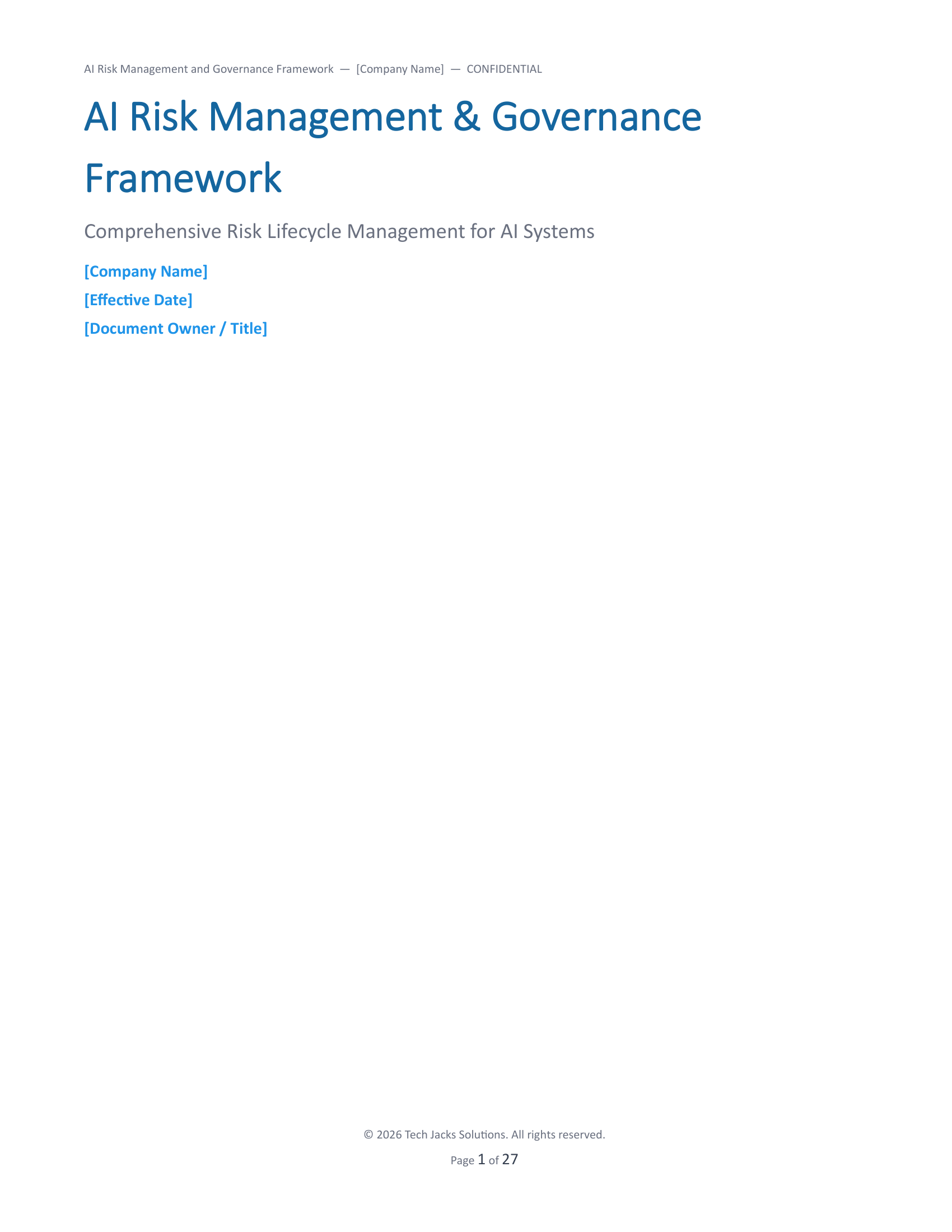
AI Risk Management and Governance Framework Template Cover Page
Templates / AI Risk Management & Governance Framework
.docx ✓ Professional Edition Updated Q1 2026

AI Risk Management & Governance Framework

A comprehensive risk management framework for AI systems covering risk identification, analysis, treatment, and continuous monitoring. Includes RACI matrix, agentic AI risks, FRIA methodology, and a four-framework crosswalk. Built for organizations that need audit-aligned risk governance from day one.

23
Sections
27
Pages
4
Frameworks
3–5hr
To Deploy
NIST AI RMF 1.0 EU AI Act 2024 ISO 42001:2023 ISO 27001:2022
Build vs. Buy
From scratch
Research 4 frameworks6 hrs = $90
Draft 27 pages8 hrs = $120
Internal review cycle4 hrs = $60
Cross-mapping 4 frameworks3 hrs = $45
21 hours$315
vs
This template
Purchase$35.00
Customize for your org3 hrs = $60
CitationsIncluded
CrosswalkIncluded
3 hours$80
$235 saved
18 hours back | 7:1 ROI on $35.00
At $35/hr — the price of this template as the hourly rate
“What if I use AI to write it?”
AI makes drafting faster — but it doesn’t reduce the total work. You still need the source framework documents, a way to verify what the AI produces, and SME-level expertise to catch what it gets wrong. AI hallucinates article numbers, invents control IDs, and generates crosswalk tables that look authoritative but aren’t. Every citation still has to be checked against the actual standard. The work shifts from writing to verification — and verification takes just as long.
~20hwith AI + expert verification
3hwith this template
13tables included
4source PDFs read
$35.00
One-time purchase · Instant download
  • Fully editable Word .docx — customize for your organization
  • 16 numbered sections plus 7 supporting sections across 27 pages. RACI matrix, risk register, scoring methodology, and crosswalk table included
  • Aligned to 4 frameworks: NIST AI RMF, EU AI Act, ISO 42001, ISO 27001
  • Dedicated agentic AI risk section with autonomous agent controls and multi-agent coordination risks
  • Every citation verified against the published standard. Not AI-generated.
  • Updated Q1 2026. EU AI Act Art. 27 FRIA methodology included
.docx NIST AI RMF EU AI Act ISO 42001 ✦ Q1 2026 v2
Overview
What this template does

Every organization deploying AI systems needs a structured approach to identifying, analyzing, and treating AI-specific risks. Without it, you face regulatory exposure under the EU AI Act, unmanaged model risks, and failed compliance audits when assessors ask for your risk management process documentation.

This framework provides a complete, professionally structured risk management system aligned to 4 frameworks: NIST AI RMF (GOVERN, MAP, MEASURE, MANAGE functions), EU AI Act 2024 (Art. 9 risk management, Art. 6 classification, Art. 27 FRIA), ISO/IEC 42001:2023 (risk assessment and treatment controls), and ISO 27001:2022 (ISMS integration). It covers every risk governance element auditors look for — including a quantitative risk scoring methodology, RACI matrix for risk activities, and EU AI Act risk classification tiers.

The Professional Edition adds sections that most risk templates omit: a dedicated Agentic AI Risk Management section covering autonomous agent action-space boundaries, least-privilege access, and multi-agent coordination risks. It also includes the Fundamental Rights Impact Assessment (FRIA) methodology per EU AI Act Art. 27, third-party supply chain risk controls, and a full crosswalk table mapping every section to specific controls across all four frameworks.

What’s Inside
23 Sections · 27 Pages · Audit-Aligned Structure
Establishes the mandate for AI risk management across the organization. Links to NIST AI RMF GOVERN function as the foundational risk culture requirement and ISO 42001 Cl. 5.1 leadership commitment. Defines why a dedicated AI risk management framework is necessary beyond general enterprise risk management.
ISO 42001 Cl. 5.1NIST GOVERN 1.0
Defines which AI systems, personnel, and processes fall under risk management. Includes explicit inclusions (production AI, pilot programs, third-party AI tools), exclusions (non-AI automation, traditional analytics), and personnel scope covering all roles with AI risk management responsibilities.
ISO 42001 Cl. 4.3EU AI Act Art. 2
Measurable risk management objectives aligned to organizational strategy. Covers risk appetite and tolerance thresholds, integration with existing enterprise risk processes, and success metrics for risk management program maturity.
ISO 42001 Cl. 6.2NIST GOVERN 1.1
Defines the AI Risk Management Officer role, AI Governance Committee structure, and reporting lines. Includes a complete RACI matrix for risk management activities covering risk identification, assessment, treatment, monitoring, and escalation across all organizational roles.
ISO 42001 A.3.2NIST GOVERN 1.7RACI
Systematic process for identifying AI risks across the entire system lifecycle. Includes risk register structure and categorization taxonomy, risk identification methods (interviews, workshops, automated scanning), and contextual mapping of AI system characteristics to potential risk vectors.
NIST MAP 1.1ISO 42001 A.5.3
EU AI Act risk tiers (unacceptable, high, limited, minimal) mapped to organizational risk scoring methodology. Includes quantitative scoring criteria for likelihood and impact, risk matrix visualization, and classification decision trees aligned to Art. 6 and Annex III requirements.
EU AI Act Art. 6ISO 42001 A.5.4
Four treatment options (avoid, reduce, transfer, accept) with decision criteria for each. Control selection methodology aligned to framework requirements, treatment plan documentation templates, and residual risk acceptance authority levels. Links treatment decisions to specific NIST MANAGE and ISO 42001 controls.
NIST MANAGE 1.1ISO 42001 A.5.5
Scope and methodology for assessing AI system impact on individuals and groups. Includes the Fundamental Rights Impact Assessment (FRIA) methodology per EU AI Act Art. 27 for high-risk AI systems. Covers assessment triggers, stakeholder consultation requirements, and documentation obligations for deployers.
EU AI Act Art. 27FRIA
Dedicated section for autonomous agent risks including action-space boundaries, least-privilege access controls, stop mechanisms, and multi-agent coordination risks. Covers risk scenarios unique to agentic systems: cascading failures, unauthorized tool use, goal drift, and emergent behaviors in multi-agent pipelines. References NIST AI 600-1 GenAI-specific risks.
EU AI Act Art. 14NIST AI 600-1Autonomous Agents
Oversight capabilities, escalation procedures, and human-in-the-loop requirements for high-risk AI systems. Defines when human intervention is mandatory, oversight competency requirements, and mechanisms for overriding or halting AI system decisions. Aligned to EU AI Act Art. 14 human oversight obligations.
EU AI Act Art. 14ISO 42001 A.9.3
Key risk indicators (KRIs), reporting cadence, and continuous monitoring requirements. Covers automated monitoring thresholds, escalation triggers, board-level risk reporting structure, and integration with existing security information and event management (SIEM) processes.
NIST MEASUREISO 42001 Cl. 9.1
Assessment requirements for AI vendors, ongoing monitoring obligations, and contractual risk controls. Covers due diligence for AI model providers, data processing agreements, incident notification requirements, and supply chain risk scoring for third-party AI components.
ISO 42001 A.10.3NIST MAP 5.1
Documentation requirements for all risk decisions including risk acceptance rationale, treatment plan approvals, and assessment evidence. Covers retention policies, access controls for risk documentation, and audit trail requirements for demonstrating ongoing compliance.
ISO 42001 Cl. 7.5EU AI Act Art. 12
Role-based training requirements for risk management activities. Covers executive risk literacy, technical team risk assessment competencies, and all-staff awareness of risk reporting obligations. Includes training frequency, competency validation, and records management.
ISO 42001 Cl. 7.2NIST GOVERN 1.7
Phased implementation approach with 30/60/90-day milestones. Covers non-compliance handling, exception management process, and enforcement mechanisms for risk management obligations across the organization.
ISO 42001 Cl. 10.1
Review triggers and improvement process for the risk management framework. Covers annual scheduled reviews, event-triggered reassessments (new regulations, significant incidents, organizational changes), lessons learned integration, and maturity model progression.
ISO 42001 Cl. 10.1NIST GOVERN 1.4
Maps every numbered section to specific controls across all four frameworks: NIST AI RMF, EU AI Act, ISO 42001, and ISO 27001. Use during internal audits, ISO 42001 certification reviews, or regulatory assessments to demonstrate compliance coverage across multiple standards simultaneously.
Multi-FrameworkCrosswalk
References to related governance documents including the AI Governance Charter, AI Security Policy, AI Acceptable Use Policy, and other risk management inputs. Establishes document hierarchy and cross-referencing structure for the complete governance program.
References
Complete bibliography of all framework source documents cited: NIST AI RMF 1.0, NIST AI 600-1 GenAI Profile, EU AI Act (Regulation 2024/1689), ISO/IEC 42001:2023, and ISO/IEC 27001:2022. Includes document identifiers and publication dates for audit traceability.
Audit TrailSource Documents
19-term glossary with precise definitions for AI risk, risk appetite, risk tolerance, risk treatment, residual risk, inherent risk, agentic AI, high-risk AI system (per EU AI Act), and key risk management terms. Aligned to ISO 42001 and NIST AI RMF terminology to ensure regulatory consistency.
19 TermsISO 42001 Definitions
Pre-built version control table tracking document revisions, approval dates, change descriptions, and responsible parties. Ready to customize — fill in your organization’s revision history to maintain a complete audit trail from day one.
ISO 42001 Cl. 7.5Document Control
Signature and approval tracking table for framework sign-off. Includes fields for approver name, title, department, signature, and date. Pre-configured for multi-stakeholder approval workflows typical in risk governance (CRO, CISO, Compliance, Legal).
Audit EvidenceSign-Off
Step-by-step deployment instructions for getting the framework operational within your organization. Includes a customization checklist, priority sections to complete first, and a rendered table of contents for quick navigation across all 27 pages.
Deployment GuideTOC
Audience
Who deploys this template
📈
Chief Risk Officer
Uses the framework to establish enterprise-wide AI risk appetite and tolerance thresholds. Provides board-ready risk reporting structure and integrates AI risk into the existing ERM program.
🛡️
CISO
Integrates AI-specific security risks into existing ISMS processes. Maps AI risk vectors to ISO 27001 controls and security monitoring. Uses the supply chain risk section for vendor assessments.
⚖️
Compliance Officer
Demonstrates regulatory readiness for EU AI Act risk management requirements (Art. 9) and ISO 42001 certification. Provides audit-aligned evidence trail for compliance assessments.
📋
AI Program Manager
Operationalizes risk management across development and procurement. Uses the RACI matrix and risk register to coordinate cross-functional risk activities and track treatment progress.
Framework Alignment
How this template maps to standards
NIST
NIST AI RMF 1.0
Maps to all four functions: GOVERN (organizational risk culture and accountability), MAP (risk context and identification), MEASURE (risk assessment and scoring), MANAGE (risk treatment and monitoring). Comprehensive coverage of the risk management lifecycle.
GOVERN 1.0MAP 1.1MEASURE 2.1MANAGE 1.1
EU
EU AI Act 2024
Addresses Art. 9 risk management system requirements, Art. 6 risk classification tiers, Art. 14 human oversight obligations, Art. 27 Fundamental Rights Impact Assessment, and Art. 12 documentation and record-keeping for high-risk AI systems.
Art. 6Art. 9Art. 12Art. 14Art. 27
42001
ISO/IEC 42001:2023
Fulfills Cl. 5.1 leadership commitment, Cl. 6.2 AI objectives, A.5.3 risk assessment requirements, A.5.4 risk treatment controls, A.9.3 human oversight provisions, and A.10.3 third-party risk management. Primary audit evidence for AIMS certification.
Cl. 5.1A.5.3A.5.4A.9.3A.10.3
ISO
ISO/IEC 27001:2022
Integrates with the ISMS risk assessment process. Maps AI-specific risks to A.5.1 security policies, A.8 asset management controls, and the information security risk treatment methodology. Enables unified risk governance across AI and traditional IT.
A.5.1A.8.1Risk Treatment
Value Proposition
Build from scratch vs. use this template
✓ With This Template
16 sections across 27 pages with risk register, RACI matrix, and scoring methodology ready to customize.
Four frameworks mapped with crosswalk table — NIST AI RMF, EU AI Act, ISO 42001, ISO 27001.
Agentic AI risks section with autonomous agent controls — rare in risk management templates.
FRIA per EU AI Act Art. 27 included with assessment methodology.
Every citation verified against the published standard — not AI-generated.
Ready in 3–5 hours instead of starting from a blank document.
✗ From Scratch
21+ hours of work researching risk frameworks, drafting, and cross-mapping controls.
EU AI Act risk classification tiers are complex — Art. 6 Annex III alone requires careful interpretation.
Agentic AI risk categories not covered in any standard yet — requires synthesis across NIST AI 600-1 and EU AI Act.
FRIA requirements scattered across multiple EU AI Act articles — easy to miss required elements.
Risk scoring methodology must balance quantitative rigor with practical usability — most first attempts need 2–3 revisions.
Crosswalk tables between 4 frameworks require deep knowledge of each standard’s structure.

Already have a risk framework? Use the crosswalk table to identify gaps in your current version against ISO 42001, EU AI Act Art. 9, and NIST AI RMF requirements.

“Why is this only $35?”

I’ve been building governance documentation since 2012. That year I helped my healthcare analytics company earn its first HITRUST certification. Since then I’ve created and managed compliance documentation for SOC 2, PCI DSS, HITRUST, and ISO 27001 programs across enterprise organizations. I have a writing degree and I genuinely like this work.

HITRUST CSF SOC 2 PCI DSS ISO 27001 14 Years in GRC Writing Degree

Credentials don’t explain the price though. This does:

I want AI adopted responsibly. I don’t want my friends, my family, or my kids dealing with threats and risks that come from deploying AI without governance. Organizations will take the path that earns them the most money. That’s how business works. So I feel obligated to put quality documentation out at a price where governance isn’t something only Fortune 500 companies can afford. I don’t need to charge thousands of dollars to make a difference. I care about helping where I can.

You’re building something that matters — documentation that earns trust from your board, your customers, and your team. And it has to be right.

The citations in these templates were checked against the published standards — the actual ISO 42001:2023 PDF, the EU AI Act regulation text, the NIST AI RMF 1.0 document. Control IDs, article numbers, crosswalk mappings. This is practitioner-built documentation from someone who’s sat in the audits, written the remediation plans, and knows what survives a compliance review.

Derrick Jackson // Founder, Tech Jacks Solutions
Related Templates
Often bought together
FRAMEWORK COVERAGE
NIST AI RMF EU AI Act ISO 42001 ISO 27001
WHAT YOU GET
16 numbered + 7 supporting sections · 27 pages
Fully editable .docx
Framework citations verified
RACI matrix & risk register
Agentic AI risk controls
13 tables included
Instant download
FREE EDITION
Need a lighter version? The Community Edition is available at no cost with core risk management sections.
★ BUNDLE DEAL — SAVE 20%
Get all 3 foundational AI governance documents
The Quick Start AI Governance Bundle includes this Risk Management Framework plus the AI Governance Charter and AI Acceptable Use Policy — $40 instead of $50 if purchased individually.
Important

This template is a starting point, not a finished product. It’s designed to accelerate your governance program by giving you a professionally structured foundation with verified framework citations. It doesn’t replace legal counsel, compliance review, or organizational judgment. Every organization is different. You’ll need to customize the content for your specific regulatory context, risk tolerance, and operational environment. We recommend routing your completed framework through your legal, compliance, and governance teams before adoption. What you’re buying is a jumpstart that saves you weeks of research and drafting, not a guarantee of compliance. Framework citations reflect regulations as of Q1 2026. Regulatory frameworks evolve. Check for updates to the EU AI Act, ISO 42001, and NIST AI RMF before your annual policy review. Single organization license. All purchases include a 14-day money-back guarantee — if the template does not meet your needs, contact us for a full refund.

Author

Tech Jacks Solutions