Gallery

Contacts

411 University St, Seattle, USA

engitech@oceanthemes.net

+1 -800-456-478-23

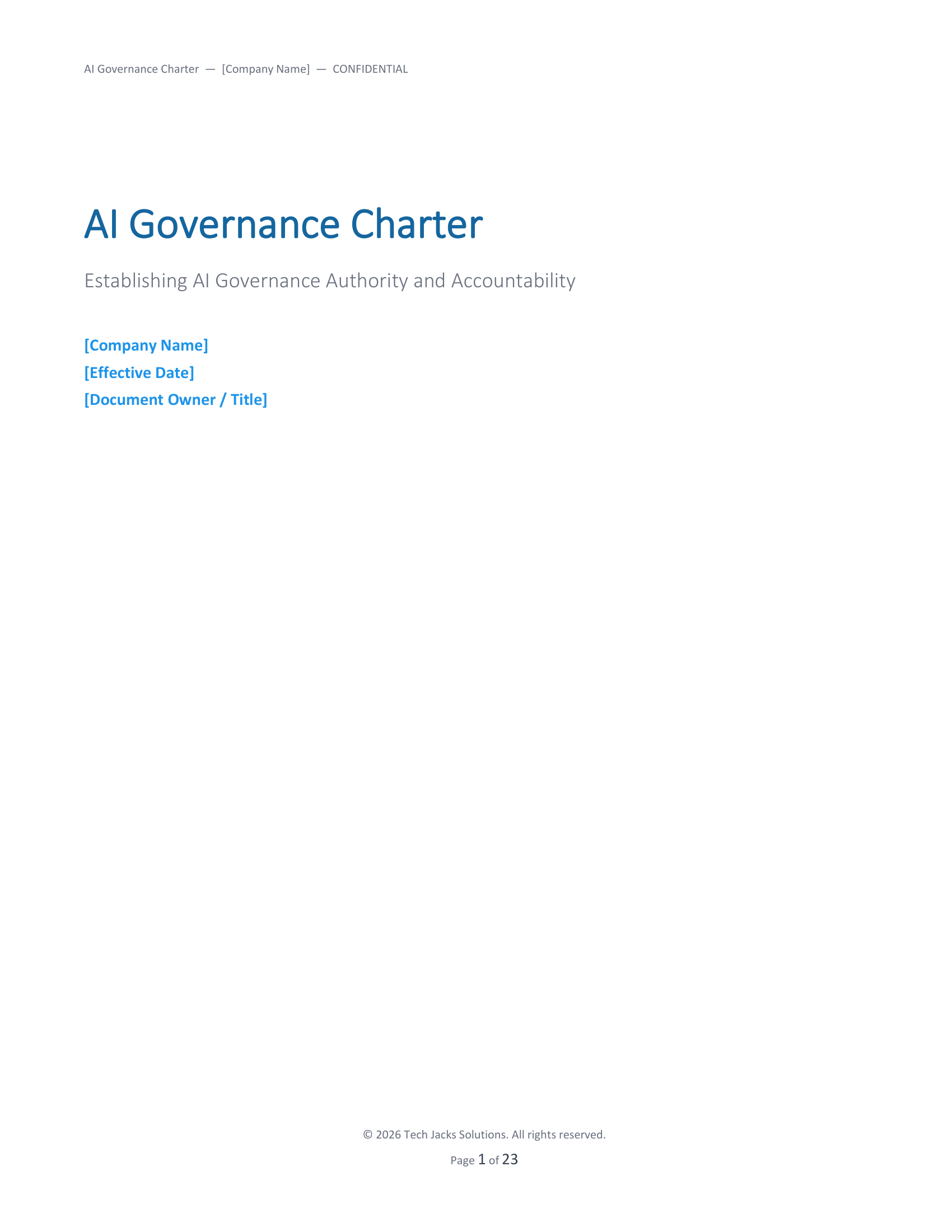
AI Governance Charter Cover Page
Templates / AI Governance Charter
.docx ✓ Professional Edition Updated Q1 2026

AI Governance Charter

The foundational authority document for your AI governance program. Establishes accountability, committee structure, risk management mandates, and cross-functional alignment across nine compliance frameworks. Built for board-level endorsement and audit alignment.

15
Sections
28
Pages
9
Frameworks
2–4hr
To Deploy
NIST AI RMF 1.0 EU AI Act 2024 ISO 42001:2023 ISO 27001:2022 OECD AI Principles IEEE Ethically Aligned Design HIPAA GDPR CSA CCM
Build vs. Buy
From scratch
Research 9 frameworks12 hrs = $180
Draft 28 pages7 hrs = $105
Internal review cycle4 hrs = $60
Cross-mapping 9 frameworks4 hrs = $60
27 hours$405
vs
This template
Purchase$15.00
Customize for your org3 hrs = $45
CitationsIncluded
CrosswalkIncluded
3 hours$60
$345 saved
24 hours back | 23:1 ROI on $15.00
At $15/hr — the price of this template as the hourly rate
“What if I use AI to write it?”
AI makes drafting faster — but it doesn’t reduce the total work. You still need the source framework documents, a way to verify what the AI produces, and SME-level expertise to catch what it gets wrong. AI hallucinates article numbers, invents control IDs, and generates crosswalk tables that look authoritative but aren’t. Every citation still has to be checked against the actual standard. The work shifts from writing to verification — and verification takes just as long.
~29hwith AI + expert verification
3hwith this template
98citations verified
6source PDFs read
$15.00
One-time purchase · Instant download
  • Fully editable Word .docx — customize for your organization
  • 15 sections across 28 pages. Governance committee structure, RACI, risk framework, agentic AI controls
  • Aligned to 9 frameworks. ISO 42001, EU AI Act, NIST AI RMF, ISO 27001, OECD, IEEE, HIPAA, GDPR, CSA
  • Cross-functional governance committee with meeting cadence and escalation authority
  • Every citation verified against the published standard. Not AI-generated.
  • Updated Q1 2026. Human oversight, FRIA per Art. 27, and framework crosswalk included
.docx NIST AI RMF EU AI Act ISO 42001 ✦ Q1 2026 v2
Overview
What this template does

An AI governance program without a charter is a program without authority. The charter is the document that gives your governance committee its mandate, defines decision rights, and tells the rest of the organization who’s accountable for what. Without it, governance decisions don’t stick and audit evidence falls apart.

The v2 Enhanced Edition is a complete, professionally structured charter aligned to 9 frameworks: NIST AI RMF, EU AI Act 2024, ISO/IEC 42001:2023, ISO 27001:2022, OECD AI Principles, IEEE Ethically Aligned Design, HIPAA, GDPR, and CSA CCM. It covers everything auditors look for in a governance authority document — leadership commitment per ISO 42001 Cl. 5.1, cross-functional committee structure with RACI responsibilities, FRIA per EU AI Act Art. 27, and a QMS mandate that connects your charter to operational processes.

The v2 Professional Edition adds what you won’t find in free charter templates: agentic AI governance controls for autonomous agent deployment, human oversight mechanisms per Art. 14, third-party and supply chain governance, incident management aligned to Art. 73 and ISO 42001 A.8.4, and a framework compliance crosswalk that maps every charter section to specific controls across all nine standards. Each section includes framework-specific rationale, cross-references to supporting governance documents, and italicized customization notes for your organization’s context.

What’s Inside
15 Sections · 28 Pages · Audit-Aligned Structure
Establishes the governance mandate and executive authority for the AI governance program. Defines why the charter exists, what organizational commitment it represents, and the leadership accountability structure per ISO 42001 Cl. 5.1. Links governance objectives to business strategy and regulatory obligations. Sets the tone for board-level endorsement of responsible AI practices.
ISO 42001 Cl. 5.1NIST GOVERN 1.0Leadership Mandate
Defines the boundaries of the AI Management System (AIMS) per ISO 42001 Cl. 4.3. Specifies which AI systems, business units, geographies, and third-party relationships fall under charter authority. Includes scope inclusions, exclusions, and the criteria for bringing new AI deployments into governance coverage. Addresses both internally developed and externally procured systems.
ISO 42001 Cl. 4.3NIST GOVERN 1.2AIMS Boundaries
Measurable AI governance objectives tied to organizational strategy and compliance requirements. Covers risk reduction targets, framework alignment milestones, training completion rates, and audit alignment benchmarks. Each objective is structured with measurable criteria so progress can be tracked and reported to leadership. Aligned to ISO 42001 Cl. 6.2 requirements for establishing AI objectives.
ISO 42001 Cl. 6.2NIST GOVERN 1.1Measurable Targets
Cross-functional governance committee structure with defined membership, meeting cadence, quorum requirements, and escalation authority. Specifies roles for executive sponsor, committee chair, and standing members from legal, compliance, engineering, HR, and business operations. Includes RACI responsibility matrix for governance decisions. Defines decision-making authority, voting procedures, and the relationship between the committee and the board.
ISO 42001 A.3.2NIST GOVERN 1.7RACI MatrixCross-Functional
Establishes the risk assessment methodology, risk appetite statement, and risk tolerance thresholds for AI systems. Covers the full risk lifecycle: identification, assessment, mitigation, monitoring, and escalation. Includes Fundamental Rights Impact Assessment (FRIA) requirements per EU AI Act Art. 27 for high-risk systems. Integrates NIST AI RMF MAP function for contextualizing AI risks within the organization’s operating environment.
EU AI Act Art. 27EU AI Act Art. 9NIST MAPISO 42001 A.5.3FRIA
Multi-framework alignment strategy covering legal obligations, voluntary standards, and ethical principles. Maps the charter to EU AI Act requirements (Art. 6 risk classification, Art. 9 risk management), ISO 42001 management system clauses, NIST AI RMF functions, ISO 27001 security controls, OECD AI Principles, and IEEE Ethically Aligned Design. Includes a regulatory monitoring process to track changes across frameworks and trigger charter updates.
EU AI Act Art. 6ISO 42001 Cl. 4.1OECD PrinciplesIEEE EAD
Documentation requirements for AI systems including model cards, system fact sheets, and decision logs. Covers EU AI Act Art. 13 transparency obligations for high-risk systems and Art. 50 user notification requirements. Establishes standards for explainability based on system risk level and audience — technical explanations for developers, plain-language summaries for stakeholders, and regulatory-ready documentation for auditors.
EU AI Act Art. 13EU AI Act Art. 50NIST MEASURE 2.5ISO 42001 A.8.3
AI-specific security controls covering data protection, model security, access management, and operational monitoring. Addresses ISO 42001 A.6.2.6 operation and monitoring requirements for AI systems in production. Covers adversarial attack mitigation, data poisoning prevention, model extraction defenses, and privacy-preserving techniques. Integrates with ISO 27001 ISMS requirements for organizations maintaining both certifications.
ISO 42001 A.6.2.6ISO 27001 A.8NIST MANAGE 2.1Data Protection
Governance framework for autonomous agents, multi-agent systems, and AI systems that execute multi-step tasks independently. Covers action-space boundaries, least-privilege access, human oversight checkpoints for irreversible actions, controllability and stop mechanisms, agent identity and immutable logging, and end-user transparency requirements. Defines approval workflows for deploying agents with increasing levels of autonomy.
ISO 42001 A.9.3EU AI Act Art. 14NIST AI 600-1Autonomous Agents
Establishes human oversight mechanisms per EU AI Act Art. 14 requirements. Defines when human review is mandatory, what override mechanisms must be in place, and how to document human intervention decisions. Covers the spectrum from human-in-the-loop (approval before action) to human-on-the-loop (monitoring with intervention capability) to human-in-command (strategic oversight). Includes escalation triggers for automated systems that exceed their authorized operating parameters.
EU AI Act Art. 14ISO 42001 A.9.3NIST GOVERN 1.4Override Mechanisms
Vendor management framework for AI systems and components procured from third parties. Covers due diligence requirements for deployer obligations, contract requirements for AI vendors, ongoing monitoring of third-party AI performance and compliance, and incident notification obligations. Addresses the full supply chain — from foundation model providers to API integrators to SaaS tools with embedded AI features.
ISO 42001 A.10.3NIST MAP 5.1Supply Chain
AI-specific incident response procedures covering detection, classification, containment, investigation, remediation, and reporting. Addresses EU AI Act Art. 73 serious incident reporting requirements for high-risk systems. Covers ISO 42001 A.8.4 for AI-related nonconformity management. Includes an exception handling process for situations where standard governance controls can’t be applied — with documentation requirements, time-limited approvals, and mandatory review triggers.
EU AI Act Art. 73ISO 42001 A.8.4NIST MANAGE 4.1Incident Response
AI literacy and training program aligned to EU AI Act Art. 4 obligations. Covers role-based training tracks (executive, technical, operational), competency assessments, and ongoing awareness campaigns. Establishes training completion requirements for anyone involved in AI deployment, procurement, or oversight. Includes metrics for tracking organizational AI maturity and a cultural change management approach for embedding responsible AI practices into daily operations.
EU AI Act Art. 4ISO 42001 A.4.2NIST GOVERN 6.1AI Literacy
Ongoing monitoring requirements per EU AI Act Art. 9(2) for continuous risk management of high-risk AI systems. Defines KPIs for governance program effectiveness, audit schedules, and improvement cycles aligned to ISO 42001 Cl. 10.1. Covers performance measurement, internal audit processes, management review inputs, and corrective action procedures. Establishes a governance maturity model with defined progression stages.
EU AI Act Art. 9(2)ISO 42001 Cl. 10.1NIST MANAGEContinuous Improvement
Annual review requirements per ISO 42001 Cl. 9.3 management review and Cl. 10.1 continual improvement. Defines trigger events that require out-of-cycle charter updates: new regulations, significant AI incidents, organizational restructuring, or material changes in AI system portfolio. Includes version control procedures, stakeholder notification process, and re-endorsement requirements for material charter changes.
ISO 42001 Cl. 9.3ISO 42001 Cl. 10.1NIST MANAGE 4.1Review Triggers
Lists the governance documents that operationalize this charter: AI Acceptable Use Policy, AI Security Policy, AI Risk Management Framework, AI Roles and Training, AI Transparency and Explainability, and AI Incident Response Playbook. Each reference includes the document’s purpose, its relationship to specific charter sections, and update synchronization requirements.
Document HierarchyCross-ReferencesGovernance Architecture
Maps every charter section to specific control IDs across NIST AI RMF, EU AI Act, ISO/IEC 42001:2023, and ISO 27001. Use during internal audits, ISO 42001 certification reviews, or regulatory assessments to demonstrate governance coverage. Covers all 15 charter sections with precise article numbers, clause references, and subcategory mappings. Designed to serve as primary audit evidence for governance authority and program structure.
Audit EvidenceISO 42001 CertificationCross-Framework Mapping
Standard governance document appendices: framework reference list with publication dates, key term definitions aligned to EU AI Act Art. 3 and ISO 42001, document version history with change summaries, and an approver sign-off section with executive endorsement fields. These sections create the audit trail that demonstrates proper document governance and organizational commitment.
EU AI Act Art. 3Document ControlExecutive Endorsement
Audience
Who deploys this template
👔
CEO / Board Member
Endorses the governance mandate and ensures AI strategy aligns with business objectives. The charter provides board-level documentation that auditors and regulators expect to see as evidence of leadership commitment per ISO 42001 Cl. 5.1.
🛡️
CISO / Security Lead
Uses the charter to establish security governance authority over AI systems. Connects AI-specific controls to existing ISMS processes per ISO 27001 and ensures the committee structure has security representation with escalation authority.
⚖️
Compliance Officer
The charter is the first document auditors ask for during an AI governance review. It satisfies ISO 42001 leadership requirements, EU AI Act Art. 9 risk management mandates, and NIST GOVERN function obligations in a single artifact.
📋
AI Program Manager
Operates under charter authority to coordinate governance activities across business units. Uses the RACI matrix, committee structure, and escalation procedures to drive cross-functional alignment without having to build the governance framework from scratch.
Framework Alignment
How this template maps to standards
NIST
NIST AI RMF 1.0
The charter maps primarily to the Govern function — establishing organizational governance structures, risk culture, and accountability. Key coverage includes GOVERN 1.0 (governance policies), GOVERN 1.4 (organizational risk tolerance), GOVERN 1.7 (workforce diversity and expertise), and MAP function integration for risk context.
GOVERN 1.0GOVERN 1.4GOVERN 1.7MAP 1.1
EU
EU AI Act 2024
Addresses Art. 9 risk management system requirements, Art. 14 human oversight obligations, Art. 27 fundamental rights impact assessment, Art. 50 transparency, and Art. 73 serious incident reporting. Structures governance for the 2025–2026 enforcement phase-in.
Art. 9Art. 14Art. 27Art. 50Art. 73
42001
ISO/IEC 42001:2023
The charter is the primary document satisfying Cl. 5.1 leadership commitment and Cl. 5.2 AI policy requirements. Covers Cl. 4.3 AIMS scope, Cl. 6.2 AI objectives, Cl. 9.3 management review, and Cl. 10.1 continual improvement. Annex A controls addressed include A.3.2 (roles and responsibilities), A.5.3 (risk assessment), A.8.4 (nonconformity management), A.9.3 (human oversight), and A.10.3 (third-party relationships).
Cl. 5.1Cl. 5.2A.3.2A.5.3A.9.3A.10.3
ISO
ISO/IEC 27001:2022
Integrates AI governance with existing ISMS processes. Supports A.5.1 (information security policies), A.6.1 (organizational roles), A.8 (asset management for AI systems), and A.15 (supplier security for AI vendors). Designed to work alongside your ISMS without creating parallel governance structures.
A.5.1A.6.1A.8.1A.15.1
OECD
OECD AI Principles
Embeds OECD Principle 1.3 (transparency and explainability), Principle 1.4 (robustness, security, and safety), and Principle 1.5 (accountability) throughout the governance structure. The charter’s committee and oversight mechanisms directly operationalize the OECD accountability principle.
Principle 1.3Principle 1.4Principle 1.5
IEEE
IEEE Ethically Aligned Design
References IEEE EAD principles for human rights (R.1), accountability (A.1), and transparency (T.2). The charter’s governance structure and human oversight requirements directly implement IEEE’s call for organizational accountability mechanisms in AI deployment.
R.1 Human RightsA.1 AccountabilityT.2 Transparency
HIPAA
HIPAA
Addresses AI governance requirements for organizations processing protected health information. Covers privacy safeguards for AI systems handling PHI, security controls for AI-driven clinical and administrative decisions, and breach notification considerations when AI systems are involved in data incidents.
Privacy RuleSecurity RulePHI Safeguards
GDPR
GDPR
Integrates data protection requirements for AI systems processing personal data of EU residents. Covers automated decision-making safeguards per Article 22, data protection impact assessments, lawful basis for AI processing, and the right to human review of significant AI-driven decisions.
Article 22DPIAData Subject Rights
CSA
CSA CCM
Applies CSA Cloud Controls Matrix (CCM) to cloud-hosted AI systems and services. Covers security controls for AI workloads, audit and review requirements referencing CCM alongside NIST AI RMF and ISO 27001, and shadow AI prevention strategies for unauthorized AI deployment.
CCMAI WorkloadsShadow AI Prevention
Value Proposition
Build from scratch vs. use this template
✓ With This Template
Ready to customize in about 3 hours. Replace [Company Name], adjust committee membership, configure for your regulatory context. You have governance authority documented by end of day.
Every citation was verified against the published standard. ISO 42001 clause numbers, EU AI Act articles, and NIST subcategories come from the actual documents, not from AI generation.
28 pages covering governance authority, committee structure, risk framework, human oversight, agentic AI controls, supply chain governance, and a compliance crosswalk. Everything an auditor expects in a charter.
Cross-functional committee structure with RACI matrix, meeting cadence, quorum requirements, and escalation authority. You don’t have to figure out who decides what.
Nine frameworks mapped with a crosswalk table ready for audit: NIST AI RMF, EU AI Act, ISO 42001, ISO 27001, OECD, IEEE, HIPAA, GDPR, and CSA. FRIA per Art. 27 included.
Current as of Q1 2026. Includes agentic AI governance, human oversight mechanisms per Art. 14, and continuous monitoring per Art. 9(2).
✗ From Scratch
27+ hours of work even if you know what you’re doing. Research, drafting, stakeholder alignment, and cross-mapping across nine standards.
ISO 42001 has specific requirements for leadership commitment (Cl. 5.1), AIMS scope (Cl. 4.3), and management review (Cl. 9.3). Miss any of them and your charter doesn’t pass audit.
Designing a governance committee structure means figuring out membership, decision rights, escalation paths, and RACI responsibilities from scratch. Getting cross-functional buy-in takes weeks.
Nine frameworks to find, read, and reconcile. NIST, EU AI Act, ISO 42001, ISO 27001, OECD, IEEE, HIPAA, GDPR, CSA. Each one structures governance differently.
Most charter templates you’ll find online don’t cover agentic AI governance or EU AI Act Art. 27 FRIA requirements. Those obligations are new and they’re not optional.
The regulatory landscape is still moving. EU AI Act enforcement is phased through 2026. ISO 42001 certification practices are still maturing. Your charter needs to accommodate change — that’s hard to design from scratch.

Already have a charter? Use the crosswalk table to identify gaps in your current version against ISO 42001, EU AI Act, and NIST AI RMF requirements.

FREE VERSION AVAILABLE
Community Edition vs Professional

A free Community Edition is available with core sections. The Professional Edition adds framework crosswalk tables, agentic AI controls, human oversight mechanisms, supply chain governance, GAIO-verified citations, and audit-aligned structure.

Download Free Community Edition →
“Why is this only $15?”

I’ve been building governance documentation since 2012. That year I helped my healthcare analytics company earn its first HITRUST certification. Since then I’ve created and managed compliance documentation for SOC 2, PCI DSS, HITRUST, and ISO 27001 programs across enterprise organizations. I have a writing degree and I genuinely like this work.

HITRUST CSF SOC 2 PCI DSS ISO 27001 14 Years in GRC Writing Degree

Credentials don’t explain the price though. This does:

I want AI adopted responsibly. I don’t want my friends, my family, or my kids dealing with threats and risks that come from deploying AI without governance. Organizations will take the path that earns them the most money. That’s how business works. So I feel obligated to put quality documentation out at a price where governance isn’t something only Fortune 500 companies can afford. I don’t need to charge thousands of dollars to make a difference. I care about helping where I can.

You’re building something that matters — documentation that earns trust from your board, your customers, and your team. And it has to be right.

The citations in these templates were checked against the published standards — the actual ISO 42001:2023 PDF, the EU AI Act regulation text, the NIST AI RMF 1.0 document. Control IDs, article numbers, crosswalk mappings. This is practitioner-built documentation from someone who’s sat in the audits, written the remediation plans, and knows what survives a compliance review.

Derrick Jackson // Founder, Tech Jacks Solutions
Related Templates
Often bought together
FRAMEWORK COVERAGE
NIST AI RMF EU AI Act ISO 42001 ISO 27001 OECD IEEE
WHAT YOU GET
15 sections · 28 pages
Fully editable .docx
Framework citations verified
Governance committee & RACI
Agentic AI governance controls
Framework crosswalk included
Instant download
★ BUNDLE DEAL — SAVE 20%
Get all 3 foundational AI governance documents
The Quick Start AI Governance Bundle includes this Charter plus the AI Acceptable Use Policy and AI Risk Management Framework — $40 instead of $50 if purchased individually.
Important

This template is a starting point, not a finished product. It’s designed to accelerate your governance program by giving you a professionally structured foundation with verified framework citations. It doesn’t replace legal counsel, compliance review, or organizational judgment. Every organization is different. You’ll need to customize the content for your specific regulatory context, risk tolerance, and operational environment. We recommend routing your completed charter through your legal, compliance, and governance teams before adoption. What you’re buying is a jumpstart that saves you weeks of research and drafting, not a guarantee of compliance. Framework citations reflect regulations as of Q1 2026. Regulatory frameworks evolve. Check for updates to the EU AI Act, ISO 42001, and NIST AI RMF before your annual charter review. Single organization license. All purchases include a 14-day money-back guarantee — if the template does not meet your needs, contact us for a full refund.

Author

Tech Jacks Solutions