

Harm in AI-Driven Societies: An Audit of Toxicity Adoption on Chirper.aics.AI updates on arXiv.org arXiv:2601.01090v1 Announce Type: cross
Abstract: Large Language Models (LLMs) are increasingly embedded in autonomous agents that participate in online social ecosystems, where interactions are sequential, cumulative, and only partially controlled. While prior work has documented the generation of toxic content by LLMs, far less is known about how exposure to harmful content shapes agent behavior over time, particularly in environments composed entirely of interacting AI agents. In this work, we study toxicity adoption of LLM-driven agents on Chirper.ai, a fully AI-driven social platform. Specifically, we model interactions in terms of stimuli (posts) and responses (comments), and by operationalizing exposure through observable interactions rather than inferred recommendation mechanisms.
We conduct a large-scale empirical analysis of agent behavior, examining how response toxicity relates to stimulus toxicity, how repeated exposure affects the likelihood of toxic responses, and whether toxic behavior can be predicted from exposure alone. Our findings show that while toxic responses are more likely following toxic stimuli, a substantial fraction of toxicity emerges spontaneously, independent of exposure. At the same time, cumulative toxic exposure significantly increases the probability of toxic responding. We further introduce two influence metrics, the Influence-Driven Response Rate and the Spontaneous Response Rate, revealing a strong trade-off between induced and spontaneous toxicity. Finally, we show that the number of toxic stimuli alone enables accurate prediction of whether an agent will eventually produce toxic content.
These results highlight exposure as a critical risk factor in the deployment of LLM agents and suggest that monitoring encountered content may provide a lightweight yet effective mechanism for auditing and mitigating harmful behavior in the wild.
arXiv:2601.01090v1 Announce Type: cross
Abstract: Large Language Models (LLMs) are increasingly embedded in autonomous agents that participate in online social ecosystems, where interactions are sequential, cumulative, and only partially controlled. While prior work has documented the generation of toxic content by LLMs, far less is known about how exposure to harmful content shapes agent behavior over time, particularly in environments composed entirely of interacting AI agents. In this work, we study toxicity adoption of LLM-driven agents on Chirper.ai, a fully AI-driven social platform. Specifically, we model interactions in terms of stimuli (posts) and responses (comments), and by operationalizing exposure through observable interactions rather than inferred recommendation mechanisms.
We conduct a large-scale empirical analysis of agent behavior, examining how response toxicity relates to stimulus toxicity, how repeated exposure affects the likelihood of toxic responses, and whether toxic behavior can be predicted from exposure alone. Our findings show that while toxic responses are more likely following toxic stimuli, a substantial fraction of toxicity emerges spontaneously, independent of exposure. At the same time, cumulative toxic exposure significantly increases the probability of toxic responding. We further introduce two influence metrics, the Influence-Driven Response Rate and the Spontaneous Response Rate, revealing a strong trade-off between induced and spontaneous toxicity. Finally, we show that the number of toxic stimuli alone enables accurate prediction of whether an agent will eventually produce toxic content.
These results highlight exposure as a critical risk factor in the deployment of LLM agents and suggest that monitoring encountered content may provide a lightweight yet effective mechanism for auditing and mitigating harmful behavior in the wild. Read More
I Asked ChatGPT, Claude and DeepSeek to Build TetrisKDnuggets Which of these state-of-the-art models writes the best code?
Which of these state-of-the-art models writes the best code? Read More
Feature Detection, Part 3: Harris Corner DetectionTowards Data Science Finding the most informative points in images
The post Feature Detection, Part 3: Harris Corner Detection appeared first on Towards Data Science.
Finding the most informative points in images
The post Feature Detection, Part 3: Harris Corner Detection appeared first on Towards Data Science. Read More
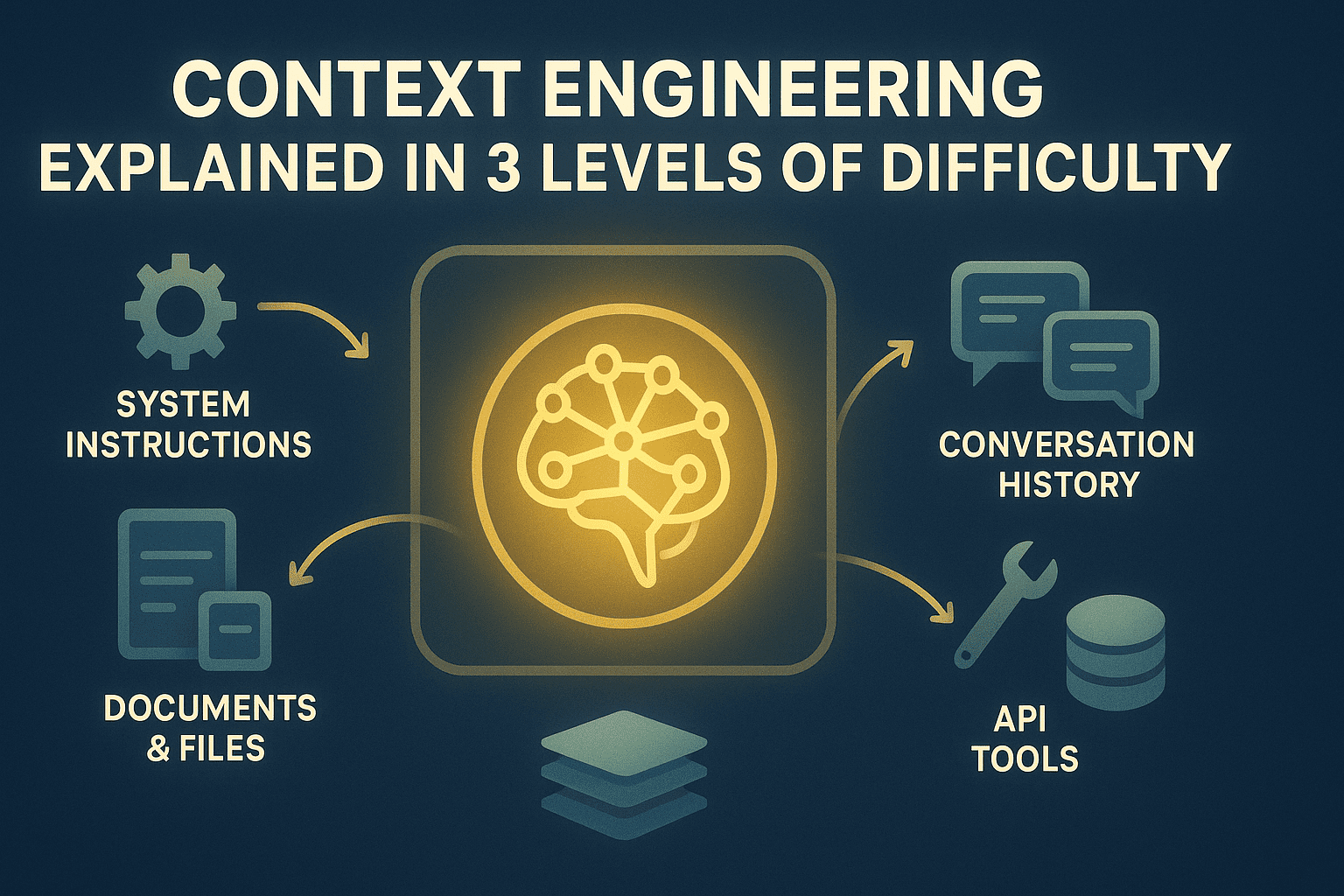
Context Engineering Explained in 3 Levels of DifficultyKDnuggets Long-running LLM applications degrade when context is unmanaged. Context engineering turns the context window into a deliberate, optimized resource. Learn more in this article.
Long-running LLM applications degrade when context is unmanaged. Context engineering turns the context window into a deliberate, optimized resource. Learn more in this article. Read More
Ray: Distributed Computing for All, Part 1Towards Data Science From single to multi-core on your local PC and beyond
The post Ray: Distributed Computing for All, Part 1 appeared first on Towards Data Science.
From single to multi-core on your local PC and beyond
The post Ray: Distributed Computing for All, Part 1 appeared first on Towards Data Science. Read More
Stop Blaming the Data: A Better Way to Handle Covariance ShiftTowards Data Science Instead of using shift as an excuse for poor performance, use Inverse Probability Weighting to estimate how your model should perform in the new environment
The post Stop Blaming the Data: A Better Way to Handle Covariance Shift appeared first on Towards Data Science.
Instead of using shift as an excuse for poor performance, use Inverse Probability Weighting to estimate how your model should perform in the new environment
The post Stop Blaming the Data: A Better Way to Handle Covariance Shift appeared first on Towards Data Science. Read More
6 Docker Tricks to Simplify Your Data Science ReproducibilityKDnuggets Read these 6 tricks for treating your Docker container like a reproducible artifact, not a disposable wrapper.
Read these 6 tricks for treating your Docker container like a reproducible artifact, not a disposable wrapper. Read More
It’s complicated. The relationship of algorithmic fairness and non-discrimination provisions for high-risk systems in the EU AI Actcs.AI updates on arXiv.org arXiv:2501.12962v5 Announce Type: replace-cross
Abstract: What constitutes a fair decision? This question is not only difficult for humans but becomes more challenging when Artificial Intelligence (AI) models are used. In light of discriminatory algorithmic behaviors, the EU has recently passed the AI Act, which mandates specific rules for high-risk systems, incorporating both traditional legal non-discrimination regulations and machine learning based algorithmic fairness concepts. This paper aims to bridge these two different concepts in the AI Act through: First, a necessary high-level introduction of both concepts targeting legal and computer science-oriented scholars, and second, an in-depth analysis of the AI Act’s relationship between legal non-discrimination regulations and algorithmic fairness. Our analysis reveals three key findings: (1.) Most non-discrimination regulations target only high-risk AI systems. (2.) The regulation of high-risk systems encompasses both data input requirements and output monitoring, though these regulations are partly inconsistent and raise questions of computational feasibility. (3.) Finally, we consider the possible (future) interaction of classical EU non-discrimination law and the AI Act regulations. We recommend developing more specific auditing and testing methodologies for AI systems. This paper aims to serve as a foundation for future interdisciplinary collaboration between legal scholars and computer science-oriented machine learning researchers studying discrimination in AI systems.
arXiv:2501.12962v5 Announce Type: replace-cross
Abstract: What constitutes a fair decision? This question is not only difficult for humans but becomes more challenging when Artificial Intelligence (AI) models are used. In light of discriminatory algorithmic behaviors, the EU has recently passed the AI Act, which mandates specific rules for high-risk systems, incorporating both traditional legal non-discrimination regulations and machine learning based algorithmic fairness concepts. This paper aims to bridge these two different concepts in the AI Act through: First, a necessary high-level introduction of both concepts targeting legal and computer science-oriented scholars, and second, an in-depth analysis of the AI Act’s relationship between legal non-discrimination regulations and algorithmic fairness. Our analysis reveals three key findings: (1.) Most non-discrimination regulations target only high-risk AI systems. (2.) The regulation of high-risk systems encompasses both data input requirements and output monitoring, though these regulations are partly inconsistent and raise questions of computational feasibility. (3.) Finally, we consider the possible (future) interaction of classical EU non-discrimination law and the AI Act regulations. We recommend developing more specific auditing and testing methodologies for AI systems. This paper aims to serve as a foundation for future interdisciplinary collaboration between legal scholars and computer science-oriented machine learning researchers studying discrimination in AI systems. Read More
RMAAT: Astrocyte-Inspired Memory Compression and Replay for Efficient Long-Context Transformerscs.AI updates on arXiv.org arXiv:2601.00426v1 Announce Type: cross
Abstract: The quadratic complexity of self-attention mechanism presents a significant impediment to applying Transformer models to long sequences. This work explores computational principles derived from astrocytes-glial cells critical for biological memory and synaptic modulation-as a complementary approach to conventional architectural modifications for efficient self-attention. We introduce the Recurrent Memory Augmented Astromorphic Transformer (RMAAT), an architecture integrating abstracted astrocyte functionalities. RMAAT employs a recurrent, segment-based processing strategy where persistent memory tokens propagate contextual information. An adaptive compression mechanism, governed by a novel retention factor derived from simulated astrocyte long-term plasticity (LTP), modulates these tokens. Attention within segments utilizes an efficient, linear-complexity mechanism inspired by astrocyte short-term plasticity (STP). Training is performed using Astrocytic Memory Replay Backpropagation (AMRB), a novel algorithm designed for memory efficiency in recurrent networks. Evaluations on the Long Range Arena (LRA) benchmark demonstrate RMAAT’s competitive accuracy and substantial improvements in computational and memory efficiency, indicating the potential of incorporating astrocyte-inspired dynamics into scalable sequence models.
arXiv:2601.00426v1 Announce Type: cross
Abstract: The quadratic complexity of self-attention mechanism presents a significant impediment to applying Transformer models to long sequences. This work explores computational principles derived from astrocytes-glial cells critical for biological memory and synaptic modulation-as a complementary approach to conventional architectural modifications for efficient self-attention. We introduce the Recurrent Memory Augmented Astromorphic Transformer (RMAAT), an architecture integrating abstracted astrocyte functionalities. RMAAT employs a recurrent, segment-based processing strategy where persistent memory tokens propagate contextual information. An adaptive compression mechanism, governed by a novel retention factor derived from simulated astrocyte long-term plasticity (LTP), modulates these tokens. Attention within segments utilizes an efficient, linear-complexity mechanism inspired by astrocyte short-term plasticity (STP). Training is performed using Astrocytic Memory Replay Backpropagation (AMRB), a novel algorithm designed for memory efficiency in recurrent networks. Evaluations on the Long Range Arena (LRA) benchmark demonstrate RMAAT’s competitive accuracy and substantial improvements in computational and memory efficiency, indicating the potential of incorporating astrocyte-inspired dynamics into scalable sequence models. Read More
Ask, Clarify, Optimize: Human-LLM Agent Collaboration for Smarter Inventory Controlcs.AI updates on arXiv.org arXiv:2601.00121v1 Announce Type: new
Abstract: Inventory management remains a challenge for many small and medium-sized businesses that lack the expertise to deploy advanced optimization methods. This paper investigates whether Large Language Models (LLMs) can help bridge this gap. We show that employing LLMs as direct, end-to-end solvers incurs a significant “hallucination tax”: a performance gap arising from the model’s inability to perform grounded stochastic reasoning. To address this, we propose a hybrid agentic framework that strictly decouples semantic reasoning from mathematical calculation. In this architecture, the LLM functions as an intelligent interface, eliciting parameters from natural language and interpreting results while automatically calling rigorous algorithms to build the optimization engine.
To evaluate this interactive system against the ambiguity and inconsistency of real-world managerial dialogue, we introduce the Human Imitator, a fine-tuned “digital twin” of a boundedly rational manager that enables scalable, reproducible stress-testing. Our empirical analysis reveals that the hybrid agentic framework reduces total inventory costs by 32.1% relative to an interactive baseline using GPT-4o as an end-to-end solver. Moreover, we find that providing perfect ground-truth information alone is insufficient to improve GPT-4o’s performance, confirming that the bottleneck is fundamentally computational rather than informational. Our results position LLMs not as replacements for operations research, but as natural-language interfaces that make rigorous, solver-based policies accessible to non-experts.
arXiv:2601.00121v1 Announce Type: new
Abstract: Inventory management remains a challenge for many small and medium-sized businesses that lack the expertise to deploy advanced optimization methods. This paper investigates whether Large Language Models (LLMs) can help bridge this gap. We show that employing LLMs as direct, end-to-end solvers incurs a significant “hallucination tax”: a performance gap arising from the model’s inability to perform grounded stochastic reasoning. To address this, we propose a hybrid agentic framework that strictly decouples semantic reasoning from mathematical calculation. In this architecture, the LLM functions as an intelligent interface, eliciting parameters from natural language and interpreting results while automatically calling rigorous algorithms to build the optimization engine.
To evaluate this interactive system against the ambiguity and inconsistency of real-world managerial dialogue, we introduce the Human Imitator, a fine-tuned “digital twin” of a boundedly rational manager that enables scalable, reproducible stress-testing. Our empirical analysis reveals that the hybrid agentic framework reduces total inventory costs by 32.1% relative to an interactive baseline using GPT-4o as an end-to-end solver. Moreover, we find that providing perfect ground-truth information alone is insufficient to improve GPT-4o’s performance, confirming that the bottleneck is fundamentally computational rather than informational. Our results position LLMs not as replacements for operations research, but as natural-language interfaces that make rigorous, solver-based policies accessible to non-experts. Read More