Development and external validation of a multimodal artificial intelligence mortality prediction model of critically ill patients using multicenter datacs.AI updates on arXiv.org arXiv:2512.19716v1 Announce Type: cross
Abstract: Early prediction of in-hospital mortality in critically ill patients can aid clinicians in optimizing treatment. The objective was to develop a multimodal deep learning model, using structured and unstructured clinical data, to predict in-hospital mortality risk among critically ill patients after their initial 24 hour intensive care unit (ICU) admission. We used data from MIMIC-III, MIMIC-IV, eICU, and HiRID. A multimodal model was developed on the MIMIC datasets, featuring time series components occurring within the first 24 hours of ICU admission and predicting risk of subsequent inpatient mortality. Inputs included time-invariant variables, time-variant variables, clinical notes, and chest X-ray images. External validation occurred in a temporally separated MIMIC population, HiRID, and eICU datasets. A total of 203,434 ICU admissions from more than 200 hospitals between 2001 to 2022 were included, in which mortality rate ranged from 5.2% to 7.9% across the four datasets. The model integrating structured data points had AUROC, AUPRC, and Brier scores of 0.92, 0.53, and 0.19, respectively. We externally validated the model on eight different institutions within the eICU dataset, demonstrating AUROCs ranging from 0.84-0.92. When including only patients with available clinical notes and imaging data, inclusion of notes and imaging into the model, the AUROC, AUPRC, and Brier score improved from 0.87 to 0.89, 0.43 to 0.48, and 0.37 to 0.17, respectively. Our findings highlight the importance of incorporating multiple sources of patient information for mortality prediction and the importance of external validation.
arXiv:2512.19716v1 Announce Type: cross
Abstract: Early prediction of in-hospital mortality in critically ill patients can aid clinicians in optimizing treatment. The objective was to develop a multimodal deep learning model, using structured and unstructured clinical data, to predict in-hospital mortality risk among critically ill patients after their initial 24 hour intensive care unit (ICU) admission. We used data from MIMIC-III, MIMIC-IV, eICU, and HiRID. A multimodal model was developed on the MIMIC datasets, featuring time series components occurring within the first 24 hours of ICU admission and predicting risk of subsequent inpatient mortality. Inputs included time-invariant variables, time-variant variables, clinical notes, and chest X-ray images. External validation occurred in a temporally separated MIMIC population, HiRID, and eICU datasets. A total of 203,434 ICU admissions from more than 200 hospitals between 2001 to 2022 were included, in which mortality rate ranged from 5.2% to 7.9% across the four datasets. The model integrating structured data points had AUROC, AUPRC, and Brier scores of 0.92, 0.53, and 0.19, respectively. We externally validated the model on eight different institutions within the eICU dataset, demonstrating AUROCs ranging from 0.84-0.92. When including only patients with available clinical notes and imaging data, inclusion of notes and imaging into the model, the AUROC, AUPRC, and Brier score improved from 0.87 to 0.89, 0.43 to 0.48, and 0.37 to 0.17, respectively. Our findings highlight the importance of incorporating multiple sources of patient information for mortality prediction and the importance of external validation. Read More
Fine-Tuned In-Context Learners for Efficient Adaptationcs.AI updates on arXiv.org arXiv:2512.19879v1 Announce Type: cross
Abstract: When adapting large language models (LLMs) to a specific downstream task, two primary approaches are commonly employed: (1) prompt engineering, often with in-context few-shot learning, leveraging the model’s inherent generalization abilities, and (2) fine-tuning on task-specific data, directly optimizing the model’s parameters. While prompt-based methods excel in few-shot scenarios, their effectiveness often plateaus as more data becomes available. Conversely, fine-tuning scales well with data but may underperform when training examples are scarce. We investigate a unified approach that bridges these two paradigms by incorporating in-context learning directly into the fine-tuning process. Specifically, we fine-tune the model on task-specific data augmented with in-context examples, mimicking the structure of k-shot prompts. This approach, while requiring per-task fine-tuning, combines the sample efficiency of in-context learning with the performance gains of fine-tuning, leading to a method that consistently matches and often significantly exceeds both these baselines. To perform hyperparameter selection in the low-data regime, we propose to use prequential evaluation, which eliminates the need for expensive cross-validation and leverages all available data for training while simultaneously providing a robust validation signal. We conduct an extensive empirical study to determine which adaptation paradigm – fine-tuning, in-context learning, or our proposed unified approach offers the best predictive performance on a concrete data downstream-tasks.
arXiv:2512.19879v1 Announce Type: cross
Abstract: When adapting large language models (LLMs) to a specific downstream task, two primary approaches are commonly employed: (1) prompt engineering, often with in-context few-shot learning, leveraging the model’s inherent generalization abilities, and (2) fine-tuning on task-specific data, directly optimizing the model’s parameters. While prompt-based methods excel in few-shot scenarios, their effectiveness often plateaus as more data becomes available. Conversely, fine-tuning scales well with data but may underperform when training examples are scarce. We investigate a unified approach that bridges these two paradigms by incorporating in-context learning directly into the fine-tuning process. Specifically, we fine-tune the model on task-specific data augmented with in-context examples, mimicking the structure of k-shot prompts. This approach, while requiring per-task fine-tuning, combines the sample efficiency of in-context learning with the performance gains of fine-tuning, leading to a method that consistently matches and often significantly exceeds both these baselines. To perform hyperparameter selection in the low-data regime, we propose to use prequential evaluation, which eliminates the need for expensive cross-validation and leverages all available data for training while simultaneously providing a robust validation signal. We conduct an extensive empirical study to determine which adaptation paradigm – fine-tuning, in-context learning, or our proposed unified approach offers the best predictive performance on a concrete data downstream-tasks. Read More
Mitigating LLM Hallucination via Behaviorally Calibrated Reinforcement Learningcs.AI updates on arXiv.org arXiv:2512.19920v1 Announce Type: cross
Abstract: LLM deployment in critical domains is currently impeded by persistent hallucinations–generating plausible but factually incorrect assertions. While scaling laws drove significant improvements in general capabilities, theoretical frameworks suggest hallucination is not merely stochastic error but a predictable statistical consequence of training objectives prioritizing mimicking data distribution over epistemic honesty. Standard RLVR paradigms, utilizing binary reward signals, inadvertently incentivize models as good test-takers rather than honest communicators, encouraging guessing whenever correctness probability exceeds zero. This paper presents an exhaustive investigation into behavioral calibration, which incentivizes models to stochastically admit uncertainty by abstaining when not confident, aligning model behavior with accuracy. Synthesizing recent advances, we propose and evaluate training interventions optimizing strictly proper scoring rules for models to output a calibrated probability of correctness. Our methods enable models to either abstain from producing a complete response or flag individual claims where uncertainty remains. Utilizing Qwen3-4B-Instruct, empirical analysis reveals behavior-calibrated reinforcement learning allows smaller models to surpass frontier models in uncertainty quantification–a transferable meta-skill decouplable from raw predictive accuracy. Trained on math reasoning tasks, our model’s log-scale Accuracy-to-Hallucination Ratio gain (0.806) exceeds GPT-5’s (0.207) in a challenging in-domain evaluation (BeyondAIME). Moreover, in cross-domain factual QA (SimpleQA), our 4B LLM achieves zero-shot calibration error on par with frontier models including Grok-4 and Gemini-2.5-Pro, even though its factual accuracy is much lower.
arXiv:2512.19920v1 Announce Type: cross
Abstract: LLM deployment in critical domains is currently impeded by persistent hallucinations–generating plausible but factually incorrect assertions. While scaling laws drove significant improvements in general capabilities, theoretical frameworks suggest hallucination is not merely stochastic error but a predictable statistical consequence of training objectives prioritizing mimicking data distribution over epistemic honesty. Standard RLVR paradigms, utilizing binary reward signals, inadvertently incentivize models as good test-takers rather than honest communicators, encouraging guessing whenever correctness probability exceeds zero. This paper presents an exhaustive investigation into behavioral calibration, which incentivizes models to stochastically admit uncertainty by abstaining when not confident, aligning model behavior with accuracy. Synthesizing recent advances, we propose and evaluate training interventions optimizing strictly proper scoring rules for models to output a calibrated probability of correctness. Our methods enable models to either abstain from producing a complete response or flag individual claims where uncertainty remains. Utilizing Qwen3-4B-Instruct, empirical analysis reveals behavior-calibrated reinforcement learning allows smaller models to surpass frontier models in uncertainty quantification–a transferable meta-skill decouplable from raw predictive accuracy. Trained on math reasoning tasks, our model’s log-scale Accuracy-to-Hallucination Ratio gain (0.806) exceeds GPT-5’s (0.207) in a challenging in-domain evaluation (BeyondAIME). Moreover, in cross-domain factual QA (SimpleQA), our 4B LLM achieves zero-shot calibration error on par with frontier models including Grok-4 and Gemini-2.5-Pro, even though its factual accuracy is much lower. Read More
Discovering Lie Groups with Flow Matchingcs.AI updates on arXiv.org arXiv:2512.20043v1 Announce Type: new
Abstract: Symmetry is fundamental to understanding physical systems, and at the same time, can improve performance and sample efficiency in machine learning. Both pursuits require knowledge of the underlying symmetries in data. To address this, we propose learning symmetries directly from data via flow matching on Lie groups. We formulate symmetry discovery as learning a distribution over a larger hypothesis group, such that the learned distribution matches the symmetries observed in data. Relative to previous works, our method, lieflow, is more flexible in terms of the types of groups it can discover and requires fewer assumptions. Experiments on 2D and 3D point clouds demonstrate the successful discovery of discrete groups, including reflections by flow matching over the complex domain. We identify a key challenge where the symmetric arrangement of the target modes causes “last-minute convergence,” where samples remain stationary until relatively late in the flow, and introduce a novel interpolation scheme for flow matching for symmetry discovery.
arXiv:2512.20043v1 Announce Type: new
Abstract: Symmetry is fundamental to understanding physical systems, and at the same time, can improve performance and sample efficiency in machine learning. Both pursuits require knowledge of the underlying symmetries in data. To address this, we propose learning symmetries directly from data via flow matching on Lie groups. We formulate symmetry discovery as learning a distribution over a larger hypothesis group, such that the learned distribution matches the symmetries observed in data. Relative to previous works, our method, lieflow, is more flexible in terms of the types of groups it can discover and requires fewer assumptions. Experiments on 2D and 3D point clouds demonstrate the successful discovery of discrete groups, including reflections by flow matching over the complex domain. We identify a key challenge where the symmetric arrangement of the target modes causes “last-minute convergence,” where samples remain stationary until relatively late in the flow, and introduce a novel interpolation scheme for flow matching for symmetry discovery. Read More
Emergent temporal abstractions in autoregressive models enable hierarchical reinforcement learningcs.AI updates on arXiv.org arXiv:2512.20605v1 Announce Type: cross
Abstract: Large-scale autoregressive models pretrained on next-token prediction and finetuned with reinforcement learning (RL) have achieved unprecedented success on many problem domains. During RL, these models explore by generating new outputs, one token at a time. However, sampling actions token-by-token can result in highly inefficient learning, particularly when rewards are sparse. Here, we show that it is possible to overcome this problem by acting and exploring within the internal representations of an autoregressive model. Specifically, to discover temporally-abstract actions, we introduce a higher-order, non-causal sequence model whose outputs control the residual stream activations of a base autoregressive model. On grid world and MuJoCo-based tasks with hierarchical structure, we find that the higher-order model learns to compress long activation sequence chunks onto internal controllers. Critically, each controller executes a sequence of behaviorally meaningful actions that unfold over long timescales and are accompanied with a learned termination condition, such that composing multiple controllers over time leads to efficient exploration on novel tasks. We show that direct internal controller reinforcement, a process we term “internal RL”, enables learning from sparse rewards in cases where standard RL finetuning fails. Our results demonstrate the benefits of latent action generation and reinforcement in autoregressive models, suggesting internal RL as a promising avenue for realizing hierarchical RL within foundation models.
arXiv:2512.20605v1 Announce Type: cross
Abstract: Large-scale autoregressive models pretrained on next-token prediction and finetuned with reinforcement learning (RL) have achieved unprecedented success on many problem domains. During RL, these models explore by generating new outputs, one token at a time. However, sampling actions token-by-token can result in highly inefficient learning, particularly when rewards are sparse. Here, we show that it is possible to overcome this problem by acting and exploring within the internal representations of an autoregressive model. Specifically, to discover temporally-abstract actions, we introduce a higher-order, non-causal sequence model whose outputs control the residual stream activations of a base autoregressive model. On grid world and MuJoCo-based tasks with hierarchical structure, we find that the higher-order model learns to compress long activation sequence chunks onto internal controllers. Critically, each controller executes a sequence of behaviorally meaningful actions that unfold over long timescales and are accompanied with a learned termination condition, such that composing multiple controllers over time leads to efficient exploration on novel tasks. We show that direct internal controller reinforcement, a process we term “internal RL”, enables learning from sparse rewards in cases where standard RL finetuning fails. Our results demonstrate the benefits of latent action generation and reinforcement in autoregressive models, suggesting internal RL as a promising avenue for realizing hierarchical RL within foundation models. Read More
VTCBench: Can Vision-Language Models Understand Long Context with Vision-Text Compression?cs.AI updates on arXiv.org arXiv:2512.15649v2 Announce Type: replace-cross
Abstract: The computational and memory overheads associated with expanding the context window of LLMs severely limit their scalability. A noteworthy solution is vision-text compression (VTC), exemplified by frameworks like DeepSeek-OCR and Glyph, which convert long texts into dense 2D visual representations, thereby achieving token compression ratios of 3x-20x. However, the impact of this high information density on the core long-context capabilities of vision-language models (VLMs) remains under-investigated. To address this gap, we introduce the first benchmark for VTC and systematically assess the performance of VLMs across three long-context understanding settings: VTC-Retrieval, which evaluates the model’s ability to retrieve and aggregate information; VTC-Reasoning, which requires models to infer latent associations to locate facts with minimal lexical overlap; and VTC-Memory, which measures comprehensive question answering within long-term dialogue memory. Furthermore, we establish the VTCBench-Wild to simulate diverse input scenarios.We comprehensively evaluate leading open-source and proprietary models on our benchmarks. The results indicate that, despite being able to decode textual information (e.g., OCR) well, most VLMs exhibit a surprisingly poor long-context understanding ability with VTC-processed information, failing to capture long associations or dependencies in the context.This study provides a deep understanding of VTC and serves as a foundation for designing more efficient and scalable VLMs.
arXiv:2512.15649v2 Announce Type: replace-cross
Abstract: The computational and memory overheads associated with expanding the context window of LLMs severely limit their scalability. A noteworthy solution is vision-text compression (VTC), exemplified by frameworks like DeepSeek-OCR and Glyph, which convert long texts into dense 2D visual representations, thereby achieving token compression ratios of 3x-20x. However, the impact of this high information density on the core long-context capabilities of vision-language models (VLMs) remains under-investigated. To address this gap, we introduce the first benchmark for VTC and systematically assess the performance of VLMs across three long-context understanding settings: VTC-Retrieval, which evaluates the model’s ability to retrieve and aggregate information; VTC-Reasoning, which requires models to infer latent associations to locate facts with minimal lexical overlap; and VTC-Memory, which measures comprehensive question answering within long-term dialogue memory. Furthermore, we establish the VTCBench-Wild to simulate diverse input scenarios.We comprehensively evaluate leading open-source and proprietary models on our benchmarks. The results indicate that, despite being able to decode textual information (e.g., OCR) well, most VLMs exhibit a surprisingly poor long-context understanding ability with VTC-processed information, failing to capture long associations or dependencies in the context.This study provides a deep understanding of VTC and serves as a foundation for designing more efficient and scalable VLMs. Read More
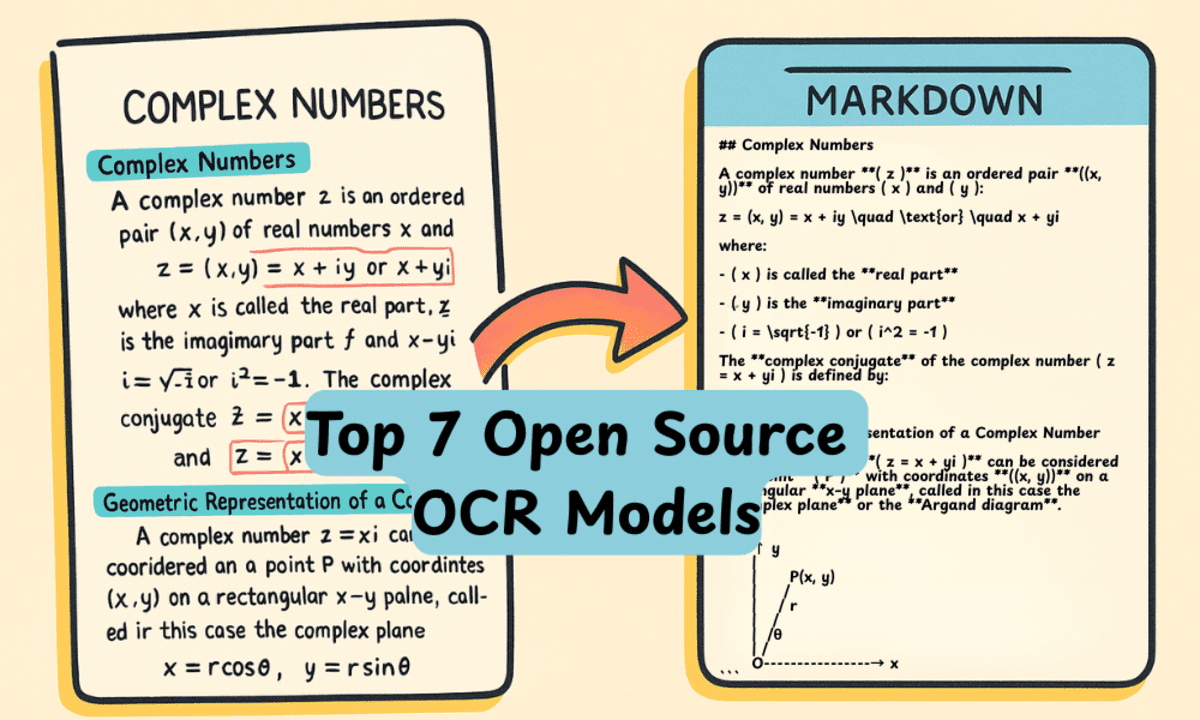
Top 7 Open Source OCR ModelsKDnuggets Best OCR and vision language models you can run locally that transform documents, tables, and diagrams into flawless markdown copies with benchmark-crushing accuracy.
Best OCR and vision language models you can run locally that transform documents, tables, and diagrams into flawless markdown copies with benchmark-crushing accuracy. Read More
Bonferroni vs. Benjamini-Hochberg: Choosing Your P-Value CorrectionTowards Data Science Multiple hypothesis testing, P-values, and Monte Carlo
The post Bonferroni vs. Benjamini-Hochberg: Choosing Your P-Value Correction appeared first on Towards Data Science.
Multiple hypothesis testing, P-values, and Monte Carlo
The post Bonferroni vs. Benjamini-Hochberg: Choosing Your P-Value Correction appeared first on Towards Data Science. Read More
Multi-Agent Intelligence for Multidisciplinary Decision-Making in Gastrointestinal Oncologycs.AI updates on arXiv.org arXiv:2512.08674v2 Announce Type: replace
Abstract: Multimodal clinical reasoning in the field of gastrointestinal (GI) oncology necessitates the integrated interpretation of endoscopic imagery, radiological data, and biochemical markers. Despite the evident potential exhibited by Multimodal Large Language Models (MLLMs), they frequently encounter challenges such as context dilution and hallucination when confronted with intricate, heterogeneous medical histories. In order to address these limitations, a hierarchical Multi-Agent Framework is proposed, which emulates the collaborative workflow of a human Multidisciplinary Team (MDT). The system attained a composite expert evaluation score of 4.60/5.00, thereby demonstrating a substantial improvement over the monolithic baseline. It is noteworthy that the agent-based architecture yielded the most substantial enhancements in reasoning logic and medical accuracy. The findings indicate that mimetic, agent-based collaboration provides a scalable, interpretable, and clinically robust paradigm for automated decision support in oncology.
arXiv:2512.08674v2 Announce Type: replace
Abstract: Multimodal clinical reasoning in the field of gastrointestinal (GI) oncology necessitates the integrated interpretation of endoscopic imagery, radiological data, and biochemical markers. Despite the evident potential exhibited by Multimodal Large Language Models (MLLMs), they frequently encounter challenges such as context dilution and hallucination when confronted with intricate, heterogeneous medical histories. In order to address these limitations, a hierarchical Multi-Agent Framework is proposed, which emulates the collaborative workflow of a human Multidisciplinary Team (MDT). The system attained a composite expert evaluation score of 4.60/5.00, thereby demonstrating a substantial improvement over the monolithic baseline. It is noteworthy that the agent-based architecture yielded the most substantial enhancements in reasoning logic and medical accuracy. The findings indicate that mimetic, agent-based collaboration provides a scalable, interpretable, and clinically robust paradigm for automated decision support in oncology. Read More
Improving Local Training in Federated Learning via Temperature Scalingcs.AI updates on arXiv.org arXiv:2401.09986v3 Announce Type: replace-cross
Abstract: Federated learning is inherently hampered by data heterogeneity: non-i.i.d. training data over local clients. We propose a novel model training approach for federated learning, FLex&Chill, which exploits the Logit Chilling method. Through extensive evaluations, we demonstrate that, in the presence of non-i.i.d. data characteristics inherent in federated learning systems, this approach can expedite model convergence and improve inference accuracy. Quantitatively, from our experiments, we observe up to 6X improvement in the global federated learning model convergence time, and up to 3.37% improvement in inference accuracy.
arXiv:2401.09986v3 Announce Type: replace-cross
Abstract: Federated learning is inherently hampered by data heterogeneity: non-i.i.d. training data over local clients. We propose a novel model training approach for federated learning, FLex&Chill, which exploits the Logit Chilling method. Through extensive evaluations, we demonstrate that, in the presence of non-i.i.d. data characteristics inherent in federated learning systems, this approach can expedite model convergence and improve inference accuracy. Quantitatively, from our experiments, we observe up to 6X improvement in the global federated learning model convergence time, and up to 3.37% improvement in inference accuracy. Read More