

RLinf: Flexible and Efficient Large-scale Reinforcement Learning via Macro-to-Micro Flow Transformationcs.AI updates on arXiv.org arXiv:2509.15965v2 Announce Type: replace-cross
Abstract: Reinforcement learning (RL) has demonstrated immense potential in advancing artificial general intelligence, agentic intelligence, and embodied intelligence. However, the inherent heterogeneity and dynamicity of RL workflows often lead to low hardware utilization and slow training on existing systems. In this paper, we present RLinf, a high-performance RL training system based on our key observation that the major roadblock to efficient RL training lies in system flexibility. To maximize flexibility and efficiency, RLinf is built atop a novel RL system design paradigm called macro-to-micro flow transformation (M2Flow), which automatically breaks down high-level, easy-to-compose RL workflows at both the temporal and spatial dimensions, and recomposes them into optimized execution flows. Supported by RLinf worker’s adaptive communication capability, we devise context switching and elastic pipelining to realize M2Flow transformation, and a profiling-guided scheduling policy to generate optimal execution plans. Extensive evaluations on both reasoning RL and embodied RL tasks demonstrate that RLinf consistently outperforms state-of-the-art systems, achieving $1.07times-2.43times$ speedup in end-to-end training throughput.
arXiv:2509.15965v2 Announce Type: replace-cross
Abstract: Reinforcement learning (RL) has demonstrated immense potential in advancing artificial general intelligence, agentic intelligence, and embodied intelligence. However, the inherent heterogeneity and dynamicity of RL workflows often lead to low hardware utilization and slow training on existing systems. In this paper, we present RLinf, a high-performance RL training system based on our key observation that the major roadblock to efficient RL training lies in system flexibility. To maximize flexibility and efficiency, RLinf is built atop a novel RL system design paradigm called macro-to-micro flow transformation (M2Flow), which automatically breaks down high-level, easy-to-compose RL workflows at both the temporal and spatial dimensions, and recomposes them into optimized execution flows. Supported by RLinf worker’s adaptive communication capability, we devise context switching and elastic pipelining to realize M2Flow transformation, and a profiling-guided scheduling policy to generate optimal execution plans. Extensive evaluations on both reasoning RL and embodied RL tasks demonstrate that RLinf consistently outperforms state-of-the-art systems, achieving $1.07times-2.43times$ speedup in end-to-end training throughput. Read More
Atom of Thoughts for Markov LLM Test-Time Scalingcs.AI updates on arXiv.org arXiv:2502.12018v4 Announce Type: replace-cross
Abstract: Large Language Models (LLMs) have achieved significant performance gains through test-time scaling methods. However, existing approaches often incur redundant computations due to the accumulation of historical dependency information during inference. To address this challenge, we leverage the memoryless property of Markov processes to minimize reliance on historical context and propose a Markovian reasoning process. This foundational Markov chain structure enables seamless integration with various test-time scaling methods, thereby improving their scaling efficiency. By further scaling up the Markovian reasoning chain through integration with techniques such as tree search and reflective refinement, we uncover an emergent atomic reasoning structure, where reasoning trajectories are decomposed into a series of self-contained, low-complexity atomic units. We name this design Atom of Thoughts (our). Extensive experiments demonstrate that our consistently outperforms existing baselines as computational budgets increase. Importantly, our integrates seamlessly with existing reasoning frameworks and different LLMs (both reasoning and non-reasoning), facilitating scalable, high-performance inference.We submit our code alongside this paper and will make it publicly available to facilitate reproducibility and future research.
arXiv:2502.12018v4 Announce Type: replace-cross
Abstract: Large Language Models (LLMs) have achieved significant performance gains through test-time scaling methods. However, existing approaches often incur redundant computations due to the accumulation of historical dependency information during inference. To address this challenge, we leverage the memoryless property of Markov processes to minimize reliance on historical context and propose a Markovian reasoning process. This foundational Markov chain structure enables seamless integration with various test-time scaling methods, thereby improving their scaling efficiency. By further scaling up the Markovian reasoning chain through integration with techniques such as tree search and reflective refinement, we uncover an emergent atomic reasoning structure, where reasoning trajectories are decomposed into a series of self-contained, low-complexity atomic units. We name this design Atom of Thoughts (our). Extensive experiments demonstrate that our consistently outperforms existing baselines as computational budgets increase. Importantly, our integrates seamlessly with existing reasoning frameworks and different LLMs (both reasoning and non-reasoning), facilitating scalable, high-performance inference.We submit our code alongside this paper and will make it publicly available to facilitate reproducibility and future research. Read More
Securing the AI Supply Chain: What Can We Learn From Developer-Reported Security Issues and Solutions of AI Projects?cs.AI updates on arXiv.org arXiv:2512.23385v1 Announce Type: cross
Abstract: The rapid growth of Artificial Intelligence (AI) models and applications has led to an increasingly complex security landscape. Developers of AI projects must contend not only with traditional software supply chain issues but also with novel, AI-specific security threats. However, little is known about what security issues are commonly encountered and how they are resolved in practice. This gap hinders the development of effective security measures for each component of the AI supply chain. We bridge this gap by conducting an empirical investigation of developer-reported issues and solutions, based on discussions from Hugging Face and GitHub. To identify security-related discussions, we develop a pipeline that combines keyword matching with an optimal fine-tuned distilBERT classifier, which achieved the best performance in our extensive comparison of various deep learning and large language models. This pipeline produces a dataset of 312,868 security discussions, providing insights into the security reporting practices of AI applications and projects. We conduct a thematic analysis of 753 posts sampled from our dataset and uncover a fine-grained taxonomy of 32 security issues and 24 solutions across four themes: (1) System and Software, (2) External Tools and Ecosystem, (3) Model, and (4) Data. We reveal that many security issues arise from the complex dependencies and black-box nature of AI components. Notably, challenges related to Models and Data often lack concrete solutions. Our insights can offer evidence-based guidance for developers and researchers to address real-world security threats across the AI supply chain.
arXiv:2512.23385v1 Announce Type: cross
Abstract: The rapid growth of Artificial Intelligence (AI) models and applications has led to an increasingly complex security landscape. Developers of AI projects must contend not only with traditional software supply chain issues but also with novel, AI-specific security threats. However, little is known about what security issues are commonly encountered and how they are resolved in practice. This gap hinders the development of effective security measures for each component of the AI supply chain. We bridge this gap by conducting an empirical investigation of developer-reported issues and solutions, based on discussions from Hugging Face and GitHub. To identify security-related discussions, we develop a pipeline that combines keyword matching with an optimal fine-tuned distilBERT classifier, which achieved the best performance in our extensive comparison of various deep learning and large language models. This pipeline produces a dataset of 312,868 security discussions, providing insights into the security reporting practices of AI applications and projects. We conduct a thematic analysis of 753 posts sampled from our dataset and uncover a fine-grained taxonomy of 32 security issues and 24 solutions across four themes: (1) System and Software, (2) External Tools and Ecosystem, (3) Model, and (4) Data. We reveal that many security issues arise from the complex dependencies and black-box nature of AI components. Notably, challenges related to Models and Data often lack concrete solutions. Our insights can offer evidence-based guidance for developers and researchers to address real-world security threats across the AI supply chain. Read More
Information Capacity: Evaluating the Efficiency of Large Language Models via Text Compressioncs.AI updates on arXiv.org arXiv:2511.08066v4 Announce Type: replace
Abstract: Recent years have witnessed the rapid advancements of large language models (LLMs) and their expanding applications, leading to soaring demands for computational resources. The widespread adoption of test-time scaling further aggravates the tension between model capability and resource consumption, highlighting the importance of inference efficiency. However, a unified metric that accurately reflects an LLM’s efficiency across different model sizes and architectures remains absent. Motivated by the correlation between compression and intelligence, we introduce information capacity, a measure of model efficiency based on text compression performance relative to computational complexity. Larger models can predict the next token more accurately, achieving greater compression gains but at higher computational costs. Empirical evaluations on mainstream open-source models show that models of varying sizes within a series exhibit consistent information capacity. This metric enables a fair efficiency comparison across model series and accurate performance prediction within a model series. A distinctive feature of information capacity is that it incorporates tokenizer efficiency, which affects both input and output token counts but is often neglected in LLM evaluations. We assess the information capacity of 52 models on 5 heterogeneous datasets and observe consistent results on the influences of tokenizer efficiency, pretraining data, and the mixture-of-experts architecture.
arXiv:2511.08066v4 Announce Type: replace
Abstract: Recent years have witnessed the rapid advancements of large language models (LLMs) and their expanding applications, leading to soaring demands for computational resources. The widespread adoption of test-time scaling further aggravates the tension between model capability and resource consumption, highlighting the importance of inference efficiency. However, a unified metric that accurately reflects an LLM’s efficiency across different model sizes and architectures remains absent. Motivated by the correlation between compression and intelligence, we introduce information capacity, a measure of model efficiency based on text compression performance relative to computational complexity. Larger models can predict the next token more accurately, achieving greater compression gains but at higher computational costs. Empirical evaluations on mainstream open-source models show that models of varying sizes within a series exhibit consistent information capacity. This metric enables a fair efficiency comparison across model series and accurate performance prediction within a model series. A distinctive feature of information capacity is that it incorporates tokenizer efficiency, which affects both input and output token counts but is often neglected in LLM evaluations. We assess the information capacity of 52 models on 5 heterogeneous datasets and observe consistent results on the influences of tokenizer efficiency, pretraining data, and the mixture-of-experts architecture. Read More
Logic Sketch Prompting (LSP): A Deterministic and Interpretable Prompting Methodcs.AI updates on arXiv.org arXiv:2512.22258v1 Announce Type: new
Abstract: Large language models (LLMs) excel at natural language reasoning but remain unreliable on tasks requiring strict rule adherence, determinism, and auditability. Logic Sketch Prompting (LSP) is a lightweight prompting framework that introduces typed variables, deterministic condition evaluators, and a rule based validator that produces traceable and repeatable outputs. Using two pharmacologic logic compliance tasks, we benchmark LSP against zero shot prompting, chain of thought prompting, and concise prompting across three open weight models: Gemma 2, Mistral, and Llama 3. Across both tasks and all models, LSP consistently achieves the highest accuracy (0.83 to 0.89) and F1 score (0.83 to 0.89), substantially outperforming zero shot prompting (0.24 to 0.60), concise prompts (0.16 to 0.30), and chain of thought prompting (0.56 to 0.75). McNemar tests show statistically significant gains for LSP across nearly all comparisons (p < 0.01). These results demonstrate that LSP improves determinism, interpretability, and consistency without sacrificing performance, supporting its use in clinical, regulated, and safety critical decision support systems.
arXiv:2512.22258v1 Announce Type: new
Abstract: Large language models (LLMs) excel at natural language reasoning but remain unreliable on tasks requiring strict rule adherence, determinism, and auditability. Logic Sketch Prompting (LSP) is a lightweight prompting framework that introduces typed variables, deterministic condition evaluators, and a rule based validator that produces traceable and repeatable outputs. Using two pharmacologic logic compliance tasks, we benchmark LSP against zero shot prompting, chain of thought prompting, and concise prompting across three open weight models: Gemma 2, Mistral, and Llama 3. Across both tasks and all models, LSP consistently achieves the highest accuracy (0.83 to 0.89) and F1 score (0.83 to 0.89), substantially outperforming zero shot prompting (0.24 to 0.60), concise prompts (0.16 to 0.30), and chain of thought prompting (0.56 to 0.75). McNemar tests show statistically significant gains for LSP across nearly all comparisons (p < 0.01). These results demonstrate that LSP improves determinism, interpretability, and consistency without sacrificing performance, supporting its use in clinical, regulated, and safety critical decision support systems. Read More
ODMA: On-Demand Memory Allocation Framework for LLM Serving on LPDDR-Class Acceleratorscs.AI updates on arXiv.org arXiv:2512.09427v2 Announce Type: replace-cross
Abstract: Device-memory management is a key bottleneck for serving large language models (LLMs) on accelerators whose memory has poor small-granularity random-access bandwidth (e.g., LPDDR5-class). Existing approaches either statically pre-allocate worst-case KV-cache per request, wasting substantial device memory, or rely on fine-grained paging that assumes high random-access tolerance and is therefore ill-suited to LPDDR-style systems. We present ODMA, an on-demand memory allocation framework for LLM serving on random-access-constrained device memory (RACM) platforms such as LPDDR5-based Cambricon MLUs. ODMA builds on generation-length prediction while addressing distribution drift and heavy-tailed request lengths via dynamic bucket partitioning and a large-bucket safeguard: bucket boundaries are periodically re-learned from online histograms, and high-uncertainty or overflowed requests fall back to a reserved large bucket for robustness. On Alpaca and Google-NQ, ODMA improves S3’s predictor accuracy from 98.60% to 99.55% and from 82.68% to 93.36%, respectively. Serving DeepSeek-R1-Distill-Qwen-7B on four Cambricon MLU370-X4 accelerators, ODMA increases device-memory utilization from 55.05% to 72.45% on Alpaca and from 42.54% to 61.79% on Google-NQ, and boosts throughput by 23% and 27% over a static pre-allocation baseline. These results show that predictor-driven, hardware-aware allocation can unlock efficient LLM serving on RACM accelerators without hardware changes, complementing paging-centric designs tailored to HBM systems.
arXiv:2512.09427v2 Announce Type: replace-cross
Abstract: Device-memory management is a key bottleneck for serving large language models (LLMs) on accelerators whose memory has poor small-granularity random-access bandwidth (e.g., LPDDR5-class). Existing approaches either statically pre-allocate worst-case KV-cache per request, wasting substantial device memory, or rely on fine-grained paging that assumes high random-access tolerance and is therefore ill-suited to LPDDR-style systems. We present ODMA, an on-demand memory allocation framework for LLM serving on random-access-constrained device memory (RACM) platforms such as LPDDR5-based Cambricon MLUs. ODMA builds on generation-length prediction while addressing distribution drift and heavy-tailed request lengths via dynamic bucket partitioning and a large-bucket safeguard: bucket boundaries are periodically re-learned from online histograms, and high-uncertainty or overflowed requests fall back to a reserved large bucket for robustness. On Alpaca and Google-NQ, ODMA improves S3’s predictor accuracy from 98.60% to 99.55% and from 82.68% to 93.36%, respectively. Serving DeepSeek-R1-Distill-Qwen-7B on four Cambricon MLU370-X4 accelerators, ODMA increases device-memory utilization from 55.05% to 72.45% on Alpaca and from 42.54% to 61.79% on Google-NQ, and boosts throughput by 23% and 27% over a static pre-allocation baseline. These results show that predictor-driven, hardware-aware allocation can unlock efficient LLM serving on RACM accelerators without hardware changes, complementing paging-centric designs tailored to HBM systems. Read More
Taming the Tail: Stable LLM Reinforcement Learning via Dynamic Vocabulary Pruningcs.AI updates on arXiv.org arXiv:2512.23087v1 Announce Type: cross
Abstract: Reinforcement learning for large language models (LLMs) faces a fundamental tension: high-throughput inference engines and numerically-precise training systems produce different probability distributions from the same parameters, creating a training-inference mismatch. We prove this mismatch has an asymmetric effect: the bound on log-probability mismatch scales as $(1-p)$ where $p$ is the token probability. For high-probability tokens, this bound vanishes, contributing negligibly to sequence-level mismatch. For low-probability tokens in the tail, the bound remains large, and moreover, when sampled, these tokens exhibit systematically biased mismatches that accumulate over sequences, destabilizing gradient estimation. Rather than applying post-hoc corrections, we propose constraining the RL objective to a dynamically-pruned “safe” vocabulary that excludes the extreme tail. By pruning such tokens, we trade large, systematically biased mismatches for a small, bounded optimization bias. Empirically, our method achieves stable training; theoretically, we bound the optimization bias introduced by vocabulary pruning.
arXiv:2512.23087v1 Announce Type: cross
Abstract: Reinforcement learning for large language models (LLMs) faces a fundamental tension: high-throughput inference engines and numerically-precise training systems produce different probability distributions from the same parameters, creating a training-inference mismatch. We prove this mismatch has an asymmetric effect: the bound on log-probability mismatch scales as $(1-p)$ where $p$ is the token probability. For high-probability tokens, this bound vanishes, contributing negligibly to sequence-level mismatch. For low-probability tokens in the tail, the bound remains large, and moreover, when sampled, these tokens exhibit systematically biased mismatches that accumulate over sequences, destabilizing gradient estimation. Rather than applying post-hoc corrections, we propose constraining the RL objective to a dynamically-pruned “safe” vocabulary that excludes the extreme tail. By pruning such tokens, we trade large, systematically biased mismatches for a small, bounded optimization bias. Empirically, our method achieves stable training; theoretically, we bound the optimization bias introduced by vocabulary pruning. Read More
Anomaly Detection by Effectively Leveraging Synthetic Imagescs.AI updates on arXiv.org arXiv:2512.23227v1 Announce Type: cross
Abstract: Anomaly detection plays a vital role in industrial manufacturing. Due to the scarcity of real defect images, unsupervised approaches that rely solely on normal images have been extensively studied. Recently, diffusion-based generative models brought attention to training data synthesis as an alternative solution. In this work, we focus on a strategy to effectively leverage synthetic images to maximize the anomaly detection performance. Previous synthesis strategies are broadly categorized into two groups, presenting a clear trade-off. Rule-based synthesis, such as injecting noise or pasting patches, is cost-effective but often fails to produce realistic defect images. On the other hand, generative model-based synthesis can create high-quality defect images but requires substantial cost. To address this problem, we propose a novel framework that leverages a pre-trained text-guided image-to-image translation model and image retrieval model to efficiently generate synthetic defect images. Specifically, the image retrieval model assesses the similarity of the generated images to real normal images and filters out irrelevant outputs, thereby enhancing the quality and relevance of the generated defect images. To effectively leverage synthetic images, we also introduce a two stage training strategy. In this strategy, the model is first pre-trained on a large volume of images from rule-based synthesis and then fine-tuned on a smaller set of high-quality images. This method significantly reduces the cost for data collection while improving the anomaly detection performance. Experiments on the MVTec AD dataset demonstrate the effectiveness of our approach.
arXiv:2512.23227v1 Announce Type: cross
Abstract: Anomaly detection plays a vital role in industrial manufacturing. Due to the scarcity of real defect images, unsupervised approaches that rely solely on normal images have been extensively studied. Recently, diffusion-based generative models brought attention to training data synthesis as an alternative solution. In this work, we focus on a strategy to effectively leverage synthetic images to maximize the anomaly detection performance. Previous synthesis strategies are broadly categorized into two groups, presenting a clear trade-off. Rule-based synthesis, such as injecting noise or pasting patches, is cost-effective but often fails to produce realistic defect images. On the other hand, generative model-based synthesis can create high-quality defect images but requires substantial cost. To address this problem, we propose a novel framework that leverages a pre-trained text-guided image-to-image translation model and image retrieval model to efficiently generate synthetic defect images. Specifically, the image retrieval model assesses the similarity of the generated images to real normal images and filters out irrelevant outputs, thereby enhancing the quality and relevance of the generated defect images. To effectively leverage synthetic images, we also introduce a two stage training strategy. In this strategy, the model is first pre-trained on a large volume of images from rule-based synthesis and then fine-tuned on a smaller set of high-quality images. This method significantly reduces the cost for data collection while improving the anomaly detection performance. Experiments on the MVTec AD dataset demonstrate the effectiveness of our approach. Read More
Act2Goal: From World Model To General Goal-conditioned Policycs.AI updates on arXiv.org arXiv:2512.23541v1 Announce Type: cross
Abstract: Specifying robotic manipulation tasks in a manner that is both expressive and precise remains a central challenge. While visual goals provide a compact and unambiguous task specification, existing goal-conditioned policies often struggle with long-horizon manipulation due to their reliance on single-step action prediction without explicit modeling of task progress. We propose Act2Goal, a general goal-conditioned manipulation policy that integrates a goal-conditioned visual world model with multi-scale temporal control. Given a current observation and a target visual goal, the world model generates a plausible sequence of intermediate visual states that captures long-horizon structure. To translate this visual plan into robust execution, we introduce Multi-Scale Temporal Hashing (MSTH), which decomposes the imagined trajectory into dense proximal frames for fine-grained closed-loop control and sparse distal frames that anchor global task consistency. The policy couples these representations with motor control through end-to-end cross-attention, enabling coherent long-horizon behavior while remaining reactive to local disturbances. Act2Goal achieves strong zero-shot generalization to novel objects, spatial layouts, and environments. We further enable reward-free online adaptation through hindsight goal relabeling with LoRA-based finetuning, allowing rapid autonomous improvement without external supervision. Real-robot experiments demonstrate that Act2Goal improves success rates from 30% to 90% on challenging out-of-distribution tasks within minutes of autonomous interaction, validating that goal-conditioned world models with multi-scale temporal control provide structured guidance necessary for robust long-horizon manipulation. Project page: https://act2goal.github.io/
arXiv:2512.23541v1 Announce Type: cross
Abstract: Specifying robotic manipulation tasks in a manner that is both expressive and precise remains a central challenge. While visual goals provide a compact and unambiguous task specification, existing goal-conditioned policies often struggle with long-horizon manipulation due to their reliance on single-step action prediction without explicit modeling of task progress. We propose Act2Goal, a general goal-conditioned manipulation policy that integrates a goal-conditioned visual world model with multi-scale temporal control. Given a current observation and a target visual goal, the world model generates a plausible sequence of intermediate visual states that captures long-horizon structure. To translate this visual plan into robust execution, we introduce Multi-Scale Temporal Hashing (MSTH), which decomposes the imagined trajectory into dense proximal frames for fine-grained closed-loop control and sparse distal frames that anchor global task consistency. The policy couples these representations with motor control through end-to-end cross-attention, enabling coherent long-horizon behavior while remaining reactive to local disturbances. Act2Goal achieves strong zero-shot generalization to novel objects, spatial layouts, and environments. We further enable reward-free online adaptation through hindsight goal relabeling with LoRA-based finetuning, allowing rapid autonomous improvement without external supervision. Real-robot experiments demonstrate that Act2Goal improves success rates from 30% to 90% on challenging out-of-distribution tasks within minutes of autonomous interaction, validating that goal-conditioned world models with multi-scale temporal control provide structured guidance necessary for robust long-horizon manipulation. Project page: https://act2goal.github.io/ Read More
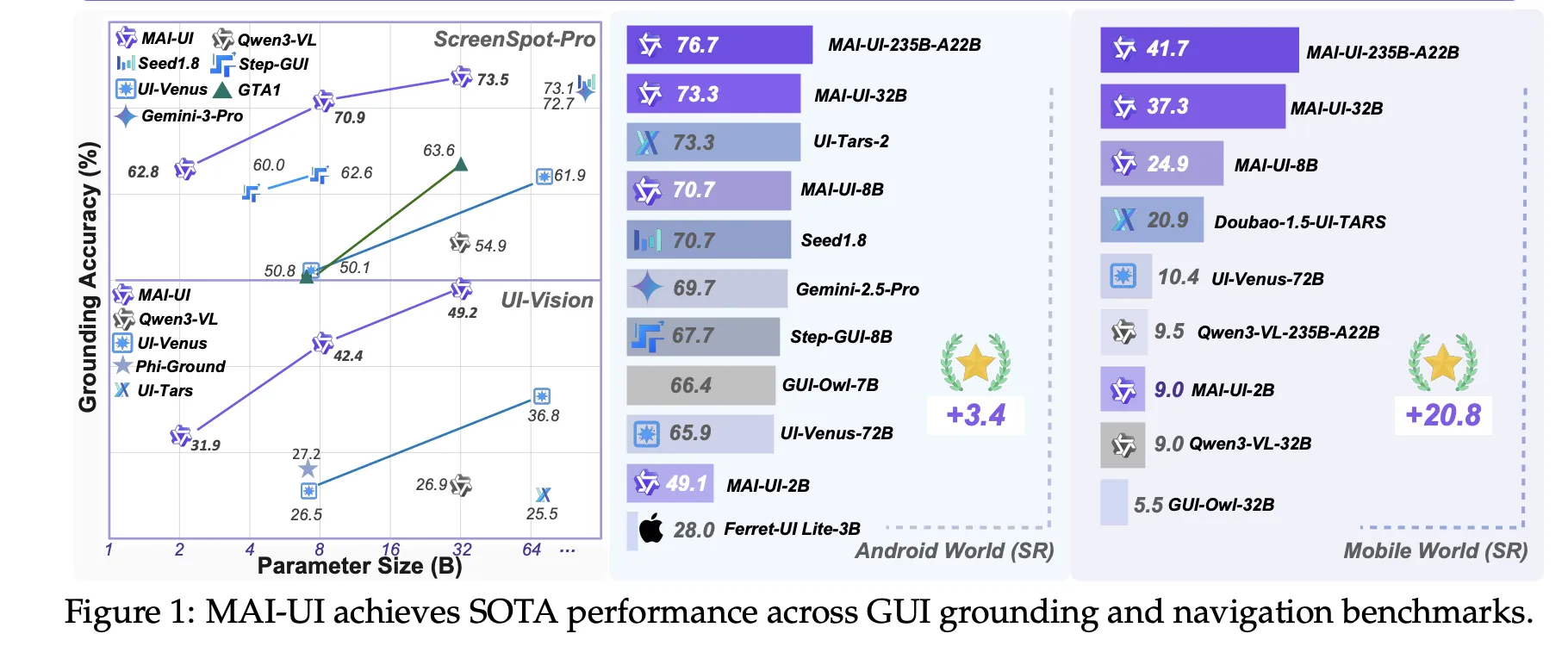
Alibaba Tongyi Lab Releases MAI-UI: A Foundation GUI Agent Family that Surpasses Gemini 2.5 Pro, Seed1.8 and UI-Tars-2 on AndroidWorldMarkTechPost Alibaba Tongyi Lab have released MAI-UI—a family of foundation GUI agents. It natively integrates MCP tool use, agent user interaction, device–cloud collaboration, and online RL, establishing state-of-the-art results in general GUI grounding and mobile GUI navigation, surpassing Gemini-2.5-Pro, Seed1.8, and UI-Tars-2 on AndroidWorld. The system targets three specific gaps that early GUI agents often ignore,
The post Alibaba Tongyi Lab Releases MAI-UI: A Foundation GUI Agent Family that Surpasses Gemini 2.5 Pro, Seed1.8 and UI-Tars-2 on AndroidWorld appeared first on MarkTechPost.
Alibaba Tongyi Lab have released MAI-UI—a family of foundation GUI agents. It natively integrates MCP tool use, agent user interaction, device–cloud collaboration, and online RL, establishing state-of-the-art results in general GUI grounding and mobile GUI navigation, surpassing Gemini-2.5-Pro, Seed1.8, and UI-Tars-2 on AndroidWorld. The system targets three specific gaps that early GUI agents often ignore,
The post Alibaba Tongyi Lab Releases MAI-UI: A Foundation GUI Agent Family that Surpasses Gemini 2.5 Pro, Seed1.8 and UI-Tars-2 on AndroidWorld appeared first on MarkTechPost. Read More