

LightSearcher: Efficient DeepSearch via Experiential Memorycs.AI updates on arXiv.org arXiv:2512.06653v2 Announce Type: replace
Abstract: DeepSearch paradigms have become a core enabler for deep reasoning models, allowing them to invoke external search tools to access up-to-date, domain-specific knowledge beyond parametric boundaries, thereby enhancing the depth and factual reliability of reasoning. Building upon this foundation, recent advances in reinforcement learning (RL) have further empowered models to autonomously and strategically control search tool usage, optimizing when and how to query external knowledge sources. Yet, these RL-driven DeepSearch systems often reveal a see-saw trade-off between accuracy and efficiency-frequent tool invocations can improve factual correctness but lead to unnecessary computational overhead and diminished efficiency. To address this challenge, we propose LightSearcher, an efficient RL framework that incorporates textual experiential memory by learning contrastive reasoning trajectories to generate interpretable summaries of successful reasoning patterns. In addition, it employs an adaptive reward shaping mechanism that penalizes redundant tool calls only in correct-answer scenarios. This design effectively balances the inherent accuracy-efficiency trade-off in DeepSearch paradigms. Experiments on four multi-hop QA benchmarks show that LightSearcher maintains accuracy comparable to SOTA baseline ReSearch, while reducing search tool invocations by 39.6%, inference time by 48.6%, and token consumption by 21.2%, demonstrating its superior efficiency.
arXiv:2512.06653v2 Announce Type: replace
Abstract: DeepSearch paradigms have become a core enabler for deep reasoning models, allowing them to invoke external search tools to access up-to-date, domain-specific knowledge beyond parametric boundaries, thereby enhancing the depth and factual reliability of reasoning. Building upon this foundation, recent advances in reinforcement learning (RL) have further empowered models to autonomously and strategically control search tool usage, optimizing when and how to query external knowledge sources. Yet, these RL-driven DeepSearch systems often reveal a see-saw trade-off between accuracy and efficiency-frequent tool invocations can improve factual correctness but lead to unnecessary computational overhead and diminished efficiency. To address this challenge, we propose LightSearcher, an efficient RL framework that incorporates textual experiential memory by learning contrastive reasoning trajectories to generate interpretable summaries of successful reasoning patterns. In addition, it employs an adaptive reward shaping mechanism that penalizes redundant tool calls only in correct-answer scenarios. This design effectively balances the inherent accuracy-efficiency trade-off in DeepSearch paradigms. Experiments on four multi-hop QA benchmarks show that LightSearcher maintains accuracy comparable to SOTA baseline ReSearch, while reducing search tool invocations by 39.6%, inference time by 48.6%, and token consumption by 21.2%, demonstrating its superior efficiency. Read More
Using LLMs in Generating Design Rationale for Software Architecture Decisionscs.AI updates on arXiv.org arXiv:2504.20781v3 Announce Type: replace-cross
Abstract: Design Rationale (DR) for software architecture decisions refers to the reasoning underlying architectural choices, which provides valuable insights into the different phases of the architecting process throughout software development. However, in practice, DR is often inadequately documented due to a lack of motivation and effort from developers. With the recent advancements in Large Language Models (LLMs), their capabilities in text comprehension, reasoning, and generation may enable the generation and recovery of DR for architecture decisions. In this study, we evaluated the performance of LLMs in generating DR for architecture decisions. First, we collected 50 Stack Overflow (SO) posts, 25 GitHub issues, and 25 GitHub discussions related to architecture decisions to construct a dataset of 100 architecture-related problems. Then, we selected five LLMs to generate DR for the architecture decisions with three prompting strategies, including zero-shot, chain of thought (CoT), and LLM-based agents. With the DR provided by human experts as ground truth, the Precision of LLM-generated DR with the three prompting strategies ranges from 0.267 to 0.278, Recall from 0.627 to 0.715, and F1-score from 0.351 to 0.389. Additionally, 64.45% to 69.42% of the arguments of DR not mentioned by human experts are also helpful, 4.12% to 4.87% of the arguments have uncertain correctness, and 1.59% to 3.24% of the arguments are potentially misleading. To further understand the trustworthiness and applicability of LLM-generated DR in practice, we conducted semi-structured interviews with six practitioners. Based on the experimental and interview results, we discussed the pros and cons of the three prompting strategies, the strengths and limitations of LLM-generated DR, and the implications for the practical use of LLM-generated DR.
arXiv:2504.20781v3 Announce Type: replace-cross
Abstract: Design Rationale (DR) for software architecture decisions refers to the reasoning underlying architectural choices, which provides valuable insights into the different phases of the architecting process throughout software development. However, in practice, DR is often inadequately documented due to a lack of motivation and effort from developers. With the recent advancements in Large Language Models (LLMs), their capabilities in text comprehension, reasoning, and generation may enable the generation and recovery of DR for architecture decisions. In this study, we evaluated the performance of LLMs in generating DR for architecture decisions. First, we collected 50 Stack Overflow (SO) posts, 25 GitHub issues, and 25 GitHub discussions related to architecture decisions to construct a dataset of 100 architecture-related problems. Then, we selected five LLMs to generate DR for the architecture decisions with three prompting strategies, including zero-shot, chain of thought (CoT), and LLM-based agents. With the DR provided by human experts as ground truth, the Precision of LLM-generated DR with the three prompting strategies ranges from 0.267 to 0.278, Recall from 0.627 to 0.715, and F1-score from 0.351 to 0.389. Additionally, 64.45% to 69.42% of the arguments of DR not mentioned by human experts are also helpful, 4.12% to 4.87% of the arguments have uncertain correctness, and 1.59% to 3.24% of the arguments are potentially misleading. To further understand the trustworthiness and applicability of LLM-generated DR in practice, we conducted semi-structured interviews with six practitioners. Based on the experimental and interview results, we discussed the pros and cons of the three prompting strategies, the strengths and limitations of LLM-generated DR, and the implications for the practical use of LLM-generated DR. Read More
Toward an AI Reasoning-Enabled System for Patient-Clinical Trial Matchingcs.AI updates on arXiv.org arXiv:2512.08026v1 Announce Type: new
Abstract: Screening patients for clinical trial eligibility remains a manual, time-consuming, and resource-intensive process. We present a secure, scalable proof-of-concept system for Artificial Intelligence (AI)-augmented patient-trial matching that addresses key implementation challenges: integrating heterogeneous electronic health record (EHR) data, facilitating expert review, and maintaining rigorous security standards. Leveraging open-source, reasoning-enabled large language models (LLMs), the system moves beyond binary classification to generate structured eligibility assessments with interpretable reasoning chains that support human-in-the-loop review. This decision support tool represents eligibility as a dynamic state rather than a fixed determination, identifying matches when available and offering actionable recommendations that could render a patient eligible in the future. The system aims to reduce coordinator burden, intelligently broaden the set of trials considered for each patient and guarantee comprehensive auditability of all AI-generated outputs.
arXiv:2512.08026v1 Announce Type: new
Abstract: Screening patients for clinical trial eligibility remains a manual, time-consuming, and resource-intensive process. We present a secure, scalable proof-of-concept system for Artificial Intelligence (AI)-augmented patient-trial matching that addresses key implementation challenges: integrating heterogeneous electronic health record (EHR) data, facilitating expert review, and maintaining rigorous security standards. Leveraging open-source, reasoning-enabled large language models (LLMs), the system moves beyond binary classification to generate structured eligibility assessments with interpretable reasoning chains that support human-in-the-loop review. This decision support tool represents eligibility as a dynamic state rather than a fixed determination, identifying matches when available and offering actionable recommendations that could render a patient eligible in the future. The system aims to reduce coordinator burden, intelligently broaden the set of trials considered for each patient and guarantee comprehensive auditability of all AI-generated outputs. Read More
From Benchmarks to Business Impact: Deploying IBM Generalist Agent in Enterprise Productioncs.AI updates on arXiv.org arXiv:2510.23856v2 Announce Type: replace
Abstract: Agents are rapidly advancing in automating digital work, but enterprises face a harder challenge: moving beyond prototypes to deployed systems that deliver measurable business value. This path is complicated by fragmented frameworks, slow development, and the absence of standardized evaluation practices. Generalist agents have emerged as a promising direction, excelling on academic benchmarks and offering flexibility across task types, applications, and modalities. Yet, evidence of their use in production enterprise settings remains limited. This paper reports IBM’s experience developing and piloting the Computer Using Generalist Agent (CUGA), which has been open-sourced for the community (https://github.com/cuga-project/cuga-agent). CUGA adopts a hierarchical planner–executor architecture with strong analytical foundations, achieving state-of-the-art performance on AppWorld and WebArena. Beyond benchmarks, it was evaluated in a pilot within the Business-Process-Outsourcing talent acquisition domain, addressing enterprise requirements for scalability, auditability, safety, and governance. To support assessment, we introduce BPO-TA, a 26-task benchmark spanning 13 analytics endpoints. In preliminary evaluations, CUGA approached the accuracy of specialized agents while indicating potential for reducing development time and cost. Our contribution is twofold: presenting early evidence of generalist agents operating at enterprise scale, and distilling technical and organizational lessons from this initial pilot. We outline requirements and next steps for advancing research-grade architectures like CUGA into robust, enterprise-ready systems.
arXiv:2510.23856v2 Announce Type: replace
Abstract: Agents are rapidly advancing in automating digital work, but enterprises face a harder challenge: moving beyond prototypes to deployed systems that deliver measurable business value. This path is complicated by fragmented frameworks, slow development, and the absence of standardized evaluation practices. Generalist agents have emerged as a promising direction, excelling on academic benchmarks and offering flexibility across task types, applications, and modalities. Yet, evidence of their use in production enterprise settings remains limited. This paper reports IBM’s experience developing and piloting the Computer Using Generalist Agent (CUGA), which has been open-sourced for the community (https://github.com/cuga-project/cuga-agent). CUGA adopts a hierarchical planner–executor architecture with strong analytical foundations, achieving state-of-the-art performance on AppWorld and WebArena. Beyond benchmarks, it was evaluated in a pilot within the Business-Process-Outsourcing talent acquisition domain, addressing enterprise requirements for scalability, auditability, safety, and governance. To support assessment, we introduce BPO-TA, a 26-task benchmark spanning 13 analytics endpoints. In preliminary evaluations, CUGA approached the accuracy of specialized agents while indicating potential for reducing development time and cost. Our contribution is twofold: presenting early evidence of generalist agents operating at enterprise scale, and distilling technical and organizational lessons from this initial pilot. We outline requirements and next steps for advancing research-grade architectures like CUGA into robust, enterprise-ready systems. Read More
Empowerment Gain and Causal Model Construction: Children and adults are sensitive to controllability and variability in their causal interventionscs.AI updates on arXiv.org arXiv:2512.08230v1 Announce Type: new
Abstract: Learning about the causal structure of the world is a fundamental problem for human cognition. Causal models and especially causal learning have proved to be difficult for large pretrained models using standard techniques of deep learning. In contrast, cognitive scientists have applied advances in our formal understanding of causation in computer science, particularly within the Causal Bayes Net formalism, to understand human causal learning. In the very different tradition of reinforcement learning, researchers have described an intrinsic reward signal called “empowerment” which maximizes mutual information between actions and their outcomes. “Empowerment” may be an important bridge between classical Bayesian causal learning and reinforcement learning and may help to characterize causal learning in humans and enable it in machines. If an agent learns an accurate causal world model, they will necessarily increase their empowerment, and increasing empowerment will lead to a more accurate causal world model. Empowerment may also explain distinctive features of childrens causal learning, as well as providing a more tractable computational account of how that learning is possible. In an empirical study, we systematically test how children and adults use cues to empowerment to infer causal relations, and design effective causal interventions.
arXiv:2512.08230v1 Announce Type: new
Abstract: Learning about the causal structure of the world is a fundamental problem for human cognition. Causal models and especially causal learning have proved to be difficult for large pretrained models using standard techniques of deep learning. In contrast, cognitive scientists have applied advances in our formal understanding of causation in computer science, particularly within the Causal Bayes Net formalism, to understand human causal learning. In the very different tradition of reinforcement learning, researchers have described an intrinsic reward signal called “empowerment” which maximizes mutual information between actions and their outcomes. “Empowerment” may be an important bridge between classical Bayesian causal learning and reinforcement learning and may help to characterize causal learning in humans and enable it in machines. If an agent learns an accurate causal world model, they will necessarily increase their empowerment, and increasing empowerment will lead to a more accurate causal world model. Empowerment may also explain distinctive features of childrens causal learning, as well as providing a more tractable computational account of how that learning is possible. In an empirical study, we systematically test how children and adults use cues to empowerment to infer causal relations, and design effective causal interventions. Read More
Large Language Models for Education and Research: An Empirical and User Survey-based Analysiscs.AI updates on arXiv.org arXiv:2512.08057v1 Announce Type: new
Abstract: Pretrained Large Language Models (LLMs) have achieved remarkable success across diverse domains, with education and research emerging as particularly impactful areas. Among current state-of-the-art LLMs, ChatGPT and DeepSeek exhibit strong capabilities in mathematics, science, medicine, literature, and programming. In this study, we present a comprehensive evaluation of these two LLMs through background technology analysis, empirical experiments, and a real-world user survey. The evaluation explores trade-offs among model accuracy, computational efficiency, and user experience in educational and research affairs. We benchmarked these LLMs performance in text generation, programming, and specialized problem-solving. Experimental results show that ChatGPT excels in general language understanding and text generation, while DeepSeek demonstrates superior performance in programming tasks due to its efficiency- focused design. Moreover, both models deliver medically accurate diagnostic outputs and effectively solve complex mathematical problems. Complementing these quantitative findings, a survey of students, educators, and researchers highlights the practical benefits and limitations of these models, offering deeper insights into their role in advancing education and research.
arXiv:2512.08057v1 Announce Type: new
Abstract: Pretrained Large Language Models (LLMs) have achieved remarkable success across diverse domains, with education and research emerging as particularly impactful areas. Among current state-of-the-art LLMs, ChatGPT and DeepSeek exhibit strong capabilities in mathematics, science, medicine, literature, and programming. In this study, we present a comprehensive evaluation of these two LLMs through background technology analysis, empirical experiments, and a real-world user survey. The evaluation explores trade-offs among model accuracy, computational efficiency, and user experience in educational and research affairs. We benchmarked these LLMs performance in text generation, programming, and specialized problem-solving. Experimental results show that ChatGPT excels in general language understanding and text generation, while DeepSeek demonstrates superior performance in programming tasks due to its efficiency- focused design. Moreover, both models deliver medically accurate diagnostic outputs and effectively solve complex mathematical problems. Complementing these quantitative findings, a survey of students, educators, and researchers highlights the practical benefits and limitations of these models, offering deeper insights into their role in advancing education and research. Read More

Inside the playbook of companies winning with AIAI News Many companies are still working out how to use AI in a steady and practical way, but a small group is already pulling ahead. New research from NTT DATA outlines a playbook that shows how these “AI leaders” set themselves apart through strong plans, firm decisions, and a disciplined approach to building and using AI
The post Inside the playbook of companies winning with AI appeared first on AI News.
Many companies are still working out how to use AI in a steady and practical way, but a small group is already pulling ahead. New research from NTT DATA outlines a playbook that shows how these “AI leaders” set themselves apart through strong plans, firm decisions, and a disciplined approach to building and using AI
The post Inside the playbook of companies winning with AI appeared first on AI News. Read More
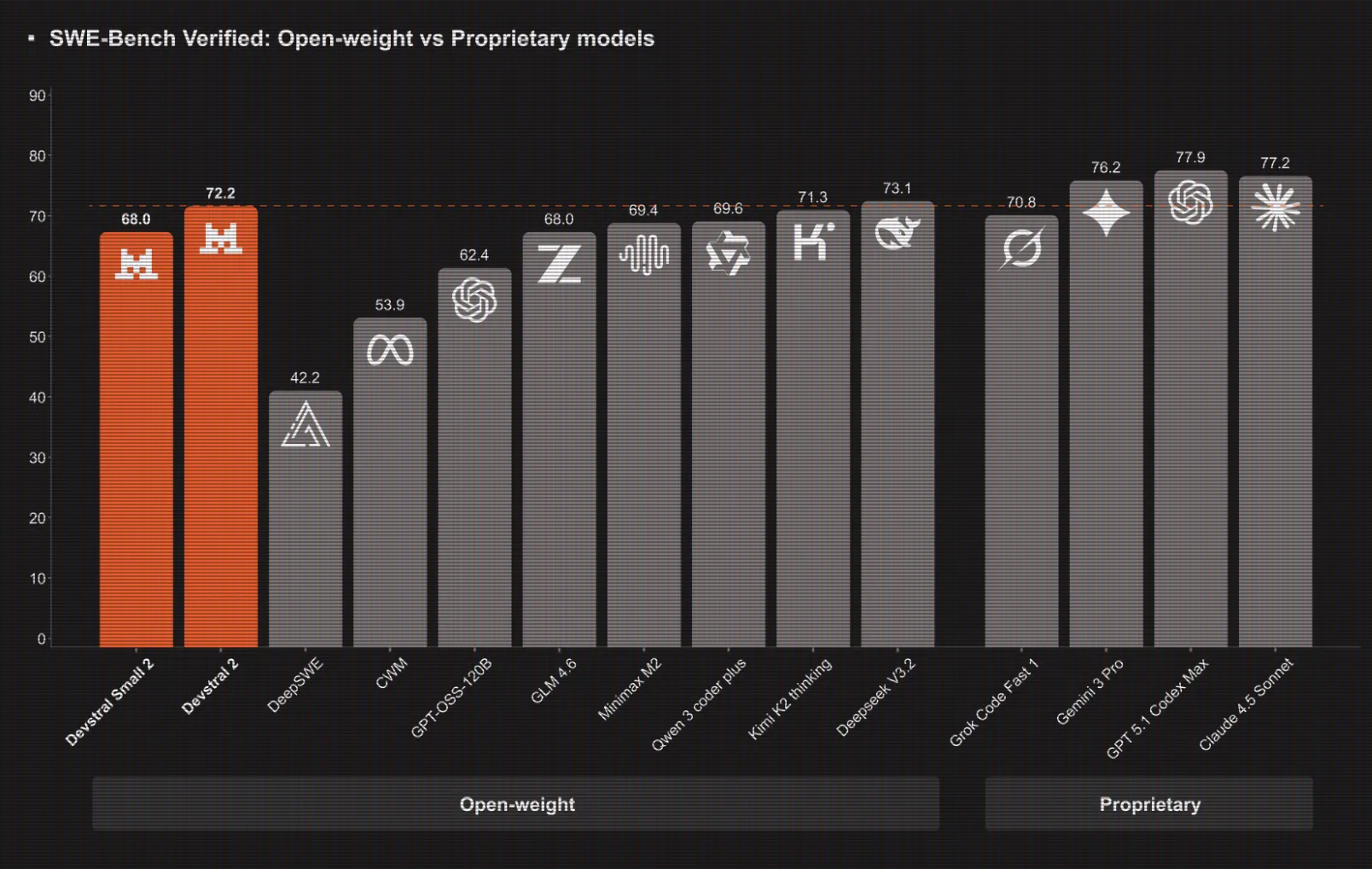
Mistral AI Ships Devstral 2 Coding Models And Mistral Vibe CLI For Agentic, Terminal Native DevelopmentMarkTechPost Mistral AI has introduced Devstral 2, a next generation coding model family for software engineering agents, together with Mistral Vibe CLI, an open source command line coding assistant that runs inside the terminal or IDEs that support the Agent Communication Protocol. Devstral 2 and Devstral Small 2, model sizes, context and benchmarks Devstral 2 is
The post Mistral AI Ships Devstral 2 Coding Models And Mistral Vibe CLI For Agentic, Terminal Native Development appeared first on MarkTechPost.
Mistral AI has introduced Devstral 2, a next generation coding model family for software engineering agents, together with Mistral Vibe CLI, an open source command line coding assistant that runs inside the terminal or IDEs that support the Agent Communication Protocol. Devstral 2 and Devstral Small 2, model sizes, context and benchmarks Devstral 2 is
The post Mistral AI Ships Devstral 2 Coding Models And Mistral Vibe CLI For Agentic, Terminal Native Development appeared first on MarkTechPost. Read More
Arbitrage: Efficient Reasoning via Advantage-Aware Speculationcs.AI updates on arXiv.org arXiv:2512.05033v2 Announce Type: replace-cross
Abstract: Modern Large Language Models achieve impressive reasoning capabilities with long Chain of Thoughts, but they incur substantial computational cost during inference, and this motivates techniques to improve the performance-cost ratio. Among these techniques, Speculative Decoding accelerates inference by employing a fast but inaccurate draft model to autoregressively propose tokens, which are then verified in parallel by a more capable target model. However, due to unnecessary rejections caused by token mismatches in semantically equivalent steps, traditional token-level Speculative Decoding struggles in reasoning tasks. Although recent works have shifted to step-level semantic verification, which improve efficiency by accepting or rejecting entire reasoning steps, existing step-level methods still regenerate many rejected steps with little improvement, wasting valuable target compute. To address this challenge, we propose Arbitrage, a novel step-level speculative generation framework that routes generation dynamically based on the relative advantage between draft and target models. Instead of applying a fixed acceptance threshold, Arbitrage uses a lightweight router trained to predict when the target model is likely to produce a meaningfully better step. This routing approximates an ideal Arbitrage Oracle that always chooses the higher-quality step, achieving near-optimal efficiency-accuracy trade-offs. Across multiple mathematical reasoning benchmarks, Arbitrage consistently surpasses prior step-level Speculative Decoding baselines, reducing inference latency by up to $sim2times$ at matched accuracy.
arXiv:2512.05033v2 Announce Type: replace-cross
Abstract: Modern Large Language Models achieve impressive reasoning capabilities with long Chain of Thoughts, but they incur substantial computational cost during inference, and this motivates techniques to improve the performance-cost ratio. Among these techniques, Speculative Decoding accelerates inference by employing a fast but inaccurate draft model to autoregressively propose tokens, which are then verified in parallel by a more capable target model. However, due to unnecessary rejections caused by token mismatches in semantically equivalent steps, traditional token-level Speculative Decoding struggles in reasoning tasks. Although recent works have shifted to step-level semantic verification, which improve efficiency by accepting or rejecting entire reasoning steps, existing step-level methods still regenerate many rejected steps with little improvement, wasting valuable target compute. To address this challenge, we propose Arbitrage, a novel step-level speculative generation framework that routes generation dynamically based on the relative advantage between draft and target models. Instead of applying a fixed acceptance threshold, Arbitrage uses a lightweight router trained to predict when the target model is likely to produce a meaningfully better step. This routing approximates an ideal Arbitrage Oracle that always chooses the higher-quality step, achieving near-optimal efficiency-accuracy trade-offs. Across multiple mathematical reasoning benchmarks, Arbitrage consistently surpasses prior step-level Speculative Decoding baselines, reducing inference latency by up to $sim2times$ at matched accuracy. Read More

OpenAI targets AI skills gap with new certification standardsAI News Adoption of generative AI has outpaced workforce capability, prompting OpenAI to target the skills gap with new certification standards. While it’s safe to say OpenAI’s tools have reached mass adoption, organisations struggle to convert this usage into reliable output. To address this, OpenAI has announced ‘AI Foundations,’ a structured initiative designed to standardise how employees
The post OpenAI targets AI skills gap with new certification standards appeared first on AI News.
Adoption of generative AI has outpaced workforce capability, prompting OpenAI to target the skills gap with new certification standards. While it’s safe to say OpenAI’s tools have reached mass adoption, organisations struggle to convert this usage into reliable output. To address this, OpenAI has announced ‘AI Foundations,’ a structured initiative designed to standardise how employees
The post OpenAI targets AI skills gap with new certification standards appeared first on AI News. Read More