Gallery

Contacts

411 University St, Seattle, USA

engitech@oceanthemes.net

+1 -800-456-478-23

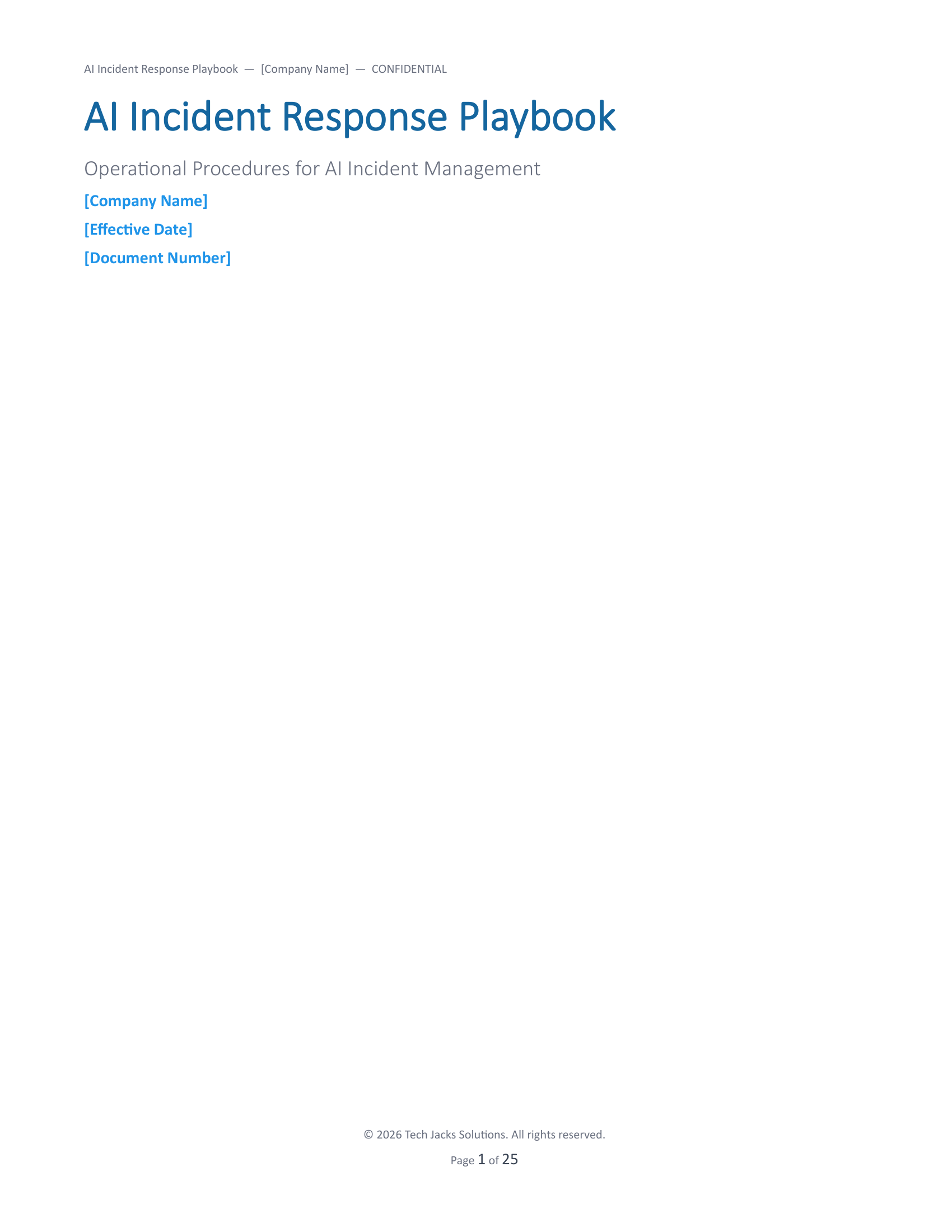
AI Incident Response Playbook Cover Page
Templates / AI Incident Response & Improvement Playbook
.docx ✓ Professional Edition Updated Q1 2026

AI Incident Response & Improvement Playbook

Structured detection, classification, containment, and recovery procedures for AI-specific incidents. Maps every response phase to EU AI Act Art. 62, NIST AI RMF MANAGE function, ISO 27001, and GDPR breach notification requirements. With a 4-tier severity classification and post-incident improvement cycle.

7
Sections
11
Pages
4
Frameworks
1–2hr
To Deploy
NIST AI RMF 1.0 EU AI Act 2024 ISO 27001:2022 GDPR
Build vs. Buy
From scratch
Research 4 frameworks6 hrs = $90
Draft 11 pages4 hrs = $60
Internal review cycle3 hrs = $45
Cross-mapping 4 frameworks3 hrs = $45
16 hours$240
vs
This template
Purchase$10.00
Customize for your org1 hr = $10
CitationsIncluded
CrosswalkIncluded
1 hour$30
$210 saved
15 hours back | 15:1 ROI on $10.00
At $10/hr. The price of this template as the hourly rate
“What if I use AI to write it?”
AI makes drafting faster, but it doesn’t reduce the total work. You still need the source framework documents, a way to verify what the AI produces, and SME-level expertise to catch what it gets wrong. AI hallucinates article numbers, invents control IDs, and generates crosswalk tables that look authoritative but aren’t. Every citation still has to be checked against the actual standard. The work shifts from writing to verification, and verification takes just as long.
~18hwith AI + expert verification
1hwith this template
126citations verified
4source PDFs read
$10.00
One-time purchase · Instant download
  • 4-tier severity classification with defined response timelines
  • EU AI Act Art. 62 notification procedures pre-built
  • GDPR Art. 33/34 breach notification workflow integrated
  • Post-incident improvement cycle with root cause methodology
  • 126 framework citations verified across 4 standards
  • Fully editable Word .docx. customize for your organization
.docx NIST AI RMF EU AI Act ISO 27001 GDPR ✦ Q1 2026
Overview
What this template does

AI incidents differ fundamentally from traditional IT security events. Model drift, adversarial attacks, data poisoning, and autonomous system failures require detection criteria, severity classification, and response procedures that generic incident response plans don’t cover. Without an AI-specific playbook, your organization faces regulatory notification failures under EU AI Act Art. 62 and GDPR Art. 33. With real consequences for missed timelines.

This playbook provides a complete incident response lifecycle: detection and identification, 4-tier severity classification, notification and escalation, containment and mitigation, investigation and root cause analysis, recovery and restoration, and post-incident review with improvement cycle. Every phase has defined roles, timelines, and documentation requirements mapped to NIST AI RMF, EU AI Act, ISO 27001, and GDPR.

The post-incident improvement cycle feeds learnings back into governance policy updates, risk assessments, and control enhancements. Turning every incident into a measurable improvement in your AI governance program.

What’s Inside
7 Sections · 11 Pages · Audit-Aligned Structure
Establishes the mandate for structured AI incident response and defines the policy scope. References NIST AI RMF MANAGE function and EU AI Act Art. 62 incident reporting obligations.
NIST MANAGEEU AI Act Art. 62
Defines which AI systems, personnel, and operational contexts are covered. Includes third-party AI services and shadow AI detection.
ISO 27001 A.5ISO 42001 Clause 4.3
The core playbook: detection and identification, severity classification (4-tier), notification and escalation, containment and mitigation, investigation and root cause analysis, recovery and restoration, post-incident review and improvement. Each phase has defined roles, timelines, and documentation requirements.
NIST MANAGE 4.1EU AI Act Art. 62ISO 27001 A.16
Complete bibliography of source documents cited: NIST AI RMF, EU AI Act, ISO 27001, GDPR incident notification requirements.
Audit TrailSource Documents
Key terms: AI incident, severity levels, containment, root cause analysis, post-incident review.
NIST AI RMF GlossaryEU AI Act Art. 3
Pre-built version control table tracking playbook revisions with date, author, and change summary. Ready to customize for your organization’s document control process.
ISO 42001 Clause 7.5Document Control
Signature and approval tracking table for CISO, AI Governance Lead, Legal, and compliance stakeholders. Pre-configured for multi-stakeholder approval workflows.
Audit EvidenceSign-Off
Audience
Who deploys this template
🛡️
CISO / Security Lead
Owns the AI incident response program. Uses the playbook to establish detection criteria, severity classification, and escalation procedures for AI-specific failures including model drift, adversarial attacks, and data poisoning.
⚖️
Compliance Officer
Maps incident response procedures to EU AI Act Art. 62 notification requirements and GDPR breach reporting timelines. Uses the post-incident review process to generate audit evidence.
🔨
IT Security Team
Executes containment and recovery procedures. Uses the 4-tier severity classification to prioritize response actions and the investigation framework to identify root causes.
📋
AI Governance Lead
Integrates incident learnings into governance policy updates. Uses the improvement cycle to strengthen controls, update risk assessments, and close gaps identified during post-incident reviews.
Framework Alignment
How this template maps to standards
NIST
NIST AI RMF 1.0
Maps to MANAGE function for ongoing monitoring and incident response. 18 citations covering detection, severity classification, and post-incident improvement.
MANAGE 4.1MANAGE 2.4MEASURE 2.6
EU
EU AI Act 2024
82 article-level citations. Covers Art. 62 incident reporting, Art. 9 risk management obligations post-incident, Art. 72 market surveillance cooperation.
Art. 62Art. 9Art. 72
ISO
ISO/IEC 27001:2022
Maps to information security incident management controls. Annex A controls for detection, escalation, and post-incident analysis.
A.16.1A.5.24A.5.25
GDPR
GDPR
Data breach notification requirements. Art. 33 72-hour notification to supervisory authority. Art. 34 communication to data subjects when high risk is likely.
Art. 33Art. 34
Value Proposition
Build from scratch vs. use this template
✓ With This Template
4-tier severity classification with defined response timelines. From low-impact model drift to critical autonomous system failures.
126 framework citations verified against source documents. Article numbers, not AI-generated approximations.
EU AI Act Art. 62 notification procedures pre-built. Timelines, required content, and authority contacts defined.
Post-incident improvement cycle with root cause methodology. Turns every incident into measurable governance improvement.
GDPR breach notification workflow integrated. 72-hour Art. 33 and Art. 34 data subject notification paths defined.
Role assignments and escalation paths defined per severity level. CISO, compliance, legal, and engineering all covered.
✗ From Scratch
Designing severity tiers without regulatory reference means guessing at thresholds. Most orgs over-classify or under-classify AI incidents because they use IT severity models.
Verifying every citation against the published standard means reading each source PDF. AI tools generate plausible but often wrong article numbers for incident response requirements.
Mapping notification requirements across EU AI Act and GDPR means reconciling two regulatory regimes with different timelines, authorities, and reporting content.
Building root cause analysis methodology from scratch requires understanding how AI failures differ from traditional IT incidents. Model drift, data poisoning, and adversarial attacks each need different investigation approaches.
Integrating breach notification timelines across regulations is error-prone. Missing the 72-hour GDPR window or the EU AI Act reporting deadline has real consequences.
Defining escalation paths without operational experience means gaps surface during actual incidents when it’s too late to fix them.

Already have an incident response plan? Use this playbook to add AI-specific detection criteria, severity classification, and regulatory notification procedures your existing plan likely doesn’t cover.

“$10 for a complete AI incident response playbook?”

Building an AI incident response playbook from scratch requires understanding how AI incidents differ from traditional IT incidents, mapping notification requirements across EU AI Act and GDPR, designing severity classification that accounts for model-specific failures, and building improvement cycles that feed back into governance. That’s specialized work.

I’ve been building governance documentation since 2012. That year I helped my healthcare analytics company earn its first HITRUST certification. Since then I’ve created and managed compliance documentation for SOC 2, PCI DSS, HITRUST, and ISO 27001 programs across enterprise organizations. I have a writing degree and I genuinely like this work.

HITRUST CSF SOC 2 PCI DSS ISO 27001 14 Years in GRC Writing Degree

Credentials don’t explain the price though. This does:

I want AI adopted responsibly. I don’t want my friends, my family, or my kids dealing with threats and risks that come from deploying AI without governance. Organizations will take the path that earns them the most money. That’s how business works. So I feel obligated to put quality documentation out at a price where governance isn’t something only Fortune 500 companies can afford. I don’t need to charge thousands of dollars to make a difference. I care about helping where I can.

You’re building something that matters. Documentation that earns trust from your board, your customers, and your team. And it has to be right.

The citations in these templates were checked against the published standards. The actual ISO 42001:2023 PDF, the EU AI Act regulation text, the NIST AI RMF 1.0 document. Control IDs, article numbers, crosswalk mappings. This is practitioner-built documentation from someone who’s sat in the audits, written the remediation plans, and knows what survives a compliance review.

Derrick Jackson // Founder, Tech Jacks Solutions
Related Templates
Often bought together
FRAMEWORK COVERAGE
NIST AI RMF EU AI Act ISO 27001 GDPR
WHAT YOU GET
7 sections · 11 pages
Editable Word .docx
GAIO-verified framework citations
4-tier severity classification
Post-incident improvement cycle
14-day money-back guarantee
★ BUNDLE DEAL AVAILABLE
Building a complete governance program?
This playbook is included in the AI Organization Starter Bundle: 9 templates, $108, save $27 (20%).
Important

This template provides a structured starting point for AI incident response, not a finished product. It’s designed to accelerate your governance program by giving you a professionally structured foundation with verified framework citations. It doesn’t replace legal counsel, compliance review, or organizational judgment. Every organization is different. You’ll need to customize the severity classification thresholds, escalation paths, notification timelines, and recovery procedures for your specific technology stack, regulatory environment, and operational context. We recommend routing your completed playbook through your legal, compliance, and security teams before adoption. What you’re buying is a jumpstart that saves you weeks of research and drafting, not a guarantee of compliance. Framework citations reflect regulations as of Q1 2026. Regulatory frameworks evolve. Check for updates to the EU AI Act, NIST AI RMF, ISO 27001, and GDPR before your annual playbook review. Single organization license. All purchases include a 14-day money-back guarantee. If the template does not meet your needs, contact us for a full refund.

Author

Tech Jacks Solutions