Why professionals trust our templates
- 270+ downloads by governance & compliance teams
- Built by AI governance practitioners, not generic template mills
- 14-day money-back guarantee • Instant download • Secure checkout via Stripe
AI Data Governance and Quality Assessment Checklist Template
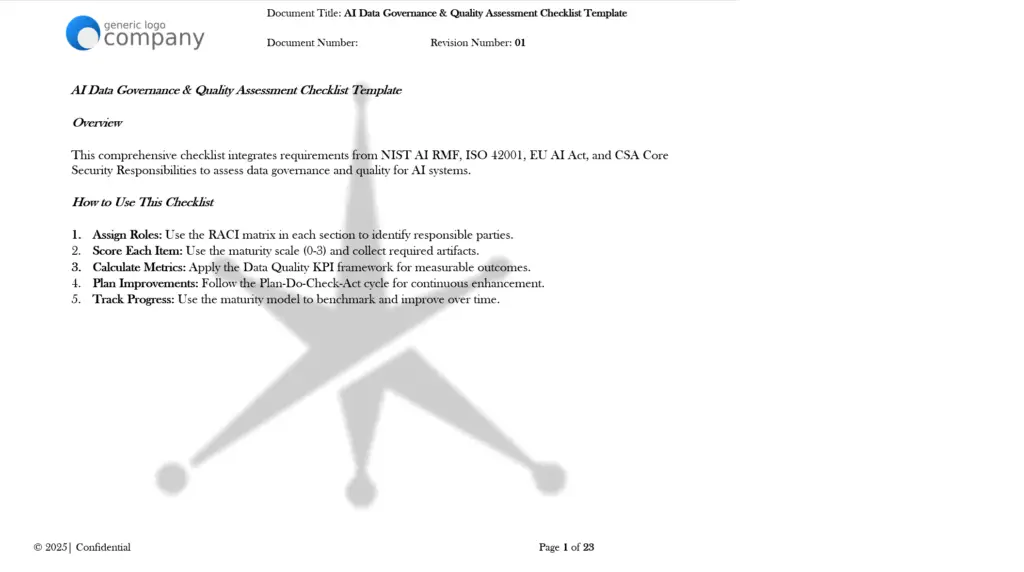
A structured assessment framework designed to support organizations in evaluating and documenting data governance practices for AI systems, with alignment to NIST AI RMF, ISO 42001, EU AI Act, and CSA Core Security Responsibilities.
[Download Now]
This checklist template provides a structured framework for assessing data governance and quality practices across the AI system lifecycle. The template includes 10 comprehensive sections covering data acquisition through retirement, with built-in RACI matrices, maturity scoring, and artifact requirements for each control area.
Organizations will need to customize the template to their specific operational context, risk profile, and regulatory requirements. The checklist format is designed to reduce the time typically spent creating assessment frameworks from scratch while providing flexibility for organizational adaptation.
Key Benefits
✓ Provides structured assessment framework across 10 governance domains
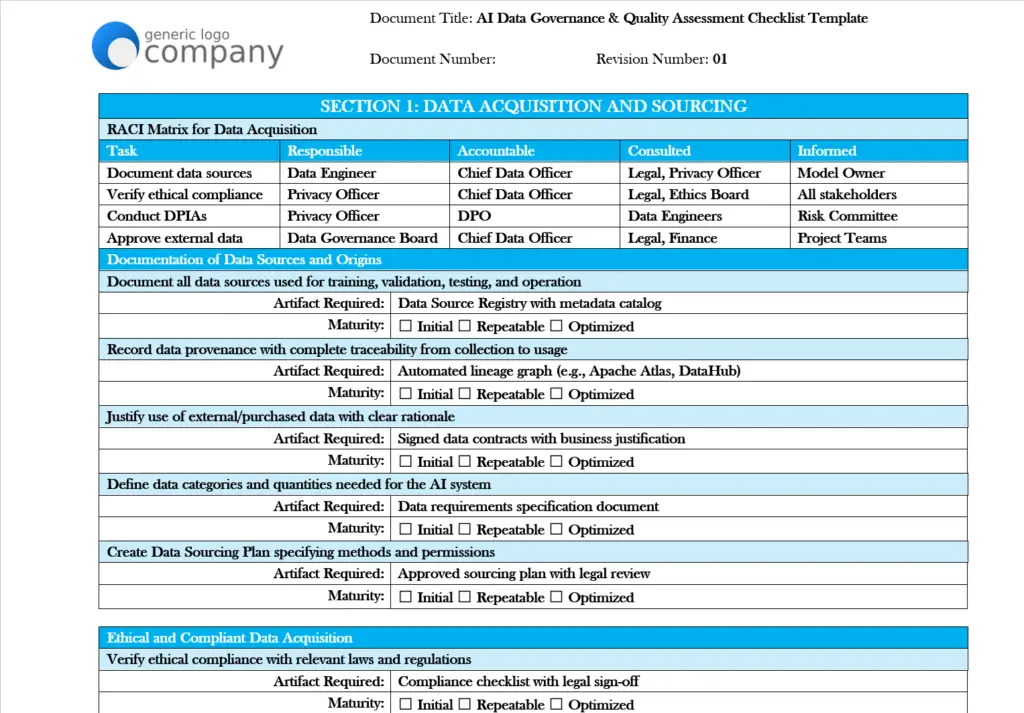
✓ Includes RACI matrices for defining roles and responsibilities
✓ Contains maturity scoring model (Initial, Repeatable, Optimized) for benchmarking
✓ Offers data quality KPI framework based on ISO 25012/DAMA dimensions
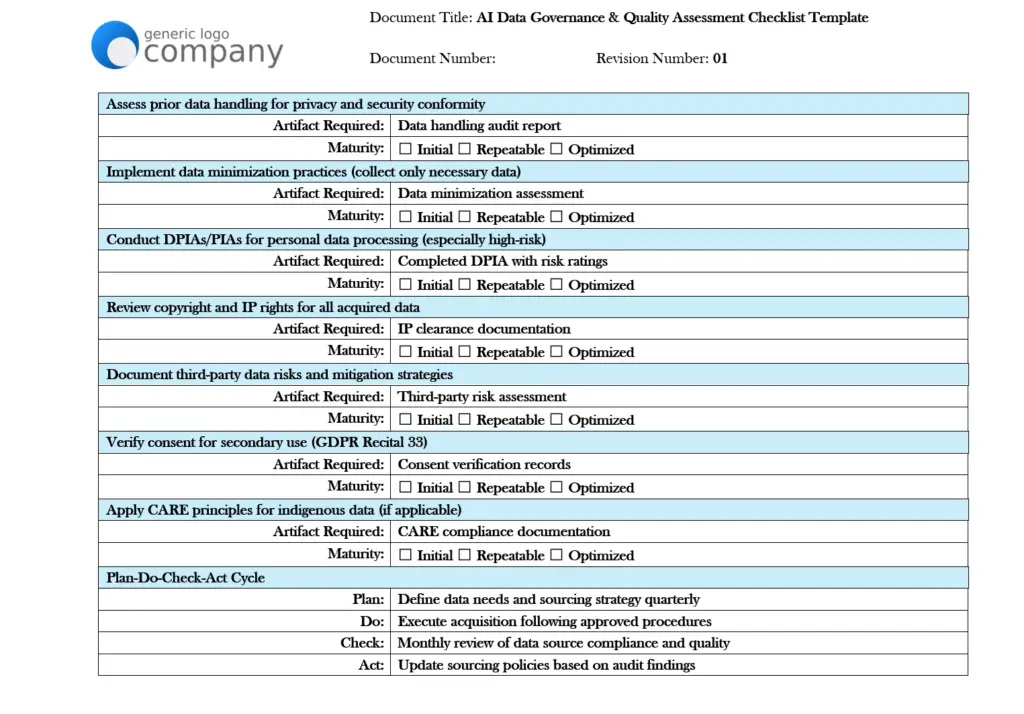
✓ Includes artifact requirements for documentation traceability
✓ Provides Plan-Do-Check-Act cycle guidance for continuous improvement
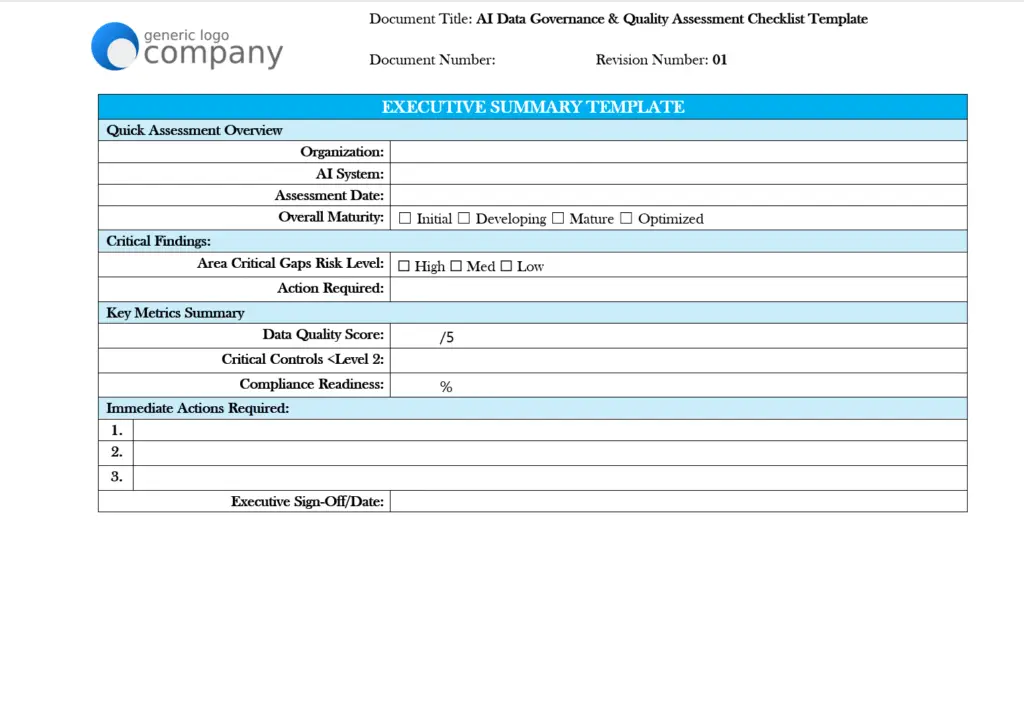
✓ Contains executive summary template for leadership reporting
✓ Includes glossary of key terms for organizational alignment
Who Uses This?
Designed for:
- Data governance professionals establishing AI data management practices
- Compliance officers assessing AI system regulatory alignment
- Risk managers evaluating data-related risks in AI deployments
- Chief Data Officers developing governance frameworks
- AI/ML engineers implementing data quality controls
- Privacy officers conducting data protection assessments
The template includes an executive summary section, 10 detailed assessment sections with checkbox controls, RACI matrices, maturity indicators, required artifacts, and a scoring guide with prioritization framework.
Why This Matters
Organizations deploying AI systems face increasing pressure to demonstrate responsible data governance practices. Regulatory frameworks like the EU AI Act establish specific requirements for data quality, documentation, and governance for high-risk AI systems. Standards such as ISO 42001 and NIST AI RMF provide guidance on establishing AI management systems and risk management practices.
Building assessment capabilities from scratch requires significant time investment and expertise across multiple regulatory and standards frameworks. Teams often struggle to identify what controls to assess, how to measure maturity, and what documentation to maintain.
This template consolidates assessment criteria from multiple frameworks into a single, structured checklist. It provides a starting point for organizations developing their data governance assessment capabilities, while requiring customization to address specific organizational contexts, risk profiles, and applicable regulations.
Framework Alignment
The template integrates requirements and guidance from:
- NIST AI RMF: Supports risk management practices for AI systems
- ISO 42001: Aligns with AI management system requirements
- EU AI Act: Addresses data governance requirements for high-risk AI systems
- CSA Core Security Responsibilities: Incorporates cloud security considerations
- ISO 25012: References data quality dimensions
- DAMA DMBOK: Utilizes data quality framework concepts
- GDPR: Includes privacy assessment considerations (DPIAs, consent verification)
Key Features
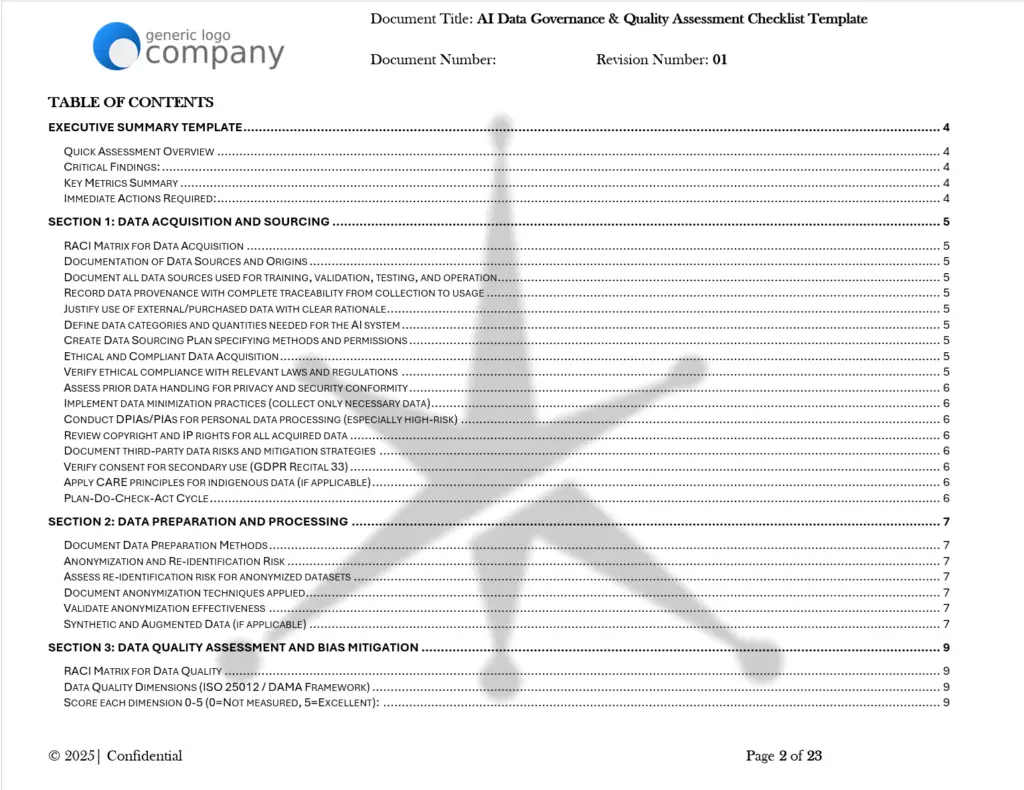
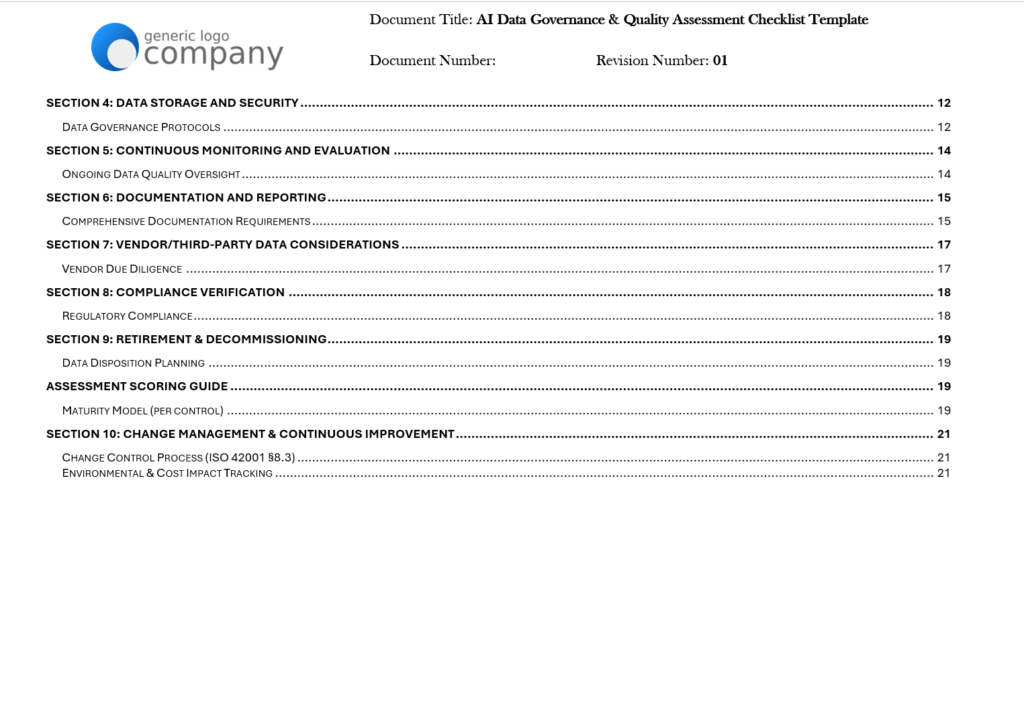
The template includes the following sections and components:
- Executive Summary Template: Pre-formatted reporting structure with quick assessment overview, critical findings section, key metrics summary, and action tracking
- Section 1 – Data Acquisition and Sourcing: RACI matrix, data source documentation controls, ethical and compliant acquisition checklist with artifact requirements
- Section 2 – Data Preparation and Processing: Data preparation method documentation, anonymization and re-identification risk assessment, synthetic data governance controls
- Section 3 – Data Quality Assessment and Bias Mitigation: ISO 25012/DAMA quality dimension scoring, data quality KPI framework, bias assessment and mitigation checklist, validation data requirements
- Section 4 – Data Storage and Security: Governance protocols, access control implementation checklist, data retention and protection controls, cross-border transfer documentation
- Section 5 – Continuous Monitoring and Evaluation: Data drift and concept drift monitoring, quality metrics tracking, public transparency documentation for high-risk systems
- Section 6 – Documentation and Reporting: Comprehensive artifact requirements by lifecycle stage, cross-cutting documentation checklist
- Section 7 – Vendor/Third-Party Data Considerations: Vendor due diligence checklist, contract review requirements
- Section 8 – Compliance Verification: EU AI Act requirements checklist, GDPR compliance items, industry-specific requirement placeholders, standards alignment verification
- Section 9 – Retirement and Decommissioning: Data disposition planning, decommissioning checklist
- Section 10 – Change Management and Continuous Improvement: Change control process aligned with ISO 42001 §8.3, environmental and cost impact tracking
Comparison Table: Generic Approach vs. This Professional Template
| Aspect | Generic Approach | This Professional Template |
|---|---|---|
| Structure | Ad-hoc checklists created per project | 10 integrated sections covering full AI data lifecycle |
| Role Assignment | Undefined responsibilities | RACI matrices included for key governance areas |
| Maturity Assessment | No standardized scoring | Three-level maturity model (Initial, Repeatable, Optimized) |
| Quality Dimensions | Informal quality checks | ISO 25012/DAMA framework with 0-5 scoring per dimension |
| Documentation | Scattered or missing artifacts | Specific artifact requirements listed for each control |
| Continuous Improvement | Reactive fixes | Plan-Do-Check-Act cycle integrated into assessment |
| Framework Coverage | Single framework or none | Multi-framework alignment (NIST, ISO, EU AI Act, CSA) |
| Executive Reporting | Manual report creation | Pre-formatted executive summary template included |
FAQ Section
Q: What file format is this template provided in? A: The template is provided in Microsoft Word (.docx) format to support collaborative editing and organizational customization.
Q: Does this template guarantee compliance with EU AI Act or other regulations? A: No. This template provides a structured assessment framework that may support compliance efforts. Organizations must evaluate their specific obligations, customize the template to their context, and may need legal counsel to determine compliance requirements. The template is a starting point, not a compliance guarantee.
Q: How much customization is required? A: The template requires customization to reflect your organization’s specific AI systems, data types, risk profile, applicable regulations, and operational context. RACI matrices need to be populated with actual roles, maturity assessments need to be conducted, and artifact requirements may need adjustment based on organizational documentation practices.
Q: What level of expertise is needed to use this template? A: Users should have familiarity with data governance concepts, AI system lifecycles, and relevant regulatory frameworks. Organizations without in-house expertise may benefit from consulting with governance, compliance, or legal professionals.
Q: Does this template include the full text of referenced standards (ISO 42001, NIST AI RMF, etc.)? A: No. The template references these frameworks and incorporates concepts from them, but does not include the full standard texts. Organizations may need to obtain official copies of standards for detailed implementation.
Q: How often should assessments be conducted using this template? A: Assessment frequency depends on organizational risk appetite, regulatory requirements, and the pace of AI system changes. The template includes guidance on periodic reviews but organizations should determine appropriate cadence based on their context.
Ideal For
- Organizations implementing AI governance programs for the first time
- Teams preparing for ISO 42001 certification efforts
- Companies assessing EU AI Act readiness for high-risk AI systems
- Data governance teams establishing AI-specific quality controls
- Risk management functions developing AI risk assessment capabilities
- Compliance teams creating audit-ready documentation frameworks
- Consultants supporting client AI governance initiatives
Pricing Strategy Options
Single Template: Contact for pricing based on organizational requirements and customization needs.
Bundle Option: May be combined with additional AI governance templates depending on organizational compliance scope.
Enterprise Option: Available as part of comprehensive governance documentation suites.
Differentiator
This template provides a consolidated assessment framework that integrates data governance requirements from multiple AI-specific frameworks (NIST AI RMF, ISO 42001, EU AI Act, CSA) into a single, structured checklist. Rather than requiring organizations to cross-reference multiple standards and create assessment criteria from scratch, the template provides pre-built control items, RACI matrices, maturity indicators, and artifact requirements across the complete AI data lifecycle. The inclusion of data quality KPIs based on ISO 25012/DAMA dimensions, Plan-Do-Check-Act cycle guidance, and a structured executive summary template supports both operational assessment and leadership reporting needs. Organizations should expect to customize the template to their specific context while benefiting from the structured starting point it provides.
Note: This template is designed to support organizational governance efforts and requires customization. It does not constitute legal advice and does not guarantee regulatory compliance. Organizations should consult with legal and compliance professionals regarding their specific obligations.