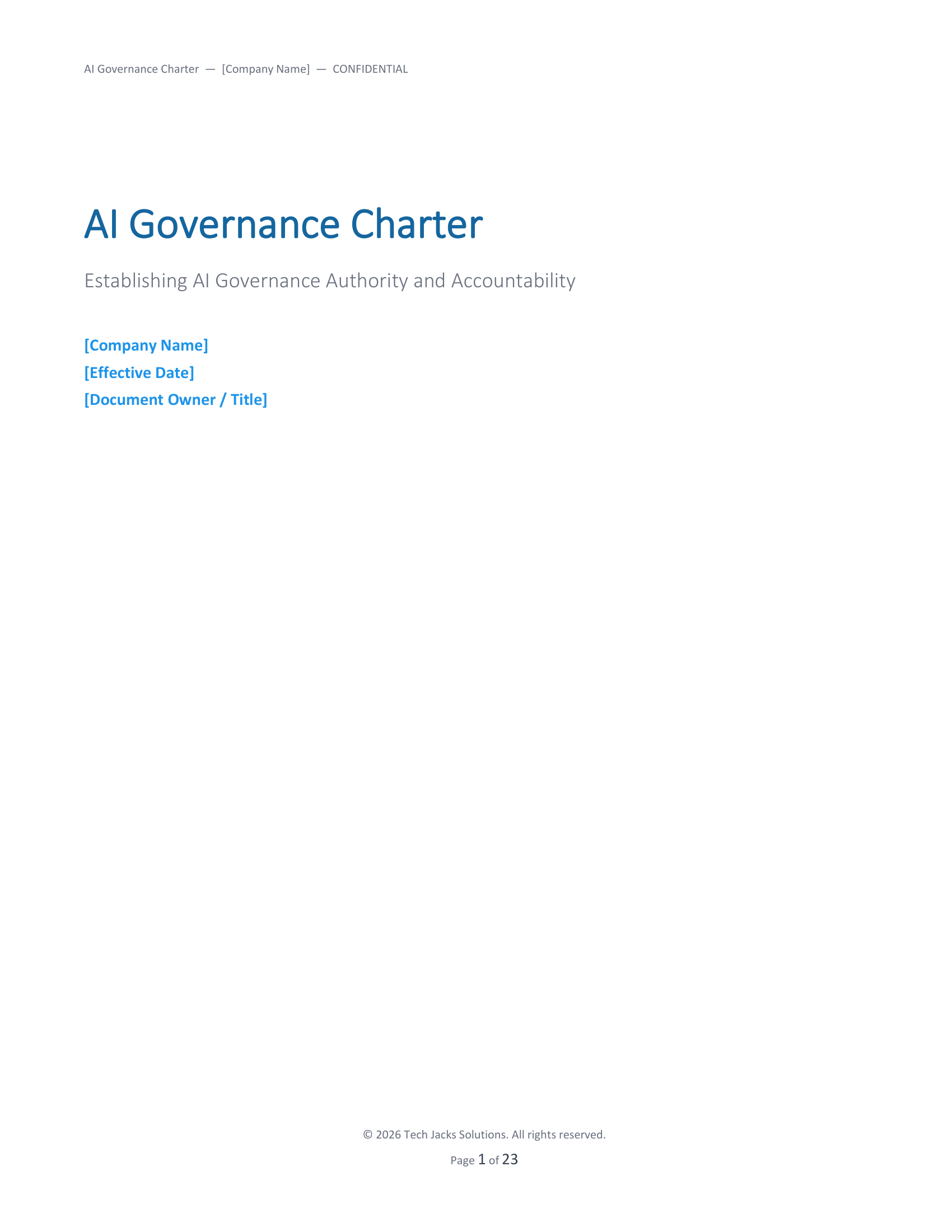
AI Governance Charter Template
Establish foundational governance principles for responsible AI development, deployment, and management within your organization.
Designed to support alignment with frameworks including NIST AI RMF, EU AI Act, ISO 27001, and IEEE ethical standards.
[Download Now]
Overview
This AI Governance Charter Template provides a structured framework for organizations seeking to establish clear governance principles for AI technologies. The template includes customizable sections covering governance committee structure, risk management approach, regulatory compliance considerations, transparency practices, security measures, and incident management protocols.
Organizations will need to customize placeholder text, adapt sections to their specific operational context, and integrate with their existing governance documentation. The template format is designed to reduce initial drafting time by providing pre-structured sections aligned with recognized AI governance frameworks.
Key Benefits
- ✓ Provides structured framework for AI governance documentation
- ✓ Includes guidance aligned with NIST AI RMF, EU AI Act, GDPR, HIPAA, and ISO 27001
- ✓ Offers customizable sections for organizational adaptation
- ✓ Contains reference sections for supporting documentation integration
- ✓ Includes version control and approval tracking sections
- ✓ Designed to support cross-functional governance committee establishment
Who Uses This?
Designed for:
- Compliance Officers establishing AI governance programs
- Risk Management professionals developing AI oversight frameworks
- CIOs and IT Leaders implementing AI governance structures
- Legal and Privacy teams addressing AI regulatory requirements
- Data Science Leaders coordinating responsible AI practices
- Organizations preparing for EU AI Act compliance efforts
What’s Included (Preview)
The template contains the following sections:
- Introduction and Purpose statements
- Scope definition framework
- Four core governance objectives
- AI Governance Committee structure and responsibilities
- Risk Management Framework approach
- Regulatory and Ethical Compliance section (referencing GDPR, HIPAA, EU AI Act, NIST AI RMF, IEEE standards, CSA CCM)
- Transparency, Documentation, and Explainability guidelines
- Security and Privacy framework
- Incident Management and Exception Handling section
- Training and Cultural Awareness provisions
- Continuous Monitoring and Improvement section
- Charter Review and Updates process
- Supporting Documentation reference list
- Comprehensive References section
- Definitions glossary (30+ terms defined)
- Version History table
- Approvers signature section
Why This Matters
Organizations deploying AI technologies face increasing pressure to demonstrate responsible governance practices. Regulatory frameworks such as the EU AI Act establish specific requirements for AI risk management, transparency, and documentation. The NIST AI Risk Management Framework provides voluntary guidance structured around four core functions: GOVERN, MAP, MEASURE, and MANAGE.
Establishing a governance charter serves as a foundational document that articulates an organization’s commitment to responsible AI practices and defines the oversight mechanisms for AI decision-making. This document type typically supports broader compliance efforts by providing the high-level framework that operational policies and procedures can reference.
Without a structured governance approach, organizations may face challenges in demonstrating accountability, managing AI-related risks, and maintaining alignment with evolving regulatory expectations. A documented governance charter can support efforts to establish clear lines of responsibility and decision-making authority for AI initiatives.
Framework Alignment
This template references the following frameworks as documented in the source material:
- NIST AI Risk Management Framework (AI RMF): Voluntary framework with GOVERN, MAP, MEASURE, and MANAGE functions for AI risk management
- EU AI Act: European regulation establishing risk-based classification for AI systems with requirements for high-risk AI
- GDPR (General Data Protection Regulation): Data protection requirements applicable to AI systems processing personal data
- HIPAA: U.S. healthcare data protection requirements relevant to AI in clinical operations
- IEEE Ethical Standards: Guidelines including IEEE 7010-2019 for AI governance and IEEE P7002 for data privacy processes
- CSA Cloud Controls Matrix (CCM): Cybersecurity framework for cloud computing with AI-specific guidance
- ISO 27001:2022: Information Security Management System standard with relevant controls for AI operations
While this template explicitly references the frameworks listed above, organizations pursuing ISO/IEC 42001 (AI Management System) certification may find the template’s structure supportive of their efforts.
The template includes governance committee frameworks, risk identification processes, documentation practices, and continuous improvement provisions that align conceptually with ISO 42001’s management system approach. Organizations can use this charter as a foundational governance document within a broader AIMS implementation.
Key Features
Based on the template’s documented content:
- Governance Committee Framework: Structured approach for establishing cross-functional AI oversight with defined responsibilities including risk management, project approval, ethical monitoring, and incident evaluation
- Risk Management Approach: Section for documenting risk identification through AI Use Case Inventory and Initial Risk Classification processes
- Regulatory Compliance Section: Framework for mapping governance practices to GDPR, HIPAA, EU AI Act, NIST AI RMF, and other referenced standards
- Transparency and Documentation Guidelines: Provisions for model documentation practices including references to Model Cards and Datasheets approaches
- Security and Privacy Framework: Section covering adversarial testing, model monitoring, access control, and related security measures
- Incident Management Structure: Framework for incident response and exception handling processes
- Definitions Glossary: Over 30 defined terms covering AI governance concepts including AI systems, high-risk AI, Model Cards, risk appetite, and shadow AI prevention
- Supporting Documentation References: List of 15 related documents that organizations may develop alongside the charter
Comparison Table: Starting From Scratch vs. Professional Template
| Aspect | Starting From Scratch | Professional Template |
|---|---|---|
| Initial Structure | Requires research into governance frameworks | Pre-structured sections based on recognized frameworks |
| Framework References | Must identify and interpret applicable frameworks | Includes references to NIST AI RMF, EU AI Act, ISO 27001, GDPR, HIPAA |
| Definitions | Must develop terminology from scratch | Provides 30+ defined terms for consistent language |
| Supporting Documentation | Must determine what additional documents are needed | Lists 15 related supporting documents |
| Customization Guidance | No guidance provided | Includes Quick Start Guide with customization instructions |
| Version Control | Must create tracking approach | Includes Version History and Approvers tables |
FAQ Section
Q: What format is this template provided in? A: Documents are optimized for Microsoft Word to ensure proper formatting and collaborative editing capabilities.
Q: Does this template guarantee compliance with the EU AI Act or other regulations? A: No. This template provides a framework designed to support governance documentation efforts. Compliance determination requires assessment against specific regulatory requirements based on your organization’s AI use cases, risk classifications, and operational context. Organizations should consult with legal and compliance professionals for compliance verification.
Q: What customization is required? A: Organizations need to replace placeholder text (company name, document numbers, roles), adapt sections to their specific operational context, delete non-applicable sections, and integrate with existing governance documentation. The template includes a Quick Start Guide with customization instructions.
Q: What supporting documents are referenced but not included? A: The template references 15 supporting documents that organizations may develop separately, including: RACI Matrix, AI Use Case Inventory, Risk Assessment Reports, Regulatory Compliance Matrix, AI Acceptable Use Policy, Ethics & Bias Policy, MLOps Security Playbook, Model Monitoring Framework, Access Control Matrix, and Incident Response Plans. These are referenced for integration but are separate documents.
Q: What frameworks does this template reference? A: The template includes references to NIST AI Risk Management Framework, EU AI Act, GDPR, HIPAA, IEEE ethical standards (7010-2019, P7002), CSA Cloud Controls Matrix, and ISO 27001:2022. These references are included to support alignment efforts but do not constitute compliance with these frameworks.
Q: Is this suitable for organizations of all sizes? A: The template states it provides a structured framework suitable for businesses of various sizes. Organizations should assess whether the governance structure and documentation depth align with their operational complexity and regulatory requirements.
Ideal For
- Organizations establishing formal AI governance programs
- Companies preparing for EU AI Act compliance efforts
- Enterprises implementing NIST AI RMF-aligned governance
- Healthcare organizations addressing AI governance with HIPAA considerations
- Financial services firms developing AI oversight frameworks
- Technology companies formalizing AI development governance
- Organizations seeking to document AI risk management approaches
- Compliance teams creating foundational AI governance documentation
SEO Keywords
- AI Governance Charter Template
- AI Governance Framework
- NIST AI RMF Template
- EU AI Act Compliance Template
- AI Risk Management Framework
- Responsible AI Governance
- AI Ethics Policy Template
- AI Compliance Documentation
- AI Oversight Framework
- Artificial Intelligence Governance
- AI Governance Committee
- AI Risk Classification
- AI Transparency Documentation
- Enterprise AI Governance
Differentiator
This AI Governance Charter Template provides a pre-structured framework that references multiple recognized standards including NIST AI RMF, EU AI Act, ISO 27001, GDPR, HIPAA, and IEEE ethical guidelines within a single document. The template includes a comprehensive definitions glossary with over 30 governance-related terms and explicitly lists 15 supporting documents that organizations typically develop alongside a governance charter. The Quick Start Guide provides clear customization instructions, and the framework sections are designed to support cross-functional governance committee establishment. Rather than providing a minimal starting point, this template offers structured content across 18 sections covering the full scope of AI governance documentation typically needed for establishing organizational AI oversight.
Note: This template requires organizational customization and does not guarantee compliance with any regulatory framework. Organizations should consult with legal and compliance professionals to determine specific requirements applicable to their AI systems and operations.


