

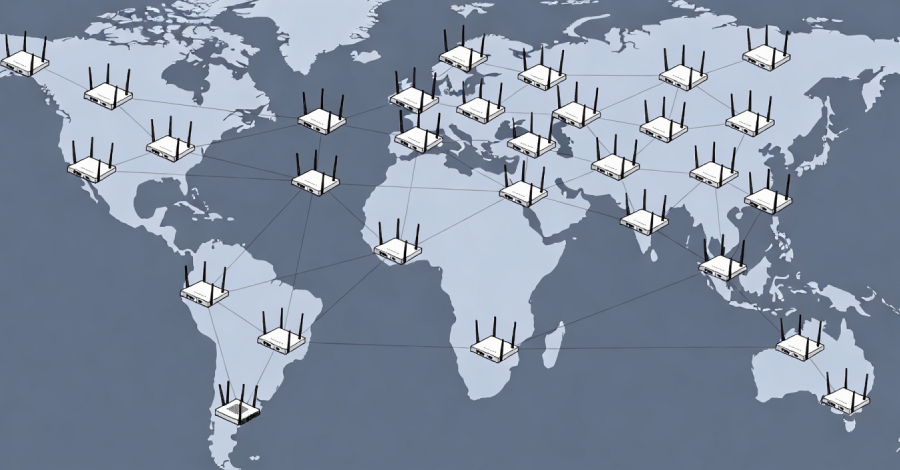
Operation Lightning, a multinational law enforcement action, dismantled SocksEscort — a five-year criminal proxy-as-a-service built on approximately 369,000 hijacked residential and SOHO routers across 163 countries. The technically critical detail: AVrecon malware flashes custom firmware using the device’s own update mechanism and disables future patching, making factory resets and standard patch management insufficient for remediation. Security teams managing SOHO and branch-office edge devices face a detection and recovery challenge that falls outside conventional vulnerability management workflows.
SocksEscort operated as a mature criminal anonymization service, not an opportunistic botnet. The service sold static residential IP access at $15 for 30 proxies per month and advertised explicitly to actors needing to bypass spam blocklists and blend malicious traffic into legitimate residential patterns. According to DoJ and Europol reporting, the payment platform received over EUR 5 million from customers before disruption. Black Lotus Labs assessed AVrecon active since at least May 2021, meaning the service ran largely uninterrupted for approximately five years. As of February 2026, nearly 8,000 routers remained actively listed in the service catalog — a detail that underscores how slowly criminal infrastructure decays even under active investigative pressure.
The persistence mechanism is what separates AVrecon from commodity router malware. Threat actors use the device’s own firmware update mechanism to flash a custom image containing AVrecon, hard-code malware execution at startup, and then disable the device’s update and flashing capabilities. The result is a permanently infected device that cannot receive legitimate vendor patches through normal channels, leaves no visible indicator of compromise to the device owner, and is invisible to standard vulnerability scanning and patch management tools. The FBI confirmed AVrecon is written in C and targets MIPS and ARM architectures, covering approximately 1,200 device models across Cisco, D-Link, Hikvision, Mikrotik, NETGEAR, TP-Link, and Zyxel hardware. NETGEAR’s public statement acknowledges early-stage targeting in 2016 but asserts no current exploitation — a claim that narrows NETGEAR-specific remediation scope but does not resolve which vendors carry active risk in 2026.
AVrecon’s capabilities extend well beyond proxy routing. The FBI alert confirms the malware can establish a remote shell to an attacker-controlled server and function as a loader for arbitrary payloads. This means compromised routers in the SocksEscort network were not passive traffic relays — they were controllable implants. Black Lotus Labs reported the botnet maintained an average of 20,000 distinct weekly victims, with C2 communications routed through an average of 15 nodes. Europol documented downstream criminal activity spanning ransomware staging, DDoS attacks, and CSAM distribution. Confirmed fraud victims include a New York cryptocurrency exchange customer ($1 million loss), a Pennsylvania manufacturer ($700,000 loss), and U.S. military personnel with MILITARY STAR accounts ($100,000 loss). These figures establish SocksEscort as infrastructure that directly enabled serious financial crime, not merely traffic obfuscation.
A significant intelligence gap limits targeted defensive response: neither the FBI alert nor Europol reporting publicly identifies the specific CVE(s) used for initial access. Europol states devices were infected through a vulnerability in residential modems of a specific brand but withholds the brand name and CVE identifier. The FBI references generic RCE and command injection vulnerability classes. Security teams cannot yet map initial access to specific CVE identifiers from publicly available reporting, which prevents precise patch prioritization. Teams should monitor for updated FBI and CISA advisories — CISA’s Known Exploited Vulnerabilities catalog is the most likely venue for disclosure if specific CVEs are confirmed. Until those identifiers are published, the defensive posture must shift from patch-based mitigation to inventory auditing, behavioral detection, and physical verification of firmware integrity.
The broader pattern here is the industrialization of residential proxy abuse as criminal infrastructure. Operation Lightning seized 34 domains, 23 servers, and froze $3.5 million in cryptocurrency across seven countries — a coordinated action that reflects how seriously law enforcement now treats proxy-as-a-service ecosystems. But takedowns create temporary disruption, not permanent remediation. The 8,000 routers still listed in the SocksEscort catalog as of February 2026 will not self-remediate. Enterprise and SMB security teams should treat any confirmed infected device as fully compromised — factory reset is insufficient, verified firmware re-flash from the vendor source or hardware replacement is required. Network-level detection should prioritize anomalous outbound SOCKS proxy traffic from edge devices and unexpected external connections from devices with no legitimate reason to initiate outbound sessions to non-local IPs.
- Takeaway 1: Factory resets do not remediate AVrecon infections. The malware flashes custom firmware using the device’s own update mechanism and disables future updates. Recovery requires a verified firmware re-flash from the vendor source or full hardware replacement.
- Takeaway 2: Audit SOHO and branch-office router inventory against the confirmed vendor impact list — Cisco, D-Link, Hikvision, Mikrotik, NETGEAR, TP-Link, and Zyxel — and verify firmware version integrity against vendor-published checksums or hashes.
- Takeaway 3: Confirmed infected devices are fully controllable implants, not misconfigured routers. AVrecon supports remote shell access and arbitrary payload loading. Treat any confirmed infection as a staging-point compromise requiring full incident response, not device reconfiguration.
- Takeaway 4: Network detection should focus on anomalous outbound SOCKS proxy traffic from edge devices and unexpected external connections from routers that have no legitimate reason to initiate outbound sessions. C2 communications averaged 15 routing nodes, complicating direct IP-based blocking.
- Takeaway 5: Specific CVE identifiers for initial access have not been publicly released. Patch prioritization cannot be mapped to specific CVEs from current reporting. Monitor CISA KEV and FBI advisories for disclosure and adjust remediation priority when identifiers are confirmed.
