Gallery

Contacts

411 University St, Seattle, USA

engitech@oceanthemes.net

+1 -800-456-478-23

Pre-Deployment AI Safety
Templates / Pre-Deployment AI Safety Gate
XLSX WORKBOOK ✓ Professional Updated Q2 2026

Pre-Deployment AI Safety Gate

A 49-item Go/No-Go assessment workbook across 7 gates with weighted scoring, dynamic applicability that adjusts based on your system’s risk profile, and a 12-framework crosswalk. It’s the structured pre-deployment review process your team doesn’t have time to build from scratch.

49
Assessment Items
7
Gates
12
Frameworks
7
Tabs
NIST AI RMF ISO 42001 EU AI Act OWASP LLM ISO 23894 NIST 600-1
Build vs. Buy
From scratch
Research 12 frameworks12 hrs = $600
Build checklist + scoring10 hrs = $500
Framework crosswalk8 hrs = $400
Scoring logic + formulas6 hrs = $300
36 hours$1,800
vs
This workbook
Purchase$50.00
Configure for your system2 hrs = $100
49 items pre-mappedIncluded
Scoring engine builtIncluded
2 hours$150
$1,650 saved
34 hours back | 33:1 ROI on $50.00
At $50/hr. The price of this workbook as the hourly rate
“What if I use AI to write it?”
AI can generate checklists fast, but it can’t verify them. You still need the 12 source framework documents, expertise to validate every control mapping, and someone who knows what auditors actually check. AI hallucinates article numbers, invents control IDs, and generates crosswalk tables that look authoritative but aren’t. The scoring logic, dynamic applicability formulas, and regulatory deadline tracking all require manual validation. The work shifts from writing to verification, and verification takes just as long.
~22hwith AI + expert verification
2hwith this workbook
49items pre-mapped
12source frameworks read
$50.00
One-time purchase · Instant download
  • 49 assessment items across 7 gates with weighted scoring engine
  • Dynamic applicability. 19 items adjust based on 8 risk classification fields
  • Automatic Go/No-Go logic with documented decision rules and thresholds
  • Regulatory Watch tab tracking 5 active regulations with countdown timers
  • Framework Crosswalk mapping every item to 12 authoritative sources
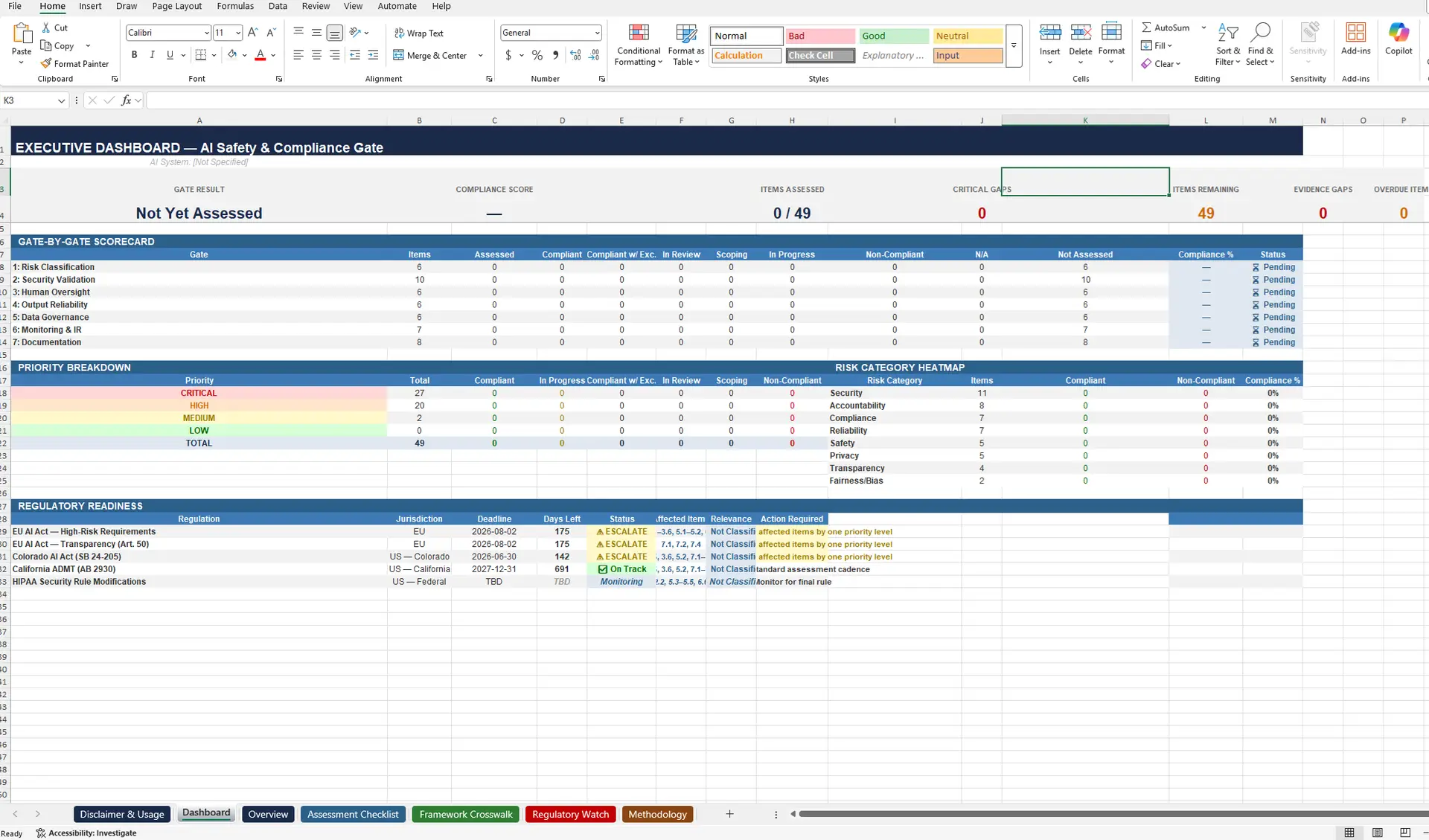
  • Executive Dashboard with gate scorecard, risk heatmap, and regulatory readiness
.xlsx NIST AI RMF ISO 42001 EU AI Act ✦ Q2 2026
Overview
What this workbook does

Deploying an AI system into production without a structured safety and compliance review is a risk most organizations can’t afford. This workbook gives you a repeatable, formula-driven assessment framework with 49 control items organized across 7 gates. It covers security validation, human oversight, output reliability, data governance, monitoring, and documentation requirements.

The scoring engine uses priority weights (CRITICAL 3x, HIGH 2x, MEDIUM 1x, LOW 0.5x) multiplied by status scores to produce a weighted compliance percentage. The Go/No-Go logic is automatic: GO requires all CRITICAL items at Compliant or better and a weighted score of 80% or above. Any single CRITICAL item scored Non-Compliant triggers an automatic NO-GO. No judgment calls, no ambiguity.

What sets this apart from a generic checklist is the dynamic applicability. 19 of 49 items adjust based on 8 risk classification fields you fill out on the Overview tab: EU market deployment, personal data processing, autonomy level, RAG usage, and more. A system that doesn’t process personal data gets a different effective assessment scope than one that does. The workbook reflects your actual deployment context instead of forcing a one-size-fits-all review.

What’s Inside
7 Tabs · 49 Items · 12 Framework Sources
Important disclaimers, an 8-step usage guide that walks you through the assessment process, status definitions quick reference for all 7 status levels, and key concepts overview covering priority weights and scoring methodology.
Setup GuideMethodologyStatus Definitions
Auto-calculated executive summary with gate-by-gate scorecard showing compliance percentage per gate. Priority breakdown across CRITICAL, HIGH, MEDIUM, and LOW items. Risk category heatmap across 8 categories. Regulatory readiness summary with escalation status for all tracked regulations.
Executive ViewAuto-CalculatedHeatmap
AI system information intake (system name, version, deployment environment, model provider). 8 risk classification fields that drive dynamic behavior across the entire workbook. Gate decision summary showing Go/No-Go outcome. Sign-off authority fields for 5 roles.
Risk ClassificationDynamic ScopingSign-Off
49 items across 7 gates with columns for Status, Priority, Framework Reference, Evidence/Artifact, Applicability, Notes/Findings, Risk Category, Effective Priority, Owner, Target Date, and Evidence Status. Scoring summary with weighted compliance calculation and automatic Go/No-Go rules at the bottom.
49 Items7 GatesWeighted ScoringGo/No-Go
Traceability matrix mapping all 49 items to specific articles, clauses, and sections across 7 regulatory and standards bodies. Covers EU AI Act articles, NIST AI RMF and NIST 600-1 functions, ISO 42001 and ISO 42005 clauses, OWASP LLM Top 10 categories, CSA/CoSAI references, and MITRE ATLAS techniques.
12 SourcesTraceability MatrixAudit Trail
Deadline tracker for 5 active regulations with countdown timers and auto-escalation rules. Status automatically changes to ESCALATE when within 180 days of a deadline and OVERDUE when passed. Dynamic relevance based on risk classification inputs from the Overview tab. Maps each deadline to affected assessment items.
5 RegulationsCountdown TimersAuto-Escalation
Priority classification criteria for all 4 levels. Autonomy-level escalation modifiers that auto-promote priorities when systems are fully autonomous. Status definitions with scoring weights (Compliant 1.0 through Non-Compliant 0.0). Weighted scoring formula documentation. Go/No-Go decision rules. Complete list of all 12 authoritative sources.
Scoring FormulaDecision Rules12 Sources
Key Features
What makes this different from a generic checklist
⚖️
Weighted Scoring Engine
Formula-driven calculation using priority weights (CRITICAL 3x, HIGH 2x, MEDIUM 1x, LOW 0.5x) multiplied by status scores (Compliant 1.0 through Non-Compliant 0.0). No subjective pass/fail judgments.
Automatic Go/No-Go Logic
GO requires all CRITICAL items Compliant and weighted score at 80%+. CONDITIONAL GO needs no CRITICAL Non-Compliant and score at 60%+ with remediation plan. Any CRITICAL Non-Compliant triggers NO-GO automatically.
🔄
Dynamic Applicability
19 of 49 items adjust based on 8 risk classification fields: EU AI Act Risk Tier, Autonomy Level, Personal Data, ePHI, EU Market Deployment, Significant Decisions, End User Interaction, and RAG Usage.
📈
Autonomy Escalation
Fully Autonomous systems auto-escalate priorities (HIGH becomes CRITICAL, MEDIUM becomes HIGH, LOW becomes MEDIUM). Semi-Autonomous uses base priorities. Human-Supervised allows review for potential downgrade.
📅
Regulatory Deadline Tracking
5 active regulations monitored with countdown timers: EU AI Act High-Risk (Aug 2026), EU AI Act Transparency (Aug 2026), Colorado AI Act (Jun 2026), California ADMT (Dec 2027), HIPAA modifications (TBD).
🔍
Evidence Tracking
Evidence Status column for each item with gap detection that flags items marked Compliant but missing evidence documentation. 8 risk categories tracked: Security (11), Accountability (8), Compliance (7), Reliability (7), Safety (5), Privacy (5), Transparency (4), Fairness/Bias (2).
Audience
Who uses this workbook
⚖️
AI Governance Teams
Primary users conducting pre-deployment risk reviews. Configure the risk classification fields, run assessments, and document Go/No-Go decisions with audit-aligned evidence.
🛡️
Security Practitioners
Validate adversarial testing controls covering prompt injection, supply chain security, and red teaming. Gate 2 has 10 dedicated security items.
📋
Compliance Officers
Track regulatory deadlines and framework alignment. The Regulatory Watch tab auto-escalates items approaching enforcement dates. Framework Crosswalk provides traceability to specific articles and clauses.
💻
Engineering Leads
Manage technical implementation against control requirements. Own specific assessment items, track evidence status, and document target dates for non-compliant items.
💼
CISOs / Executives
Review Go/No-Go decisions at the Dashboard level. Gate-by-gate scorecard, risk category heatmap, and regulatory readiness summary provide an executive view without digging into individual items.
🔍
Auditors
Require traceability from control items to specific regulatory articles and standard clauses. The Framework Crosswalk and evidence tracking fields provide the documentation chain auditors expect.
Framework Alignment
12 authoritative sources mapped
EU
EU AI Act
High-risk system requirements, transparency obligations, conformity assessment, and risk management articles mapped to specific assessment items with regulatory deadline tracking.
Art. 6, 7, 9-15Art. 17, 27, 49-50Annexes III, IV, VIII
NIST
NIST AI RMF 1.0
All four core functions mapped across assessment items. Crosswalk includes function-level and subcategory-level references for organizations maintaining dual compliance.
GOVERNMAPMEASUREMANAGE
42001
ISO/IEC 42001:2023
AI Management System clauses and Annex A controls mapped to assessment items. Supports organizations building toward ISO 42001 certification alongside pre-deployment review.
Cl. 6.1.3Annex ACl. 9.1
OWASP
OWASP LLM Top 10
LLM-specific vulnerability categories mapped to security validation items. Covers prompt injection, supply chain, insecure output handling, and other LLM attack vectors directly referenced in Gate 2.
LLM01-LLM08v2.0 (2025)
NIST
NIST AI 600-1
Generative AI Profile controls for confabulation risk, information security, data privacy, and value chain integrity. Specific control identifiers like MS-2.5, MS-2.6, MS-4.2, GV-1.2, GV-1.3, and GV-3.2 referenced.
MS-2.5MS-4.2GV-1.2GV-3.2
23894
ISO/IEC 23894:2023
AI-specific risk management guidance mapped to assessment items. Also references ISO/IEC 42005 (AI System Impact Assessment), CSA/CoSAI agentic security guidance, MITRE ATLAS techniques, NIST SP 1270 (bias), and OpenSSF ML supply chain.
ISO 42005CSAMITRE ATLASOpenSSF
Value Proposition
Ad-hoc review vs. structured pre-deployment gate
✓ With This Workbook
49 items across 7 gates with standardized columns. Scoring auto-calculates.
Framework Crosswalk maps each item to specific articles and clauses across 12 sources.
Weighted formula with defined status values and priority multipliers. No subjective pass/fail.
Formula-driven Go/No-Go with documented decision rules and thresholds.
Built-in Regulatory Watch with countdown timers and auto-escalation status.
19 items auto-adjust applicability based on your risk classification inputs.
Structured fields for evidence, owner, target date, notes, and sign-off authorities.
Auto-calculated Dashboard with gate scorecard, heatmap, and regulatory readiness.
✗ Ad-Hoc Review
Varies by reviewer. No consistent format, no standardized columns, no repeatable structure.
Manual cross-referencing of regulations. Mapping 12 frameworks takes dual expertise and significant time.
Subjective pass/fail or narrative-based. Different reviewers produce different results for the same system.
Based on individual judgment. No documented thresholds, no formula, no audit trail for the decision.
Regulatory deadline tracking requires separate systems. Easy to miss enforcement dates.
Manual determination of applicable controls. One-size-fits-all or custom scoping every time.
Depends on reviewer documentation habits. Audit trail gaps are common.
Custom executive summary required each time. No auto-calculated dashboard view.

Already have a pre-deployment review process? Use this workbook to identify gaps in your current approach, add regulatory traceability, and replace subjective scoring with a weighted formula.

FAQ
Common questions
Not necessarily. The workbook includes dynamic applicability driven by the risk classification fields on the Overview tab. Depending on your system’s characteristics (EU market deployment, personal data processing, autonomy level, RAG usage), some items will be set to “N/A” or “Recommended” rather than “Required.” Complete the Overview tab’s risk classification section first, since it drives applicability across the Assessment Checklist.
No. This is a decision-support tool, not legal or compliance advice. It doesn’t constitute a certification, attestation, or guarantee of regulatory compliance. Priority classifications are derived from authoritative sources but represent a composite interpretation, not direct regulatory prescription. Use it alongside qualified legal counsel and compliance professionals.
The scoring engine uses a weighted formula: Weighted Score = SUM(Status_Value x Priority_Weight) / SUM(Priority_Weight). Status values range from Compliant (1.0) to Non-Compliant (0.0). Priority weights are CRITICAL 3x, HIGH 2x, MEDIUM 1x, LOW 0.5x. GO requires all CRITICAL items at Compliant or better AND a weighted score of 80%+. Any single CRITICAL item scored Non-Compliant triggers an automatic NO-GO.
You’ll need to complete the AI System Information section on the Overview tab, set all 8 risk classification fields, assess each applicable item’s status, document evidence references, assign owners and target dates for non-compliant items, and verify the Regulatory Watch deadlines as regulations are finalized or amended. The workbook is a starting framework for your organization’s specific deployment context.
The Regulatory Watch tab tracks 5 regulations: EU AI Act High-Risk Requirements (August 2, 2026), EU AI Act Transparency Art. 50 (August 2, 2026), Colorado AI Act SB 24-205 (June 30, 2026), California ADMT AB 2930 (December 31, 2027), and HIPAA Security Rule Modifications (TBD pending HHS action). These deadlines should be verified and updated as regulations evolve.
“Why is this only $50?”

I’ve been building governance documentation since 2012. That year I helped my healthcare analytics company earn its first HITRUST certification. Since then I’ve created and managed compliance documentation for SOC 2, PCI DSS, HITRUST, and ISO 27001 programs across enterprise organizations. I have a writing degree and I genuinely like this work.

HITRUST CSF SOC 2 PCI DSS ISO 27001 14 Years in GRC Writing Degree

Credentials don’t explain the price though. This does:

I want AI adopted responsibly. I don’t want my friends, my family, or my kids dealing with threats and risks that come from deploying AI without governance. Organizations will take the path that earns them the most money. That’s how business works. So I feel obligated to put quality documentation out at a price where governance isn’t something only Fortune 500 companies can afford. I don’t need to charge thousands of dollars to make a difference. I care about helping where I can.

You’re building something that matters. A pre-deployment assessment process that earns trust from your board, your regulators, and your engineering teams. And it has to be right.

The citations in this workbook were checked against the published standards. The actual EU AI Act regulation text, the NIST AI RMF 1.0 document, ISO 42001:2023, OWASP LLM Top 10 v2.0, and 8 more framework sources. Article numbers, control IDs, crosswalk mappings. This is practitioner-built documentation from someone who’s sat in the audits, written the remediation plans, and knows what survives a compliance review.

Derrick Jackson // Founder, Tech Jacks Solutions
Related Templates
Often bought together
FRAMEWORK COVERAGE
NIST AI RMF ISO 42001 EU AI Act OWASP LLM
WHAT YOU GET
7 tabs · 49 items
Weighted scoring engine
Go/No-Go logic
Dynamic applicability
Regulatory Watch
Framework Crosswalk
Dashboard
Instant download
★ BUNDLE DEAL. SAVE 30%
Get the full AI Risk Management Command Bundle
The AI Risk Management Command Bundle includes this Safety Gate plus 11 more risk management documents and tools: $449 instead of $639 if purchased individually.
Important

This workbook is a decision-support and internal assessment tool. It does not constitute legal advice, regulatory compliance certification, formal audit, or attestation of any kind. Priority classifications are derived from authoritative sources and represent a composite interpretation, not direct regulatory prescription. Go/No-Go recommendations are advisory. Deployment decisions remain the responsibility of designated organizational authorities. Organizations should consult qualified legal counsel and compliance professionals for definitive regulatory guidance. Regulatory references and deadlines should be independently verified, as AI governance requirements evolve rapidly. Framework mappings are provided as guidance and do not represent exhaustive coverage of any single standard. Single organization license. All purchases include a 14-day money-back guarantee. If the workbook does not meet your needs, contact us for a full refund.

Author

Tech Jacks Solutions