AI Roles, Responsibilities, and Training Policy
[Download Now]
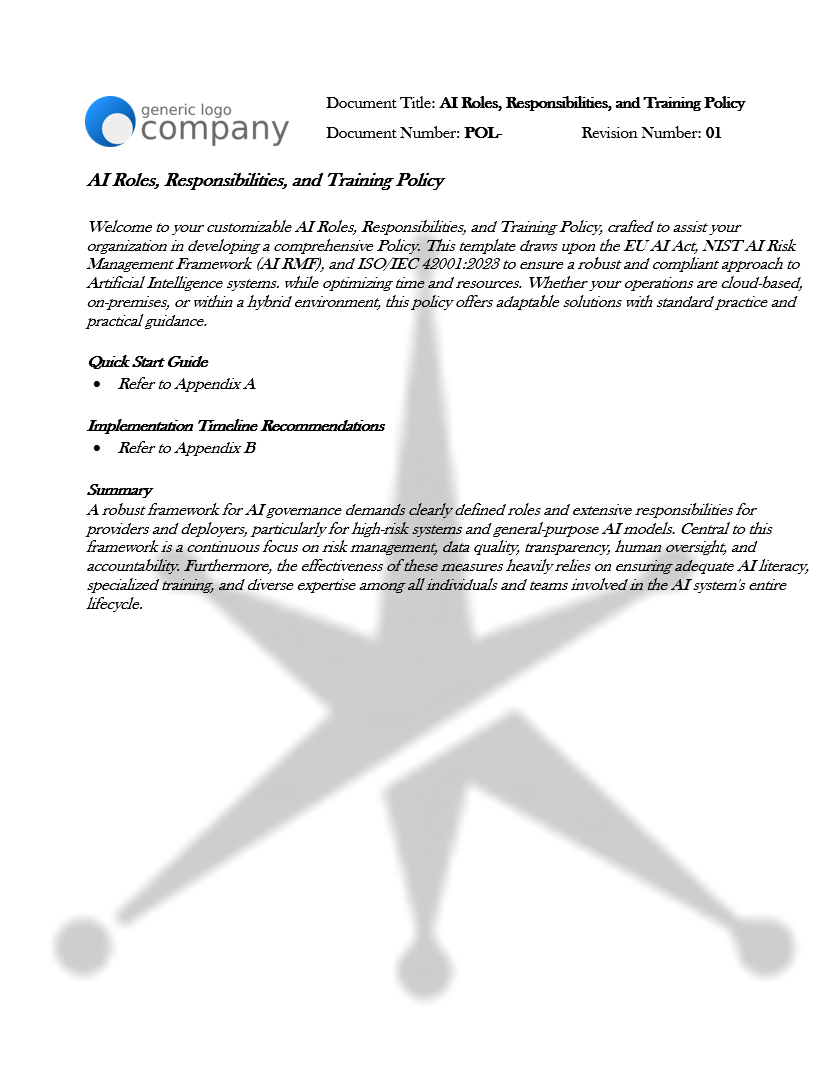
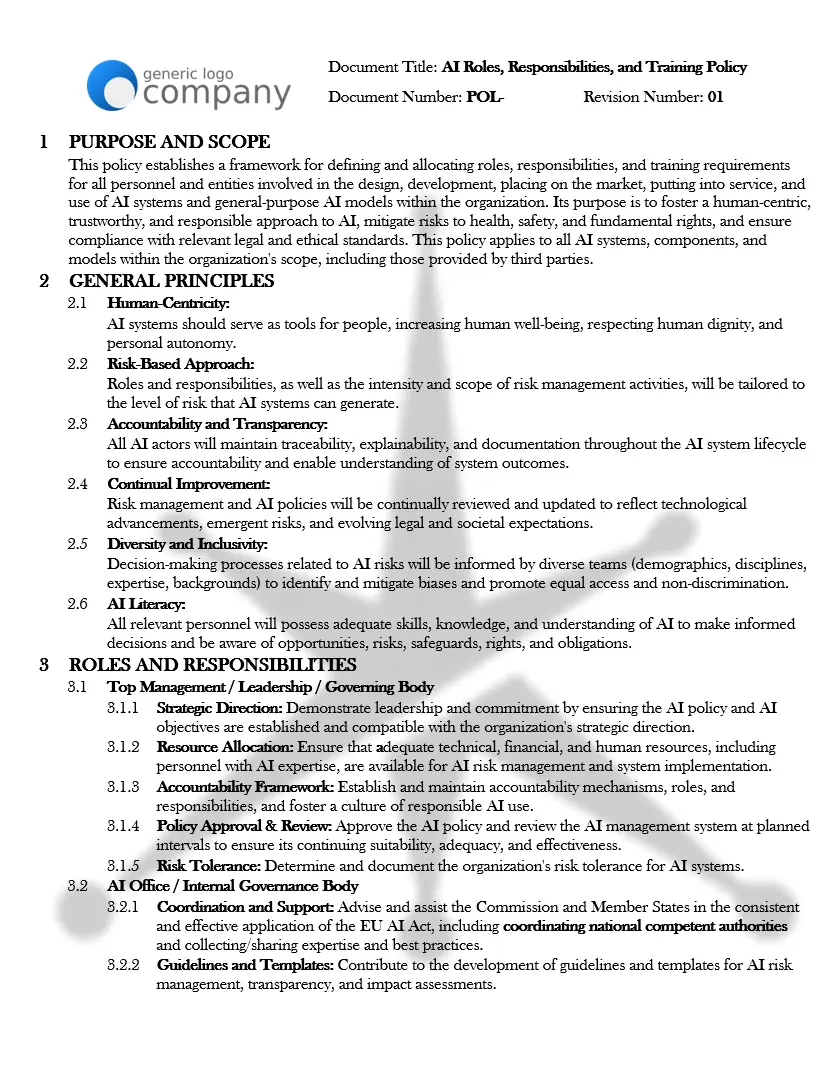
This policy template provides organizations with a structured starting point for defining and allocating AI roles, responsibilities, and training requirements. The document covers personnel and entities involved across the AI lifecycle, from design and development through deployment and ongoing operations. Organizations will need to customize the template to reflect their specific AI systems, risk profiles, and operational contexts. The structured format and comprehensive coverage may help reduce the time required to develop AI governance documentation from scratch.
Key Benefits
✓ Provides a framework for defining AI roles across providers, deployers, and supply chain actors
✓ Includes guidance on competence and training requirements aligned with regulatory expectations
✓ Supports accountability and human oversight documentation efforts
✓ Offers structured sections for Fundamental Rights Impact Assessment (FRIA) requirements
✓ Contains implementation appendices with role determination guidance and timeline recommendations
✓ Includes a comprehensive definitions section covering regulatory terminology
Who Uses This?
Designed for:
- Compliance Officers and GRC teams implementing AI governance programs
- CIOs and IT leaders establishing AI accountability frameworks
- Risk Managers developing AI risk management documentation
- Legal and regulatory affairs professionals preparing for EU AI Act requirements
- Organizations operating as AI providers, deployers, or within AI supply chains
Preview Mention
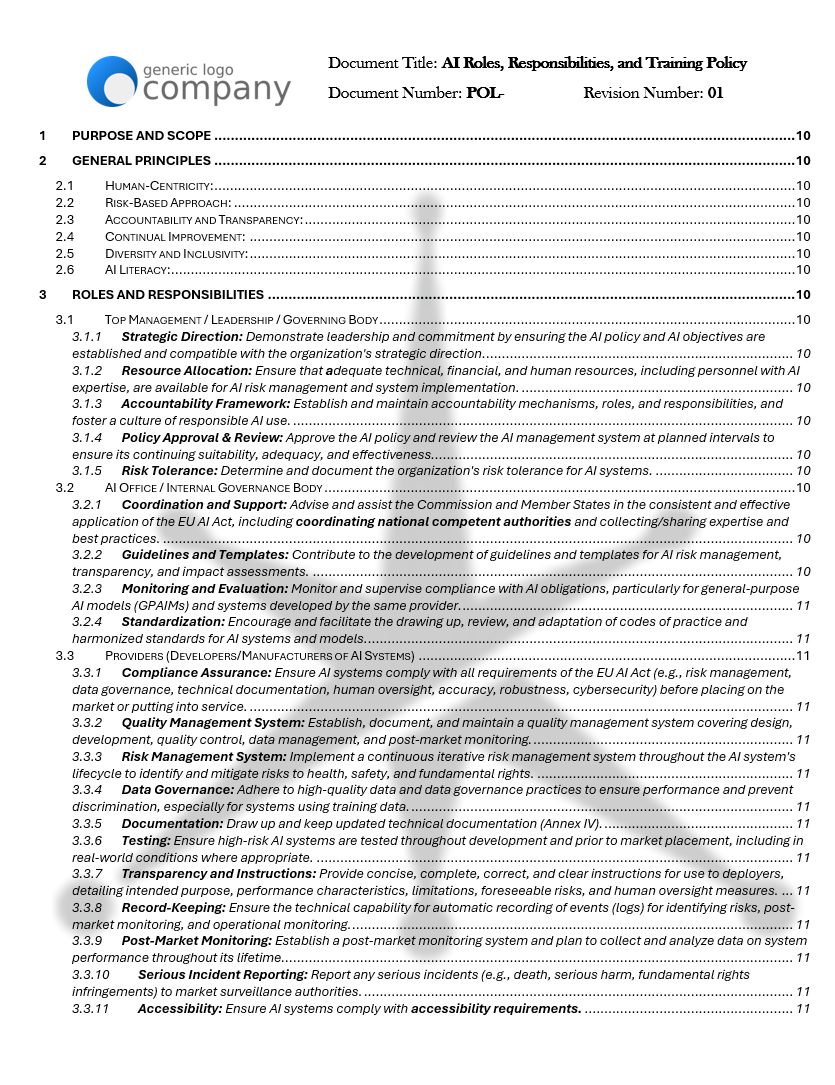
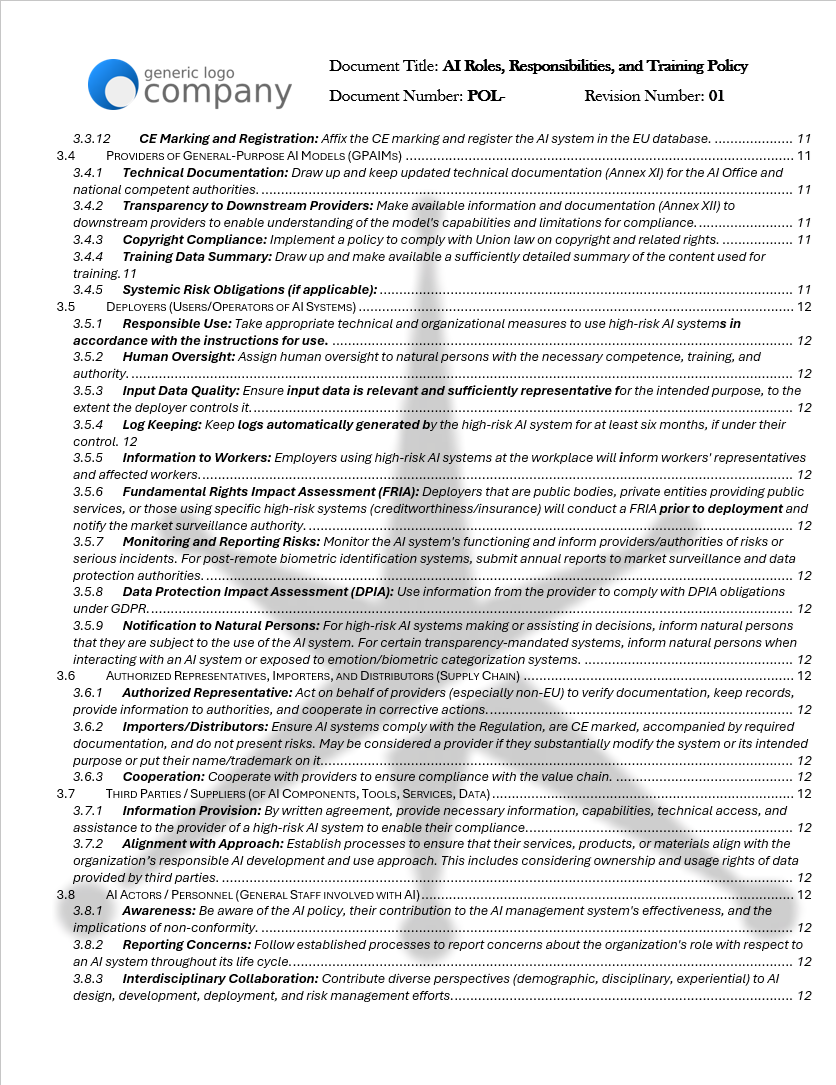
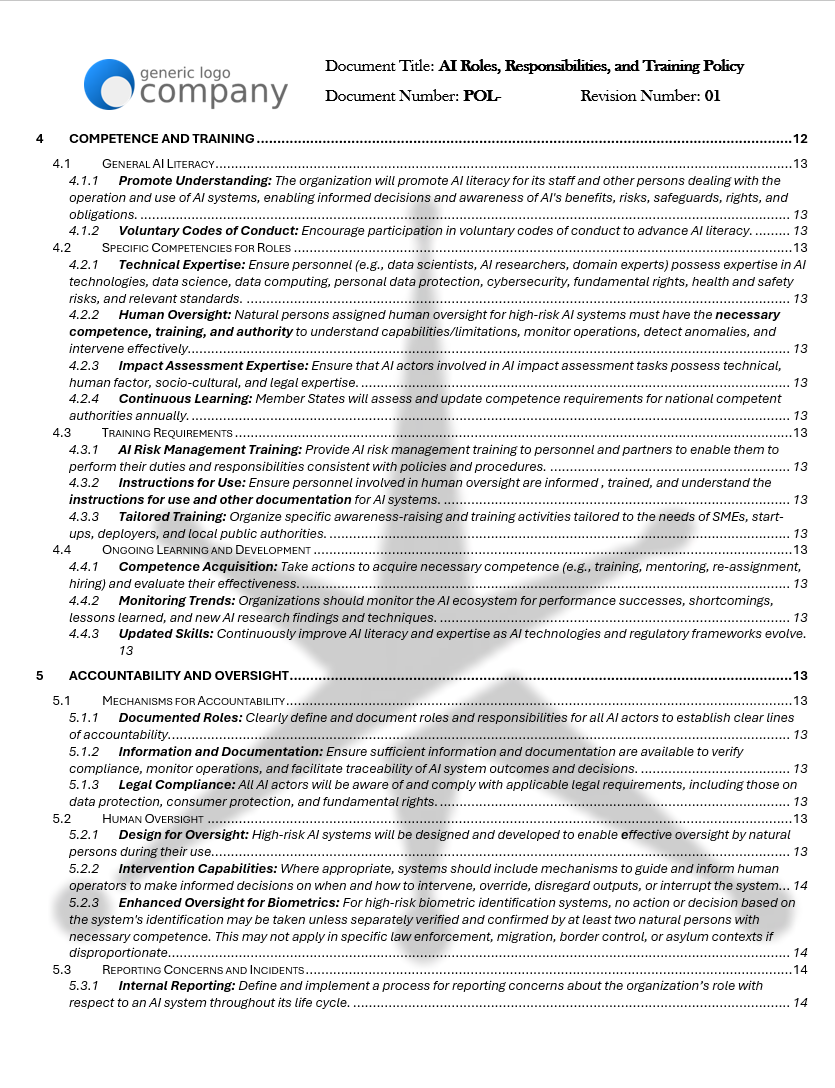
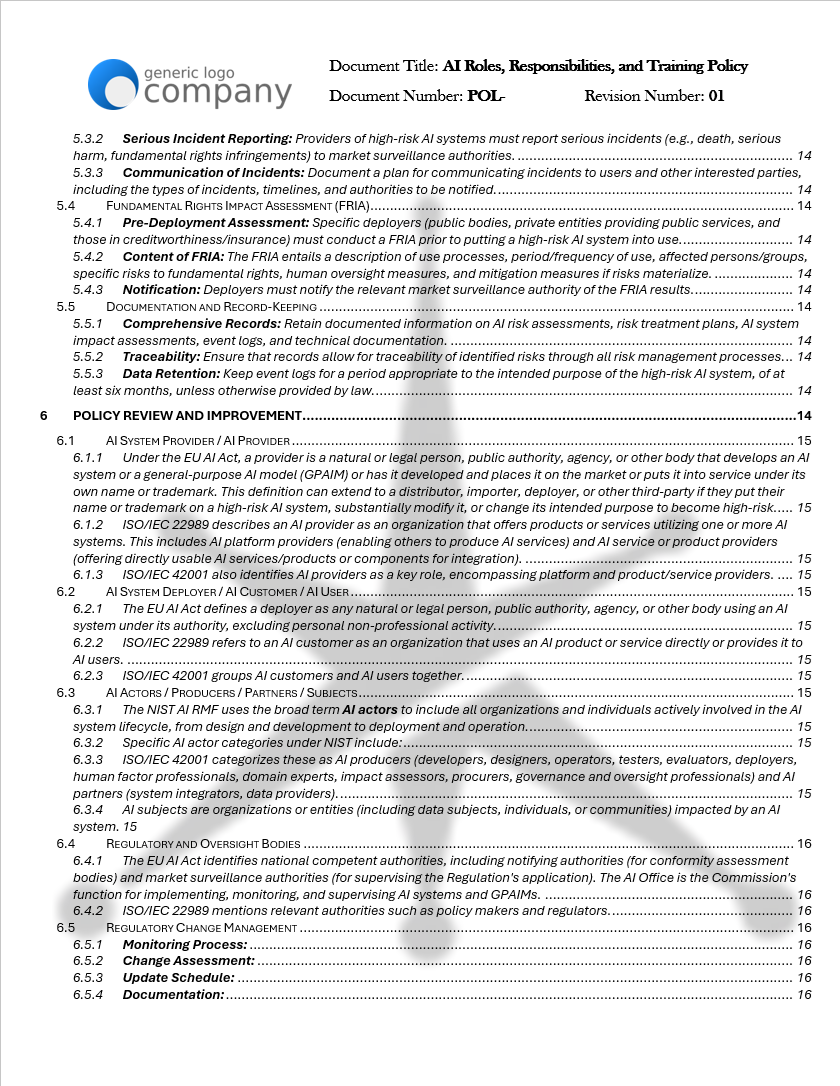
The template includes a detailed table of contents covering 12 main sections: Purpose and Scope, General Principles, Roles and Responsibilities, Competence and Training, Accountability and Oversight, Policy Review and Improvement, AI Roles definitions, Responsibilities by stakeholder type, Training and Competence requirements, References, Definitions, and Version History with Approvers sections. Two appendices provide guidance on determining applicable sections based on organizational role and a phased implementation timeline.
Why This Matters
The regulatory landscape for artificial intelligence has shifted substantially with the introduction of binding requirements under the EU AI Act (Regulation 2024/1689). Organizations placing AI systems on the EU market or putting them into service face specific obligations depending on their role as providers, deployers, importers, or distributors. Clear documentation of roles and responsibilities forms the foundation of demonstrable AI governance.
Beyond regulatory compliance, establishing defined AI roles supports organizational risk management objectives. The NIST AI Risk Management Framework emphasizes that accountability structures and competence requirements help organizations identify, assess, and mitigate AI-related risks throughout the system lifecycle. ISO/IEC 42001:2023 similarly requires organizations to determine necessary competencies and ensure personnel are appropriately trained.
This policy template addresses the intersection of these three frameworks, providing a unified approach to documenting who does what, who is accountable for which decisions, and what training supports effective AI governance. Organizations can use this structure as a foundation while customizing content to reflect their specific operational context and AI system portfolio.
Framework Alignment
- EU AI Act (Regulation 2024/1689): Addresses provider and deployer obligations, high-risk AI system requirements, GPAIM obligations, and supply chain responsibilities as specified in the regulation
- NIST AI Risk Management Framework: Incorporates AI actor categories and risk management responsibilities from the GOVERN, MAP, MEASURE, and MANAGE functions
- ISO/IEC 42001:2023: Aligns with AI management system requirements for roles, competence, training, and accountability
- ISO/IEC 22989: References AI concepts and terminology definitions
- ISO/IEC 23894: Supports AI risk management guidance requirements
- GDPR: Addresses Data Protection Impact Assessment (DPIA) requirements relevant to AI systems processing personal data
Key Features
- Comprehensive Role Definitions: Covers Top Management, AI Office/Internal Governance Body, Providers, GPAIM Providers, Deployers, Authorized Representatives, Importers, Distributors, Third Party Suppliers, and AI Actors/Personnel
- Detailed Responsibility Matrices: Sections 7.1 through 7.4 provide specific responsibilities for providers of high-risk AI systems (16 areas), GPAIM providers (6 areas plus systemic risk obligations), deployers (8 areas), and general AI risk management (13 areas)
- Training Framework Structure: Section 4 addresses AI literacy requirements, specific competencies for roles, training requirements, and ongoing learning and development provisions
- Accountability Mechanisms: Section 5 covers documented roles, human oversight requirements, reporting processes, FRIA requirements, and record-keeping provisions
- Regulatory Change Management: Section 6.5 includes monitoring process, change assessment, update schedule, and documentation requirements for tracking regulatory developments
- Practical Implementation Guidance: Appendix A provides a quick-start assessment with five questions to determine applicable sections; Appendix B offers a 12-month phased implementation timeline
- Comprehensive Definitions: Section 10 defines core AI terms, regulatory roles, technical concepts, compliance elements, and data/performance concepts
- Version Control Structure: Includes version history table and approvers section for document governance
Comparison Table: Generic Policy vs. Professional Template
| Area | Generic Approach | This Template |
|---|---|---|
| Role Coverage | Basic provider/user distinction | Detailed coverage of 10+ role categories with specific responsibilities per EU AI Act, NIST, and ISO requirements |
| Framework Alignment | Single framework or general principles | Explicit alignment with EU AI Act, NIST AI RMF, ISO/IEC 42001, ISO/IEC 22989, and ISO/IEC 23894 |
| Training Requirements | General statements about competence | Structured sections on AI literacy, role-specific competencies, and ongoing development |
| Accountability | Basic responsibility statements | Comprehensive coverage including FRIA requirements, human oversight provisions, and incident reporting |
| Implementation Guidance | Left to organization | Appendices with role determination flowchart and 12-month implementation timeline |
| Definitions | Limited or absent | 25+ defined terms across regulatory, technical, and compliance categories |
FAQ Section
Q: What regulatory frameworks does this policy template address? A: The template draws upon the EU AI Act (Regulation 2024/1689), NIST AI Risk Management Framework, and ISO/IEC 42001:2023. It also references ISO/IEC 22989, ISO/IEC 23894, and GDPR where relevant to AI governance.
Q: Is this template suitable for organizations that only deploy AI systems rather than develop them? A: Yes. The template includes specific sections for deployers (Section 3.5, Section 7.3) and Appendix A provides guidance on determining which sections apply based on organizational role. Organizations can customize or remove sections that don’t align with their position in the AI value chain.
Q: Does this template guarantee compliance with the EU AI Act? A: No. This template provides a structured framework designed to support compliance efforts. Organizations must customize the content to reflect their specific AI systems, risk profiles, and operational contexts. Professional legal and compliance review is recommended before implementation.
Q: What format is the document provided in? A: Documents are optimized for Microsoft Word to ensure proper formatting and collaborative editing capabilities. The template includes formatted tables, bulleted lists, and structured sections that may not display correctly in other applications.
Q: How much customization is required? A: Significant customization is required. The template provides structure and framework-aligned content, but organizations must tailor definitions, role assignments, training requirements, and accountability mechanisms to their specific operational context, AI system inventory, and risk tolerance.
Q: Does the template address General-Purpose AI Model (GPAIM) requirements? A: Yes. Section 3.4 covers GPAIM provider responsibilities, and Section 7.2 details specific obligations including technical documentation, transparency to downstream providers, copyright compliance, and training content summary requirements. Additional obligations for GPAIMs with systemic risk are also included.
Ideal For Section
- Organizations preparing for EU AI Act compliance requirements effective August 2026
- Companies establishing AI governance programs aligned with multiple regulatory frameworks
- Enterprises documenting AI roles and responsibilities for audit and certification purposes
- Risk management teams developing AI-specific accountability structures
- Legal and compliance departments creating AI governance policy documentation
- Organizations operating as AI providers needing to document obligations to deployers
- Public bodies and entities providing public services subject to FRIA requirements
- Supply chain participants (importers, distributors, authorized representatives) establishing compliance documentation
Pricing Strategy Options
Single Template: Contact for pricing based on organizational requirements and customization needs.
Bundle Option: May be combined with additional AI governance templates (AI Risk Assessment Framework, AI Incident Response Policy, AI Procurement Guidelines) depending on organizational compliance scope.
Enterprise Option: Available as part of comprehensive AI governance documentation suites for organizations implementing full AI management systems.
⚖️ Differentiator
This template provides a unified approach to AI roles, responsibilities, and training by integrating requirements from three major frameworks: the EU AI Act, NIST AI RMF, and ISO/IEC 42001:2023. Rather than addressing each framework separately, the document synthesizes common elements while preserving framework-specific requirements where they differ. The inclusion of practical implementation appendices (role determination guidance and phased timeline) supports organizations in translating policy content into operational practice. The comprehensive definitions section addresses the terminology variations across frameworks, providing clarity for teams working with multiple regulatory sources. Organizations receive a structured starting point that requires customization but provides framework coverage that would otherwise demand substantial research across primary regulatory and standards documents.
This template is provided as a starting point for organizational customization. Professional review by legal, compliance, and AI governance specialists is recommended before implementation. No guarantees of regulatory compliance are expressed or implied.