

Free AI Risk Management Guide – Community Edition
A structured framework designed to support responsible AI development and procurement through practical risk management processes
[Download Now]
AI Risk Management Guide – Community Edition
This guide provides organizations with a systematic approach to AI risk management across the entire system lifecycle. It includes checklists, decision trees, and practical guidance for teams building AI internally or purchasing from vendors. The framework requires customization to your specific organizational context and regulatory environment. Organizations using this guide may save significant time in establishing baseline risk management processes compared to developing frameworks from scratch.
Key Benefits
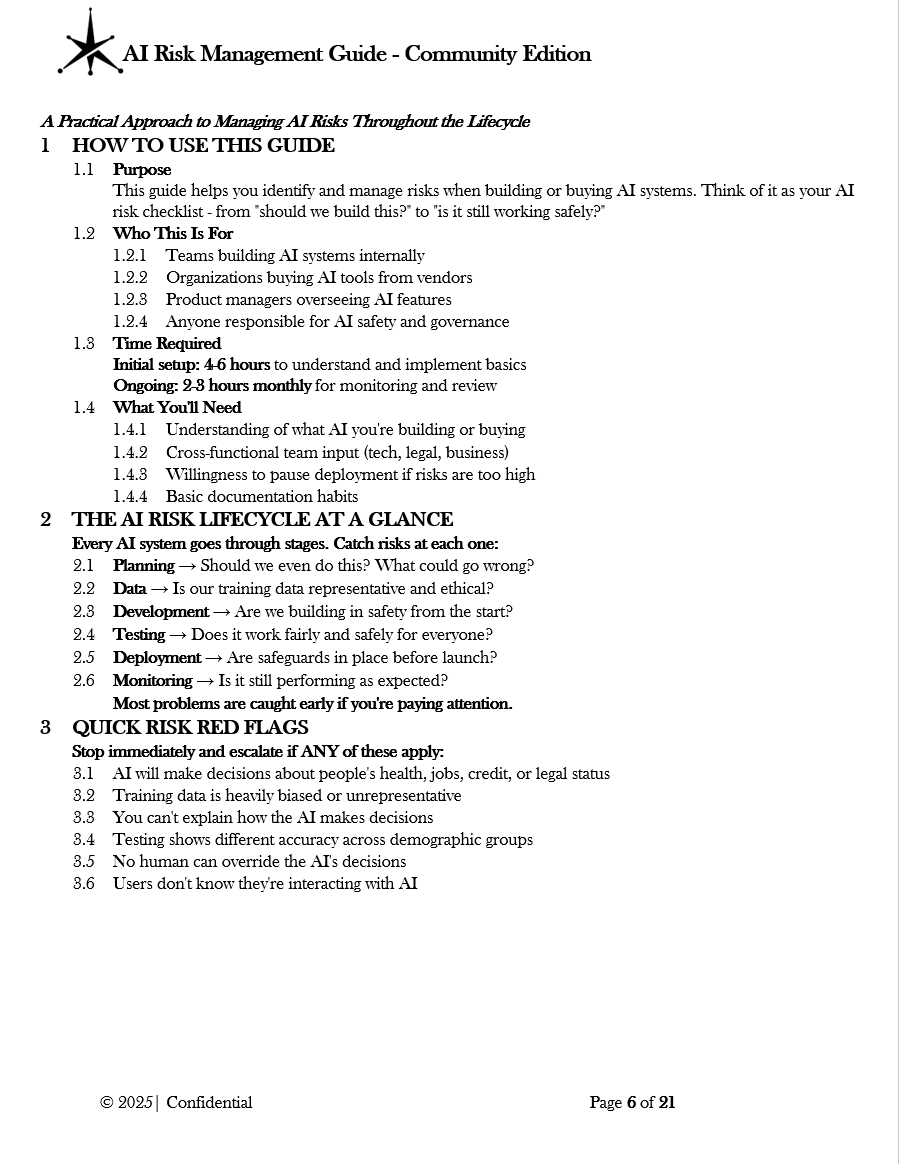
✓ Provides structured guidance for AI risk identification across six lifecycle stages (Planning, Data, Development, Testing, Deployment, Monitoring)
✓ Includes practical tools such as risk registers, model cards, testing checklists, and incident logs
✓ Supports both internal AI development and vendor procurement scenarios with specific evaluation criteria
✓ Offers role-based guidance for cross-functional teams including technical, legal, and business stakeholders
✓ Contains decision trees and quick reference guides for common AI risk scenarios
✓ Includes simple metrics frameworks for tracking performance, fairness, and operational indicators
✓ Provides clear warning signs and red flags for immediate escalation scenarios
✓ Free to use and modify under Community Edition license
Who Uses This?
This guide is designed for:
- Teams building AI systems internally
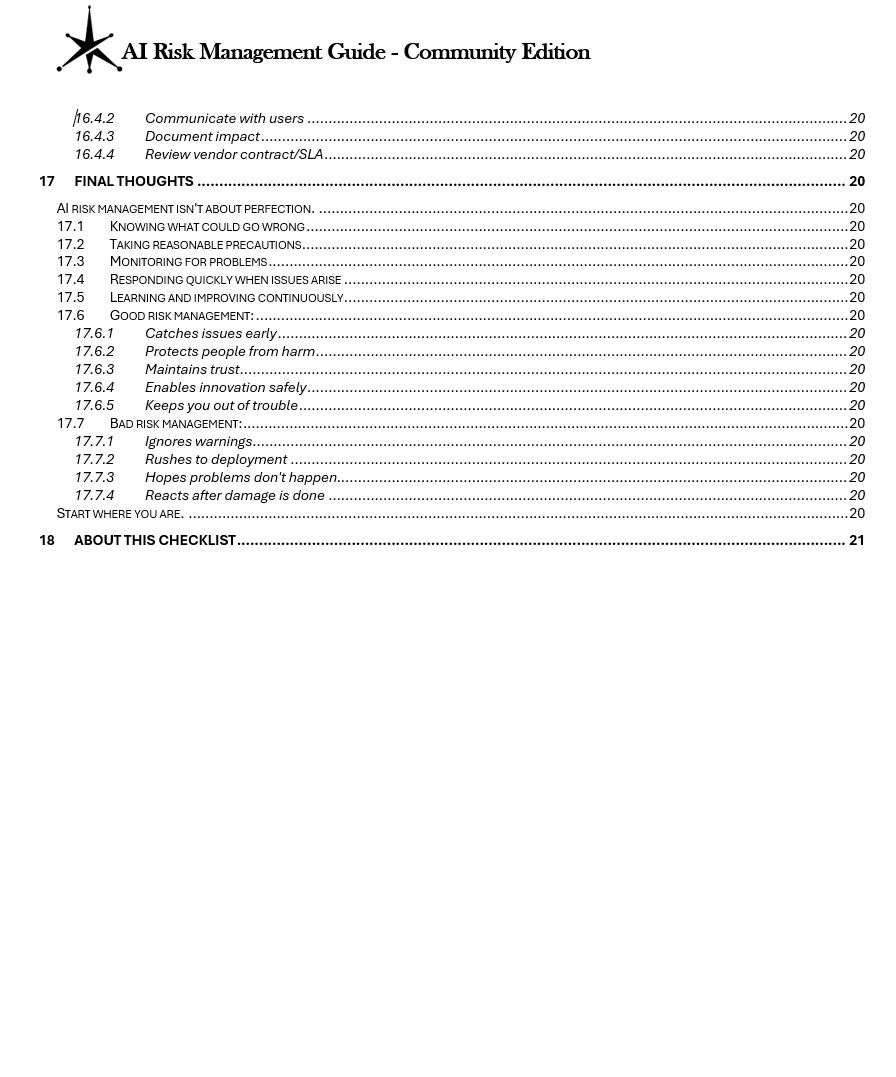
- Organizations buying AI tools from vendors
- Product managers overseeing AI features
- Risk management professionals
- Compliance officers evaluating AI implementations
- Technical leads responsible for AI safety
What’s Included
The guide contains seven main sections with supporting documentation templates:
- Role definitions and responsibilities framework
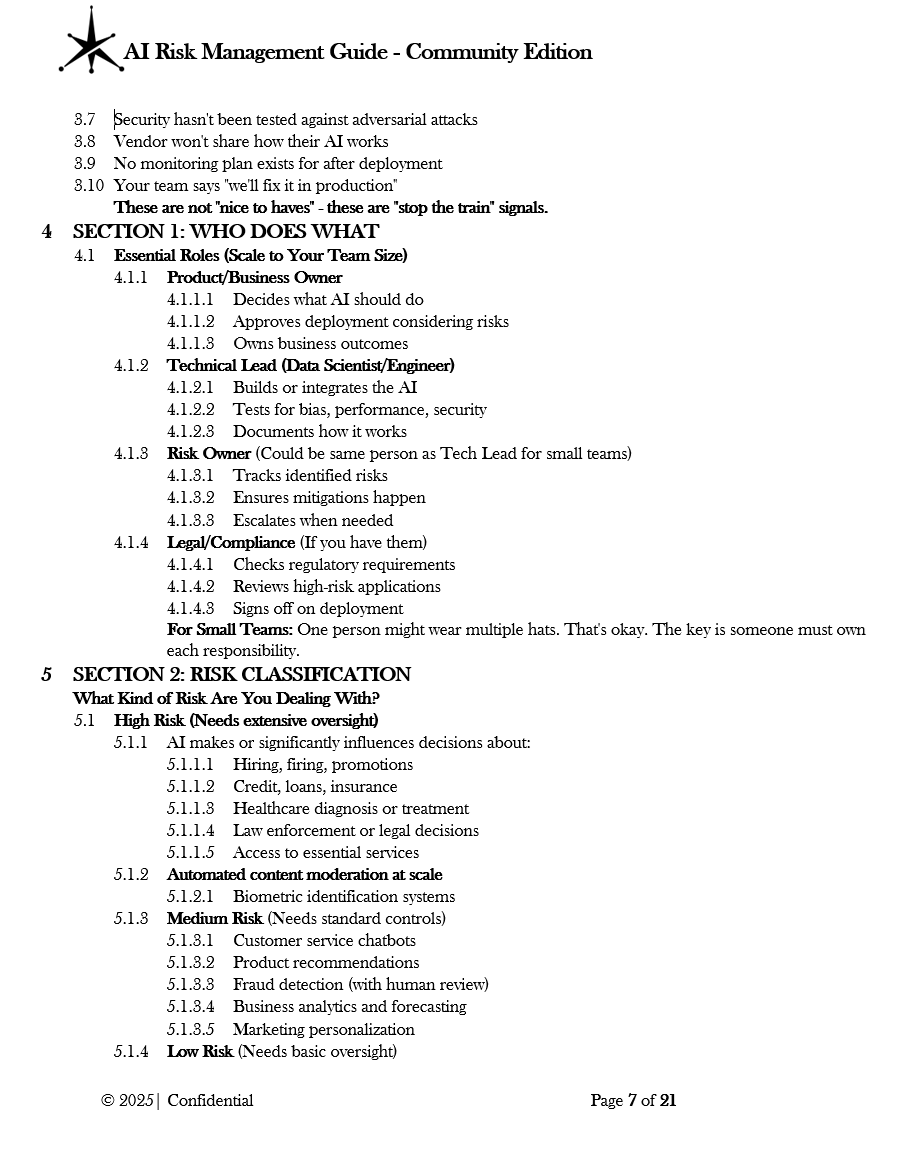
- Risk classification system (High/Medium/Low)
- Stage-by-stage implementation guidance
- Vendor evaluation questionnaire
- Five key risk area breakdowns (Bias, Privacy, Security, Transparency, Performance)
- Practical scenario walkthroughs
- Essential documentation templates and metrics
Why This Matters
Organizations deploying AI systems face increasing scrutiny around safety, fairness, and accountability. Without structured risk management processes, teams may miss critical issues during development that become costly problems post-deployment. This guide addresses common gaps in AI governance by providing a practical, lifecycle-based approach to risk identification and mitigation.
The framework acknowledges that AI systems introduce unique challenges compared to traditional software, including potential bias in training data, difficulty explaining decision-making processes, and performance degradation over time. By establishing checkpoints at each development stage, organizations can identify issues early when they’re less expensive to address.
The guide recognizes that risk management requirements differ significantly based on AI application context. Systems making decisions about healthcare, employment, credit, or legal matters require more extensive oversight than productivity tools. The three-tier risk classification system helps teams apply appropriate controls based on potential impact.
Framework Alignment
This guide references and aligns with established AI governance frameworks where relevant to practical implementation:
General Principles: The guide’s approach to identifying bias, ensuring transparency, and maintaining human oversight reflects principles found in various AI ethics frameworks
Risk-Based Approach: The three-tier risk classification (High/Medium/Low) provides a practical structure for applying controls proportionate to potential harm
Documentation Standards: Recommended templates for risk registers, model cards, and testing reports support organizations in establishing evidence-based practices
The guide does not claim to provide comprehensive compliance with any specific regulation or standard. Organizations should consult with legal counsel regarding applicable requirements in their jurisdiction.
What You Get
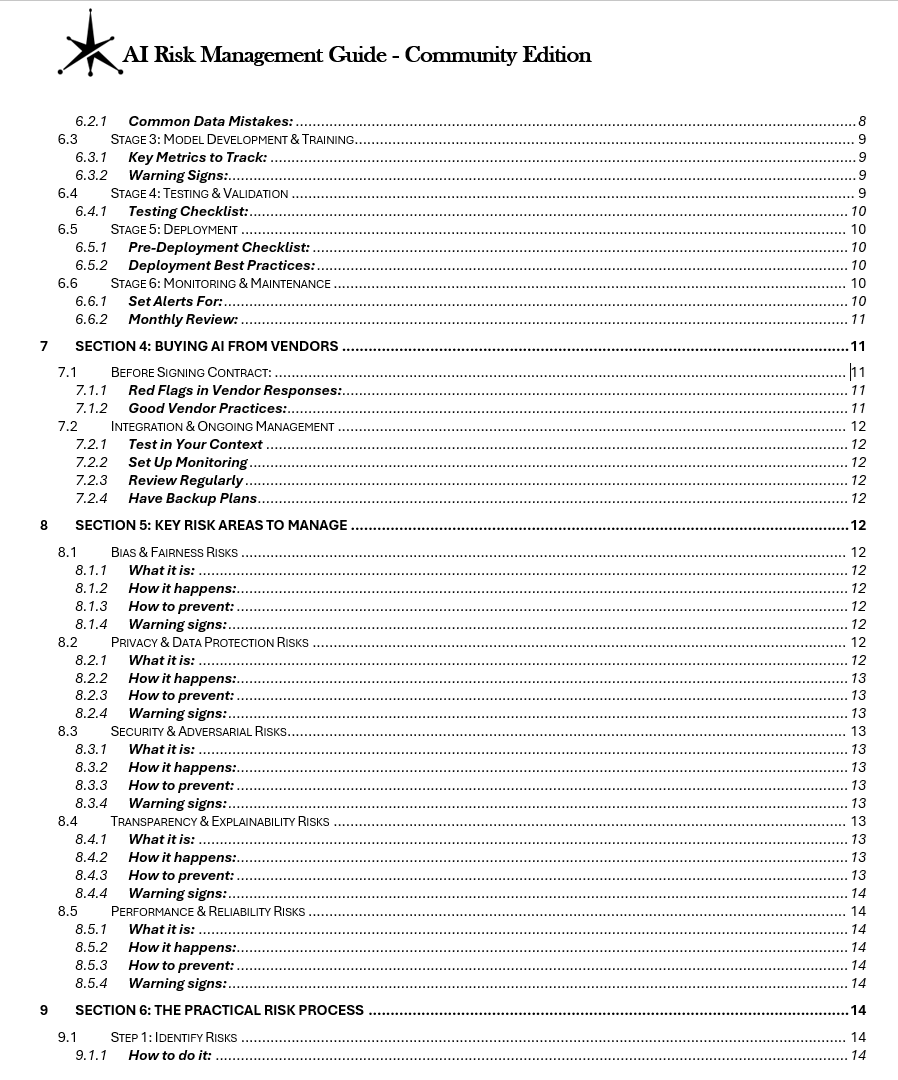
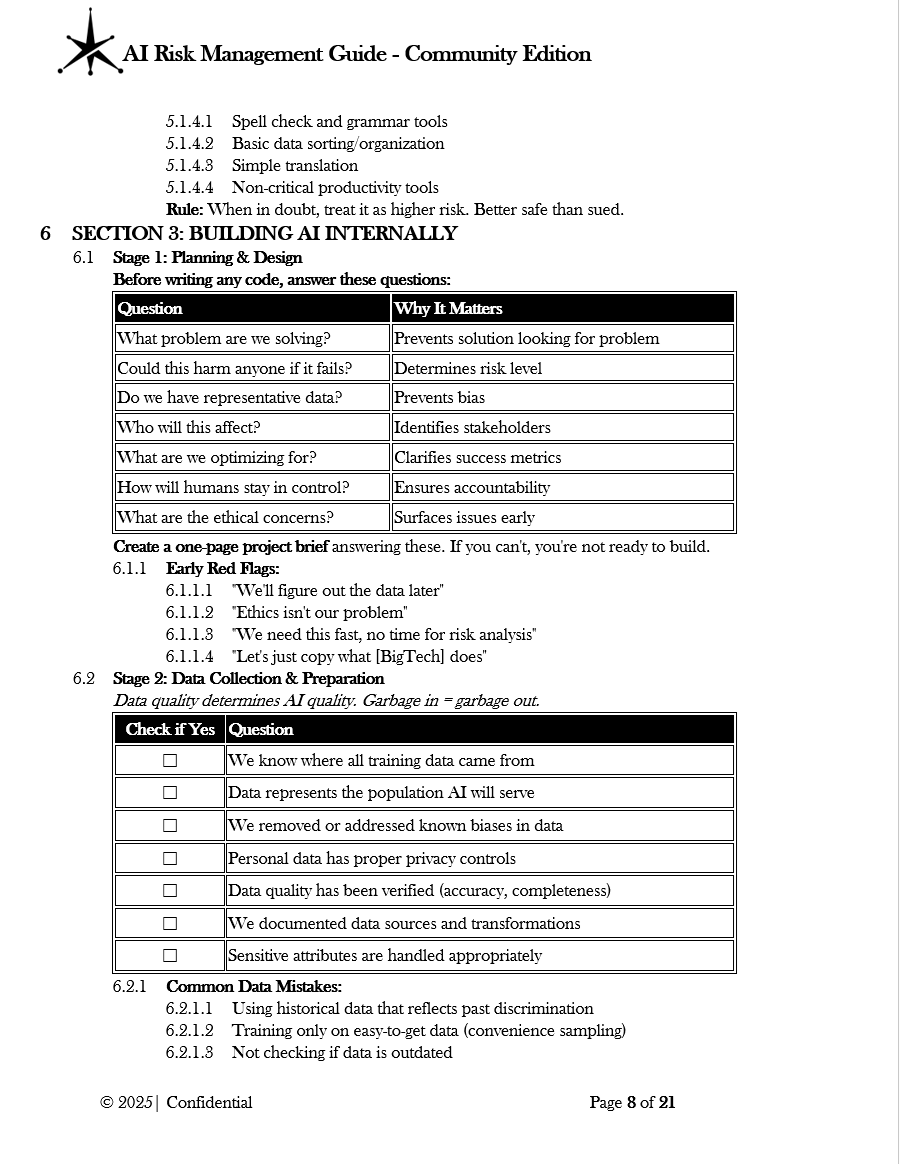
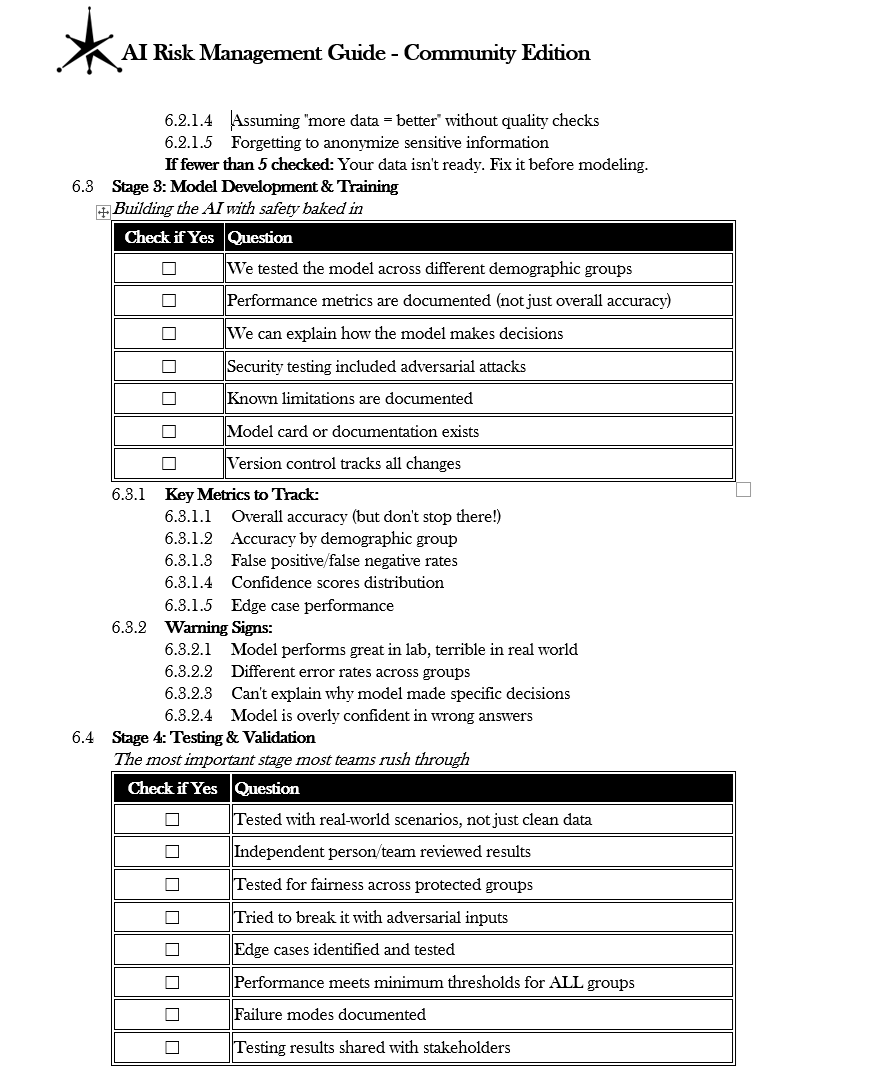
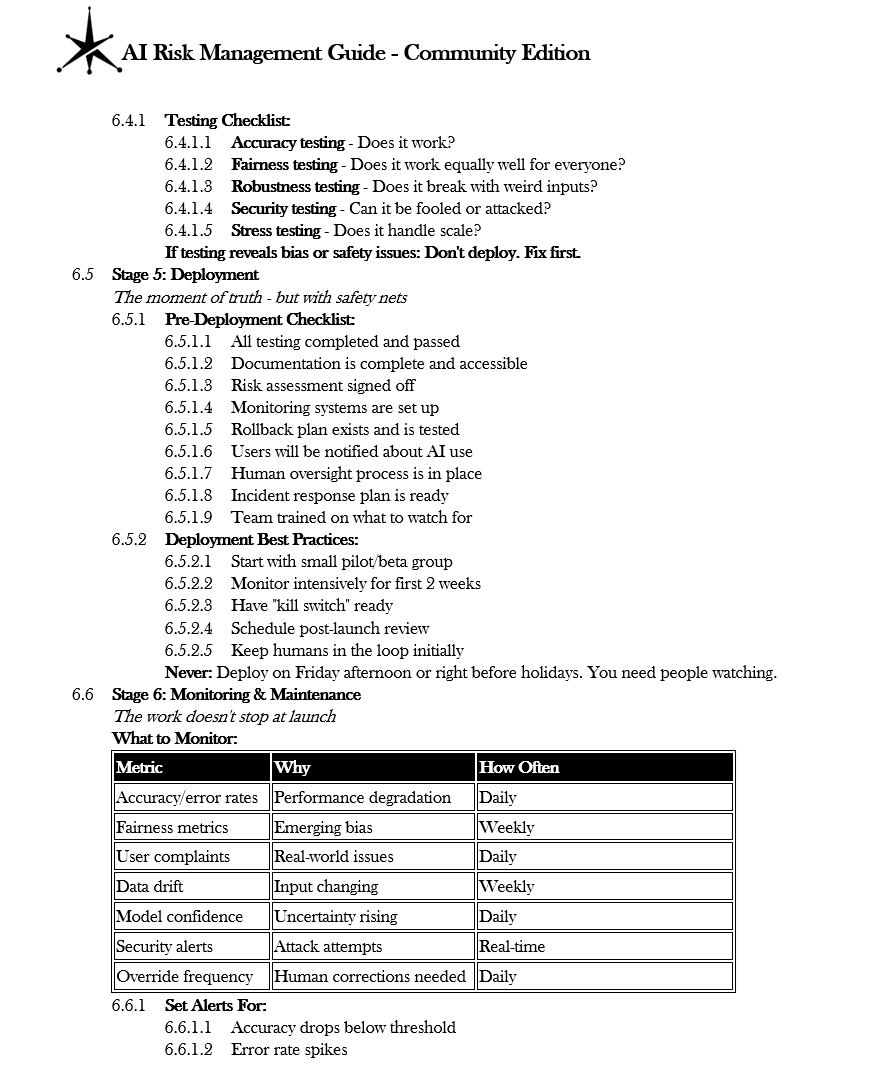
Stage-by-Stage Guidance Six detailed sections covering Planning, Data Collection, Development, Testing, Deployment, and Monitoring with specific checklists for each phase
Risk Management Process Five-step framework for identifying, analyzing, prioritizing, mitigating, and monitoring AI risks with practical examples
Vendor Evaluation Tools Pre-contract due diligence checklist with questions covering AI transparency, bias testing, security, data handling, and incident response
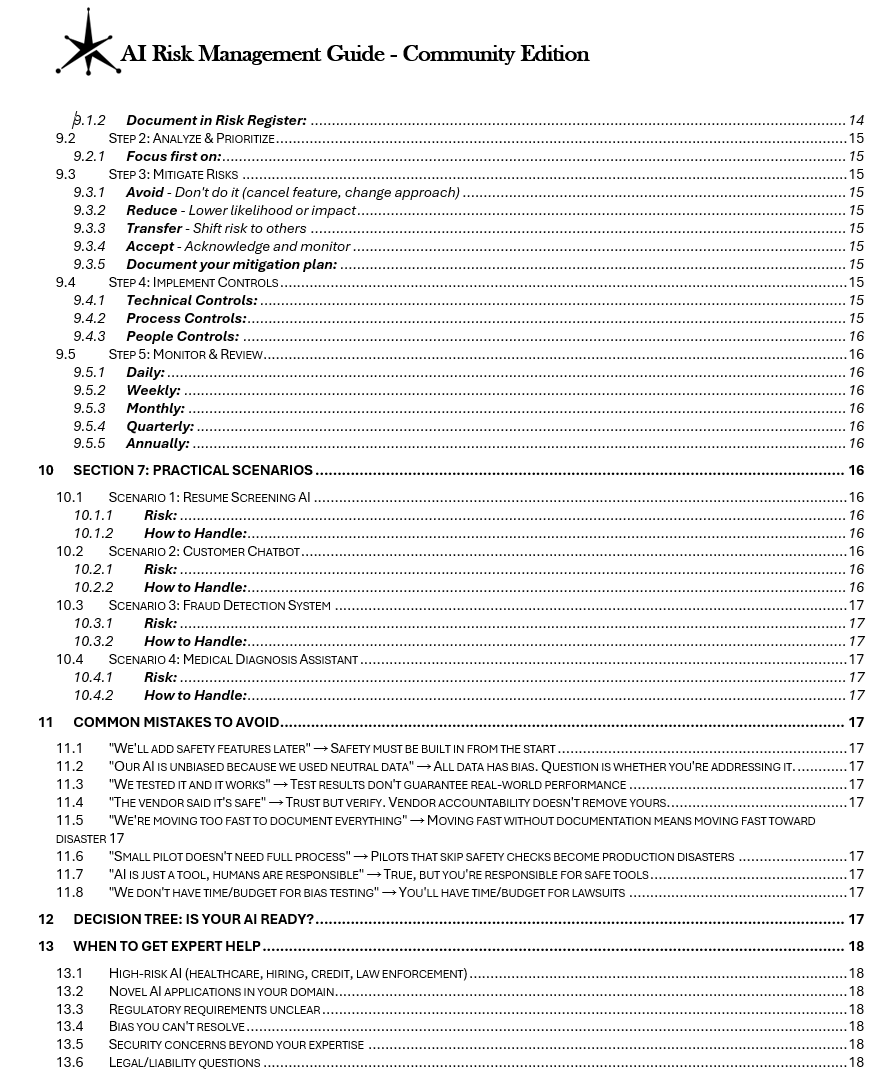
Practical Scenarios Four worked examples (Resume Screening AI, Customer Chatbot, Fraud Detection, Medical Diagnosis Assistant) showing how to apply the framework
Documentation Templates Structures for Risk Register, Model Card, Testing Report, Deployment Plan, and Incident Log
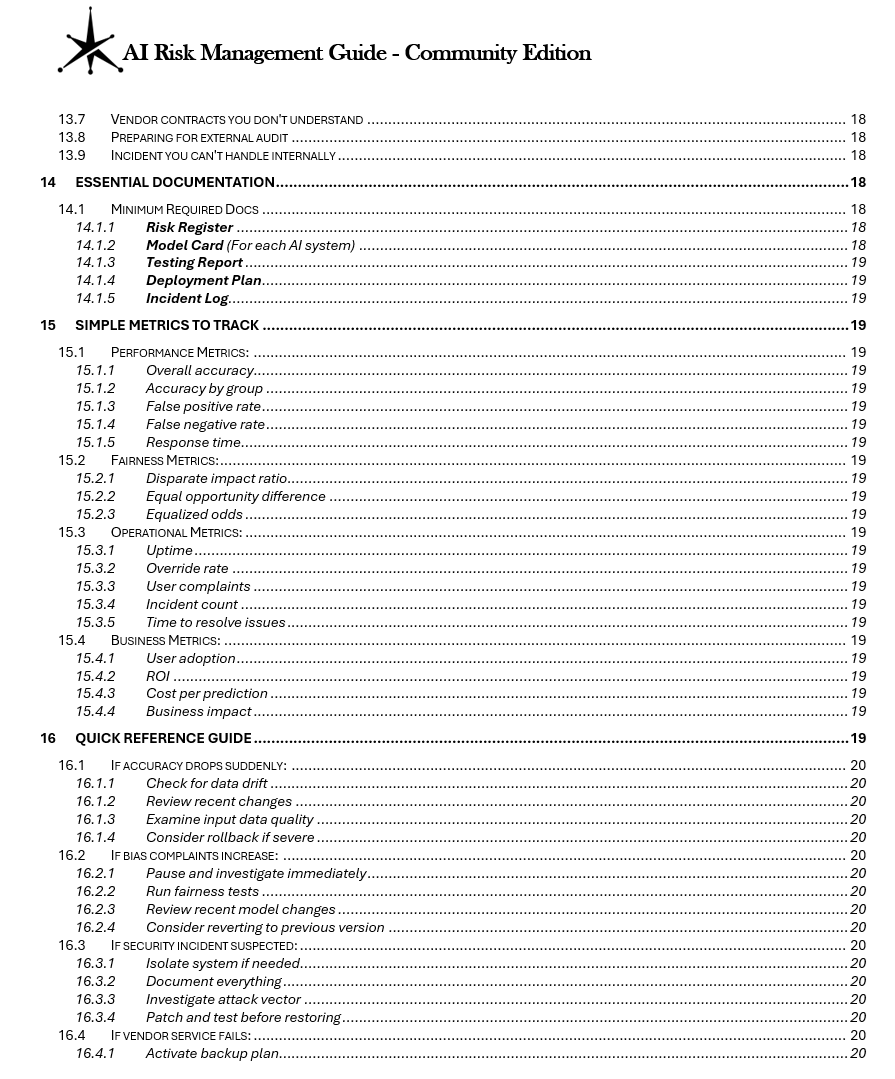
Quick Reference Materials Decision trees, red flags lists, and troubleshooting guides for common situations
Metrics Framework Simple tracking approach for Performance, Fairness, Operational, and Business metrics
Lifecycle-Based Structure: Organized around the six stages AI systems typically progress through, from initial planning to ongoing monitoring
Dual Application: Separate sections address both internal AI development and vendor procurement scenarios
Role Clarity: Defines essential responsibilities for Product/Business Owner, Technical Lead, Risk Owner, and Legal/Compliance (scalable for team size)
Risk Red Flags: Ten immediate escalation criteria including unexplainable decisions, demographic performance differences, and absence of human override
Common Mistakes Section: Addresses frequent pitfalls like “we’ll add safety features later” and “the vendor said it’s safe”
Time Estimates: Specifies 4-6 hours for initial framework implementation and 2-3 hours monthly for ongoing management
Monitoring Guidance: Specific alert thresholds and review cadences (daily, weekly, monthly, quarterly, annually)
Free License: Available at no cost under Community Edition 1.0 terms for use and modification
Comparison Table: Ad Hoc Approach vs. Structured Framework
| Aspect | Ad Hoc Approach | Our Community Edition Framework |
|---|---|---|
| Risk Identification | Reactive, after issues emerge | Proactive at each lifecycle stage with specific checklists |
| Documentation | Minimal or inconsistent | Structured templates for Risk Register, Model Card, Testing Report, Deployment Plan, Incident Log |
| Testing Scope | Overall accuracy focus | Requires testing across demographic groups plus fairness, robustness, security, and stress testing |
| Vendor Evaluation | Trust vendor claims | 10-point due diligence questionnaire with red flags list |
| Monitoring | Irregular or complaint-driven | Defined metrics with daily/weekly/monthly/quarterly/annual review cycles |
| Role Clarity | Unclear ownership | Explicit RACI for Product Owner, Technical Lead, Risk Owner, Legal/Compliance |
FAQ Section
Q: Is this guide sufficient for regulatory compliance? A: This guide provides a risk management framework but does not guarantee compliance with specific regulations. Organizations should consult legal counsel regarding applicable requirements in their jurisdiction. The guide references common AI governance principles but does not provide legal advice.
Q: How long does it take to implement this framework? A: The guide indicates 4-6 hours for initial setup to understand and implement basics, with 2-3 hours monthly for ongoing monitoring and review. Implementation time varies based on AI system complexity and organizational size.
Q: Can this be used for both building and buying AI? A: Yes. Section 3 addresses internal AI development across six lifecycle stages, while Section 4 focuses specifically on vendor procurement including pre-contract evaluation and integration management.
Q: What documentation templates are included? A: The guide includes structures for Risk Register, Model Card (per AI system), Testing Report, Deployment Plan, and Incident Log. These require customization to your specific context.
Q: Does this framework apply to all AI systems equally? A: No. The guide includes a risk classification system (High/Medium/Low) to help organizations apply appropriate controls based on AI application context. High-risk applications like healthcare diagnosis or hiring decisions require more extensive oversight than productivity tools.
Q: What if we’re a small team without dedicated roles? A: The guide acknowledges that for small teams, one person might wear multiple hats. The key is ensuring someone owns each responsibility area (Product/Business Owner, Technical Lead, Risk Owner, Legal/Compliance).
Documents are optimized for Microsoft Word to ensure proper formatting and collaborative editing capabilities.
Ideal For
- Small to mid-size organizations implementing their first AI risk management processes
- Cross-functional teams needing clear role definitions for AI governance
- Product managers overseeing AI feature development without prior risk management experience
- Procurement teams evaluating AI vendor offerings
- Risk and compliance professionals seeking practical AI-specific guidance
- Technical leads responsible for AI safety who need structured processes
- Organizations requiring basic documentation frameworks before developing custom approaches
ess metrics
