AI Risk Management and Governance Framework Template
A structured framework designed to support organizations in managing AI-related risks through alignment with international standards and best practices
[Download Now]
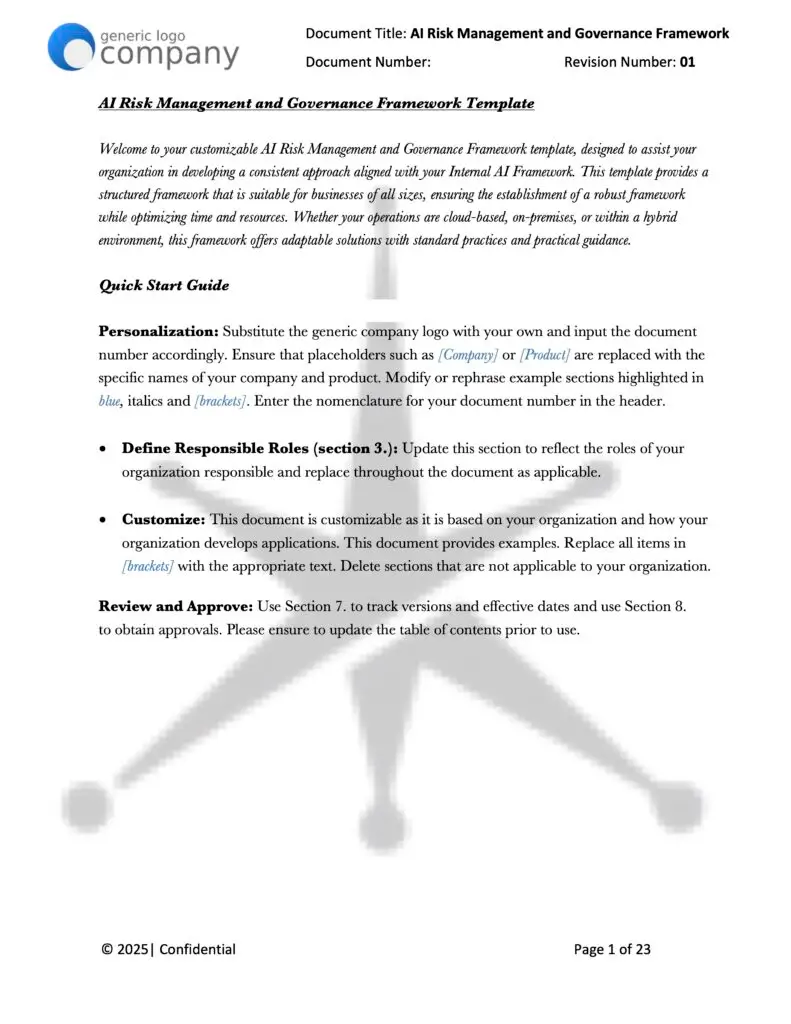
This template provides organizations with a customizable framework for managing risks associated with Artificial Intelligence systems. The document includes structured guidance for both internal AI development and external AI procurement, with sections that can be adapted to your organization’s specific context and requirements.
The framework requires customization to your organization’s specific operations, including updating company information, defining responsible roles, and adapting example sections to match your processes. Organizations save time by starting with pre-structured sections covering governance, risk identification, assessment processes, and control implementation rather than developing these frameworks from scratch.
Key Benefits
✓ Provides structured framework aligned with NIST AI RMF, EU AI Act, ISO/IEC 23894:2023, and CSA guidance
✓ Includes guidance for both internal AI system development and external AI service procurement
✓ Contains customizable sections for governance roles, risk assessment processes, and control implementation
✓ Offers templates for risk registers, documentation requirements, and approval workflows
✓ Designed for scalability across organizations of varying sizes from SMEs to large enterprises
✓ Includes definitions section with 50+ AI risk management terms
Who Uses This?
This framework is designed for organizations that develop AI systems internally, procure external AI services, or both. The template supports compliance officers, CISOs, IT managers, risk officers, AI development teams, and governance committees seeking to establish structured AI risk management practices.
Preview the Framework
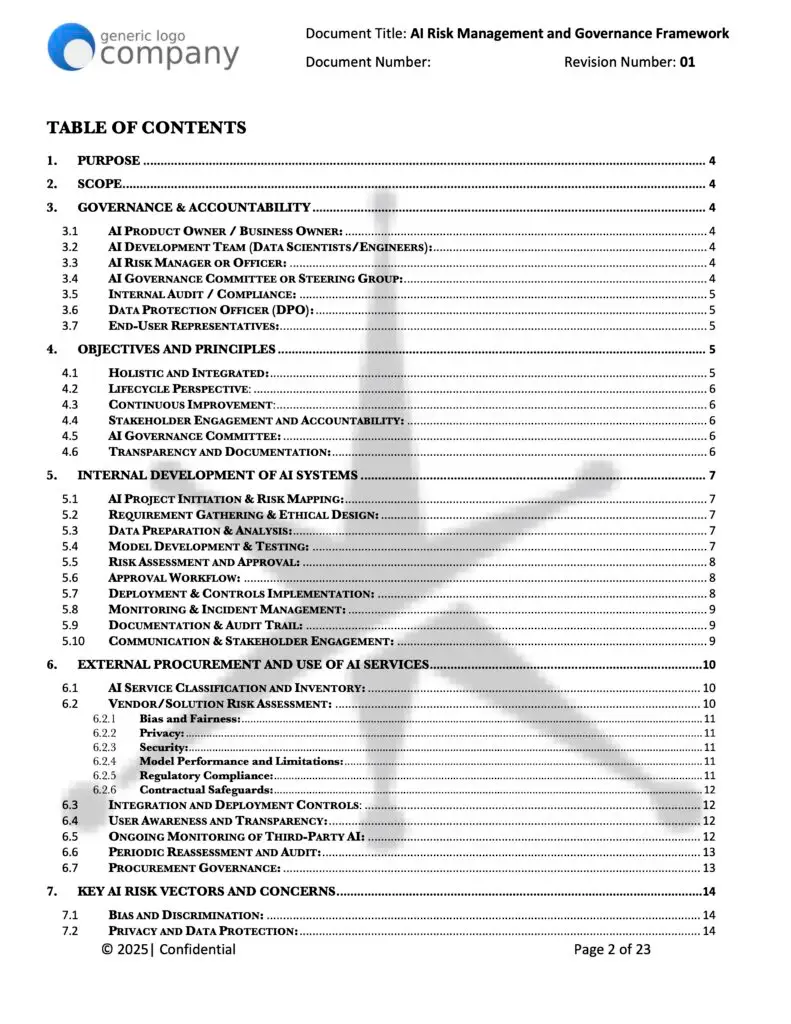
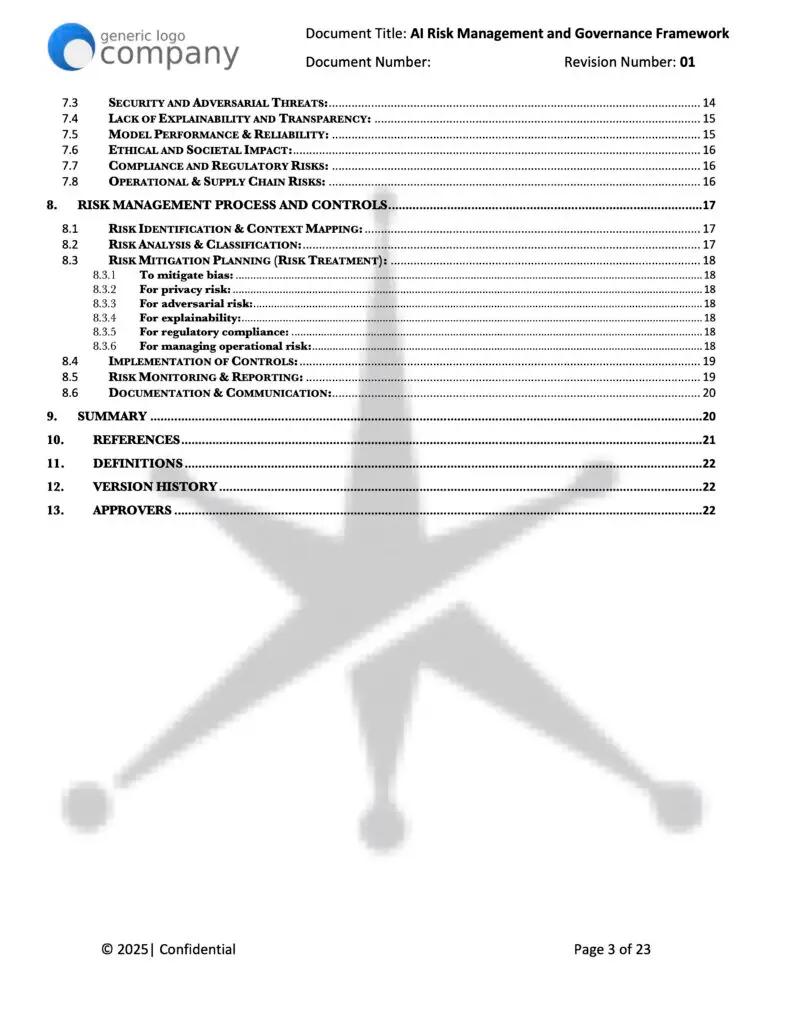
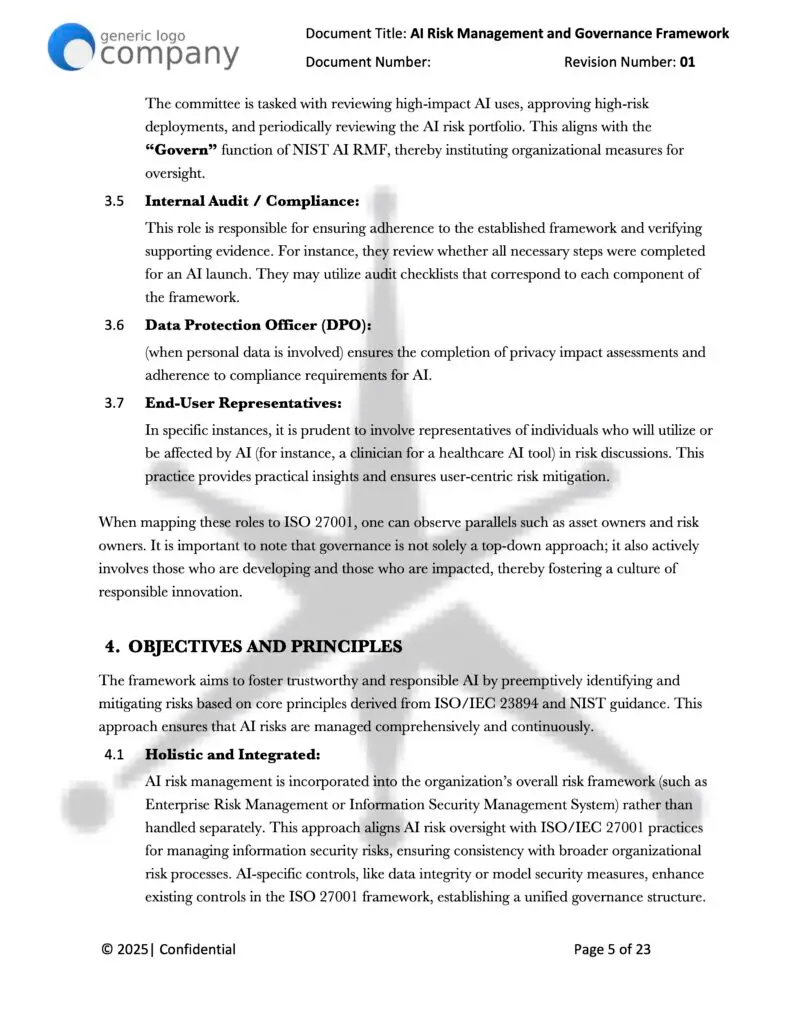
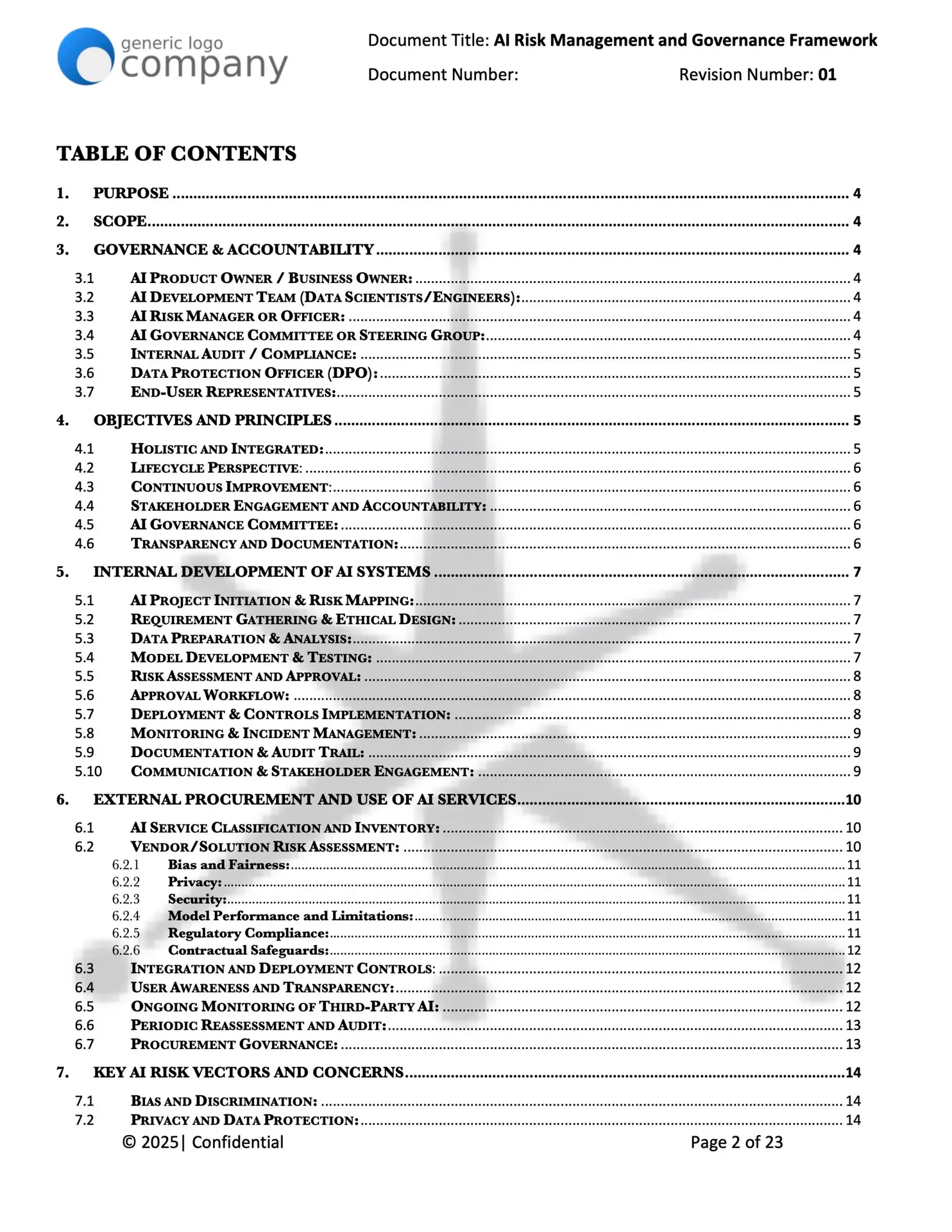
The template includes 13 major sections covering Purpose, Scope, Governance & Accountability (7 defined roles), Objectives and Principles (6 core principles), Internal AI Development (10 process stages), External AI Procurement (8 governance areas), Key Risk Vectors (8 categories), Risk Management Process (7 steps), Summary, References (6 major frameworks), Definitions (50+ terms), Version History, and Approvers.
Why This Matters
Organizations developing or deploying AI systems face risks across multiple dimensions including bias and discrimination, privacy concerns, security threats, explainability challenges, performance reliability, ethical considerations, regulatory compliance, and operational dependencies. Without structured approaches to identifying and managing these risks, organizations may encounter regulatory challenges, reputational damage, operational disruptions, or unintended harmful impacts.
The evolving regulatory landscape, including the EU AI Act’s risk-based classification system and sector-specific requirements in healthcare and finance, creates pressure for organizations to demonstrate systematic risk management practices. This framework provides structured guidance aligned with recognized standards to support organizations in developing their risk management approaches.
Framework Alignment
This template incorporates guidance from frameworks explicitly referenced in the document:
- NIST AI Risk Management Framework (AI RMF): The document aligns with NIST’s Govern, Map, Measure, and Manage functions, incorporating the framework’s emphasis on trustworthy AI characteristics including validity, reliability, safety, security, accountability, transparency, explainability, privacy enhancement, and fairness
- EU AI Act: Includes consideration of risk-based classification systems (Unacceptable, High, Limited, Minimal Risk) and requirements for high-risk AI systems including risk management processes, technical documentation, logging, human oversight, and data quality standards
- ISO/IEC 23894:2023 (Risk Management Guidance for AI): Incorporates lifecycle perspective on risk management from design through decommissioning, risk identification and assessment methodologies, and documentation requirements
- Cloud Security Alliance (CSA) AI Risk Guidance: References CSA’s emphasis on impartial evaluation beyond compliance, model cards, data sheets, risk cards, and scenario planning approaches
- ISO 27001 (Information Security Management System): Integrates information security risk management principles including logging, monitoring, incident management, change management, supplier security, and secure development controls
- ISO 31000:2018 (Risk Management Guidelines): Aligns risk assessment methodology with general risk management principles
Key Features
Governance Structure
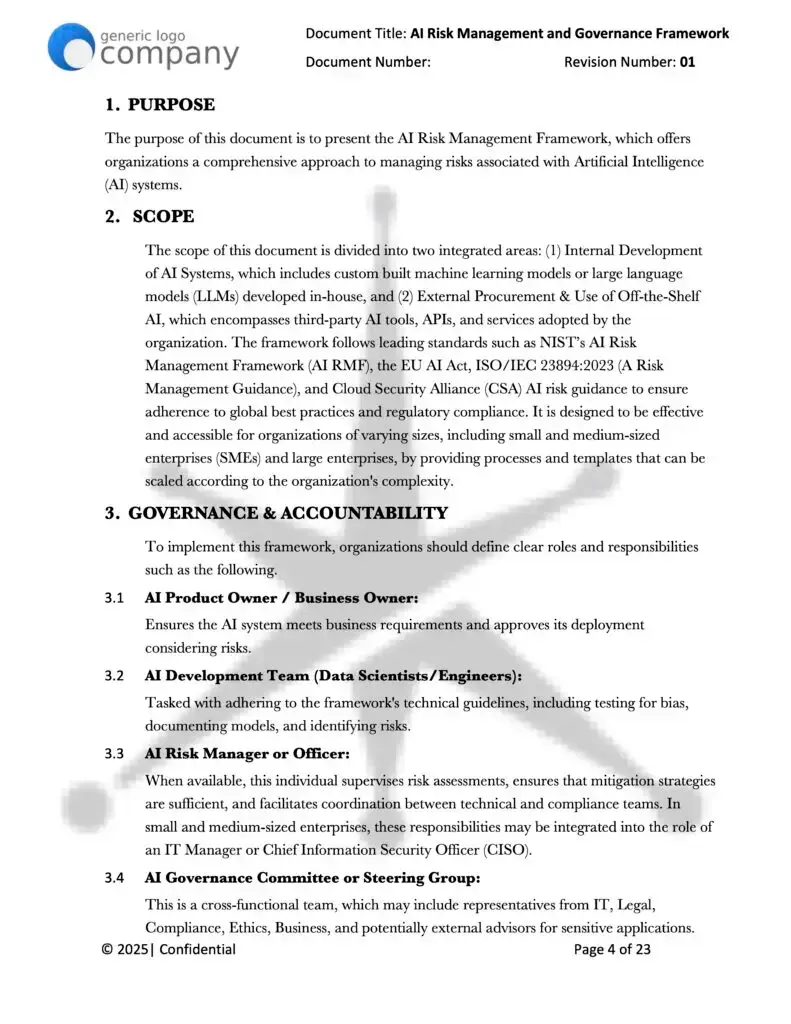
- Defines seven organizational roles including AI Product Owner, AI Development Team, AI Risk Manager/Officer, AI Governance Committee, Internal Audit/Compliance, Data Protection Officer, and End-User Representatives
- Provides guidance on cross-functional governance committee composition and responsibilities
- Includes scalable governance approaches for organizations of different sizes
Internal AI Development Process
- Ten-stage development lifecycle from project initiation through ongoing monitoring
- Risk mapping and classification procedures aligned with EU AI Act risk tiers
- Bias impact assessment guidance and fairness testing procedures
- Security testing protocols including adversarial attack considerations
- Formal risk assessment and approval workflow templates
- Deployment controls including access restrictions, monitoring tools, and fallback mechanisms
- Incident response planning and documentation requirements
External AI Procurement Governance
- AI service classification and inventory guidance
- Vendor risk assessment framework covering bias, privacy, security, performance, and regulatory compliance
- Contractual safeguard considerations including audit rights and data use limitations
- Integration and deployment control guidance for third-party AI services
- Ongoing monitoring procedures for external AI solutions
- Periodic reassessment and audit guidance
Risk Identification and Assessment
- Structured coverage of eight key AI risk vectors: bias and discrimination, privacy and data protection, security and adversarial threats, explainability and transparency, model performance and reliability, ethical and societal impact, compliance and regulatory risks, operational and supply chain risks
- Risk identification checklists and brainstorming frameworks
- Risk analysis and classification methodology with likelihood and impact evaluation
- Risk treatment planning guidance including avoidance, reduction, transfer, and acceptance strategies
- Key Risk Indicator (KRI) development guidance
Documentation and Compliance Support
- Comprehensive definitions section with 50+ AI risk management terms
- References section covering six major frameworks and standards
- Version history tracking template
- Approver signature section
- Guidance on model cards, data sheets, risk cards, and technical documentation
- Audit trail requirements and record-keeping guidance
Process Templates and Workflows
- Quick Start Guide for template customization
- Pre-deployment checklist guidance
- Risk register structure and maintenance guidance
- Incident reporting and post-deployment review frameworks
- Change management procedures for AI systems
- Monitoring and maintenance routine guidance
Comparison Table: Generic Approach vs. Professional Template
| Aspect | Basic DIY Approach | This Professional Template |
|---|---|---|
| Framework Alignment | Researching multiple standards independently | Pre-aligned with NIST AI RMF, EU AI Act, ISO/IEC 23894, CSA guidance, ISO 27001, and ISO 31000 |
| Governance Structure | Creating organizational roles from scratch | Seven defined roles with responsibilities and scalability guidance for different organization sizes |
| Development Process | Developing custom lifecycle stages | Ten-stage structured development lifecycle with risk checkpoints and decision gates |
| Risk Coverage | Identifying risk categories independently | Eight pre-identified key risk vectors with detailed mitigation guidance |
| Procurement Guidance | No structured vendor assessment | Eight-component vendor risk assessment framework with contractual safeguard guidance |
| Documentation | Creating terminology and definitions | 50+ defined terms and comprehensive references section |
| Customization Support | Starting from blank page | Quick Start Guide with clear customization instructions and bracketed placeholders |
| Process Integration | Designing workflows independently | Pre-structured workflows for risk assessment, approval, deployment, monitoring, and incident response |
FAQ Section
Q: What file format is this template provided in? A: Documents are optimized for Microsoft Word to ensure proper formatting and collaborative editing capabilities.
Q: Does this template provide compliance certification? A: No. This template provides a framework structure aligned with recognized standards. Organizations must customize the template to their specific context and operations. Compliance certification requires formal assessment by accredited bodies.
Q: What customization is required? A: Organizations need to replace generic placeholders (such as [Company], [Product]) with specific information, define responsible roles matching their organizational structure, customize example sections highlighted in brackets and blue italics, adapt risk assessments to their specific AI systems and contexts, and remove sections not applicable to their operations.
Q: Is this suitable for small and medium-sized enterprises (SMEs)? A: Yes. The template explicitly includes guidance for scalability across organization sizes. Sections note where SMEs can simplify governance structures (for example, combining roles or using lightweight risk assessment approaches) while maintaining core risk management principles.
Q: What AI systems does this framework cover? A: The framework addresses both internally developed AI systems (including custom machine learning models and large language models) and externally procured AI services (including third-party AI tools, APIs, and off-the-shelf solutions). Organizations customize the framework based on their specific AI system portfolio.
Q: Does this replace legal or compliance review? A: No. This template provides risk management framework structure. Organizations should engage legal and compliance professionals to ensure their customized framework meets applicable regulatory requirements for their jurisdiction and industry.
Q: How does this relate to the EU AI Act? A: The framework incorporates considerations aligned with the EU AI Act’s risk-based classification approach and includes guidance on requirements for high-risk AI systems. Organizations subject to the EU AI Act should work with legal counsel to ensure full compliance with the regulation’s specific requirements.
Q: What ongoing maintenance does this framework require? A: The template includes sections for version history tracking and ongoing risk monitoring. Organizations need to regularly review and update their framework based on changes in their AI systems, emerging risks, regulatory developments, and lessons learned from incidents or near-misses.
Ideal For
This template is designed for organizations and professionals including:
- Compliance Officers and Risk Managers establishing AI governance programs
- Chief Information Security Officers (CISOs) integrating AI risk into information security management systems
- IT Managers at SMEs responsible for AI oversight without dedicated AI governance teams
- AI Development Teams seeking structured risk management processes aligned with industry standards
- Legal and Ethics Teams developing AI governance policies and approval workflows
- AI Governance Committees requiring framework structure for oversight responsibilities
- Data Protection Officers managing privacy considerations in AI systems
- Organizations of any size developing internal AI systems or procuring external AI services
- Businesses seeking to align AI risk management with ISO 27001, NIST, or EU AI Act requirements
Pricing Strategy Options
Single Template: Contact for pricing based on organizational requirements and customization needs.
Bundle Option: May be combined with related AI governance and compliance templates depending on organizational scope.
Enterprise Option: Available as part of comprehensive AI governance documentation suites for organizations requiring multiple framework components.
Differentiator
This template distinguishes itself by providing dual-path coverage addressing both internal AI development and external AI procurement within a single integrated framework, rather than treating these as separate governance challenges. The framework incorporates alignment with six major standards and frameworks (NIST AI RMF, EU AI Act, ISO/IEC 23894, CSA guidance, ISO 27001, ISO 31000) in a cohesive structure, providing organizations with a comprehensive starting point that connects concepts across these frameworks rather than requiring separate research and integration efforts.
The template includes scalability guidance explicitly addressing implementation approaches for organizations of different sizes, recognizing that SMEs and large enterprises face different resource constraints and governance structures. This scalability extends beyond simple notes to include specific examples of how governance committees, risk assessment depth, and documentation requirements can be adapted while maintaining core risk management principles.
The inclusion of 50+ defined terms in a comprehensive definitions section, detailed references to source frameworks, and structured guidance across governance, development, procurement, and monitoring creates a knowledge resource alongside the framework structure. Organizations gain not just templates to populate, but educational context supporting informed customization decisions aligned with their specific AI risk profiles and regulatory environments.