Gallery

Contacts

405 W. Greenlawn Ave Lansing, Michigan 48910

contact@techjacksolutions.com

+1-616-320-4064

AI Procurement and Third Party Risk Assessment Playbook
Templates / AI Procurement & Third-Party AI Risk Policy
.docx ✓ Professional Edition New v2 · Q2 2026

AI Procurement & Third-Party AI Risk Policy

Full-lifecycle policy and operational playbook for governing AI vendor identification, assessment, approval, onboarding, monitoring, and offboarding. Maps deployer and provider obligations under the EU AI Act with contractual templates, a three-tier vendor risk classification, RACI matrix, and a 28-question AI vendor risk questionnaire.

19+1
Sections
24
Pages
4
Frameworks
4–6h
To Deploy
EU AI Act 2024 NIST AI RMF 1.0 ISO 42001:2023 CSA Supply Chain
Build vs. Buy
From scratch
Research 4 frameworks + vendor mgmt10 hrs = $300
Draft 24-page policy/playbook12 hrs = $360
Legal + contracts review6 hrs = $180
Cross-mapping 4 frameworks4 hrs = $120
32 hours$960
vs
This template
Purchase$30.00
Customize for your org5 hrs = $150
CitationsIncluded
QuestionnaireIncluded
5 hours$180
$780 saved
27 hours back | 26:1 ROI on $30.00
At $30/hr. the price of this template as the hourly rate
“What if I use AI to write it?”
AI makes drafting faster, but it doesn’t reduce the total work. Procurement policy requires understanding the legal distinction between AI providers and deployers under the EU AI Act, mapping contractual obligations to specific articles, and designing vendor lifecycle controls that satisfy ISO 42001 Annex A.10. AI tools generate plausible vendor questionnaires, but the questions lack the regulatory specificity that makes them useful during audits. The work shifts from writing to verification, and verification takes just as long.
~28hwith AI + expert verification
5hwith this template
136citations verified
4source PDFs read
$30.00
One-time purchase · Instant download
  • 19 sections + Appendix A with 28-question vendor risk questionnaire
  • EU AI Act provider/deployer classification with Art. 25–26 obligations
  • Three-tier vendor classification with assessment depth matrix
  • RACI matrix + three-way sign-off approval gates
  • 136 framework citations verified across 4 standards
  • 7 contractual clause templates for AI vendor agreements
.docx EU AI Act NIST AI RMF ISO 42001 CSA ✦ v2 Q2 2026
Overview
What this template does

Third-party AI systems introduce risk categories that standard IT procurement questionnaires do not cover. Model opacity limits your ability to understand how vendor decisions are made. Training data provenance creates intellectual property and regulatory exposure you may not anticipate. Performance drift can degrade vendor AI behavior after deployment without visible indicators. Bias amplification can scale discriminatory outcomes across your operations through a system you do not control.

This template provides a complete policy-playbook hybrid: Sections 1–6 establish the governance mandate and decision authority, while Sections 7–13 provide step-by-step operational procedures for every stage of the vendor AI lifecycle. The template covers screening, AI-specific risk profiling, security assessment, compliance and legal review, onboarding, ongoing monitoring, and offboarding. All mapped to four frameworks: EU AI Act 2024, NIST AI RMF 1.0, ISO/IEC 42001:2023, and CSA Third-Party/Supply Chain Management.

The v2 Professional Edition includes a Quick Start guide, EU AI Act provider/deployer distinction with Art. 25–26 obligations mapped, a three-tier vendor classification matrix, RACI matrix with 9 lifecycle activities, three-way sign-off approval gates, 7 contractual clause templates, vendor incident severity matrix, 6 program KPIs, a 4-framework compliance crosswalk, and a 28-question AI Vendor Risk Profiling Questionnaire covering 7 risk categories. These are the sections auditors ask for when evaluating third-party AI governance maturity.

What’s Inside
19 Sections + Appendix A · 24 Pages · Audit-Aligned Structure
Establishes why AI-specific procurement controls are necessary beyond standard IT vendor management. Identifies model opacity, training data provenance, performance drift, and bias amplification as risk categories that demand dedicated assessment and monitoring. Maps the EU AI Act provider liability transfer (Art. 25) that makes AI procurement a compliance decision, not just a cost decision.
ISO 42001 A.10EU AI Act Art. 25–26NIST GOVERN 6.1
Defines in-scope AI procurement categories (SaaS, foundation model APIs, pre-trained components, data providers, consulting services) and out-of-scope exclusions. Includes the critical EU AI Act provider/deployer classification: when you use a vendor system under your authority you are a deployer (Art. 26), but putting your name on it, modifying it substantially, or changing its purpose makes you a provider (Art. 25).
EU AI Act Art. 25EU AI Act Art. 26ISO 42001 Cl. 4.3
Six measurable objectives: complete vendor risk coverage (no unevaluated AI systems), supply chain transparency (traceable AI component origins), regulatory compliance (EU AI Act deployer obligations satisfied), continuous monitoring (drift/bias within SLA thresholds), contractual protection (right-to-audit, incident notification, model change pre-notification), and exit readiness (transition plans for Critical-tier vendors).
ISO 42001 Cl. 6.2NIST MAP 4.1
Three-tier vendor classification (Critical, Significant, Standard) based on AI risk exposure, not contract value. Each tier determines assessment depth, approval authority, monitoring frequency, and contractual requirements. Includes prohibited AI procurement criteria mapped to EU AI Act Art. 5. Links vendor risk assessment to the AI Risk Register for unified organizational risk posture.
EU AI Act Art. 5–6ISO 42001 A.10.3NIST MAP 3.1
RACI matrix covering 9 procurement lifecycle activities across 6 roles (AI Governance Committee, Procurement Lead, CISO/Security, Legal/Compliance, AI System Owner, DPO). Includes AI-specific competency requirements beyond standard procurement skills: model risk, data provenance, performance monitoring, and regulatory classification expertise.
ISO 42001 A.3.2ISO 42001 Cl. 7.2EU AI Act Art. 4
Tiered approval authority matrix: Standard (AI System Owner), Significant (CISO + Governance Lead), Critical (three-way sign-off: Business + Legal + Security). Defines the three-way sign-off requirement in detail, plus an exception process for operationally necessary vendors that cannot meet all requirements.
ISO 42001 Cl. 6.1.3NIST GOVERN 6.1
Rapid screening checklist with red flags (blocks progression) and green flags (accelerates assessment). Red flags include inability to confirm training data sources, refusal of model documentation, EU AI Act Art. 5 prohibited practices, and refusal of right-to-audit clauses. Green flags include ISO 42001 certification, complete model cards, and SBOM availability.
ISO 42001 A.10.3CSA §2.1CSA §2.5
Core assessment stage covering 7 AI-specific risk categories that standard IT questionnaires miss: AI governance maturity, model risk (opacity/explainability), data risk (training data provenance/IP), operational risk (drift/retraining), regulatory risk (EU AI Act classification), ethical risk (bias/fairness), and supply chain risk (sub-processor AI chains). Includes AI supply chain mapping requirements.
NIST MAP 4.1–4.2EU AI Act Art. 11CSA §2.6
AI-enhanced security questionnaire covering adversarial robustness (prompt injection, data poisoning, model evasion), model access controls, training pipeline security, and AI-specific logging. Includes attestation verification table with renewal frequencies for ISO 42001, SOC 2, ISO 27001, penetration testing, and HIPAA/HITRUST.
EU AI Act Art. 15NIST MEASURE 2.7CSA §2.3
EU AI Act deployer obligations assessment (risk classification, FRIA, transparency, provider liability transfer). 7 contractual clause templates: model version change notification, right to audit, AI incident notification, training data provenance representations, performance SLAs, data processing terms, and exit/transition obligations. Includes intellectual property and training data risk analysis.
EU AI Act Art. 25–27ISO 42001 A.10.2CSA §2.4
Four-outcome approval decision framework (Approve, Approve with Conditions, Defer, Reject). Onboarding checklist: AIMS registration, monitoring configuration with baseline metrics, communication channels, baseline documentation, Statement of Applicability update, and first review date scheduling by vendor tier.
ISO 42001 A.6.2.5NIST MANAGE 3.1
Performance, drift, bias, and compliance monitoring differentiated by vendor tier. Model version change management process with re-benchmarking. Vendor AI incident response with 4-level severity classification and escalation paths. 6 program KPIs with targets and measurement frequency.
NIST MANAGE 3.1–4.3EU AI Act Art. 26CSA §2.6
Exit planning for data portability, capability transition, knowledge transfer, and contractual wind-down. AI-specific decommissioning: endpoint termination, data feed disconnection, log archival (EU AI Act Art. 26(6) minimum 6 months), and AI System Inventory/Risk Register/SoA updates.
ISO 42001 Cl. 6.3EU AI Act Art. 18
Operational vendor risk register format with cross-reference to the centralized AI Risk Register. 4-framework compliance crosswalk mapping every section to ISO 42001, NIST AI RMF, EU AI Act, and CSA requirements. Enables audit teams to identify evidence artifacts by framework obligation.
Multi-framework4 standards
7 source standards with document identifiers and publication dates. 15 defined terms including provider, deployer, substantial modification, high-risk AI system, prohibited practice, drift, model card, SBOM, and three-way sign-off. Version history and multi-stakeholder approver tables.
Document ControlAudit Evidence
28 questions across 7 AI-specific risk categories: governance maturity, model risk, data risk, operational risk, regulatory risk, security risk, and supply chain transparency. Each question includes scoring guidance with specific evidence to request. Risk rating per question (Low/Medium/High/Critical) for quantitative vendor risk scoring.
ISO 42001 A.10CSA §2.1–2.10EU AI Act Art. 13
Audience
Who deploys this template
🛡️
CISO / Security Lead
Owns the AI vendor security assessment. Uses the AI-enhanced security questionnaire and adversarial robustness evaluation to assess vendor AI attack surfaces beyond traditional IT security.
⚖️
Compliance Officer
Maps EU AI Act deployer obligations to contractual requirements. Uses the provider/deployer classification and framework crosswalk to demonstrate regulatory compliance during audits.
💼
Procurement Lead
Executes the vendor lifecycle from screening through onboarding to monitoring. Uses the screening checklist, risk profiling questionnaire, and vendor tier classification to standardize AI vendor evaluation.
⚗️
Legal / Contracts
Reviews AI-specific contractual clauses: model change notification, right-to-audit, training data IP representations, and exit/transition obligations. Assesses whether procurement triggers provider-level EU AI Act obligations.
Framework Alignment
How this template maps to standards
EU
EU AI Act 2024
Art. 5 prohibited practices screening, Art. 6 risk classification, Art. 25 provider liability transfer, Art. 26 deployer obligations, Art. 27 FRIA requirements. Provider/deployer distinction drives the entire governance model. 71 EU AI Act citations verified.
Art. 5Art. 6Art. 25Art. 26Art. 27Art. 28
NIST
NIST AI RMF 1.0
GOVERN 6 for third-party risk governance, MAP 4 for supply chain mapping, MANAGE 3 for ongoing monitoring, MEASURE 2 for security evaluation. All four core functions addressed for vendor AI context.
GOVERN 6.1–6.2MAP 3.1–3.3MAP 4.1–4.2MANAGE 3.1
42001
ISO/IEC 42001:2023
Annex A.10 third-party management (objective, controls, implementation guidance from Annex B.10). Clause 6.1.2 risk assessment, Clause 6.2 objectives, Clause 7.2 competence. 40 ISO 42001 citations.
A.10Cl. 6.1.2Cl. 6.2Cl. 7.2A.3.2
CSA
CSA AI Supply Chain
CSA AI Organizational Responsibilities: Third-Party/Supply Chain Management. 10-section structure covering governance policies, evaluation criteria, attestation verification, contractual requirements, dependency monitoring, and SBOM management.
§2.1§2.3§2.4§2.6§2.8§2.10
Value Proposition
Build from scratch vs. use this template
✓ With This Template
EU AI Act provider/deployer distinction with Art. 25–26 obligations already mapped. Classify your vendor relationships in minutes, not days.
28-question AI vendor risk questionnaire with scoring guidance. Covers 7 risk categories that standard IT vendor questionnaires miss entirely.
7 contractual clause templates including model change notification, right-to-audit, AI incident notification, and training data provenance representations.
Three-tier vendor classification with assessment depth, approval authority, and monitoring frequency defined per tier. Ready to assign and execute.
136 framework citations verified across 4 standards. Article numbers and clause-level specificity, not AI-generated approximations.
Full vendor lifecycle: screening → risk profiling → security assessment → legal review → onboarding → monitoring → offboarding. Every stage documented.
✗ From Scratch
Understanding when you become an AI provider vs. deployer requires reading EU AI Act Art. 25–26 and their recitals. Most organizations get this classification wrong, creating unexpected regulatory exposure.
Designing an AI-specific vendor questionnaire means identifying risk categories that standard IT security questionnaires don’t cover: model opacity, training data provenance, drift behavior, sub-processor AI chains.
Drafting AI-specific contractual clauses requires synthesizing regulatory requirements across multiple jurisdictions. Standard vendor contract templates have no provisions for model version changes or AI incidents.
Designing a risk-based vendor tier system means calibrating assessment depth, approval authority, and monitoring frequency to AI risk exposure rather than contract value. This is a different axis than traditional procurement.
Verifying 136 citations across 4 frameworks means reading every source standard. AI tools generate plausible but often wrong article numbers for procurement and third-party requirements.
Building a complete vendor lifecycle from scratch requires synthesizing procurement, legal, security, and AI governance perspectives into a single coherent process. Most organizations build this incrementally over years.

Already have a vendor management process? Use this template to add AI-specific controls: provider/deployer classification, AI risk profiling, and contractual clause templates that close the gaps standard IT procurement misses.

“Why is this only $30?”

I’ve been building governance documentation since 2012. That year I helped my healthcare analytics company earn its first HITRUST certification. Since then I’ve created and managed compliance documentation for SOC 2, PCI DSS, HITRUST, and ISO 27001 programs across enterprise organizations. I have a writing degree and I genuinely like this work.

HITRUST CSF SOC 2 PCI DSS ISO 27001 14 Years in GRC Writing Degree

Credentials don’t explain the price though. This does:

I want AI adopted responsibly. I don’t want my friends, my family, or my kids dealing with threats and risks that come from deploying AI without governance. Organizations will take the path that earns them the most money. That’s how business works. So I feel obligated to put quality documentation out at a price where governance isn’t something only Fortune 500 companies can afford. I don’t need to charge thousands of dollars to make a difference. I care about helping where I can.

You’re building something that matters. Documentation that earns trust from your board, your customers, and your team. And it has to be right.

The citations in these templates were checked against the published standards. The actual ISO 42001:2023 PDF, the EU AI Act regulation text, the NIST AI RMF 1.0 document. Control IDs, article numbers, crosswalk mappings. This is practitioner-built documentation from someone who’s sat in the audits, written the remediation plans, and knows what survives a compliance review.

Derrick Jackson // Founder, Tech Jacks Solutions
Related Templates
Often bought together
FRAMEWORK COVERAGE
EU AI Act NIST AI RMF ISO 42001 CSA
WHAT YOU GET
19 sections + Appendix A · 24 pages
28-question vendor risk questionnaire
Editable Word .docx
136 source-verified framework citations
4-framework compliance crosswalk
Quick Start with deployment priority
14-day money-back guarantee
★ BUNDLE DEAL AVAILABLE
Need the complete AI risk management toolkit?
The Core AI Risk Bundle includes this template plus 4 more risk management documents for $92 instead of $145+ if purchased individually. Save 20%.
Important

This template is a starting point, not a finished product. It is designed to accelerate your AI procurement governance by giving you a professionally structured foundation with verified framework citations. It does not replace legal counsel, compliance review, or organizational judgment. Every organization is different. You will need to customize the vendor classification tiers, contractual clause specifics, approval authority levels, and monitoring frequency for your specific vendor portfolio, regulatory environment, and risk appetite. We recommend routing your completed policy through your legal, compliance, and procurement teams before adoption. What you are buying is a jumpstart that saves you weeks of research and drafting, not a guarantee of compliance. Framework citations reflect regulations as of Q2 2026. Regulatory frameworks evolve. Check for updates to the EU AI Act, ISO 42001, and NIST AI RMF before your annual policy review. Single organization license. All purchases include a 14-day money-back guarantee. If the template does not meet your needs, contact us for a full refund.

Why professionals trust our templates

  • 270+ downloads by governance & compliance teams
  • Built by AI governance practitioners, not generic template mills
  • 14-day money-back guarantee • Instant download • Secure checkout via Stripe

AI Procurement and Third Party Risk Assessment Playbook Template

A customizable framework designed to support organizations in establishing consistent processes for evaluating third-party AI vendors, assessing associated risks, and documenting approval decisions.

[Download Now]


Acquiring AI products from external vendors introduces risks that many organizations struggle to evaluate systematically. This playbook template provides a structured approach to vendor assessment, from initial screening through contract approval and ongoing monitoring. The template requires customization to reflect your organization's specific technologies, risk tolerance, and regulatory environment. Organizations using this framework can potentially reduce the time spent developing procurement procedures from scratch while establishing documentation that supports consistent evaluation practices.


Key Benefits

✓ Provides a structured eight-step procurement workflow covering requirements definition through vendor onboarding

✓ Includes guidance for sending and evaluating vendor risk questionnaires across security, privacy, compliance, and operational categories

✓ Supports risk assessment documentation with mitigation planning frameworks

✓ Contains approval workflow structure for governance committee or executive review

✓ Includes monitoring and review guidance for ongoing vendor relationships

✓ Offers alignment considerations for EU AI Act, ISO 27001, and CSA guidance

Who Uses This?

This template is designed for:

  • Procurement and vendor management teams evaluating AI solutions
  • IT security professionals conducting third-party risk assessments
  • Compliance officers establishing AI procurement governance
  • Legal teams reviewing AI vendor contracts
  • Organizations beginning to formalize AI acquisition processes

Preview: What's Included

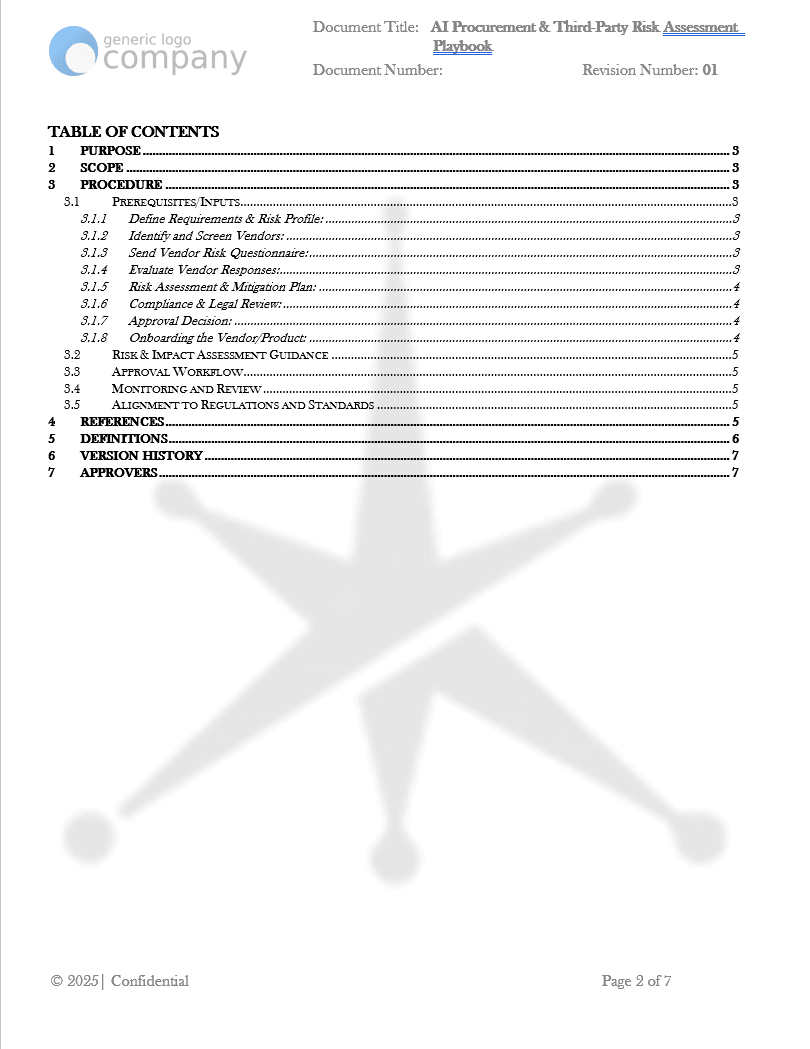
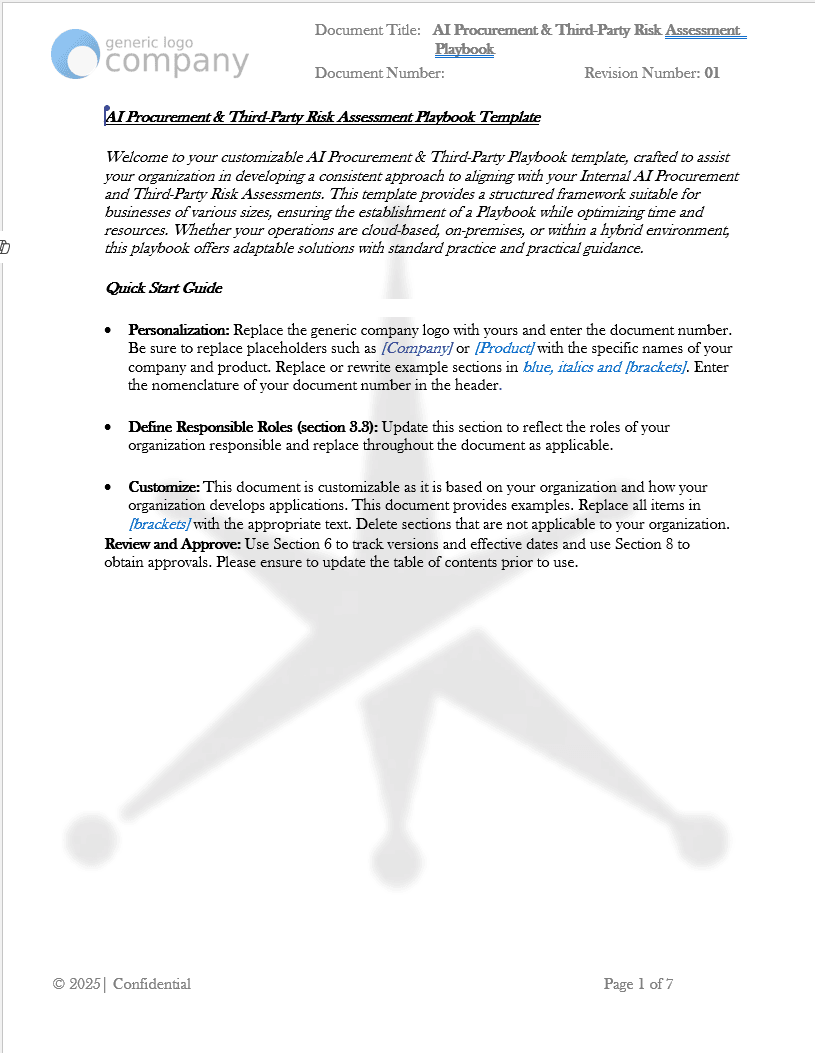
The playbook contains a complete procedure section covering eight procurement phases, risk and impact assessment guidance, approval workflow documentation, monitoring requirements, a definitions section, version history tracking, and an approvers signature page. Blue italicized text in brackets indicates customizable sections requiring organization-specific information.


Why This Matters

Organizations increasingly rely on external AI products for everything from customer service automation to data analytics. Each vendor relationship introduces potential risks: security vulnerabilities, compliance gaps, biased model outputs, and contractual ambiguities around liability and intellectual property. Without a structured evaluation process, procurement decisions often happen inconsistently across departments, creating exposure that surfaces only after problems occur.

The challenge isn't simply whether to use third-party AI. It's establishing a repeatable process that surfaces risks before contracts are signed. A well-documented procurement playbook helps cross-functional teams (security, legal, data science, and business units) coordinate their review activities and document their findings in ways that support governance requirements.

This template addresses the procedural gap many organizations face when they recognize the need for AI vendor governance but lack the internal resources to develop comprehensive documentation from scratch. The framework requires significant customization, but provides a starting structure that reflects common industry practices for technology procurement and risk assessment.


Framework Alignment

The template includes alignment considerations for the following frameworks and standards explicitly referenced in the document:

  • EU AI Act: Includes guidance on verifying vendor compliance support for high-risk AI applications, including documentation requirements and notification of model changes
  • ISO/IEC 27001:2022: Aligns with supplier security controls (Annex A.5.19) regarding security of supplier relationships, extended to include AI-specific criteria
  • CSA (Cloud Security Alliance): Incorporates CSA guidance on AI supply chain risk assessment, including trustworthiness and transparency evaluation beyond compliance checkboxes
  • Cloud Controls Matrix (CCM): References alignment with cloud security frameworks for vendors offering cloud-based AI services
  • GDPR and HIPAA: Includes considerations for data protection agreements and Business Associate Agreements where applicable to the AI solution

Key Features

The playbook template includes the following sections and components:

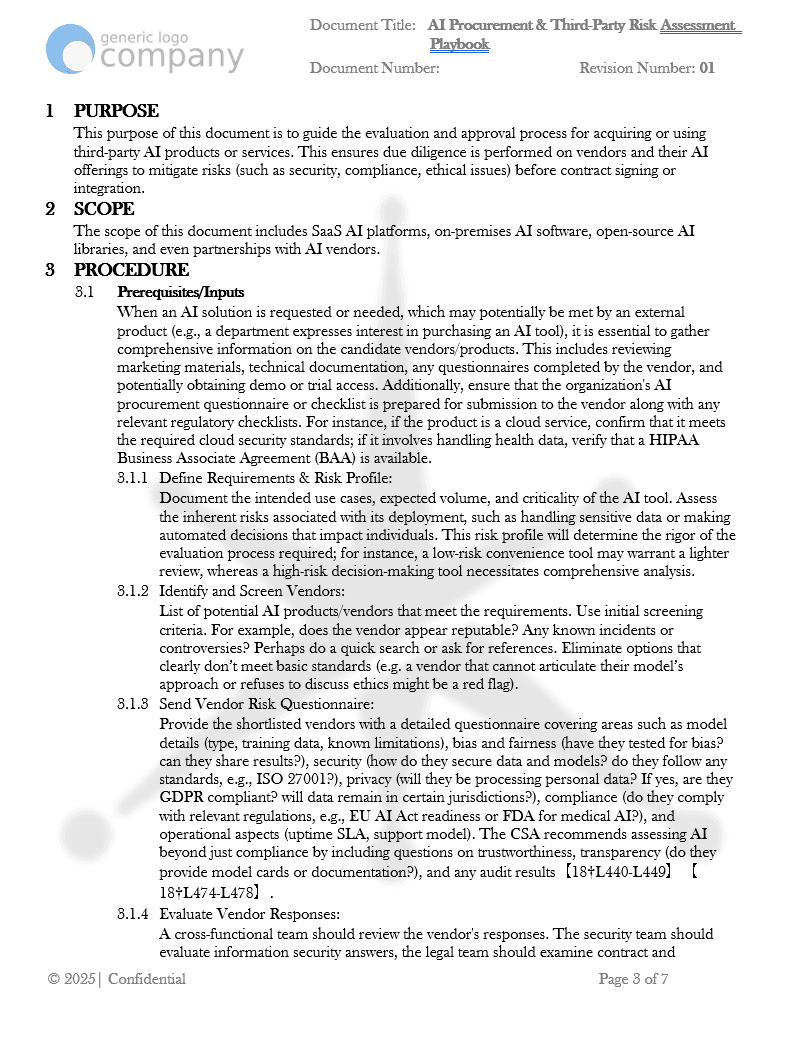
  1. Purpose and Scope Definition: Establishes the document's application to SaaS AI platforms, on-premises AI software, open-source AI libraries, and AI vendor partnerships
  2. Prerequisites and Inputs Guidance: Documents information gathering requirements including marketing materials, technical documentation, vendor questionnaires, and demo or trial access
  3. Eight-Step Procurement Procedure:
    • Define Requirements and Risk Profile
    • Identify and Screen Vendors
    • Send Vendor Risk Questionnaire
    • Evaluate Vendor Responses
    • Risk Assessment and Mitigation Plan
    • Compliance and Legal Review
    • Approval Decision
    • Onboarding the Vendor/Product
  4. Risk Assessment Guidance: Provides interpretation guidance for vendor responses and common third-party AI risks including data residency and model transparency
  5. Approval Workflow Structure: Documents threshold-based approval requirements and integration with procurement department procedures
  6. Monitoring and Review Framework: Establishes ongoing relationship monitoring, annual reassessment triggers, and vendor change notification requirements
  7. Definitions Section: Includes key terms such as AI Systems, Inherent Risks, Mitigation, Acceptable Risks, and Onboarding
  8. Version History and Approvers: Provides tracking tables for document governance

Comparison Table: Generic Approach vs. This Professional Template

Evaluation AspectGeneric ApproachThis Professional Template
Procurement ProcessAd hoc evaluation varying by department or individualStructured eight-step workflow with defined phases
Vendor QuestionnaireInconsistent questions or reliance on vendor-provided materialsComprehensive questionnaire categories covering model details, bias testing, security, privacy, compliance, and operations
Risk DocumentationInformal notes or email threadsStructured risk assessment with mitigation planning framework
Cross-Functional ReviewSequential or siloed reviewsGuidance for coordinated security, legal, and technical team evaluation
Approval AuthorityUnclear decision-making responsibilityDocumented approval workflow with executive and risk/compliance sign-off
Ongoing MonitoringContract renewal reminders onlyAnnual reassessment guidance with change notification requirements
Regulatory AlignmentFramework references added retroactivelyBuilt-in alignment considerations for EU AI Act, ISO 27001, and CSA guidance

FAQ Section

Q: What file format is this template delivered in? A: The template is delivered as a Microsoft Word document (.docx) to ensure proper formatting and enable collaborative editing. This format supports tracked changes, comments, and standard business document workflows.

Q: How much customization is required before using this template? A: Significant customization is required. Sections marked with blue italicized text in brackets (such as [Company], [Product], and role definitions) must be replaced with organization-specific information. The document explicitly states that sections not applicable to your organization should be deleted, and examples provided should be replaced with your actual processes.

Q: Does this template include a vendor risk questionnaire? A: The template provides guidance on questionnaire categories and topics to address (model details, bias and fairness, security, privacy, compliance, and operational aspects) but does not include a standalone questionnaire form. Organizations may need to develop their specific questionnaire based on the guidance provided.

Q: What frameworks does this template reference? A: The template explicitly references the EU AI Act, ISO/IEC 27001:2022 (specifically Annex A.5.19 on supplier relationships), CSA guidance on AI supply chain risk, and Cloud Controls Matrix. It also mentions GDPR and HIPAA considerations where applicable to specific AI deployments.

Q: Is this template suitable for all organization sizes? A: The template states it provides a framework suitable for businesses of various sizes. However, the approval workflow structure assumes the presence of governance bodies such as a Procurement Review Board or AI Governance Committee, and executive roles such as CIO, CTO, or risk/compliance executives. Smaller organizations may need to adapt these structures.

Q: Does using this template guarantee compliance with AI regulations? A: No. This template provides a documentation framework that may support compliance efforts, but does not guarantee compliance with any regulation. Organizations should consult with qualified legal and compliance professionals to determine specific regulatory requirements applicable to their situation.


Ideal For Section

This template may be particularly relevant for:

  • Mid-size to enterprise organizations beginning to formalize AI procurement governance
  • Compliance and risk management teams establishing vendor assessment documentation
  • IT and security departments integrating AI-specific criteria into existing vendor management processes
  • Legal teams developing contract review checklists for AI acquisitions
  • Organizations preparing for EU AI Act requirements that need to document vendor due diligence for high-risk AI systems
  • Healthcare organizations requiring structured evaluation of AI vendors handling protected health information
  • Cloud-first companies evaluating SaaS AI platforms against security frameworks

Pricing Strategy Options

Single Template: Contact for pricing based on organizational requirements and customization needs.

Bundle Option: May be combined with additional AI governance templates (such as AI Acceptable Use Policy or AI Risk Management Framework) depending on organizational compliance scope.

Enterprise Option: Available as part of comprehensive AI governance documentation suites for organizations requiring multiple policy and procedure templates.


⚖️ Differentiator

This playbook template provides a structured procurement workflow specifically designed for AI vendor evaluation, distinguishing it from generic vendor management procedures that may not address AI-specific risks such as model bias, algorithmic transparency, and the unique regulatory requirements emerging from frameworks like the EU AI Act. The template includes explicit alignment considerations for ISO 27001 supplier security controls and CSA guidance on AI supply chain risk, providing organizations with a starting framework that connects procurement activities to recognized governance standards. Unlike high-level guidance documents, this template offers procedural detail including eight defined procurement phases, cross-functional review coordination, and ongoing monitoring requirements that organizations can adapt to their specific governance structures.


Note: This template requires customization to reflect your organization's specific technologies, processes, and regulatory environment. The document provides a framework and examples that must be tailored to your situation. Consultation with qualified legal and compliance professionals is recommended before implementation. Documents are optimized for Microsoft Word to ensure proper formatting and collaborative editing capabilities.
Author

Tech Jacks Solutions