
Practical implementation considerations to close the AI value gapArtificial Intelligence The AWS Customer Success Center of Excellence (CS COE) helps customers get tangible value from their AWS investments. We’ve seen a pattern: customers who build AI strategies that address people, process, and technology together succeed more often. In this post, we share practical considerations that can help close the AI value gap.
The AWS Customer Success Center of Excellence (CS COE) helps customers get tangible value from their AWS investments. We’ve seen a pattern: customers who build AI strategies that address people, process, and technology together succeed more often. In this post, we share practical considerations that can help close the AI value gap. Read More

Why CrewAI’s Manager-Worker Architecture Fails — and How to Fix ItTowards Data Science A real-world analysis of why CrewAI’s hierarchical orchestration misfires—and a practical fix you can implement today.
The post Why CrewAI’s Manager-Worker Architecture Fails — and How to Fix It appeared first on Towards Data Science.
A real-world analysis of why CrewAI’s hierarchical orchestration misfires—and a practical fix you can implement today.
The post Why CrewAI’s Manager-Worker Architecture Fails — and How to Fix It appeared first on Towards Data Science. Read More

Our favourite Black Friday deal to Learn SQL, AI, Python, and become a certified data analyst!KDnuggets Don’t Miss DataCamp’s Black Friday Deal: Nov 12-Dec 4
Don’t Miss DataCamp’s Black Friday Deal: Nov 12-Dec 4 Read More
Warner Bros. Discovery achieves 60% cost savings and faster ML inference with AWS GravitonArtificial Intelligence Warner Bros. Discovery (WBD) is a leading global media and entertainment company that creates and distributes the world’s most differentiated and complete portfolio of content and brands across television, film and streaming. In this post, we describe the scale of our offerings, artificial intelligence (AI)/machine learning (ML) inference infrastructure requirements for our real time recommender systems, and how we used AWS Graviton-based Amazon SageMaker AI instances for our ML inference workloads and achieved 60% cost savings and 7% to 60% latency improvements across different models.
Warner Bros. Discovery (WBD) is a leading global media and entertainment company that creates and distributes the world’s most differentiated and complete portfolio of content and brands across television, film and streaming. In this post, we describe the scale of our offerings, artificial intelligence (AI)/machine learning (ML) inference infrastructure requirements for our real time recommender systems, and how we used AWS Graviton-based Amazon SageMaker AI instances for our ML inference workloads and achieved 60% cost savings and 7% to 60% latency improvements across different models. Read More
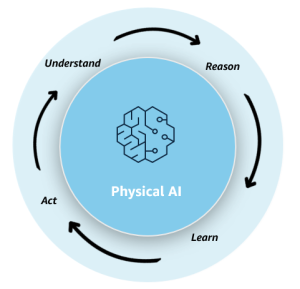
Physical AI in practice: Technical foundations that fuel human-machine interactionsArtificial Intelligence In this post, we explore the complete development lifecycle of physical AI—from data collection and model training to edge deployment—and examine how these intelligent systems learn to understand, reason, and interact with the physical world through continuous feedback loops. We illustrate this workflow through Diligent Robotics’ Moxi, a mobile manipulation robot that has completed over 1.2 million deliveries in hospitals, saving nearly 600,000 hours for clinical staff while transforming healthcare logistics and returning valuable time to patient care.
In this post, we explore the complete development lifecycle of physical AI—from data collection and model training to edge deployment—and examine how these intelligent systems learn to understand, reason, and interact with the physical world through continuous feedback loops. We illustrate this workflow through Diligent Robotics’ Moxi, a mobile manipulation robot that has completed over 1.2 million deliveries in hospitals, saving nearly 600,000 hours for clinical staff while transforming healthcare logistics and returning valuable time to patient care. Read More

HyperPod now supports Multi-Instance GPU to maximize GPU utilization for generative AI tasksArtificial Intelligence In this post, we explore how Amazon SageMaker HyperPod now supports NVIDIA Multi-Instance GPU (MIG) technology, enabling you to partition powerful GPUs into multiple isolated instances for running concurrent workloads like inference, research, and interactive development. By maximizing GPU utilization and reducing wasted resources, MIG helps organizations optimize costs while maintaining performance isolation and predictable quality of service across diverse machine learning tasks.
In this post, we explore how Amazon SageMaker HyperPod now supports NVIDIA Multi-Instance GPU (MIG) technology, enabling you to partition powerful GPUs into multiple isolated instances for running concurrent workloads like inference, research, and interactive development. By maximizing GPU utilization and reducing wasted resources, MIG helps organizations optimize costs while maintaining performance isolation and predictable quality of service across diverse machine learning tasks. Read More

Deploy an AI Analyst in Minutes: Connect Any LLM to Any Data Source with Bag of WordsKDnuggets Deploy an AI analyst fast by connecting any LLM to your SQL database with Bag of Words, allowing immediate, trustworthy data insights via natural language queries.
Deploy an AI analyst fast by connecting any LLM to your SQL database with Bag of Words, allowing immediate, trustworthy data insights via natural language queries. Read More

Adversarial learning breakthrough enables real-time AI securityAI News The ability to execute adversarial learning for real-time AI security offers a decisive advantage over static defence mechanisms. The emergence of AI-driven attacks – utilising reinforcement learning (RL) and Large Language Model (LLM) capabilities – has created a class of “vibe hacking” and adaptive threats that mutate faster than human teams can respond. This represents
The post Adversarial learning breakthrough enables real-time AI security appeared first on AI News.
The ability to execute adversarial learning for real-time AI security offers a decisive advantage over static defence mechanisms. The emergence of AI-driven attacks – utilising reinforcement learning (RL) and Large Language Model (LLM) capabilities – has created a class of “vibe hacking” and adaptive threats that mutate faster than human teams can respond. This represents
The post Adversarial learning breakthrough enables real-time AI security appeared first on AI News. Read More

e-Conomy SEA 2025: Malaysia takes 32% of regional AI fundingAI News Malaysia has captured 32% of Southeast Asia’s total AI funding – equivalent to US$759 million – between H2 2024 and H1 2025, establishing itself as the region’s dominant destination for artificial intelligence investment as massive infrastructure expansion and high consumer adoption converge to reshape the country’s technology landscape, according to the e-Conomy SEA 2025 report
The post e-Conomy SEA 2025: Malaysia takes 32% of regional AI funding appeared first on AI News.
Malaysia has captured 32% of Southeast Asia’s total AI funding – equivalent to US$759 million – between H2 2024 and H1 2025, establishing itself as the region’s dominant destination for artificial intelligence investment as massive infrastructure expansion and high consumer adoption converge to reshape the country’s technology landscape, according to the e-Conomy SEA 2025 report
The post e-Conomy SEA 2025: Malaysia takes 32% of regional AI funding appeared first on AI News. Read More
SGDFuse: SAM-Guided Diffusion for High-Fidelity Infrared and Visible Image Fusioncs.AI updates on arXiv.org arXiv:2508.05264v4 Announce Type: replace-cross
Abstract: Infrared and visible image fusion (IVIF) aims to combine the thermal radiation information from infrared images with the rich texture details from visible images to enhance perceptual capabilities for downstream visual tasks. However, existing methods often fail to preserve key targets due to a lack of deep semantic understanding of the scene, while the fusion process itself can also introduce artifacts and detail loss, severely compromising both image quality and task performance. To address these issues, this paper proposes SGDFuse, a conditional diffusion model guided by the Segment Anything Model (SAM), to achieve high-fidelity and semantically-aware image fusion. The core of our method is to utilize high-quality semantic masks generated by SAM as explicit priors to guide the optimization of the fusion process via a conditional diffusion model. Specifically, the framework operates in a two-stage process: it first performs a preliminary fusion of multi-modal features, and then utilizes the semantic masks from SAM jointly with the preliminary fused image as a condition to drive the diffusion model’s coarse-to-fine denoising generation. This ensures the fusion process not only has explicit semantic directionality but also guarantees the high fidelity of the final result. Extensive experiments demonstrate that SGDFuse achieves state-of-the-art performance in both subjective and objective evaluations, as well as in its adaptability to downstream tasks, providing a powerful solution to the core challenges in image fusion. The code of SGDFuse is available at https://github.com/boshizhang123/SGDFuse.
arXiv:2508.05264v4 Announce Type: replace-cross
Abstract: Infrared and visible image fusion (IVIF) aims to combine the thermal radiation information from infrared images with the rich texture details from visible images to enhance perceptual capabilities for downstream visual tasks. However, existing methods often fail to preserve key targets due to a lack of deep semantic understanding of the scene, while the fusion process itself can also introduce artifacts and detail loss, severely compromising both image quality and task performance. To address these issues, this paper proposes SGDFuse, a conditional diffusion model guided by the Segment Anything Model (SAM), to achieve high-fidelity and semantically-aware image fusion. The core of our method is to utilize high-quality semantic masks generated by SAM as explicit priors to guide the optimization of the fusion process via a conditional diffusion model. Specifically, the framework operates in a two-stage process: it first performs a preliminary fusion of multi-modal features, and then utilizes the semantic masks from SAM jointly with the preliminary fused image as a condition to drive the diffusion model’s coarse-to-fine denoising generation. This ensures the fusion process not only has explicit semantic directionality but also guarantees the high fidelity of the final result. Extensive experiments demonstrate that SGDFuse achieves state-of-the-art performance in both subjective and objective evaluations, as well as in its adaptability to downstream tasks, providing a powerful solution to the core challenges in image fusion. The code of SGDFuse is available at https://github.com/boshizhang123/SGDFuse. Read More