
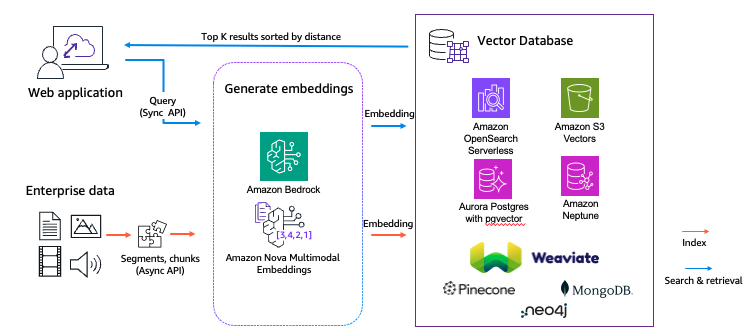
A practical guide to Amazon Nova Multimodal EmbeddingsArtificial Intelligence In this post, you will learn how to configure and use Amazon Nova Multimodal Embeddings for media asset search systems, product discovery experiences, and document retrieval applications.
In this post, you will learn how to configure and use Amazon Nova Multimodal Embeddings for media asset search systems, product discovery experiences, and document retrieval applications. Read More

Scaling In-Context Online Learning Capability of LLMs via Cross-Episode Meta-RLcs.AI updates on arXiv.org arXiv:2602.04089v1 Announce Type: new
Abstract: Large language models (LLMs) achieve strong performance when all task-relevant information is available upfront, as in static prediction and instruction-following problems. However, many real-world decision-making tasks are inherently online: crucial information must be acquired through interaction, feedback is delayed, and effective behavior requires balancing information collection and exploitation over time. While in-context learning enables adaptation without weight updates, existing LLMs often struggle to reliably leverage in-context interaction experience in such settings. In this work, we show that this limitation can be addressed through training. We introduce ORBIT, a multi-task, multi-episode meta-reinforcement learning framework that trains LLMs to learn from interaction in context. After meta-training, a relatively small open-source model (Qwen3-14B) demonstrates substantially improved in-context online learning on entirely unseen environments, matching the performance of GPT-5.2 and outperforming standard RL fine-tuning by a large margin. Scaling experiments further reveal consistent gains with model size, suggesting significant headroom for learn-at-inference-time decision-making agents. Code reproducing the results in the paper can be found at https://github.com/XiaofengLin7/ORBIT.
arXiv:2602.04089v1 Announce Type: new
Abstract: Large language models (LLMs) achieve strong performance when all task-relevant information is available upfront, as in static prediction and instruction-following problems. However, many real-world decision-making tasks are inherently online: crucial information must be acquired through interaction, feedback is delayed, and effective behavior requires balancing information collection and exploitation over time. While in-context learning enables adaptation without weight updates, existing LLMs often struggle to reliably leverage in-context interaction experience in such settings. In this work, we show that this limitation can be addressed through training. We introduce ORBIT, a multi-task, multi-episode meta-reinforcement learning framework that trains LLMs to learn from interaction in context. After meta-training, a relatively small open-source model (Qwen3-14B) demonstrates substantially improved in-context online learning on entirely unseen environments, matching the performance of GPT-5.2 and outperforming standard RL fine-tuning by a large margin. Scaling experiments further reveal consistent gains with model size, suggesting significant headroom for learn-at-inference-time decision-making agents. Code reproducing the results in the paper can be found at https://github.com/XiaofengLin7/ORBIT. Read More
A Novel Framework for Uncertainty-Driven Adaptive Explorationcs.AI updates on arXiv.org arXiv:2509.03219v5 Announce Type: replace
Abstract: Adaptive exploration methods propose ways to learn complex policies via alternating between exploration and exploitation. An important question for such methods is to determine the appropriate moment to switch between exploration and exploitation and vice versa. This is critical in domains that require the learning of long and complex sequences of actions. In this work, we present a generic adaptive exploration framework that employs uncertainty to address this important issue in a principled manner. Our framework includes previous adaptive exploration approaches as special cases. Moreover, we can incorporate in our framework any uncertainty-measuring mechanism of choice, for instance mechanisms used in intrinsic motivation or epistemic uncertainty-based exploration methods. We experimentally demonstrate that our framework gives rise to adaptive exploration strategies that outperform standard ones across several environments.
arXiv:2509.03219v5 Announce Type: replace
Abstract: Adaptive exploration methods propose ways to learn complex policies via alternating between exploration and exploitation. An important question for such methods is to determine the appropriate moment to switch between exploration and exploitation and vice versa. This is critical in domains that require the learning of long and complex sequences of actions. In this work, we present a generic adaptive exploration framework that employs uncertainty to address this important issue in a principled manner. Our framework includes previous adaptive exploration approaches as special cases. Moreover, we can incorporate in our framework any uncertainty-measuring mechanism of choice, for instance mechanisms used in intrinsic motivation or epistemic uncertainty-based exploration methods. We experimentally demonstrate that our framework gives rise to adaptive exploration strategies that outperform standard ones across several environments. Read More
EvoFSM: Controllable Self-Evolution for Deep Research with Finite State Machinescs.AI updates on arXiv.org arXiv:2601.09465v2 Announce Type: replace
Abstract: While LLM-based agents have shown promise for deep research, most existing approaches rely on fixed workflows that struggle to adapt to real-world, open-ended queries. Recent work therefore explores self-evolution by allowing agents to rewrite their own code or prompts to improve problem-solving ability, but unconstrained optimization often triggers instability, hallucinations, and instruction drift. We propose EvoFSM, a structured self-evolving framework that achieves both adaptability and control by evolving an explicit Finite State Machine (FSM) instead of relying on free-form rewriting. EvoFSM decouples the optimization space into macroscopic Flow (state-transition logic) and microscopic Skill (state-specific behaviors), enabling targeted improvements under clear behavioral boundaries. Guided by a critic mechanism, EvoFSM refines the FSM through a small set of constrained operations, and further incorporates a self-evolving memory that distills successful trajectories as reusable priors and failure patterns as constraints for future queries. Extensive evaluations on five multi-hop QA benchmarks demonstrate the effectiveness of EvoFSM. In particular, EvoFSM reaches 58.0% accuracy on the DeepSearch benchmark. Additional results on interactive decision-making tasks further validate its generalization.
arXiv:2601.09465v2 Announce Type: replace
Abstract: While LLM-based agents have shown promise for deep research, most existing approaches rely on fixed workflows that struggle to adapt to real-world, open-ended queries. Recent work therefore explores self-evolution by allowing agents to rewrite their own code or prompts to improve problem-solving ability, but unconstrained optimization often triggers instability, hallucinations, and instruction drift. We propose EvoFSM, a structured self-evolving framework that achieves both adaptability and control by evolving an explicit Finite State Machine (FSM) instead of relying on free-form rewriting. EvoFSM decouples the optimization space into macroscopic Flow (state-transition logic) and microscopic Skill (state-specific behaviors), enabling targeted improvements under clear behavioral boundaries. Guided by a critic mechanism, EvoFSM refines the FSM through a small set of constrained operations, and further incorporates a self-evolving memory that distills successful trajectories as reusable priors and failure patterns as constraints for future queries. Extensive evaluations on five multi-hop QA benchmarks demonstrate the effectiveness of EvoFSM. In particular, EvoFSM reaches 58.0% accuracy on the DeepSearch benchmark. Additional results on interactive decision-making tasks further validate its generalization. Read More
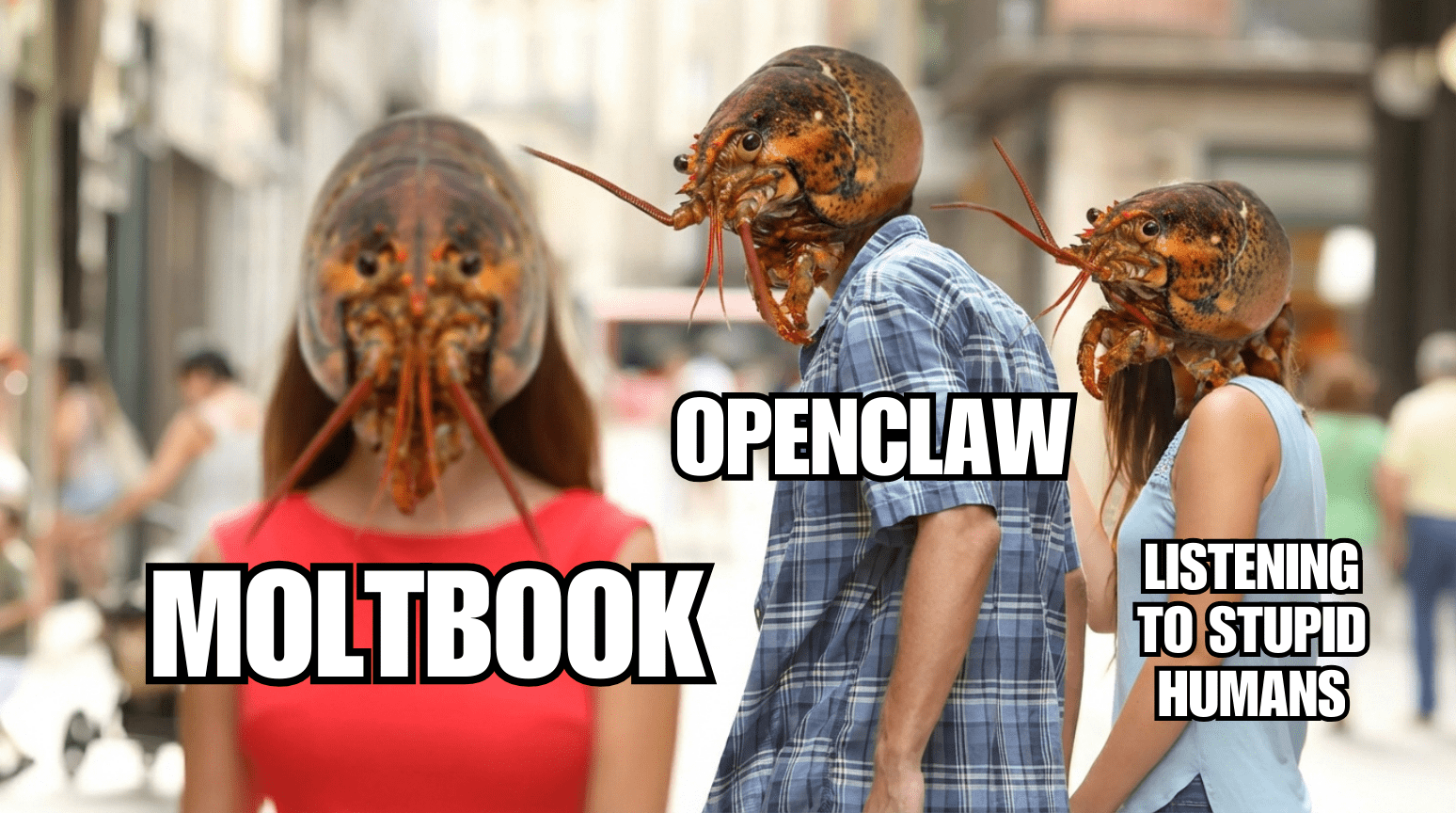
The Absolute Insanity of MoltbookKDnuggets What the… AI agents arguing over memes? Sure, why not.
What the… AI agents arguing over memes? Sure, why not. Read More
The Rule Everyone Misses: How to Stop Confusing loc and iloc in PandasTowards Data Science A simple mental model to remember when each one works (with examples that finally click).
The post The Rule Everyone Misses: How to Stop Confusing loc and iloc in Pandas appeared first on Towards Data Science.
A simple mental model to remember when each one works (with examples that finally click).
The post The Rule Everyone Misses: How to Stop Confusing loc and iloc in Pandas appeared first on Towards Data Science. Read More
Microsoft unveils method to detect sleeper agent backdoorsAI News Researchers from Microsoft have unveiled a scanning method to identify poisoned models without knowing the trigger or intended outcome. Organisations integrating open-weight large language models (LLMs) face a specific supply chain vulnerability where distinct memory leaks and internal attention patterns expose hidden threats known as “sleeper agents”. These poisoned models contain backdoors that lie dormant
The post Microsoft unveils method to detect sleeper agent backdoors appeared first on AI News.
Researchers from Microsoft have unveiled a scanning method to identify poisoned models without knowing the trigger or intended outcome. Organisations integrating open-weight large language models (LLMs) face a specific supply chain vulnerability where distinct memory leaks and internal attention patterns expose hidden threats known as “sleeper agents”. These poisoned models contain backdoors that lie dormant
The post Microsoft unveils method to detect sleeper agent backdoors appeared first on AI News. Read More
OpenAI’s enterprise push: The hidden story behind AI’s sales raceAI News As OpenAI races toward its ambitious US$100 billion revenue target by 2027, the ChatGPT maker is reportedly building an army of AI consultants to bridge the gap between cutting-edge technology and enterprise boardrooms—a move that signals a fundamental shift in how AI companies are approaching the notoriously difficult challenge of enterprise adoption. According to industry
The post OpenAI’s enterprise push: The hidden story behind AI’s sales race appeared first on AI News.
As OpenAI races toward its ambitious US$100 billion revenue target by 2027, the ChatGPT maker is reportedly building an army of AI consultants to bridge the gap between cutting-edge technology and enterprise boardrooms—a move that signals a fundamental shift in how AI companies are approaching the notoriously difficult challenge of enterprise adoption. According to industry
The post OpenAI’s enterprise push: The hidden story behind AI’s sales race appeared first on AI News. Read More
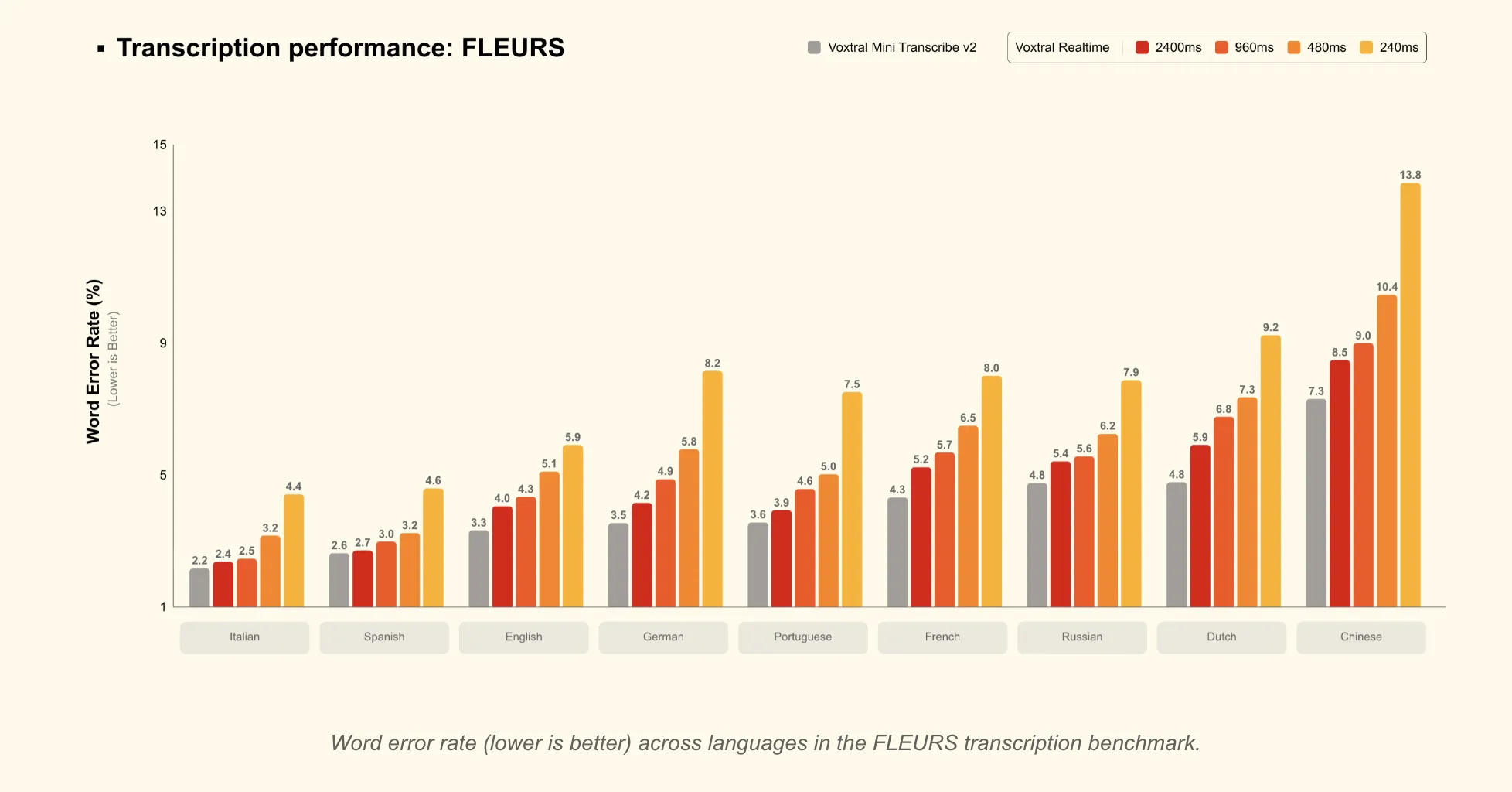
Mistral AI Launches Voxtral Transcribe 2: Pairing Batch Diarization And Open Realtime ASR For Multilingual Production Workloads At ScaleMarkTechPost Automatic speech recognition (ASR) is becoming a core building block for AI products, from meeting tools to voice agents. Mistral’s new Voxtral Transcribe 2 family targets this space with 2 models that split cleanly into batch and realtime use cases, while keeping cost, latency, and deployment constraints in focus. The release includes: Both models are
The post Mistral AI Launches Voxtral Transcribe 2: Pairing Batch Diarization And Open Realtime ASR For Multilingual Production Workloads At Scale appeared first on MarkTechPost.
Automatic speech recognition (ASR) is becoming a core building block for AI products, from meeting tools to voice agents. Mistral’s new Voxtral Transcribe 2 family targets this space with 2 models that split cleanly into batch and realtime use cases, while keeping cost, latency, and deployment constraints in focus. The release includes: Both models are
The post Mistral AI Launches Voxtral Transcribe 2: Pairing Batch Diarization And Open Realtime ASR For Multilingual Production Workloads At Scale appeared first on MarkTechPost. Read More
Revisiting Prompt Sensitivity in Large Language Models for Text Classification: The Role of Prompt Underspecificationcs.AI updates on arXiv.org arXiv:2602.04297v1 Announce Type: cross
Abstract: Large language models (LLMs) are widely used as zero-shot and few-shot classifiers, where task behaviour is largely controlled through prompting. A growing number of works have observed that LLMs are sensitive to prompt variations, with small changes leading to large changes in performance. However, in many cases, the investigation of sensitivity is performed using underspecified prompts that provide minimal task instructions and weakly constrain the model’s output space. In this work, we argue that a significant portion of the observed prompt sensitivity can be attributed to prompt underspecification. We systematically study and compare the sensitivity of underspecified prompts and prompts that provide specific instructions. Utilising performance analysis, logit analysis, and linear probing, we find that underspecified prompts exhibit higher performance variance and lower logit values for relevant tokens, while instruction-prompts suffer less from such problems. However, linear probing analysis suggests that the effects of prompt underspecification have only a marginal impact on the internal LLM representations, instead emerging in the final layers. Overall, our findings highlight the need for more rigour when investigating and mitigating prompt sensitivity.
arXiv:2602.04297v1 Announce Type: cross
Abstract: Large language models (LLMs) are widely used as zero-shot and few-shot classifiers, where task behaviour is largely controlled through prompting. A growing number of works have observed that LLMs are sensitive to prompt variations, with small changes leading to large changes in performance. However, in many cases, the investigation of sensitivity is performed using underspecified prompts that provide minimal task instructions and weakly constrain the model’s output space. In this work, we argue that a significant portion of the observed prompt sensitivity can be attributed to prompt underspecification. We systematically study and compare the sensitivity of underspecified prompts and prompts that provide specific instructions. Utilising performance analysis, logit analysis, and linear probing, we find that underspecified prompts exhibit higher performance variance and lower logit values for relevant tokens, while instruction-prompts suffer less from such problems. However, linear probing analysis suggests that the effects of prompt underspecification have only a marginal impact on the internal LLM representations, instead emerging in the final layers. Overall, our findings highlight the need for more rigour when investigating and mitigating prompt sensitivity. Read More