
Bridging the Silence: How LEO Satellites and Edge AI Will Democratize ConnectivityTowards Data Science Why on-device intelligence and low-orbit constellations are the only viable path to universal accessibility
The post Bridging the Silence: How LEO Satellites and Edge AI Will Democratize Connectivity appeared first on Towards Data Science.
Why on-device intelligence and low-orbit constellations are the only viable path to universal accessibility
The post Bridging the Silence: How LEO Satellites and Edge AI Will Democratize Connectivity appeared first on Towards Data Science. Read More
The Machine Learning “Advent Calendar” Day 8: Isolation Forest in ExcelTowards Data Science Isolation Forest may look technical, but its idea is simple: isolate points using random splits. If a point is isolated quickly, it is an anomaly; if it takes many splits, it is normal.
Using the tiny dataset 1, 2, 3, 9, we can see the logic clearly. We build several random trees, measure how many splits each point needs, average the depths, and convert them into anomaly scores. Short depths become scores close to 1, long depths close to 0.
The Excel implementation is painful, but the algorithm itself is elegant. It scales to many features, makes no assumptions about distributions, and even works with categorical data. Above all, Isolation Forest asks a different question: not “What is normal?”, but “How fast can I isolate this point?”
The post The Machine Learning “Advent Calendar” Day 8: Isolation Forest in Excel appeared first on Towards Data Science.
Isolation Forest may look technical, but its idea is simple: isolate points using random splits. If a point is isolated quickly, it is an anomaly; if it takes many splits, it is normal.
Using the tiny dataset 1, 2, 3, 9, we can see the logic clearly. We build several random trees, measure how many splits each point needs, average the depths, and convert them into anomaly scores. Short depths become scores close to 1, long depths close to 0.
The Excel implementation is painful, but the algorithm itself is elegant. It scales to many features, makes no assumptions about distributions, and even works with categorical data. Above all, Isolation Forest asks a different question: not “What is normal?”, but “How fast can I isolate this point?”
The post The Machine Learning “Advent Calendar” Day 8: Isolation Forest in Excel appeared first on Towards Data Science. Read More
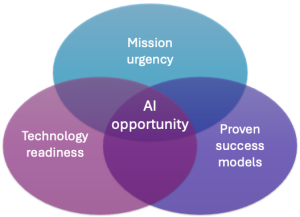
How AWS delivers generative AI to the public sector in weeks, not yearsArtificial Intelligence Experts at the Generative AI Innovation Center share several strategies to help organizations excel with generative AI.
Experts at the Generative AI Innovation Center share several strategies to help organizations excel with generative AI. Read More

Interview: From CUDA to Tile-Based Programming: NVIDIA’s Stephen Jones on Building the Future of AIMarkTechPost As AI models grow in complexity and hardware evolves to meet the demand, the software layer connecting the two must also adapt. We recently sat down with Stephen Jones, a Distinguished Engineer at NVIDIA and one of the original architects of CUDA. Jones, whose background spans from fluid mechanics to aerospace engineering, offered deep insights
The post Interview: From CUDA to Tile-Based Programming: NVIDIA’s Stephen Jones on Building the Future of AI appeared first on MarkTechPost.
As AI models grow in complexity and hardware evolves to meet the demand, the software layer connecting the two must also adapt. We recently sat down with Stephen Jones, a Distinguished Engineer at NVIDIA and one of the original architects of CUDA. Jones, whose background spans from fluid mechanics to aerospace engineering, offered deep insights
The post Interview: From CUDA to Tile-Based Programming: NVIDIA’s Stephen Jones on Building the Future of AI appeared first on MarkTechPost. Read More

Statistics at the Command Line for Beginner Data ScientistsKDnuggets You don’t need Python or R to start working with data. This guide walks you through using built-in Unix utilities for real statistical analysis.
You don’t need Python or R to start working with data. This guide walks you through using built-in Unix utilities for real statistical analysis. Read More
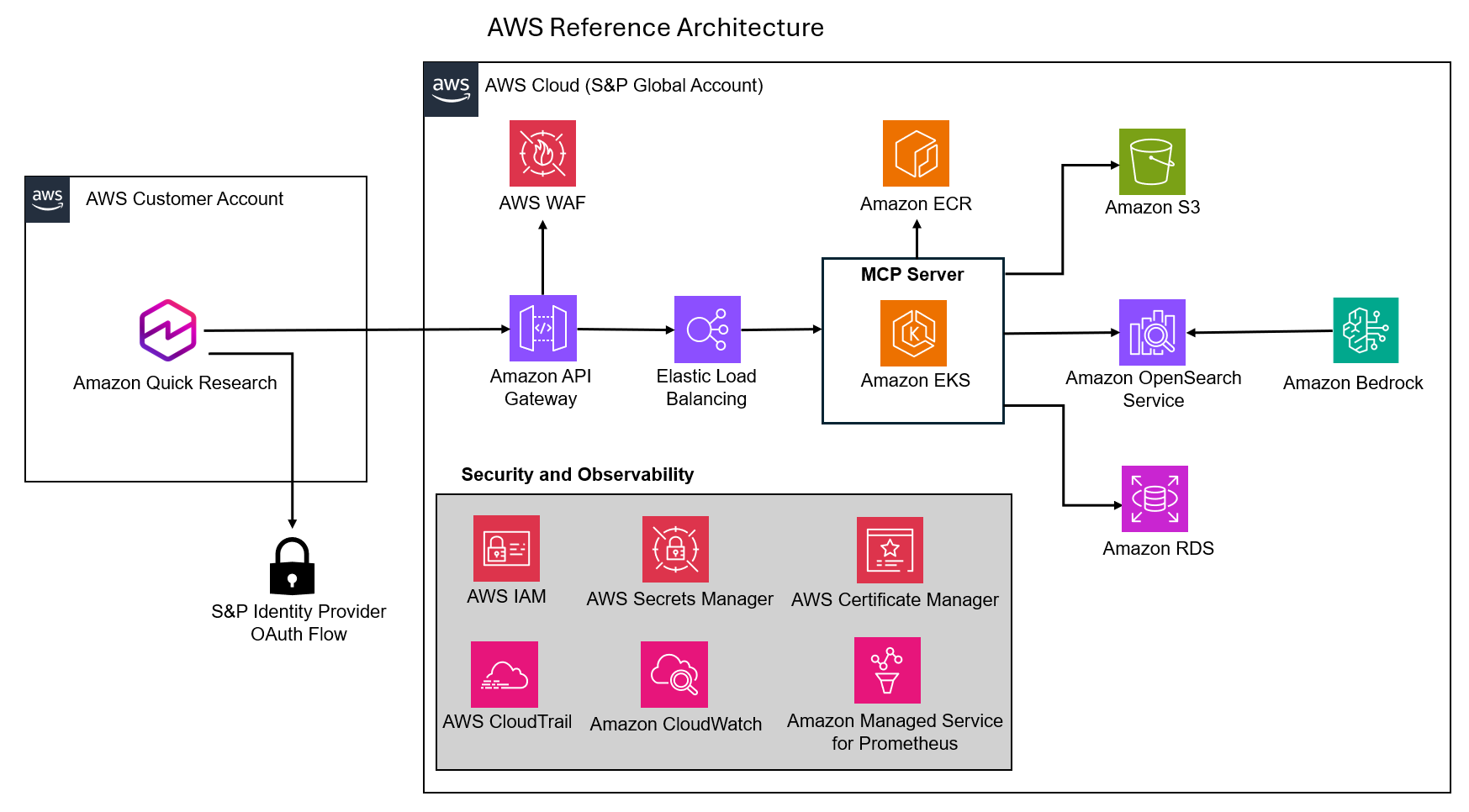
S&P Global Data integration expands Amazon Quick Research capabilitiesArtificial Intelligence Today, we are pleased to announce a new integration between Amazon Quick Research and S&P Global. This integration brings both S&P Global Energy news, research, and insights and S&P Global Market Intelligence data to Quick Research customers in one deep research agent. In this post, we explore S&P Global’s data sets and the solution architecture of the integration with Quick Research.
Today, we are pleased to announce a new integration between Amazon Quick Research and S&P Global. This integration brings both S&P Global Energy news, research, and insights and S&P Global Market Intelligence data to Quick Research customers in one deep research agent. In this post, we explore S&P Global’s data sets and the solution architecture of the integration with Quick Research. Read More
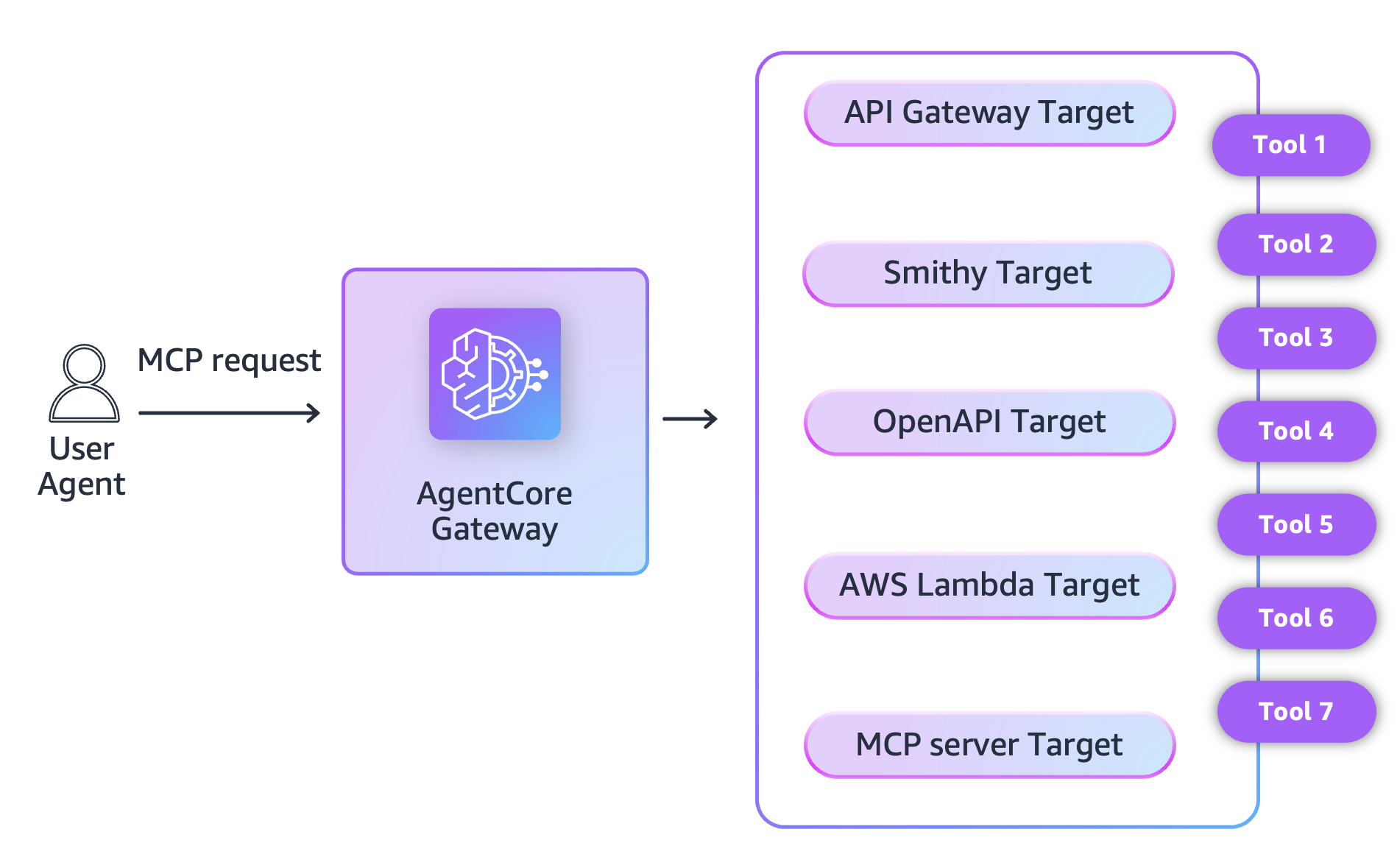
Streamline AI agent tool interactions: Connect API Gateway to AgentCore Gateway with MCPArtificial Intelligence AgentCore Gateway now supports API GatewayAs organizations explore the possibilities of agentic applications, they continue to navigate challenges of using enterprise data as context in invocation requests to large language models (LLMs) in a manner that is secure and aligned with enterprise policies. This post covers these new capabilities and shows how to implement them.
AgentCore Gateway now supports API GatewayAs organizations explore the possibilities of agentic applications, they continue to navigate challenges of using enterprise data as context in invocation requests to large language models (LLMs) in a manner that is secure and aligned with enterprise policies. This post covers these new capabilities and shows how to implement them. Read More
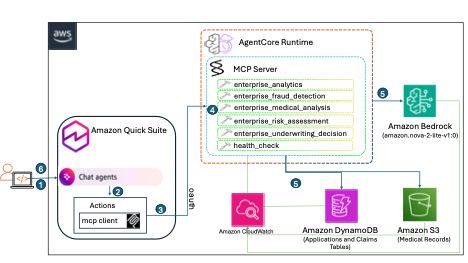
Create an intelligent insurance underwriter agent powered by Amazon Nova 2 Lite and Amazon Quick SuiteArtificial Intelligence In this post, we demonstrate how to build an intelligent insurance underwriting agent that addresses three critical challenges: unifying siloed data across CRM systems and databases, providing explainable and auditable AI decisions for regulatory compliance, and enabling automated fraud detection with consistent underwriting rules. The solution combines Amazon Nova 2 Lite for transparent risk assessment, Amazon Bedrock AgentCore for managed MCP server infrastructure, and Amazon Quick Suite for natural language interactions—delivering a production-ready system that underwriters can deploy in under 30 minutes .
In this post, we demonstrate how to build an intelligent insurance underwriting agent that addresses three critical challenges: unifying siloed data across CRM systems and databases, providing explainable and auditable AI decisions for regulatory compliance, and enabling automated fraud detection with consistent underwriting rules. The solution combines Amazon Nova 2 Lite for transparent risk assessment, Amazon Bedrock AgentCore for managed MCP server infrastructure, and Amazon Quick Suite for natural language interactions—delivering a production-ready system that underwriters can deploy in under 30 minutes . Read More

Instacart pilots agentic commerce by embedding in ChatGPTAI News Instacart has deployed an embedded checkout experience within ChatGPT through the emerging Agentic Commerce Protocol. With the deployment, the company is the first partner to launch an app on ChatGPT that offers a complete shopping cycle – from query to payment – without requiring the user to leave the conversation interface. Operationalising agentic commerce The
The post Instacart pilots agentic commerce by embedding in ChatGPT appeared first on AI News.
Instacart has deployed an embedded checkout experience within ChatGPT through the emerging Agentic Commerce Protocol. With the deployment, the company is the first partner to launch an app on ChatGPT that offers a complete shopping cycle – from query to payment – without requiring the user to leave the conversation interface. Operationalising agentic commerce The
The post Instacart pilots agentic commerce by embedding in ChatGPT appeared first on AI News. Read More
Phase-OTDR Event Detection Using Image-Based Data Transformation and Deep Learningcs.AI updates on arXiv.org arXiv:2512.05830v1 Announce Type: cross
Abstract: This study focuses on event detection in optical fibers, specifically classifying six events using the Phase-OTDR system. A novel approach is introduced to enhance Phase-OTDR data analysis by transforming 1D data into grayscale images through techniques such as Gramian Angular Difference Field, Gramian Angular Summation Field, and Recurrence Plot. These grayscale images are combined into a multi-channel RGB representation, enabling more robust and adaptable analysis using transfer learning models. The proposed methodology achieves high classification accuracies of 98.84% and 98.24% with the EfficientNetB0 and DenseNet121 models, respectively. A 5-fold cross-validation process confirms the reliability of these models, with test accuracy rates of 99.07% and 98.68%. Using a publicly available Phase-OTDR dataset, the study demonstrates an efficient approach to understanding optical fiber events while reducing dataset size and improving analysis efficiency. The results highlight the transformative potential of image-based analysis in interpreting complex fiber optic sensing data, offering significant advancements in the accuracy and reliability of fiber optic monitoring systems. The codes and the corresponding image-based dataset are made publicly available on GitHub to support further research: https://github.com/miralab-ai/Phase-OTDR-event-detection.
arXiv:2512.05830v1 Announce Type: cross
Abstract: This study focuses on event detection in optical fibers, specifically classifying six events using the Phase-OTDR system. A novel approach is introduced to enhance Phase-OTDR data analysis by transforming 1D data into grayscale images through techniques such as Gramian Angular Difference Field, Gramian Angular Summation Field, and Recurrence Plot. These grayscale images are combined into a multi-channel RGB representation, enabling more robust and adaptable analysis using transfer learning models. The proposed methodology achieves high classification accuracies of 98.84% and 98.24% with the EfficientNetB0 and DenseNet121 models, respectively. A 5-fold cross-validation process confirms the reliability of these models, with test accuracy rates of 99.07% and 98.68%. Using a publicly available Phase-OTDR dataset, the study demonstrates an efficient approach to understanding optical fiber events while reducing dataset size and improving analysis efficiency. The results highlight the transformative potential of image-based analysis in interpreting complex fiber optic sensing data, offering significant advancements in the accuracy and reliability of fiber optic monitoring systems. The codes and the corresponding image-based dataset are made publicly available on GitHub to support further research: https://github.com/miralab-ai/Phase-OTDR-event-detection. Read More