

How to Use GPT-5 EffectivelyTowards Data Science Learn about GPT-5’s features and settings, and how to optimally apply them to your use case
The post How to Use GPT-5 Effectively appeared first on Towards Data Science.
Learn about GPT-5’s features and settings, and how to optimally apply them to your use case
The post How to Use GPT-5 Effectively appeared first on Towards Data Science. Read More
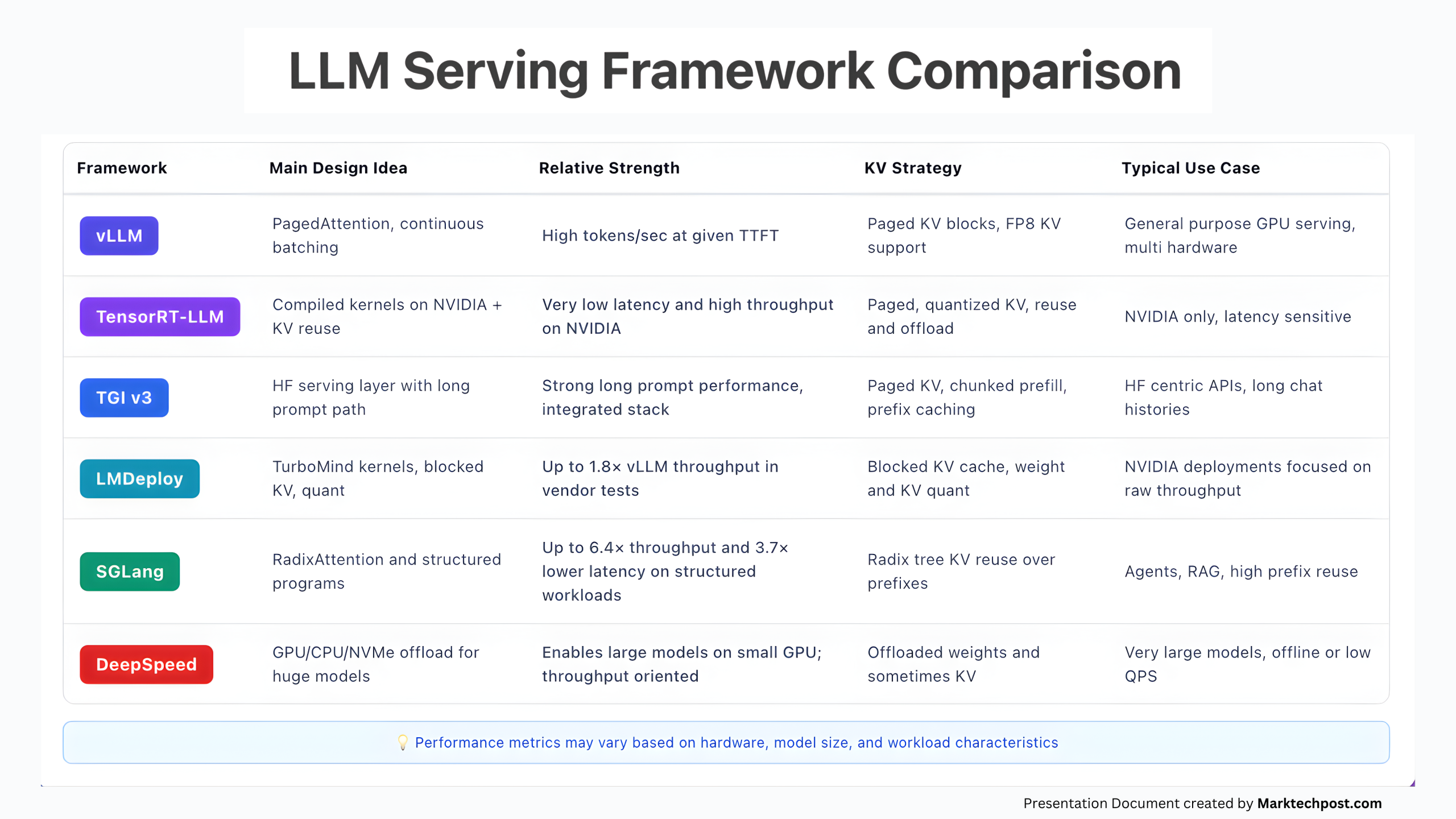
Comparing the Top 6 Inference Runtimes for LLM Serving in 2025MarkTechPost Large language models are now limited less by training and more by how fast and cheaply we can serve tokens under real traffic. That comes down to three implementation details: how the runtime batches requests, how it overlaps prefill and decode, and how it stores and reuses the KV cache. Different engines make different tradeoffs
The post Comparing the Top 6 Inference Runtimes for LLM Serving in 2025 appeared first on MarkTechPost.
Large language models are now limited less by training and more by how fast and cheaply we can serve tokens under real traffic. That comes down to three implementation details: how the runtime batches requests, how it overlaps prefill and decode, and how it stores and reuses the KV cache. Different engines make different tradeoffs
The post Comparing the Top 6 Inference Runtimes for LLM Serving in 2025 appeared first on MarkTechPost. Read More

Nvidia AI chip ban: Can tech giants navigate a geopolitical zero-sum game?AI News When Nvidia CEO Jensen Huang initially told the Financial Times that China would “win the AI race” before softening his stance, it crystallised a predicament that’s been years in the making. The world’s most valuable chipmaker now finds itself caught between two superpowers, each wielding the Nvidia AI chip ban as a weapon in a broader technological
The post Nvidia AI chip ban: Can tech giants navigate a geopolitical zero-sum game? appeared first on AI News.
When Nvidia CEO Jensen Huang initially told the Financial Times that China would “win the AI race” before softening his stance, it crystallised a predicament that’s been years in the making. The world’s most valuable chipmaker now finds itself caught between two superpowers, each wielding the Nvidia AI chip ban as a weapon in a broader technological
The post Nvidia AI chip ban: Can tech giants navigate a geopolitical zero-sum game? appeared first on AI News. Read More

Microsoft’s next big AI bet: building a ‘humanist superintelligence’AI News Microsoft is forming a new team to research superintelligence and other advanced forms of artificial intelligence. Mustafa Suleyman, who leads Microsoft’s AI division overseeing Bing and Copilot, announced the creation of the MAI Superintelligence Team in a blog post. He said he will head the group and that Microsoft plans to put “a lot of
The post Microsoft’s next big AI bet: building a ‘humanist superintelligence’ appeared first on AI News.
Microsoft is forming a new team to research superintelligence and other advanced forms of artificial intelligence. Mustafa Suleyman, who leads Microsoft’s AI division overseeing Bing and Copilot, announced the creation of the MAI Superintelligence Team in a blog post. He said he will head the group and that Microsoft plans to put “a lot of
The post Microsoft’s next big AI bet: building a ‘humanist superintelligence’ appeared first on AI News. Read More
Build a Multi-Agent System for Integrated Transcriptomic, Proteomic, and Metabolomic Data Interpretation with Pathway ReasoningMarkTechPost In this tutorial, we build an advanced multi-agent pipeline that interprets integrated omics data, including transcriptomics, proteomics, and metabolomics, to uncover key biological insights. We begin by generating coherent synthetic datasets that mimic realistic biological trends and then move step by step through agents designed for statistical analysis, network inference, pathway enrichment, and drug repurposing.
The post Build a Multi-Agent System for Integrated Transcriptomic, Proteomic, and Metabolomic Data Interpretation with Pathway Reasoning appeared first on MarkTechPost.
In this tutorial, we build an advanced multi-agent pipeline that interprets integrated omics data, including transcriptomics, proteomics, and metabolomics, to uncover key biological insights. We begin by generating coherent synthetic datasets that mimic realistic biological trends and then move step by step through agents designed for statistical analysis, network inference, pathway enrichment, and drug repurposing.
The post Build a Multi-Agent System for Integrated Transcriptomic, Proteomic, and Metabolomic Data Interpretation with Pathway Reasoning appeared first on MarkTechPost. Read More
Divide by Question, Conquer by Agent: SPLIT-RAG with Question-Driven Graph Partitioningcs.AI updates on arXiv.org arXiv:2505.13994v2 Announce Type: replace
Abstract: Retrieval-Augmented Generation (RAG) systems empower large language models (LLMs) with external knowledge, yet struggle with efficiency-accuracy trade-offs when scaling to large knowledge graphs. Existing approaches often rely on monolithic graph retrieval, incurring unnecessary latency for simple queries and fragmented reasoning for complex multi-hop questions. To address these challenges, this paper propose SPLIT-RAG, a multi-agent RAG framework that addresses these limitations with question-driven semantic graph partitioning and collaborative subgraph retrieval. The innovative framework first create Semantic Partitioning of Linked Information, then use the Type-Specialized knowledge base to achieve Multi-Agent RAG. The attribute-aware graph segmentation manages to divide knowledge graphs into semantically coherent subgraphs, ensuring subgraphs align with different query types, while lightweight LLM agents are assigned to partitioned subgraphs, and only relevant partitions are activated during retrieval, thus reduce search space while enhancing efficiency. Finally, a hierarchical merging module resolves inconsistencies across subgraph-derived answers through logical verifications. Extensive experimental validation demonstrates considerable improvements compared to existing approaches.
arXiv:2505.13994v2 Announce Type: replace
Abstract: Retrieval-Augmented Generation (RAG) systems empower large language models (LLMs) with external knowledge, yet struggle with efficiency-accuracy trade-offs when scaling to large knowledge graphs. Existing approaches often rely on monolithic graph retrieval, incurring unnecessary latency for simple queries and fragmented reasoning for complex multi-hop questions. To address these challenges, this paper propose SPLIT-RAG, a multi-agent RAG framework that addresses these limitations with question-driven semantic graph partitioning and collaborative subgraph retrieval. The innovative framework first create Semantic Partitioning of Linked Information, then use the Type-Specialized knowledge base to achieve Multi-Agent RAG. The attribute-aware graph segmentation manages to divide knowledge graphs into semantically coherent subgraphs, ensuring subgraphs align with different query types, while lightweight LLM agents are assigned to partitioned subgraphs, and only relevant partitions are activated during retrieval, thus reduce search space while enhancing efficiency. Finally, a hierarchical merging module resolves inconsistencies across subgraph-derived answers through logical verifications. Extensive experimental validation demonstrates considerable improvements compared to existing approaches. Read More
Voost: A Unified and Scalable Diffusion Transformer for Bidirectional Virtual Try-On and Try-Offcs.AI updates on arXiv.org arXiv:2508.04825v2 Announce Type: replace-cross
Abstract: Virtual try-on aims to synthesize a realistic image of a person wearing a target garment, but accurately modeling garment-body correspondence remains a persistent challenge, especially under pose and appearance variation. In this paper, we propose Voost – a unified and scalable framework that jointly learns virtual try-on and try-off with a single diffusion transformer. By modeling both tasks jointly, Voost enables each garment-person pair to supervise both directions and supports flexible conditioning over generation direction and garment category, enhancing garment-body relational reasoning without task-specific networks, auxiliary losses, or additional labels. In addition, we introduce two inference-time techniques: attention temperature scaling for robustness to resolution or mask variation, and self-corrective sampling that leverages bidirectional consistency between tasks. Extensive experiments demonstrate that Voost achieves state-of-the-art results on both try-on and try-off benchmarks, consistently outperforming strong baselines in alignment accuracy, visual fidelity, and generalization.
arXiv:2508.04825v2 Announce Type: replace-cross
Abstract: Virtual try-on aims to synthesize a realistic image of a person wearing a target garment, but accurately modeling garment-body correspondence remains a persistent challenge, especially under pose and appearance variation. In this paper, we propose Voost – a unified and scalable framework that jointly learns virtual try-on and try-off with a single diffusion transformer. By modeling both tasks jointly, Voost enables each garment-person pair to supervise both directions and supports flexible conditioning over generation direction and garment category, enhancing garment-body relational reasoning without task-specific networks, auxiliary losses, or additional labels. In addition, we introduce two inference-time techniques: attention temperature scaling for robustness to resolution or mask variation, and self-corrective sampling that leverages bidirectional consistency between tasks. Extensive experiments demonstrate that Voost achieves state-of-the-art results on both try-on and try-off benchmarks, consistently outperforming strong baselines in alignment accuracy, visual fidelity, and generalization. Read More
VoiceAgentBench: Are Voice Assistants ready for agentic tasks?cs.AI updates on arXiv.org arXiv:2510.07978v2 Announce Type: replace
Abstract: Large-scale Speech Language Models (SpeechLMs) have enabled voice assistants capable of understanding natural spoken queries and performing complex tasks. However, existing speech benchmarks primarily focus on isolated capabilities such as transcription, or question-answering, and do not systematically evaluate agentic scenarios encompassing multilingual and cultural understanding, as well as adversarial robustness. To address this, we introduce VoiceAgentBench, a comprehensive benchmark designed to evaluate SpeechLMs in realistic spoken agentic settings. It comprises over 5,500 synthetic spoken queries, including dialogues grounded in Indian context, covering single-tool invocations, multi-tool workflows, multi-turn interactions, and safety evaluations. The benchmark supports English, Hindi, and 5 other Indian languages, reflecting real-world linguistic and cultural diversity. We simulate speaker variability using a novel sampling algorithm that selects audios for TTS voice conversion based on its speaker embeddings, maximizing acoustic and speaker diversity. Our evaluation measures tool selection accuracy, structural consistency, and the correctness of tool invocations, including adversarial robustness. Our experiments reveal significant gaps in contextual tool orchestration tasks, Indic generalization, and adversarial robustness, exposing critical limitations of current SpeechLMs.
arXiv:2510.07978v2 Announce Type: replace
Abstract: Large-scale Speech Language Models (SpeechLMs) have enabled voice assistants capable of understanding natural spoken queries and performing complex tasks. However, existing speech benchmarks primarily focus on isolated capabilities such as transcription, or question-answering, and do not systematically evaluate agentic scenarios encompassing multilingual and cultural understanding, as well as adversarial robustness. To address this, we introduce VoiceAgentBench, a comprehensive benchmark designed to evaluate SpeechLMs in realistic spoken agentic settings. It comprises over 5,500 synthetic spoken queries, including dialogues grounded in Indian context, covering single-tool invocations, multi-tool workflows, multi-turn interactions, and safety evaluations. The benchmark supports English, Hindi, and 5 other Indian languages, reflecting real-world linguistic and cultural diversity. We simulate speaker variability using a novel sampling algorithm that selects audios for TTS voice conversion based on its speaker embeddings, maximizing acoustic and speaker diversity. Our evaluation measures tool selection accuracy, structural consistency, and the correctness of tool invocations, including adversarial robustness. Our experiments reveal significant gaps in contextual tool orchestration tasks, Indic generalization, and adversarial robustness, exposing critical limitations of current SpeechLMs. Read More
FaStfact: Faster, Stronger Long-Form Factuality Evaluations in LLMscs.AI updates on arXiv.org arXiv:2510.12839v2 Announce Type: replace-cross
Abstract: Evaluating the factuality of long-form generations from Large Language Models (LLMs) remains challenging due to efficiency bottlenecks and reliability concerns. Prior efforts attempt this by decomposing text into claims, searching for evidence, and verifying claims, but suffer from critical drawbacks: (1) inefficiency due to overcomplicated pipeline components, and (2) ineffectiveness stemming from inaccurate claim sets and insufficient evidence. To address these limitations, we propose textbf{FaStfact}, an evaluation framework that achieves the highest alignment with human evaluation and time/token efficiency among existing baselines. FaStfact first employs chunk-level claim extraction integrated with confidence-based pre-verification, significantly reducing the time and token cost while ensuring reliability. For searching and verification, it collects document-level evidence from crawled web-pages and selectively retrieves it during verification. Extensive experiments based on an annotated benchmark textbf{FaStfact-Bench} demonstrate the reliability of FaStfact in both efficiently and effectively evaluating long-form factuality. Code, benchmark data, and annotation interface tool are available at https://github.com/Yingjia-Wan/FaStfact.
arXiv:2510.12839v2 Announce Type: replace-cross
Abstract: Evaluating the factuality of long-form generations from Large Language Models (LLMs) remains challenging due to efficiency bottlenecks and reliability concerns. Prior efforts attempt this by decomposing text into claims, searching for evidence, and verifying claims, but suffer from critical drawbacks: (1) inefficiency due to overcomplicated pipeline components, and (2) ineffectiveness stemming from inaccurate claim sets and insufficient evidence. To address these limitations, we propose textbf{FaStfact}, an evaluation framework that achieves the highest alignment with human evaluation and time/token efficiency among existing baselines. FaStfact first employs chunk-level claim extraction integrated with confidence-based pre-verification, significantly reducing the time and token cost while ensuring reliability. For searching and verification, it collects document-level evidence from crawled web-pages and selectively retrieves it during verification. Extensive experiments based on an annotated benchmark textbf{FaStfact-Bench} demonstrate the reliability of FaStfact in both efficiently and effectively evaluating long-form factuality. Code, benchmark data, and annotation interface tool are available at https://github.com/Yingjia-Wan/FaStfact. Read More
AI for Requirements Engineering: Industry adoption and Practitioner perspectivescs.AI updates on arXiv.org arXiv:2511.01324v3 Announce Type: replace-cross
Abstract: The integration of AI for Requirements Engineering (RE) presents significant benefits but also poses real challenges. Although RE is fundamental to software engineering, limited research has examined AI adoption in RE. We surveyed 55 software practitioners to map AI usage across four RE phases: Elicitation, Analysis, Specification, and Validation, and four approaches for decision making: human-only decisions, AI validation, Human AI Collaboration (HAIC), and full AI automation. Participants also shared their perceptions, challenges, and opportunities when applying AI for RE tasks. Our data show that 58.2% of respondents already use AI in RE, and 69.1% view its impact as positive or very positive. HAIC dominates practice, accounting for 54.4% of all RE techniques, while full AI automation remains minimal at 5.4%. Passive AI validation (4.4 to 6.2%) lags even further behind, indicating that practitioners value AI’s active support over passive oversight. These findings suggest that AI is most effective when positioned as a collaborative partner rather than a replacement for human expertise. It also highlights the need for RE-specific HAIC frameworks along with robust and responsible AI governance as AI adoption in RE grows.
arXiv:2511.01324v3 Announce Type: replace-cross
Abstract: The integration of AI for Requirements Engineering (RE) presents significant benefits but also poses real challenges. Although RE is fundamental to software engineering, limited research has examined AI adoption in RE. We surveyed 55 software practitioners to map AI usage across four RE phases: Elicitation, Analysis, Specification, and Validation, and four approaches for decision making: human-only decisions, AI validation, Human AI Collaboration (HAIC), and full AI automation. Participants also shared their perceptions, challenges, and opportunities when applying AI for RE tasks. Our data show that 58.2% of respondents already use AI in RE, and 69.1% view its impact as positive or very positive. HAIC dominates practice, accounting for 54.4% of all RE techniques, while full AI automation remains minimal at 5.4%. Passive AI validation (4.4 to 6.2%) lags even further behind, indicating that practitioners value AI’s active support over passive oversight. These findings suggest that AI is most effective when positioned as a collaborative partner rather than a replacement for human expertise. It also highlights the need for RE-specific HAIC frameworks along with robust and responsible AI governance as AI adoption in RE grows. Read More