

Toward Ultra-Long-Horizon Agentic Science: Cognitive Accumulation for Machine Learning Engineeringcs.AI updates on arXiv.org arXiv:2601.10402v4 Announce Type: replace
Abstract: The advancement of artificial intelligence toward agentic science is currently bottlenecked by the challenge of ultra-long-horizon autonomy, the ability to sustain strategic coherence and iterative correction over experimental cycles spanning days or weeks. While Large Language Models (LLMs) have demonstrated prowess in short-horizon reasoning, they are easily overwhelmed by execution details in the high-dimensional, delayed-feedback environments of real-world research, failing to consolidate sparse feedback into coherent long-term guidance. Here, we present ML-Master 2.0, an autonomous agent that masters ultra-long-horizon machine learning engineering (MLE) which is a representative microcosm of scientific discovery. By reframing context management as a process of cognitive accumulation, our approach introduces Hierarchical Cognitive Caching (HCC), a multi-tiered architecture inspired by computer systems that enables the structural differentiation of experience over time. By dynamically distilling transient execution traces into stable knowledge and cross-task wisdom, HCC allows agents to decouple immediate execution from long-term experimental strategy, effectively overcoming the scaling limits of static context windows. In evaluations on OpenAI’s MLE-Bench under 24-hour budgets, ML-Master 2.0 achieves a state-of-the-art medal rate of 56.44%. Our findings demonstrate that ultra-long-horizon autonomy provides a scalable blueprint for AI capable of autonomous exploration beyond human-precedent complexities.
arXiv:2601.10402v4 Announce Type: replace
Abstract: The advancement of artificial intelligence toward agentic science is currently bottlenecked by the challenge of ultra-long-horizon autonomy, the ability to sustain strategic coherence and iterative correction over experimental cycles spanning days or weeks. While Large Language Models (LLMs) have demonstrated prowess in short-horizon reasoning, they are easily overwhelmed by execution details in the high-dimensional, delayed-feedback environments of real-world research, failing to consolidate sparse feedback into coherent long-term guidance. Here, we present ML-Master 2.0, an autonomous agent that masters ultra-long-horizon machine learning engineering (MLE) which is a representative microcosm of scientific discovery. By reframing context management as a process of cognitive accumulation, our approach introduces Hierarchical Cognitive Caching (HCC), a multi-tiered architecture inspired by computer systems that enables the structural differentiation of experience over time. By dynamically distilling transient execution traces into stable knowledge and cross-task wisdom, HCC allows agents to decouple immediate execution from long-term experimental strategy, effectively overcoming the scaling limits of static context windows. In evaluations on OpenAI’s MLE-Bench under 24-hour budgets, ML-Master 2.0 achieves a state-of-the-art medal rate of 56.44%. Our findings demonstrate that ultra-long-horizon autonomy provides a scalable blueprint for AI capable of autonomous exploration beyond human-precedent complexities. Read More
Knowledge Fusion of Large Language Models Via Modular SkillPackscs.AI updates on arXiv.org arXiv:2505.18502v2 Announce Type: replace
Abstract: Cross-capability transfer is a key challenge in large language model (LLM) research, with applications in multi-task integration, model compression, and continual learning. Recent works like FuseLLM and FuseChat have demonstrated the potential of transferring multiple model capabilities to lightweight models, enhancing adaptability and efficiency, which motivates our investigation into more efficient cross-capability transfer methods. However, existing approaches primarily focus on small, homogeneous models, limiting their applicability. For large, heterogeneous models, knowledge distillation with full-parameter fine-tuning often overlooks the student model’s intrinsic capacity and risks catastrophic forgetting, while PEFT methods struggle to effectively absorb knowledge from source LLMs. To address these issues, we introduce GraftLLM, a novel method that stores source model capabilities in a target model with SkillPack format. This approach preserves general capabilities, reduces parameter conflicts, and supports forget-free continual learning and model fusion. We employ a module-aware adaptive compression strategy to compress parameter updates, ensuring efficient storage while maintaining task-specific knowledge. The resulting SkillPack serves as a compact and transferable knowledge carrier, ideal for heterogeneous model fusion and continual learning. Experiments across various scenarios demonstrate that GraftLLM outperforms existing techniques in knowledge transfer, knowledge fusion, and forget-free learning, providing a scalable and efficient solution for cross-capability transfer. The code is publicly available at: https://github.com/duguodong7/GraftLLM.
arXiv:2505.18502v2 Announce Type: replace
Abstract: Cross-capability transfer is a key challenge in large language model (LLM) research, with applications in multi-task integration, model compression, and continual learning. Recent works like FuseLLM and FuseChat have demonstrated the potential of transferring multiple model capabilities to lightweight models, enhancing adaptability and efficiency, which motivates our investigation into more efficient cross-capability transfer methods. However, existing approaches primarily focus on small, homogeneous models, limiting their applicability. For large, heterogeneous models, knowledge distillation with full-parameter fine-tuning often overlooks the student model’s intrinsic capacity and risks catastrophic forgetting, while PEFT methods struggle to effectively absorb knowledge from source LLMs. To address these issues, we introduce GraftLLM, a novel method that stores source model capabilities in a target model with SkillPack format. This approach preserves general capabilities, reduces parameter conflicts, and supports forget-free continual learning and model fusion. We employ a module-aware adaptive compression strategy to compress parameter updates, ensuring efficient storage while maintaining task-specific knowledge. The resulting SkillPack serves as a compact and transferable knowledge carrier, ideal for heterogeneous model fusion and continual learning. Experiments across various scenarios demonstrate that GraftLLM outperforms existing techniques in knowledge transfer, knowledge fusion, and forget-free learning, providing a scalable and efficient solution for cross-capability transfer. The code is publicly available at: https://github.com/duguodong7/GraftLLM. Read More
DCoPilot: Generative AI-Empowered Policy Adaptation for Dynamic Data Center Operationscs.AI updates on arXiv.org arXiv:2602.02137v3 Announce Type: replace-cross
Abstract: Modern data centers (DCs) hosting artificial intelligence (AI)-dedicated devices operate at high power densities with rapidly varying workloads, making minute-level adaptation essential for safe and energy-efficient operation. However, manually designing piecewise deep reinforcement learning (DRL) agents cannot keep pace with frequent dynamics shifts and service-level agreement (SLA) changes of an evolving DC. This specification-to-policy lag causes a lack of timely, effective control policies, which may lead to service outages. To bridge the gap, we present DCoPilot, a hybrid framework for generative control policies in dynamic DC operation. DCoPilot synergizes two distinct generative paradigms, i.e., a large language model (LLM) that performs symbolic generation of structured reward forms, and a hypernetwork that conducts parametric generation of policy weights. DCoPilot operates through three coordinated phases: (i) simulation scale-up, which stress-tests reward candidates across diverse simulation-ready (SimReady) scenes; (ii) meta policy distillation, where a hypernetwork is trained to output policy weights conditioned on SLA and scene embeddings; and (iii) online adaptation, enabling zero-shot policy generation in response to updated specifications. Evaluated across five control task families spanning diverse DC components, DCoPilot achieves near-zero constraint violations and outperforms all baselines across specification variations. Ablation studies validate the effectiveness of LLM-based unified reward generation in enabling stable hypernetwork convergence.
arXiv:2602.02137v3 Announce Type: replace-cross
Abstract: Modern data centers (DCs) hosting artificial intelligence (AI)-dedicated devices operate at high power densities with rapidly varying workloads, making minute-level adaptation essential for safe and energy-efficient operation. However, manually designing piecewise deep reinforcement learning (DRL) agents cannot keep pace with frequent dynamics shifts and service-level agreement (SLA) changes of an evolving DC. This specification-to-policy lag causes a lack of timely, effective control policies, which may lead to service outages. To bridge the gap, we present DCoPilot, a hybrid framework for generative control policies in dynamic DC operation. DCoPilot synergizes two distinct generative paradigms, i.e., a large language model (LLM) that performs symbolic generation of structured reward forms, and a hypernetwork that conducts parametric generation of policy weights. DCoPilot operates through three coordinated phases: (i) simulation scale-up, which stress-tests reward candidates across diverse simulation-ready (SimReady) scenes; (ii) meta policy distillation, where a hypernetwork is trained to output policy weights conditioned on SLA and scene embeddings; and (iii) online adaptation, enabling zero-shot policy generation in response to updated specifications. Evaluated across five control task families spanning diverse DC components, DCoPilot achieves near-zero constraint violations and outperforms all baselines across specification variations. Ablation studies validate the effectiveness of LLM-based unified reward generation in enabling stable hypernetwork convergence. Read More
OGD4All: A Framework for Accessible Interaction with Geospatial Open Government Data Based on Large Language Modelscs.AI updates on arXiv.org arXiv:2602.00012v2 Announce Type: replace-cross
Abstract: We present OGD4All, a transparent, auditable, and reproducible framework based on Large Language Models (LLMs) to enhance citizens’ interaction with geospatial Open Government Data (OGD). The system combines semantic data retrieval, agentic reasoning for iterative code generation, and secure sandboxed execution that produces verifiable multimodal outputs. Evaluated on a 199-question benchmark covering both factual and unanswerable questions, across 430 City-of-Zurich datasets and 11 LLMs, OGD4All reaches 98% analytical correctness and 94% recall while reliably rejecting questions unsupported by available data, which minimizes hallucination risks. Statistical robustness tests, as well as expert feedback, show reliability and social relevance. The proposed approach shows how LLMs can provide explainable, multimodal access to public data, advancing trustworthy AI for open governance.
arXiv:2602.00012v2 Announce Type: replace-cross
Abstract: We present OGD4All, a transparent, auditable, and reproducible framework based on Large Language Models (LLMs) to enhance citizens’ interaction with geospatial Open Government Data (OGD). The system combines semantic data retrieval, agentic reasoning for iterative code generation, and secure sandboxed execution that produces verifiable multimodal outputs. Evaluated on a 199-question benchmark covering both factual and unanswerable questions, across 430 City-of-Zurich datasets and 11 LLMs, OGD4All reaches 98% analytical correctness and 94% recall while reliably rejecting questions unsupported by available data, which minimizes hallucination risks. Statistical robustness tests, as well as expert feedback, show reliability and social relevance. The proposed approach shows how LLMs can provide explainable, multimodal access to public data, advancing trustworthy AI for open governance. Read More
MoMaGen: Generating Demonstrations under Soft and Hard Constraints for Multi-Step Bimanual Mobile Manipulationcs.AI updates on arXiv.org arXiv:2510.18316v4 Announce Type: replace-cross
Abstract: Imitation learning from large-scale, diverse human demonstrations has been shown to be effective for training robots, but collecting such data is costly and time-consuming. This challenge intensifies for multi-step bimanual mobile manipulation, where humans must teleoperate both the mobile base and two high-DoF arms. Prior X-Gen works have developed automated data generation frameworks for static (bimanual) manipulation tasks, augmenting a few human demos in simulation with novel scene configurations to synthesize large-scale datasets. However, prior works fall short for bimanual mobile manipulation tasks for two major reasons: 1) a mobile base introduces the problem of how to place the robot base to enable downstream manipulation (reachability) and 2) an active camera introduces the problem of how to position the camera to generate data for a visuomotor policy (visibility). To address these challenges, MoMaGen formulates data generation as a constrained optimization problem that satisfies hard constraints (e.g., reachability) while balancing soft constraints (e.g., visibility while navigation). This formulation generalizes across most existing automated data generation approaches and offers a principled foundation for developing future methods. We evaluate on four multi-step bimanual mobile manipulation tasks and find that MoMaGen enables the generation of much more diverse datasets than previous methods. As a result of the dataset diversity, we also show that the data generated by MoMaGen can be used to train successful imitation learning policies using a single source demo. Furthermore, the trained policy can be fine-tuned with a very small amount of real-world data (40 demos) to be succesfully deployed on real robotic hardware. More details are on our project page: momagen.github.io.
arXiv:2510.18316v4 Announce Type: replace-cross
Abstract: Imitation learning from large-scale, diverse human demonstrations has been shown to be effective for training robots, but collecting such data is costly and time-consuming. This challenge intensifies for multi-step bimanual mobile manipulation, where humans must teleoperate both the mobile base and two high-DoF arms. Prior X-Gen works have developed automated data generation frameworks for static (bimanual) manipulation tasks, augmenting a few human demos in simulation with novel scene configurations to synthesize large-scale datasets. However, prior works fall short for bimanual mobile manipulation tasks for two major reasons: 1) a mobile base introduces the problem of how to place the robot base to enable downstream manipulation (reachability) and 2) an active camera introduces the problem of how to position the camera to generate data for a visuomotor policy (visibility). To address these challenges, MoMaGen formulates data generation as a constrained optimization problem that satisfies hard constraints (e.g., reachability) while balancing soft constraints (e.g., visibility while navigation). This formulation generalizes across most existing automated data generation approaches and offers a principled foundation for developing future methods. We evaluate on four multi-step bimanual mobile manipulation tasks and find that MoMaGen enables the generation of much more diverse datasets than previous methods. As a result of the dataset diversity, we also show that the data generated by MoMaGen can be used to train successful imitation learning policies using a single source demo. Furthermore, the trained policy can be fine-tuned with a very small amount of real-world data (40 demos) to be succesfully deployed on real robotic hardware. More details are on our project page: momagen.github.io. Read More
Dual-Channel Attention Guidance for Training-Free Image Editing Control in Diffusion Transformerscs.AI updates on arXiv.org arXiv:2602.18022v2 Announce Type: replace-cross
Abstract: Training-free control over editing intensity is a critical requirement for diffusion-based image editing models built on the Diffusion Transformer (DiT) architecture. Existing attention manipulation methods focus exclusively on the Key space to modulate attention routing, leaving the Value space — which governs feature aggregation — entirely unexploited. In this paper, we first reveal that both Key and Value projections in DiT’s multi-modal attention layers exhibit a pronounced bias-delta structure, where token embeddings cluster tightly around a layer-specific bias vector. Building on this observation, we propose Dual-Channel Attention Guidance (DCAG), a training-free framework that simultaneously manipulates both the Key channel (controlling where to attend) and the Value channel (controlling what to aggregate). We provide a theoretical analysis showing that the Key channel operates through the nonlinear softmax function, acting as a coarse control knob, while the Value channel operates through linear weighted summation, serving as a fine-grained complement. Together, the two-dimensional parameter space $(delta_k, delta_v)$ enables more precise editing-fidelity trade-offs than any single-channel method. Extensive experiments on the PIE-Bench benchmark (700 images, 10 editing categories) demonstrate that DCAG consistently outperforms Key-only guidance across all fidelity metrics, with the most significant improvements observed in localized editing tasks such as object deletion (4.9% LPIPS reduction) and object addition (3.2% LPIPS reduction).
arXiv:2602.18022v2 Announce Type: replace-cross
Abstract: Training-free control over editing intensity is a critical requirement for diffusion-based image editing models built on the Diffusion Transformer (DiT) architecture. Existing attention manipulation methods focus exclusively on the Key space to modulate attention routing, leaving the Value space — which governs feature aggregation — entirely unexploited. In this paper, we first reveal that both Key and Value projections in DiT’s multi-modal attention layers exhibit a pronounced bias-delta structure, where token embeddings cluster tightly around a layer-specific bias vector. Building on this observation, we propose Dual-Channel Attention Guidance (DCAG), a training-free framework that simultaneously manipulates both the Key channel (controlling where to attend) and the Value channel (controlling what to aggregate). We provide a theoretical analysis showing that the Key channel operates through the nonlinear softmax function, acting as a coarse control knob, while the Value channel operates through linear weighted summation, serving as a fine-grained complement. Together, the two-dimensional parameter space $(delta_k, delta_v)$ enables more precise editing-fidelity trade-offs than any single-channel method. Extensive experiments on the PIE-Bench benchmark (700 images, 10 editing categories) demonstrate that DCAG consistently outperforms Key-only guidance across all fidelity metrics, with the most significant improvements observed in localized editing tasks such as object deletion (4.9% LPIPS reduction) and object addition (3.2% LPIPS reduction). Read More
Nous Research Releases ‘Hermes Agent’ to Fix AI Forgetfulness with Multi-Level Memory and Dedicated Remote Terminal Access SupportMarkTechPost In the current AI landscape, we’ve become accustomed to the ‘ephemeral agent’—a brilliant but forgetful assistant that restarts its cognitive clock with every new chat session. While LLMs have become master coders, they lack the persistent state required to function as true teammates. Nous Research team released Hermes Agent, an open-source autonomous system designed to
The post Nous Research Releases ‘Hermes Agent’ to Fix AI Forgetfulness with Multi-Level Memory and Dedicated Remote Terminal Access Support appeared first on MarkTechPost.
In the current AI landscape, we’ve become accustomed to the ‘ephemeral agent’—a brilliant but forgetful assistant that restarts its cognitive clock with every new chat session. While LLMs have become master coders, they lack the persistent state required to function as true teammates. Nous Research team released Hermes Agent, an open-source autonomous system designed to
The post Nous Research Releases ‘Hermes Agent’ to Fix AI Forgetfulness with Multi-Level Memory and Dedicated Remote Terminal Access Support appeared first on MarkTechPost. Read More
1-2-3 Check: Enhancing Contextual Privacy in LLM via Multi-Agent Reasoningcs.AI updates on arXiv.org arXiv:2508.07667v3 Announce Type: replace
Abstract: Addressing contextual privacy concerns remains challenging in interactive settings where large language models (LLMs) process information from multiple sources (e.g., summarizing meetings with private and public information). We introduce a multi-agent framework that decomposes privacy reasoning into specialized subtasks (extraction, classification), reducing the information load on any single agent while enabling iterative validation and more reliable adherence to contextual privacy norms. To understand how privacy errors emerge and propagate, we conduct a systematic ablation over information-flow topologies, revealing when and why upstream detection mistakes cascade into downstream leakage. Experiments on the ConfAIde and PrivacyLens benchmark with several open-source and closed-sourced LLMs demonstrate that our best multi-agent configuration substantially reduces private information leakage (textbf{18%} on ConfAIde and textbf{19%} on PrivacyLens with GPT-4o) while preserving the fidelity of public content, outperforming single-agent baselines. These results highlight the promise of principled information-flow design in multi-agent systems for contextual privacy with LLMs.
arXiv:2508.07667v3 Announce Type: replace
Abstract: Addressing contextual privacy concerns remains challenging in interactive settings where large language models (LLMs) process information from multiple sources (e.g., summarizing meetings with private and public information). We introduce a multi-agent framework that decomposes privacy reasoning into specialized subtasks (extraction, classification), reducing the information load on any single agent while enabling iterative validation and more reliable adherence to contextual privacy norms. To understand how privacy errors emerge and propagate, we conduct a systematic ablation over information-flow topologies, revealing when and why upstream detection mistakes cascade into downstream leakage. Experiments on the ConfAIde and PrivacyLens benchmark with several open-source and closed-sourced LLMs demonstrate that our best multi-agent configuration substantially reduces private information leakage (textbf{18%} on ConfAIde and textbf{19%} on PrivacyLens with GPT-4o) while preserving the fidelity of public content, outperforming single-agent baselines. These results highlight the promise of principled information-flow design in multi-agent systems for contextual privacy with LLMs. Read More
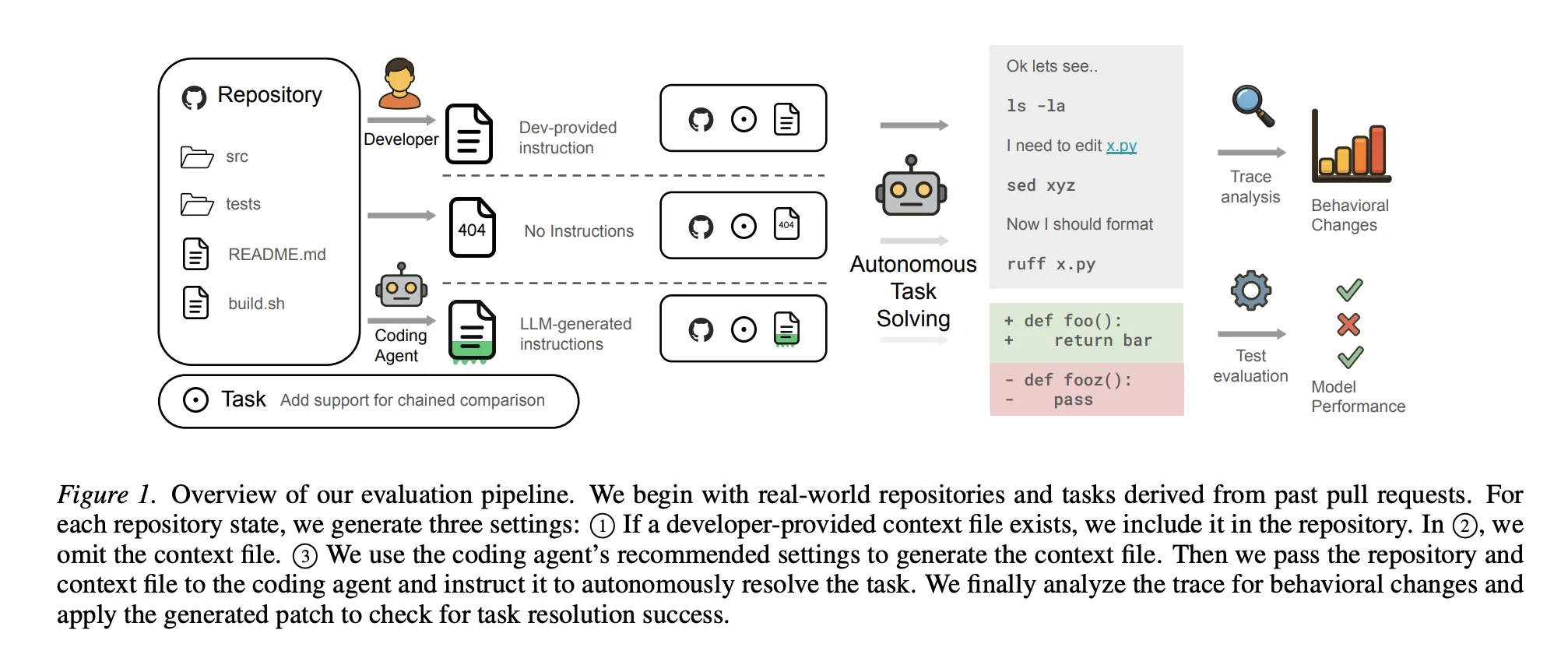
New ETH Zurich Study Proves Your AI Coding Agents are Failing Because Your AGENTS.md Files are too DetailedMarkTechPost In the high-stakes world of AI, ‘Context Engineering’ has emerged as the latest frontier for squeezing performance out of LLMs. Industry leaders have touted AGENTS.md (and its cousins like CLAUDE.md) as the ultimate configuration point for coding agents—a repository-level ‘North Star’ injected into every conversation to guide the AI through complex codebases. But a recent
The post New ETH Zurich Study Proves Your AI Coding Agents are Failing Because Your AGENTS.md Files are too Detailed appeared first on MarkTechPost.
In the high-stakes world of AI, ‘Context Engineering’ has emerged as the latest frontier for squeezing performance out of LLMs. Industry leaders have touted AGENTS.md (and its cousins like CLAUDE.md) as the ultimate configuration point for coding agents—a repository-level ‘North Star’ injected into every conversation to guide the AI through complex codebases. But a recent
The post New ETH Zurich Study Proves Your AI Coding Agents are Failing Because Your AGENTS.md Files are too Detailed appeared first on MarkTechPost. Read More
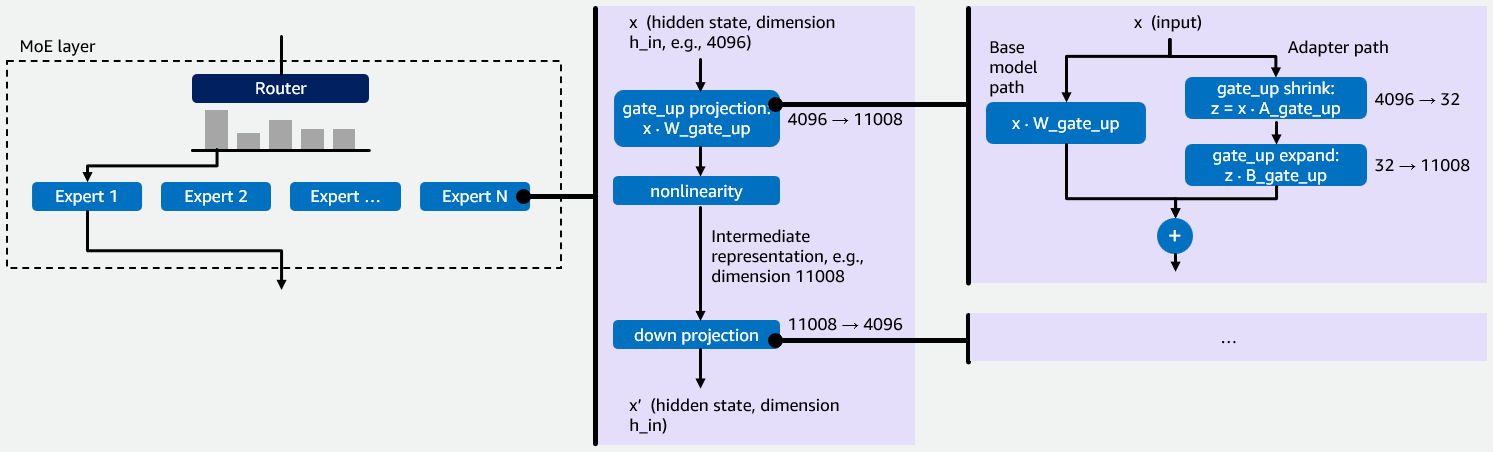
Efficiently serve dozens of fine-tuned models with vLLM on Amazon SageMaker AI and Amazon BedrockArtificial Intelligence In this post, we explain how we implemented multi-LoRA inference for Mixture of Experts (MoE) models in vLLM, describe the kernel-level optimizations we performed, and show you how you can benefit from this work. We use GPT-OSS 20B as our primary example throughout this post.
In this post, we explain how we implemented multi-LoRA inference for Mixture of Experts (MoE) models in vLLM, describe the kernel-level optimizations we performed, and show you how you can benefit from this work. We use GPT-OSS 20B as our primary example throughout this post. Read More