

Splitwise: Collaborative Edge-Cloud Inference for LLMs via Lyapunov-Assisted DRLcs.AI updates on arXiv.org arXiv:2512.23310v1 Announce Type: cross
Abstract: Deploying large language models (LLMs) on edge devices is challenging due to their limited memory and power resources. Cloud-only inference reduces device burden but introduces high latency and cost. Static edge-cloud partitions optimize a single metric and struggle when bandwidth fluctuates. We propose Splitwise, a novel Lyapunov-assisted deep reinforcement learning (DRL) framework for fine-grained, adaptive partitioning of LLMs across edge and cloud environments. Splitwise decomposes transformer layers into attention heads and feed-forward sub-blocks, exposing more partition choices than layer-wise schemes. A hierarchical DRL policy, guided by Lyapunov optimization, jointly minimizes latency, energy consumption, and accuracy degradation while guaranteeing queue stability under stochastic workloads and variable network bandwidth. Splitwise also guarantees robustness via partition checkpoints with exponential backoff recovery in case of communication failures. Experiments on Jetson Orin NX, Galaxy S23, and Raspberry Pi 5 with GPT-2 (1.5B), LLaMA-7B, and LLaMA-13B show that Splitwise reduces end-to-end latency by 1.4x-2.8x and cuts energy consumption by up to 41% compared with existing partitioners. It lowers the 95th-percentile latency by 53-61% relative to cloud-only execution, while maintaining accuracy and modest memory requirements.
arXiv:2512.23310v1 Announce Type: cross
Abstract: Deploying large language models (LLMs) on edge devices is challenging due to their limited memory and power resources. Cloud-only inference reduces device burden but introduces high latency and cost. Static edge-cloud partitions optimize a single metric and struggle when bandwidth fluctuates. We propose Splitwise, a novel Lyapunov-assisted deep reinforcement learning (DRL) framework for fine-grained, adaptive partitioning of LLMs across edge and cloud environments. Splitwise decomposes transformer layers into attention heads and feed-forward sub-blocks, exposing more partition choices than layer-wise schemes. A hierarchical DRL policy, guided by Lyapunov optimization, jointly minimizes latency, energy consumption, and accuracy degradation while guaranteeing queue stability under stochastic workloads and variable network bandwidth. Splitwise also guarantees robustness via partition checkpoints with exponential backoff recovery in case of communication failures. Experiments on Jetson Orin NX, Galaxy S23, and Raspberry Pi 5 with GPT-2 (1.5B), LLaMA-7B, and LLaMA-13B show that Splitwise reduces end-to-end latency by 1.4x-2.8x and cuts energy consumption by up to 41% compared with existing partitioners. It lowers the 95th-percentile latency by 53-61% relative to cloud-only execution, while maintaining accuracy and modest memory requirements. Read More
Eliminating Inductive Bias in Reward Models with Information-Theoretic Guidancecs.AI updates on arXiv.org arXiv:2512.23461v1 Announce Type: cross
Abstract: Reward models (RMs) are essential in reinforcement learning from human feedback (RLHF) to align large language models (LLMs) with human values. However, RM training data is commonly recognized as low-quality, containing inductive biases that can easily lead to overfitting and reward hacking. For example, more detailed and comprehensive responses are usually human-preferred but with more words, leading response length to become one of the inevitable inductive biases. A limited number of prior RM debiasing approaches either target a single specific type of bias or model the problem with only simple linear correlations, textit{e.g.}, Pearson coefficients. To mitigate more complex and diverse inductive biases in reward modeling, we introduce a novel information-theoretic debiasing method called textbf{D}ebiasing via textbf{I}nformation optimization for textbf{R}M (DIR). Inspired by the information bottleneck (IB), we maximize the mutual information (MI) between RM scores and human preference pairs, while minimizing the MI between RM outputs and biased attributes of preference inputs. With theoretical justification from information theory, DIR can handle more sophisticated types of biases with non-linear correlations, broadly extending the real-world application scenarios for RM debiasing methods. In experiments, we verify the effectiveness of DIR with three types of inductive biases: textit{response length}, textit{sycophancy}, and textit{format}. We discover that DIR not only effectively mitigates target inductive biases but also enhances RLHF performance across diverse benchmarks, yielding better generalization abilities. The code and training recipes are available at https://github.com/Qwen-Applications/DIR.
arXiv:2512.23461v1 Announce Type: cross
Abstract: Reward models (RMs) are essential in reinforcement learning from human feedback (RLHF) to align large language models (LLMs) with human values. However, RM training data is commonly recognized as low-quality, containing inductive biases that can easily lead to overfitting and reward hacking. For example, more detailed and comprehensive responses are usually human-preferred but with more words, leading response length to become one of the inevitable inductive biases. A limited number of prior RM debiasing approaches either target a single specific type of bias or model the problem with only simple linear correlations, textit{e.g.}, Pearson coefficients. To mitigate more complex and diverse inductive biases in reward modeling, we introduce a novel information-theoretic debiasing method called textbf{D}ebiasing via textbf{I}nformation optimization for textbf{R}M (DIR). Inspired by the information bottleneck (IB), we maximize the mutual information (MI) between RM scores and human preference pairs, while minimizing the MI between RM outputs and biased attributes of preference inputs. With theoretical justification from information theory, DIR can handle more sophisticated types of biases with non-linear correlations, broadly extending the real-world application scenarios for RM debiasing methods. In experiments, we verify the effectiveness of DIR with three types of inductive biases: textit{response length}, textit{sycophancy}, and textit{format}. We discover that DIR not only effectively mitigates target inductive biases but also enhances RLHF performance across diverse benchmarks, yielding better generalization abilities. The code and training recipes are available at https://github.com/Qwen-Applications/DIR. Read More
Timepoint-Specific Benchmarking of Deep Learning Models for Glioblastoma Follow-Up MRIcs.AI updates on arXiv.org arXiv:2511.18595v2 Announce Type: replace-cross
Abstract: Differentiating true tumor progression (TP) from treatment-related pseudoprogression (PsP) in glioblastoma remains challenging, especially at early follow-up. We present the first stage-specific, cross-sectional benchmarking of deep learning models for follow-up MRI using the Burdenko GBM Progression cohort (n = 180). We analyze different post-RT scans independently to test whether architecture performance depends on time-point. Eleven representative DL families (CNNs, LSTMs, hybrids, transformers, and selective state-space models) were trained under a unified, QC-driven pipeline with patient-level cross-validation. Across both stages, accuracies were comparable (~0.70-0.74), but discrimination improved at the second follow-up, with F1 and AUC increasing for several models, indicating richer separability later in the care pathway. A Mamba+CNN hybrid consistently offered the best accuracy-efficiency trade-off, while transformer variants delivered competitive AUCs at substantially higher computational cost and lightweight CNNs were efficient but less reliable. Performance also showed sensitivity to batch size, underscoring the need for standardized training protocols. Notably, absolute discrimination remained modest overall, reflecting the intrinsic difficulty of TP vs. PsP and the dataset’s size imbalance. These results establish a stage-aware benchmark and motivate future work incorporating longitudinal modeling, multi-sequence MRI, and larger multi-center cohorts.
arXiv:2511.18595v2 Announce Type: replace-cross
Abstract: Differentiating true tumor progression (TP) from treatment-related pseudoprogression (PsP) in glioblastoma remains challenging, especially at early follow-up. We present the first stage-specific, cross-sectional benchmarking of deep learning models for follow-up MRI using the Burdenko GBM Progression cohort (n = 180). We analyze different post-RT scans independently to test whether architecture performance depends on time-point. Eleven representative DL families (CNNs, LSTMs, hybrids, transformers, and selective state-space models) were trained under a unified, QC-driven pipeline with patient-level cross-validation. Across both stages, accuracies were comparable (~0.70-0.74), but discrimination improved at the second follow-up, with F1 and AUC increasing for several models, indicating richer separability later in the care pathway. A Mamba+CNN hybrid consistently offered the best accuracy-efficiency trade-off, while transformer variants delivered competitive AUCs at substantially higher computational cost and lightweight CNNs were efficient but less reliable. Performance also showed sensitivity to batch size, underscoring the need for standardized training protocols. Notably, absolute discrimination remained modest overall, reflecting the intrinsic difficulty of TP vs. PsP and the dataset’s size imbalance. These results establish a stage-aware benchmark and motivate future work incorporating longitudinal modeling, multi-sequence MRI, and larger multi-center cohorts. Read More
The Law of Multi-Model Collaboration: Scaling Limits of Model Ensembling for Large Language Modelscs.AI updates on arXiv.org arXiv:2512.23340v1 Announce Type: cross
Abstract: Recent advances in large language models (LLMs) have been largely driven by scaling laws for individual models, which predict performance improvements as model parameters and data volume increase. However, the capabilities of any single LLM are inherently bounded. One solution originates from intricate interactions among multiple LLMs, rendering their collective performance surpasses that of any constituent model. Despite the rapid proliferation of multi-model integration techniques such as model routing and post-hoc ensembling, a unifying theoretical framework of performance scaling for multi-model collaboration remains absent. In this work, we propose the Law of Multi-model Collaboration, a scaling law that predicts the performance limits of LLM ensembles based on their aggregated parameter budget. To quantify the intrinsic upper bound of multi-model collaboration, we adopt a method-agnostic formulation and assume an idealized integration oracle where the total cross-entropy loss of each sample is determined by the minimum loss of any model in the model pool. Experimental results reveal that multi-model systems follow a power-law scaling with respect to the total parameter count, exhibiting a more significant improvement trend and a lower theoretical loss floor compared to single model scaling. Moreover, ensembles of heterogeneous model families achieve better performance scaling than those formed within a single model family, indicating that model diversity is a primary driver of collaboration gains. These findings suggest that model collaboration represents a critical axis for extending the intelligence frontier of LLMs.
arXiv:2512.23340v1 Announce Type: cross
Abstract: Recent advances in large language models (LLMs) have been largely driven by scaling laws for individual models, which predict performance improvements as model parameters and data volume increase. However, the capabilities of any single LLM are inherently bounded. One solution originates from intricate interactions among multiple LLMs, rendering their collective performance surpasses that of any constituent model. Despite the rapid proliferation of multi-model integration techniques such as model routing and post-hoc ensembling, a unifying theoretical framework of performance scaling for multi-model collaboration remains absent. In this work, we propose the Law of Multi-model Collaboration, a scaling law that predicts the performance limits of LLM ensembles based on their aggregated parameter budget. To quantify the intrinsic upper bound of multi-model collaboration, we adopt a method-agnostic formulation and assume an idealized integration oracle where the total cross-entropy loss of each sample is determined by the minimum loss of any model in the model pool. Experimental results reveal that multi-model systems follow a power-law scaling with respect to the total parameter count, exhibiting a more significant improvement trend and a lower theoretical loss floor compared to single model scaling. Moreover, ensembles of heterogeneous model families achieve better performance scaling than those formed within a single model family, indicating that model diversity is a primary driver of collaboration gains. These findings suggest that model collaboration represents a critical axis for extending the intelligence frontier of LLMs. Read More
QLLM: Do We Really Need a Mixing Network for Credit Assignment in Multi-Agent Reinforcement Learning?cs.AI updates on arXiv.org arXiv:2504.12961v4 Announce Type: replace-cross
Abstract: Credit assignment has remained a fundamental challenge in multi-agent reinforcement learning (MARL). Previous studies have primarily addressed this issue through value decomposition methods under the centralized training with decentralized execution paradigm, where neural networks are utilized to approximate the nonlinear relationship between individual Q-values and the global Q-value. Although these approaches have achieved considerable success in various benchmark tasks, they still suffer from several limitations, including imprecise attribution of contributions, limited interpretability, and poor scalability in high-dimensional state spaces. To address these challenges, we propose a novel algorithm, QLLM, which facilitates the automatic construction of credit assignment functions using large language models (LLMs). Specifically, the concept of TFCAF is introduced, wherein the credit allocation process is represented as a direct and expressive nonlinear functional formulation. A custom-designed coder-evaluator framework is further employed to guide the generation and verification of executable code by LLMs, significantly mitigating issues such as hallucination and shallow reasoning during inference. Furthermore, an IGM-Gating Mechanism enables QLLM to flexibly enforce or relax the monotonicity constraint depending on task demands, covering both IGM-compliant and non-monotonic scenarios. Extensive experiments conducted on several standard MARL benchmarks demonstrate that the proposed method consistently outperforms existing state-of-the-art baselines. Moreover, QLLM exhibits strong generalization capability and maintains compatibility with a wide range of MARL algorithms that utilize mixing networks, positioning it as a promising and versatile solution for complex multi-agent scenarios. The code is available at https://github.com/zhouyangjiang71-sys/QLLM.
arXiv:2504.12961v4 Announce Type: replace-cross
Abstract: Credit assignment has remained a fundamental challenge in multi-agent reinforcement learning (MARL). Previous studies have primarily addressed this issue through value decomposition methods under the centralized training with decentralized execution paradigm, where neural networks are utilized to approximate the nonlinear relationship between individual Q-values and the global Q-value. Although these approaches have achieved considerable success in various benchmark tasks, they still suffer from several limitations, including imprecise attribution of contributions, limited interpretability, and poor scalability in high-dimensional state spaces. To address these challenges, we propose a novel algorithm, QLLM, which facilitates the automatic construction of credit assignment functions using large language models (LLMs). Specifically, the concept of TFCAF is introduced, wherein the credit allocation process is represented as a direct and expressive nonlinear functional formulation. A custom-designed coder-evaluator framework is further employed to guide the generation and verification of executable code by LLMs, significantly mitigating issues such as hallucination and shallow reasoning during inference. Furthermore, an IGM-Gating Mechanism enables QLLM to flexibly enforce or relax the monotonicity constraint depending on task demands, covering both IGM-compliant and non-monotonic scenarios. Extensive experiments conducted on several standard MARL benchmarks demonstrate that the proposed method consistently outperforms existing state-of-the-art baselines. Moreover, QLLM exhibits strong generalization capability and maintains compatibility with a wide range of MARL algorithms that utilize mixing networks, positioning it as a promising and versatile solution for complex multi-agent scenarios. The code is available at https://github.com/zhouyangjiang71-sys/QLLM. Read More
What Advent of Code Has Taught Me About Data ScienceTowards Data Science Five key learnings that I discovered during a programming challenge and how they apply to data science
The post What Advent of Code Has Taught Me About Data Science appeared first on Towards Data Science.
Five key learnings that I discovered during a programming challenge and how they apply to data science
The post What Advent of Code Has Taught Me About Data Science appeared first on Towards Data Science. Read More
10 Lesser-Known Python Libraries Every Data Scientist Should Be Using in 2026KDnuggets Want to level up your data science toolkit? Here are some Python libraries that’ll make your work easier.
Want to level up your data science toolkit? Here are some Python libraries that’ll make your work easier. Read More
Chunk Size as an Experimental Variable in RAG SystemsTowards Data Science Understanding retrieval in RAG systems by experimenting with different chunk sizes
The post Chunk Size as an Experimental Variable in RAG Systems appeared first on Towards Data Science.
Understanding retrieval in RAG systems by experimenting with different chunk sizes
The post Chunk Size as an Experimental Variable in RAG Systems appeared first on Towards Data Science. Read More
The Machine Learning “Advent Calendar” Bonus 2: Gradient Descent Variants in ExcelTowards Data Science Gradient Descent, Momentum, RMSProp, and Adam all aim for the same minimum. They do not change the destination, only the path. Each method adds a mechanism that fixes a limitation of the previous one, making the movement faster, more stable, or more adaptive. The goal stays the same. The update becomes smarter.
The post The Machine Learning “Advent Calendar” Bonus 2: Gradient Descent Variants in Excel appeared first on Towards Data Science.
Gradient Descent, Momentum, RMSProp, and Adam all aim for the same minimum. They do not change the destination, only the path. Each method adds a mechanism that fixes a limitation of the previous one, making the movement faster, more stable, or more adaptive. The goal stays the same. The update becomes smarter.
The post The Machine Learning “Advent Calendar” Bonus 2: Gradient Descent Variants in Excel appeared first on Towards Data Science. Read More
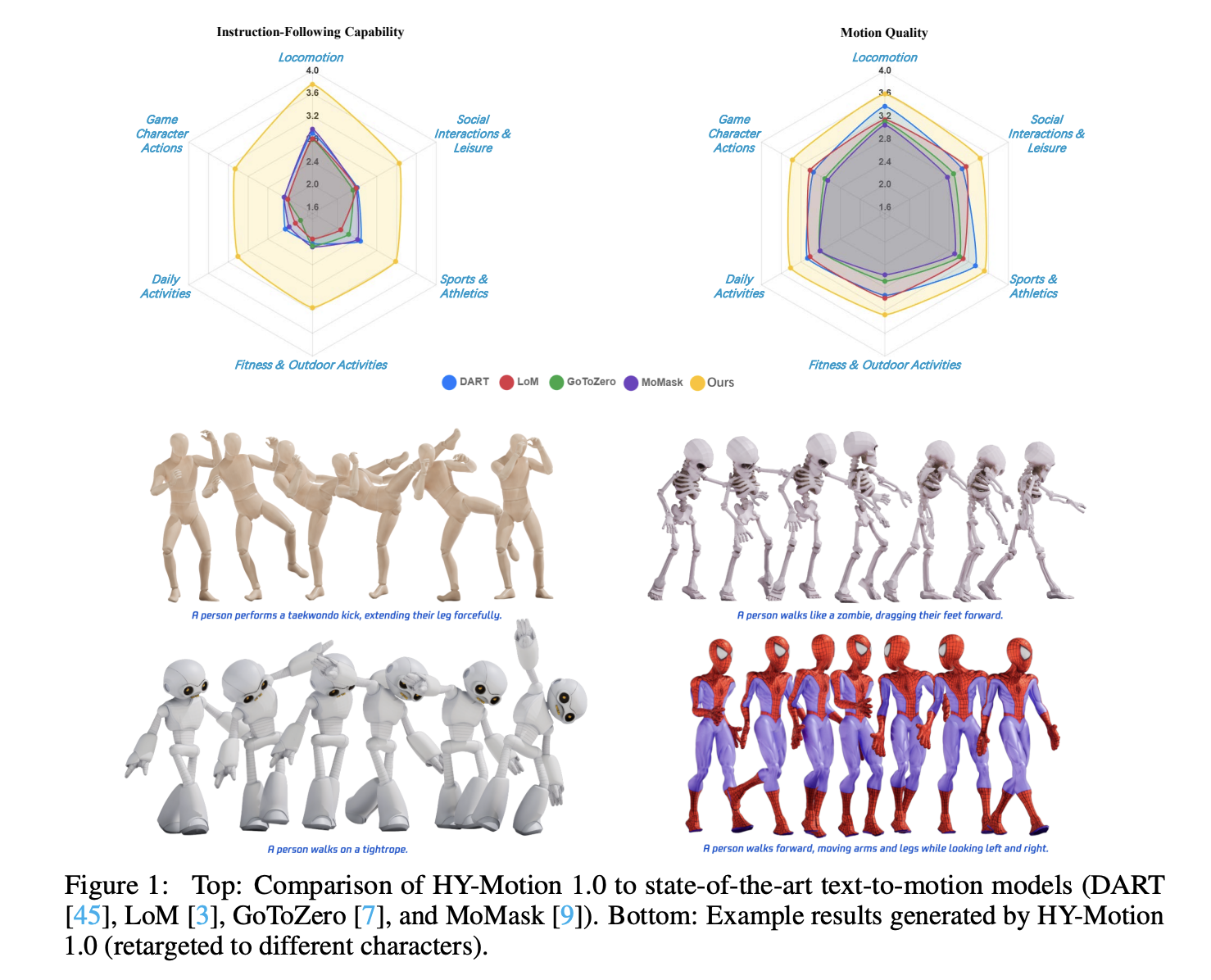
Tencent Released Tencent HY-Motion 1.0: A Billion-Parameter Text-to-Motion Model Built on the Diffusion Transformer (DiT) Architecture and Flow MatchingMarkTechPost Tencent Hunyuan’s 3D Digital Human team has released HY-Motion 1.0, an open weight text-to-3D human motion generation family that scales Diffusion Transformer based Flow Matching to 1B parameters in the motion domain. The models turn natural language prompts plus an expected duration into 3D human motion clips on a unified SMPL-H skeleton and are available
The post Tencent Released Tencent HY-Motion 1.0: A Billion-Parameter Text-to-Motion Model Built on the Diffusion Transformer (DiT) Architecture and Flow Matching appeared first on MarkTechPost.
Tencent Hunyuan’s 3D Digital Human team has released HY-Motion 1.0, an open weight text-to-3D human motion generation family that scales Diffusion Transformer based Flow Matching to 1B parameters in the motion domain. The models turn natural language prompts plus an expected duration into 3D human motion clips on a unified SMPL-H skeleton and are available
The post Tencent Released Tencent HY-Motion 1.0: A Billion-Parameter Text-to-Motion Model Built on the Diffusion Transformer (DiT) Architecture and Flow Matching appeared first on MarkTechPost. Read More