

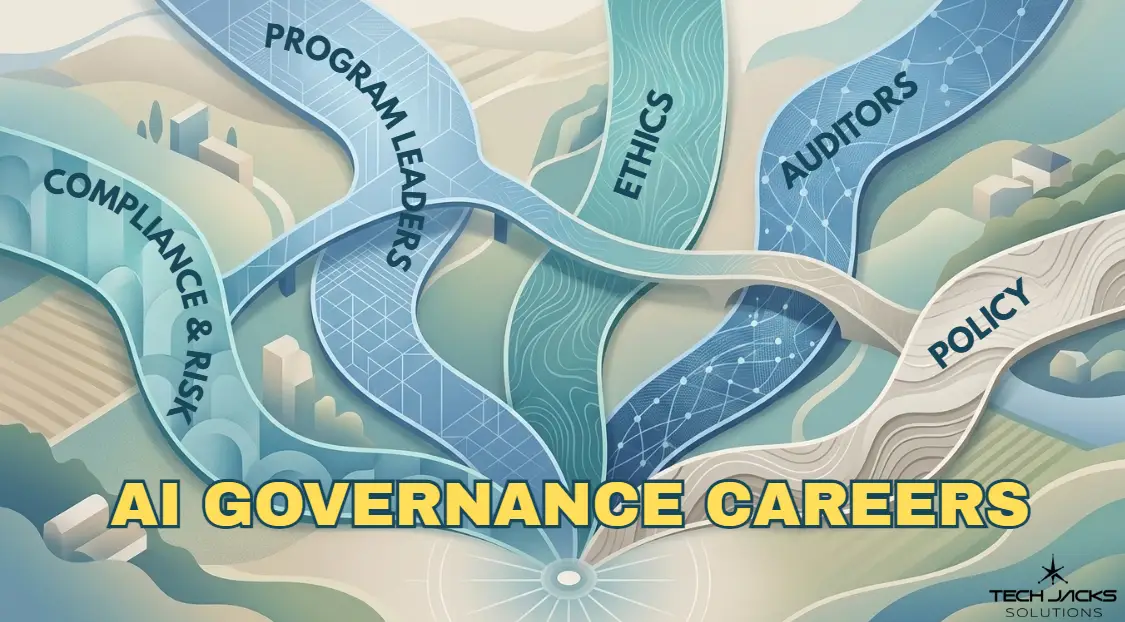
This guide is one piece of a 20-role interactive ecosystem with verified salary data, skills assessments, and market intelligence. Start with the tool that fits where you are right now.
AI Governance Careers at a Glance
The numbers that matter, the links that get you there faster.
AI Governance Careers
Companies everywhere are hiring AI governance professionals. Fast.
The numbers tell the story. According to the IAPP AI Governance Profession Report, 77% of organizations are actively building AI governance programs, and that figure climbs above 85% among companies already deploying AI. The problem is staffing: only 1.5% of organizations report being satisfied with their current AI governance headcount. Meanwhile, the World Economic Forum’s Future of Jobs Report 2025 projects 170 million new jobs created globally by 2030 and 92 million displaced, for a net gain of 78 million positions. Governance, risk, and oversight roles are among the fastest-growing categories in that projection.
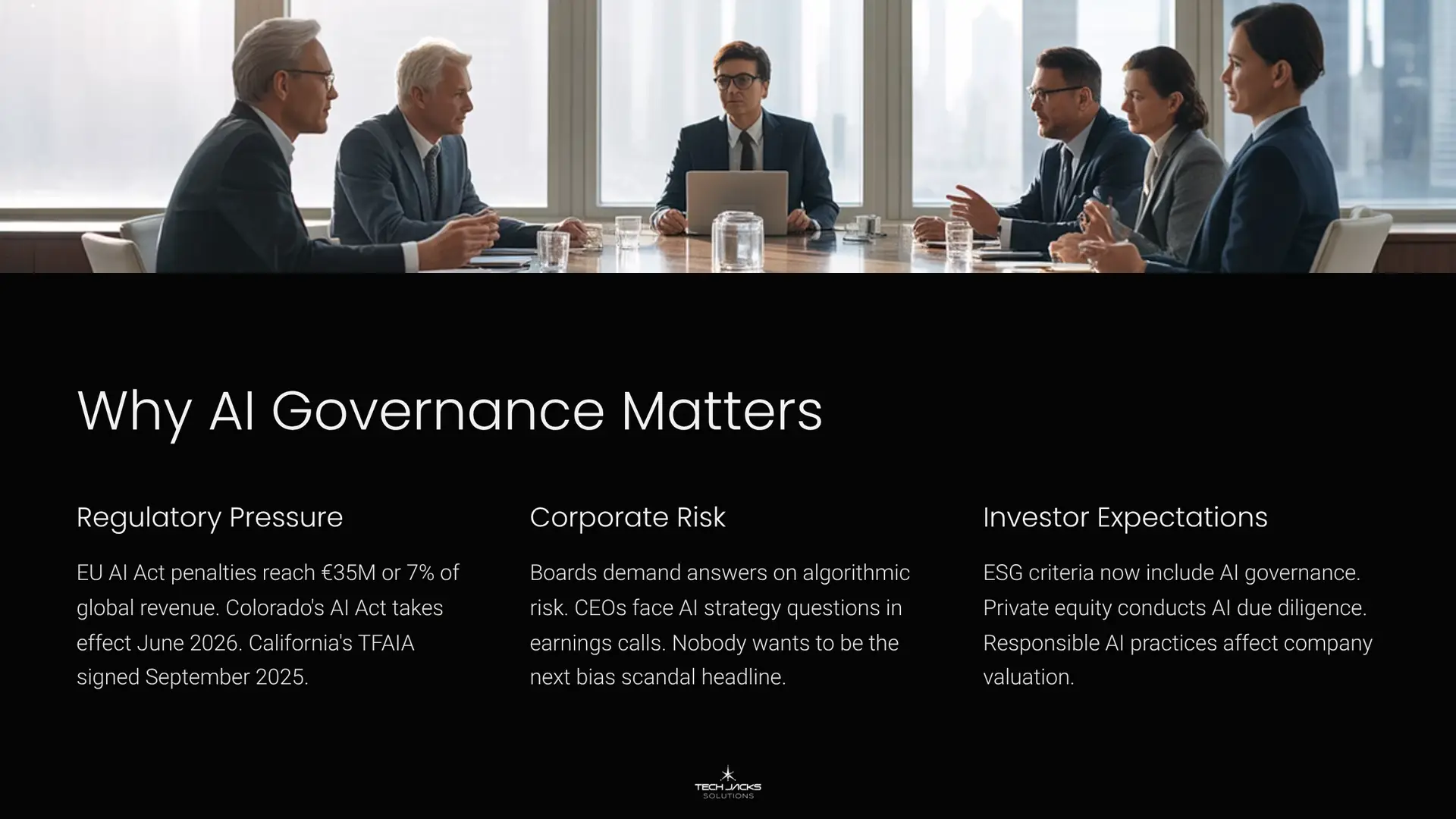
The EU AI Act’s most consequential provisions take effect August 2, 2026: high-risk system requirements, transparency obligations, and enforcement mechanisms all go live on the same date. Corporate boards face direct liability for AI failures. Investors want proof that companies can manage algorithmic risk.
This creates opportunity.
You don’t need to be a machine learning engineer to break into AI governance. If you understand compliance, know how to assess risk, or can translate technical concepts into business language, you already have transferable skills. The field needs people who think about fairness, accountability, and how systems affect real humans. It needs people who can read regulations and actually implement them.
I’m baffled that more of my colleagues haven’t jumped on this yet. I saw the same thing happen with cloud computing and DevOps. Early movers built entire careers. Governance has never been the sexy part of tech, but it pays well and the work matters. The field is wide open right now.
You don’t need to be a machine learning engineer to break into AI governance. If you understand compliance, know how to assess risk, or can translate technical concepts into business language, you already have transferable skills. The field needs people who think about fairness, accountability, and how systems affect real humans. It needs people who can read regulations and actually implement them.
I’m baffled that more of my colleagues haven’t jumped on this yet. I saw the same thing happen with cloud computing and DevOps. Early movers built entire careers. Governance has never been the sexy part of tech, but it pays well and the work matters. The field is wide open right now.
This guide is part of the AI Governance Career Hub. For the latest salary benchmarks, hiring trends, and interactive career tools, explore the full hub ecosystem.
What is AI Governance and Why Does It Matter?
AI governance means making sure artificial intelligence gets used responsibly. You’re looking at transparency, fairness, accountability, and staying legal. Think of it as quality control for algorithms.
Every industry with regulatory oversight needs this. Finance, healthcare, government, insurance. They’re not just worried about compliance fines (though the EU AI Act can impose penalties up to €35 million or 7% of global annual turnover under Article 99). The Act classifies AI systems into four risk tiers (Unacceptable, High, Limited, and Minimal), and anything touching hiring, lending, insurance, or law enforcement lands in the high-risk category. Companies are worried about algorithmic bias in hiring, discriminatory lending models, diagnostic errors, wrongful arrests from facial recognition.
The NIST AI Risk Management Framework (released January 26, 2023) provides structure for how organizations should approach AI governance, defining four core functions: Govern, Map, Measure, and Manage. ISO/IEC 42001, published in December 2023, adds an international standard for AI management systems that gives organizations a certifiable framework. Most companies are actively building governance programs but critically understaffed for the work ahead. That’s where you come in.

Key Roles in AI Governance Career Paths |
The field has organized into 20 distinct roles across six categories, from entry-level positions starting around $75K to executive roles exceeding $400K. Your background determines which path makes the most sense. The grid below covers every active role in the market with salary ranges, demand levels, and whether it's accessible without prior AI governance experience.
| Role | Salary Range | Demand | Entry-Level? | Background Fit |
|---|
For interactive comparison tools, skills assessments, and detailed career guides for each role, visit the Roles & Career Paths page.
Salary Expectations
AI governance pays competitively, and the data tells a clear story about where the money concentrates. According to the IAPP 2025-26 Salary and Jobs Report (surveying over 1,600 professionals across 60+ countries), professionals working in both privacy and AI governance earn a median of $169,700 in total compensation. Those focused solely on AI governance earn a median of $151,800, while privacy-only professionals sit at $123,000. That $46,700 gap between privacy-only and dual-expertise roles is one of the clearest salary acceleration strategies in the field.
Professionals who add AI governance to an existing privacy, compliance, or legal background see measurable compensation gains. Technology sector roles push even higher, with legal and compliance positions earning a median of $205,000 and technical AI governance roles reaching $221,000. Entry-level positions typically start between $75,000 and $95,000 based on current market postings.
Market Corroboration and Work Structure
Independent job market data confirms these numbers. An Axial Search analysis of 146 AI governance postings (January 2026) found a median salary of $158,750, with 85% of positions targeting professionals with five or more years of experience. Geographic premiums still exist (San Francisco, New York, and Seattle command higher base salaries), but the traditional location lock is loosening. The IAPP reports that 61% of AI governance professionals now work from home more than from an office. Factor in that 70% receive bonuses and 88% at medium-to-large organizations receive health benefits, and total compensation typically exceeds base salary by a meaningful margin.
These are the headlines. For role-by-role breakdowns, certification premiums, and an interactive salary estimator that adjusts for your experience and specialization, explore our full Salary Data page.
Why AI Governance is Growing Rapidly
Three forces are converging to drive sustained demand for governance professionals: regulatory deadlines with real penalties, a corporate investment surge that has outpaced operational readiness, and shifting investor expectations around AI risk. Explore each driver below, then see the compliance deadlines shaping hiring urgency.
The Regulatory Countdown
Key dates shaping AI governance hiring demand. Upcoming deadlines are highlighted.
How to Transition Into an AI Governance Career
Here is the part most people get wrong about AI governance: they assume it requires a background in artificial intelligence. It does not. The OECD found that 72% of high-AI-exposure vacancies require management skills and 67% require business process expertise, not deep technical fluency. The skills that matter most in this field (regulatory analysis, stakeholder communication, risk assessment, policy writing) are the same skills built across compliance, legal, privacy, audit, IT, and dozens of other professional backgrounds.
The talent pipeline reflects this. According to the IAPP, 68% of privacy professionals have already added AI governance to their responsibilities. The ISACA reports that 47% of cybersecurity teams are now involved in AI governance activities, up from 35% the prior year. These professionals are not starting from scratch. They are applying domain expertise they already have to a governance function that desperately needs it.
Select your current background below to see which AI governance roles are the strongest match, how long the transition typically takes, and where to start.
If your background is not listed above, or you want to explore the full landscape of 20 roles across six categories, visit the Roles and Career Paths page for the complete interactive taxonomy.
Essential Certifications for AI Governance
Certifications are not gatekeepers in AI governance. Only 12% of postings explicitly request them (Axial Search, Jan 2026). But they are accelerators. The IAPP reports that 77% of governance professionals hold at least one IAPP certification and 39% hold multiple, with measurable salary premiums: approximately 13% higher compensation with one IAPP credential and 27% higher with multiple. When you are competing against candidates who already hold these credentials, not having them puts you at a disadvantage even when the posting does not require them.
The certification landscape for AI governance has expanded rapidly since 2024. The IAPP AIGP ($649 to $799 exam fee, no prerequisites) has become the anchor credential for the field, with its Body of Knowledge updated to version 2.1 in February 2026 to include agentic AI architectures and updated regulatory coverage. ISACA followed with the AAIA for AI auditors and the CDPSE for privacy engineers, while GARP introduced the RAI certificate for financial services risk professionals. The table below compares every certification relevant to AI governance careers, filterable by category, so you can prioritize based on your target role and current background.
AI Governance Certification Comparison
Filter by category. Costs verified as of February 2026.
Beyond certifications, structured learning accelerates your readiness. Free options include AI Governance 101 (covers NIST AI RMF, ISO 42001, and EU AI Act), Coursera courses from Wharton and Oxford on AI governance strategy, and the NIST AI RMF Playbook for framework-level depth. For premium training, the IAPP offers official AIGP prep ($995 to $1,195) and Dr. Kyle David's AIGP Certification Masterclass on Udemy covers the full v2.1 Body of Knowledge. Georgetown University offers a Certificate in AI Governance and Compliance ($2,995, 32 contact hours, no technical prerequisites) with a capstone project.
For community and networking, the IAPP is the single most valuable professional organization, with its Global Privacy Summit (March 30 to April 1, 2026, Washington, D.C.), 400+ free CPE webinars annually, and local chapters in 60+ countries. ISACA provides strong GRC-oriented networking across 230+ chapters worldwide. Hands-on experience matters as much as credentials: volunteer for AI governance committees, build model cards and risk assessments, and contribute to open-source fairness tools like Fairlearn or IBM AIF360.
For the full certification deep-dive and salary premium analysis for each role, visit the individual role guides where each of the 20 roles includes a dedicated "Certifications That Move the Needle" section with role-specific recommendations and cost breakdowns. For compensation benchmarks tied to certification holdings, see the Salary Data page.
Career Progression Pathways
Career paths in AI governance are not linear, but clear patterns have emerged as the field matures. Most professionals enter through adjacent disciplines (compliance, legal, privacy, IT, audit) and progress through increasingly senior governance roles as they build cross-functional expertise and regulatory depth. The ladder below maps four tiers of progression from entry-level positions through executive leadership, with salary ranges and representative roles at each level.
Each of the 20 roles in our taxonomy includes a dedicated career pathways section showing feeder roles, lateral moves, and advancement targets. For the compensation view of this same progression (including certification premiums and sector differentials), visit the Salary Data page. To explore the full role landscape with filtering by category, demand level, and background fit, visit the Roles and Career Paths page.
Strategic Development RecommendationsStrategic Development Recommendations
The timelines below assume you are starting from an adjacent profession and building toward a dedicated AI governance role. The urgency is real: the EU AI Act's high-risk system requirements become enforceable on August 2, 2026, and Colorado's SB 24-205 takes effect June 30, 2026. Organizations are hiring governance professionals now to meet those deadlines.
Immediate actions (0 to 6 months). Identify your target role using the Career Evaluator (7 questions, personalized results) or the Background Fit Navigator above. Once you know which role fits your experience, read the full role guide for your top match on the Roles and Career Paths page. Every guide includes a learning roadmap, certification priorities, and quick-start actions specific to that role. If you begin today, you can be AIGP-certified and job-ready before either regulatory deadline arrives.
Medium-term development (6 to 18 months). Use the Certification Comparison Table to plan your credential stack. One IAPP certification correlates with approximately 13% higher compensation, and multiple certifications push that to 27%. Build a portfolio of governance artifacts (model cards, risk assessments, policy documents) using the frameworks covered in each role guide's Learning Roadmap section. Track hiring trends and compensation benchmarks on the Market Intelligence page and Salary Data page to ensure your specialization aligns with where demand is heading.
Long-term positioning (18+ months). The Robert Half 2026 Salary Guide projects 4.1% salary growth for AI, ML, and data science roles (above average), with "AI governance" explicitly cited as a premium talent area. Target the Senior ($190K to $250K+) and Executive ($250K to $400K+) tiers visible in the Career Ladder. Explore the high-value specializations in the next section to identify where the deepest demand concentration will be over the next three to five years.
High-Value Specializations
Certain areas within AI governance are experiencing outsized demand. If you are choosing where to deepen your expertise, these six specializations represent the strongest concentration of hiring activity and compensation premiums heading into 2027.
Generative AI Governance. Managing risks specific to large language models, including prompt injection vulnerabilities, hallucination management, copyright exposure, and training data privacy. The ModelOp 2025 Benchmark Report found that 80% of enterprises now have 50 or more generative AI use cases in production, but only 14% have enterprise-level AI assurance programs covering them. That 66-point gap is where gen AI governance professionals operate, and it is widening as deployment accelerates faster than oversight. Roles with the strongest gen AI focus include AI Risk Manager, Responsible AI Scientist, and AI Model Validator.
Agentic AI Governance. Autonomous AI systems that plan, reason, and act independently create unprecedented governance challenges around accountability, ethical reasoning, and decision transparency. When an AI agent executes a multi-step workflow without human intervention, who is responsible for the outcome? Companies like OneTrust and IBM are building governance platforms specifically for autonomous AI workflows. The IAPP recognized this shift by adding agentic architectures to the AIGP Body of Knowledge v2.1 (effective February 2026). This specialization is early-stage but growing fast, particularly relevant for AI Systems Safety Manager and AI Ethics Officer roles.
AI Regulatory Compliance. Navigating the EU AI Act, state-level regulations like Colorado's SB 24-205 and California's TFAIA, and sector-specific requirements. This specialization will remain in sustained demand as regulations multiply across jurisdictions. The strongest entry points are AI Compliance Manager and AI Policy Analyst.
AI Model Risk Management. Validating and auditing complex AI systems for accuracy, bias, drift, and regulatory compliance. Financial services firms are the primary employers given existing model risk management frameworks (SR 11-7, OCC 2011-12), but demand is expanding into healthcare, insurance, and any sector deploying high-stakes decision models. See AI Model Validator and AI Auditor for dedicated role guides.
Physical AI Governance. An emerging sub-field covering governance for AI deployed in the physical world: manufacturing robotics, logistics automation, healthcare robotics, and autonomous vehicles. These systems introduce safety, liability, and accountability dimensions that purely digital AI does not. As traditionally non-tech sectors accelerate AI adoption, governance professionals who understand both the regulatory landscape and the operational realities of physical deployment will command premium positioning.
AI Supply Chain Governance. Managing third-party AI vendor risks across procurement, deployment, and ongoing monitoring. Most organizations use AI services from multiple vendors, and someone needs to assess those risks systematically. The EU AI Act's supply chain obligations (requiring providers and deployers to share compliance documentation) are creating dedicated headcount in this area. Relevant roles include AI Compliance Manager and Data Governance Manager (AI).
For a complete view of all 20 roles mapped by category, demand level, and salary range, visit the Roles and Career Paths page. For compensation benchmarks across specialization areas, see the Salary Data page.
Your Next Steps
AI governance is not a future career opportunity. It is a present one. Organizations are building teams now to meet regulatory deadlines, close the gap between AI deployment and AI oversight, and satisfy board-level demand for accountability. The tools on this page and across the AI Career Hub are designed to turn that opportunity into a concrete plan.
Start here:
- Find your role. Take the Career Evaluator (7 questions, 90 seconds) for a personalized recommendation, or use the Background Fit Navigator to see which roles match your professional experience.
- Explore the landscape. Browse all 20 roles in the Role Grid above or on the Roles and Career Paths page, where each role has a dedicated guide covering salary analysis, skills assessment, certification priorities, and a learning roadmap.
- Plan your credentials. Use the Certification Comparison Table to compare 14 certifications by cost, format, prerequisites, and relevant roles. For a deeper dive on the leading credential, see our AIGP Certification Guide.
- Track the market. Follow hiring trends, demand signals, and compensation benchmarks on the Market Intelligence page and Salary Data page.
- Go deeper. Explore the full AI Governance Career Hub for the complete ecosystem of interactive tools, research, and career resources.
Author: Derrick D. Jackson
Title: Founder & Senior Director of Cloud Security Architecture & Risk
Credentials: CISSP, CRISC, CCSP
Last updated Feb 02-22-2026
