
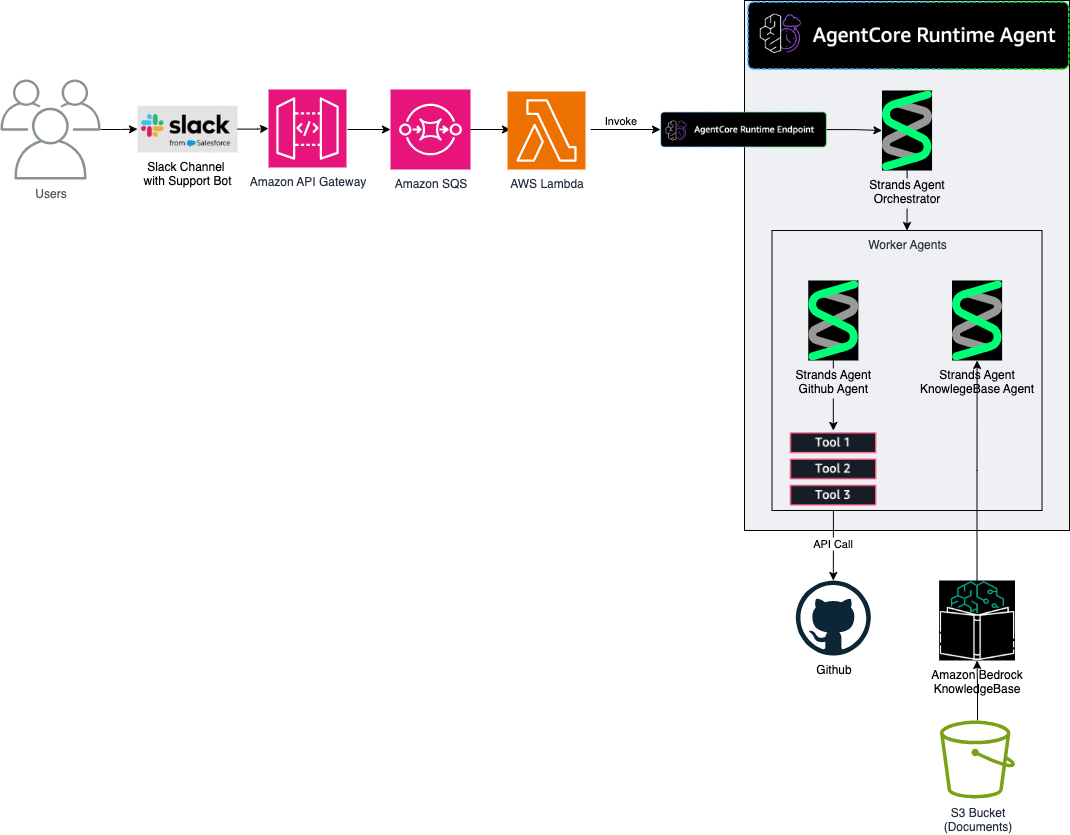
How AutoScout24 built a Bot Factory to standardize AI agent development with Amazon BedrockArtificial Intelligence In this post, we explore the architecture that AutoScout24 used to build their standardized AI development framework, enabling rapid deployment of secure and scalable AI agents.
In this post, we explore the architecture that AutoScout24 used to build their standardized AI development framework, enabling rapid deployment of secure and scalable AI agents. Read More

Generative AI tool helps 3D print personal items that sustain daily useMIT News – Machine learning “MechStyle” allows users to personalize 3D models, while ensuring they’re physically viable after fabrication, producing unique personal items and assistive technology.
“MechStyle” allows users to personalize 3D models, while ensuring they’re physically viable after fabrication, producing unique personal items and assistive technology. Read More

What Is a Knowledge Graph — and Why It MattersTowards Data Science How structured knowledge became healthcare’s quiet advantage
The post What Is a Knowledge Graph — and Why It Matters appeared first on Towards Data Science.
How structured knowledge became healthcare’s quiet advantage
The post What Is a Knowledge Graph — and Why It Matters appeared first on Towards Data Science. Read More

Avoiding Overfitting, Class Imbalance, & Feature Scaling Issues: The Machine Learning Practitioner’s NotebookKDnuggets Machine learning practitioners encounter three persistent challenges that can undermine model performance: overfitting, class imbalance, and feature scaling issues.
Machine learning practitioners encounter three persistent challenges that can undermine model performance: overfitting, class imbalance, and feature scaling issues. Read More
OpenAI partners with Cerebras OpenAI News OpenAI partners with Cerebras to add 750MW of high-speed AI compute, reducing inference latency and making ChatGPT faster for real-time AI workloads.
OpenAI partners with Cerebras to add 750MW of high-speed AI compute, reducing inference latency and making ChatGPT faster for real-time AI workloads. Read More
VideoHEDGE: Entropy-Based Hallucination Detection for Video-VLMs via Semantic Clustering and Spatiotemporal Perturbationscs.AI updates on arXiv.org arXiv:2601.08557v1 Announce Type: cross
Abstract: Hallucinations in video-capable vision-language models (Video-VLMs) remain frequent and high-confidence, while existing uncertainty metrics often fail to align with correctness. We introduce VideoHEDGE, a modular framework for hallucination detection in video question answering that extends entropy-based reliability estimation from images to temporally structured inputs. Given a video-question pair, VideoHEDGE draws a baseline answer and multiple high-temperature generations from both clean clips and photometrically and spatiotemporally perturbed variants, then clusters the resulting textual outputs into semantic hypotheses using either Natural Language Inference (NLI)-based or embedding-based methods. Cluster-level probability masses yield three reliability scores: Semantic Entropy (SE), RadFlag, and Vision-Amplified Semantic Entropy (VASE). We evaluate VideoHEDGE on the SoccerChat benchmark using an LLM-as-a-judge to obtain binary hallucination labels. Across three 7B Video-VLMs (Qwen2-VL, Qwen2.5-VL, and a SoccerChat-finetuned model), VASE consistently achieves the highest ROC-AUC, especially at larger distortion budgets, while SE and RadFlag often operate near chance. We further show that embedding-based clustering matches NLI-based clustering in detection performance at substantially lower computational cost, and that domain fine-tuning reduces hallucination frequency but yields only modest improvements in calibration. The hedge-bench PyPI library enables reproducible and extensible benchmarking, with full code and experimental resources available at https://github.com/Simula/HEDGE#videohedge .
arXiv:2601.08557v1 Announce Type: cross
Abstract: Hallucinations in video-capable vision-language models (Video-VLMs) remain frequent and high-confidence, while existing uncertainty metrics often fail to align with correctness. We introduce VideoHEDGE, a modular framework for hallucination detection in video question answering that extends entropy-based reliability estimation from images to temporally structured inputs. Given a video-question pair, VideoHEDGE draws a baseline answer and multiple high-temperature generations from both clean clips and photometrically and spatiotemporally perturbed variants, then clusters the resulting textual outputs into semantic hypotheses using either Natural Language Inference (NLI)-based or embedding-based methods. Cluster-level probability masses yield three reliability scores: Semantic Entropy (SE), RadFlag, and Vision-Amplified Semantic Entropy (VASE). We evaluate VideoHEDGE on the SoccerChat benchmark using an LLM-as-a-judge to obtain binary hallucination labels. Across three 7B Video-VLMs (Qwen2-VL, Qwen2.5-VL, and a SoccerChat-finetuned model), VASE consistently achieves the highest ROC-AUC, especially at larger distortion budgets, while SE and RadFlag often operate near chance. We further show that embedding-based clustering matches NLI-based clustering in detection performance at substantially lower computational cost, and that domain fine-tuning reduces hallucination frequency but yields only modest improvements in calibration. The hedge-bench PyPI library enables reproducible and extensible benchmarking, with full code and experimental resources available at https://github.com/Simula/HEDGE#videohedge . Read More
Topic Modeling Techniques for 2026: Seeded Modeling, LLM Integration, and Data SummariesTowards Data Science Seeded topic modeling, integration with LLMs, and training on summarized data are the fresh parts of the NLP toolkit.
The post Topic Modeling Techniques for 2026: Seeded Modeling, LLM Integration, and Data Summaries appeared first on Towards Data Science.
Seeded topic modeling, integration with LLMs, and training on summarized data are the fresh parts of the NLP toolkit.
The post Topic Modeling Techniques for 2026: Seeded Modeling, LLM Integration, and Data Summaries appeared first on Towards Data Science. Read More
SAC: A Framework for Measuring and Inducing Personality Traits in LLMs with Dynamic Intensity Controlcs.AI updates on arXiv.org arXiv:2506.20993v2 Announce Type: replace-cross
Abstract: Large language models (LLMs) have gained significant traction across a wide range of fields in recent years. There is also a growing expectation for them to display human-like personalities during interactions. To meet this expectation, numerous studies have proposed methods for modelling LLM personalities through psychometric evaluations. However, most existing models face two major limitations: they rely on the Big Five (OCEAN) framework, which only provides coarse personality dimensions, and they lack mechanisms for controlling trait intensity. In this paper, we address this gap by extending the Machine Personality Inventory (MPI), which originally used the Big Five model, to incorporate the 16 Personality Factor (16PF) model, allowing expressive control over sixteen distinct traits. We also developed a structured framework known as Specific Attribute Control (SAC) for evaluating and dynamically inducing trait intensity in LLMs. Our method introduces adjective-based semantic anchoring to guide trait intensity expression and leverages behavioural questions across five intensity factors: textit{Frequency}, textit{Depth}, textit{Threshold}, textit{Effort}, and textit{Willingness}. Through experimentation, we find that modelling intensity as a continuous spectrum yields substantially more consistent and controllable personality expression compared to binary trait toggling. Moreover, we observe that changes in target trait intensity systematically influence closely related traits in psychologically coherent directions, suggesting that LLMs internalize multi-dimensional personality structures rather than treating traits in isolation. Our work opens new pathways for controlled and nuanced human-machine interactions in domains such as healthcare, education, and interviewing processes, bringing us one step closer to truly human-like social machines.
arXiv:2506.20993v2 Announce Type: replace-cross
Abstract: Large language models (LLMs) have gained significant traction across a wide range of fields in recent years. There is also a growing expectation for them to display human-like personalities during interactions. To meet this expectation, numerous studies have proposed methods for modelling LLM personalities through psychometric evaluations. However, most existing models face two major limitations: they rely on the Big Five (OCEAN) framework, which only provides coarse personality dimensions, and they lack mechanisms for controlling trait intensity. In this paper, we address this gap by extending the Machine Personality Inventory (MPI), which originally used the Big Five model, to incorporate the 16 Personality Factor (16PF) model, allowing expressive control over sixteen distinct traits. We also developed a structured framework known as Specific Attribute Control (SAC) for evaluating and dynamically inducing trait intensity in LLMs. Our method introduces adjective-based semantic anchoring to guide trait intensity expression and leverages behavioural questions across five intensity factors: textit{Frequency}, textit{Depth}, textit{Threshold}, textit{Effort}, and textit{Willingness}. Through experimentation, we find that modelling intensity as a continuous spectrum yields substantially more consistent and controllable personality expression compared to binary trait toggling. Moreover, we observe that changes in target trait intensity systematically influence closely related traits in psychologically coherent directions, suggesting that LLMs internalize multi-dimensional personality structures rather than treating traits in isolation. Our work opens new pathways for controlled and nuanced human-machine interactions in domains such as healthcare, education, and interviewing processes, bringing us one step closer to truly human-like social machines. Read More
Structured Debate Improves Corporate Credit Reasoning in Financial AIcs.AI updates on arXiv.org arXiv:2510.17108v4 Announce Type: replace
Abstract: This study investigated LLM-based automation for analyzing non-financial data in corporate credit evaluation. Two systems were developed and compared: a Single-Agent System (SAS), in which one LLM agent infers favorable and adverse repayment signals, and a Popperian Multi-agent Debate System (PMADS), which structures the dual-perspective analysis as adversarial argumentation under the Karl Popper Debate protocol. Evaluation addressed three fronts: (i) work productivity compared with human experts; (ii) perceived report quality and usability, rated by credit risk professionals for system-generated reports; and (iii) reasoning characteristics quantified via reasoning-tree analysis. Both systems drastically reduced task completion time relative to human experts. Professionals rated SAS reports as adequate, while PMADS reports exceeded neutral benchmarks and scored significantly higher in explanatory adequacy, practical applicability, and usability. Reasoning-tree analysis showed PMADS produced deeper, more elaborated structures, whereas SAS yielded single-layered trees. These findings suggest that structured multi-agent debate enhances analytical rigor and perceived usefulness, though at the cost of longer computation time. Overall, the results demonstrate that reasoning-centered automation represents a promising approach for developing useful AI systems in decision-critical financial contexts.
arXiv:2510.17108v4 Announce Type: replace
Abstract: This study investigated LLM-based automation for analyzing non-financial data in corporate credit evaluation. Two systems were developed and compared: a Single-Agent System (SAS), in which one LLM agent infers favorable and adverse repayment signals, and a Popperian Multi-agent Debate System (PMADS), which structures the dual-perspective analysis as adversarial argumentation under the Karl Popper Debate protocol. Evaluation addressed three fronts: (i) work productivity compared with human experts; (ii) perceived report quality and usability, rated by credit risk professionals for system-generated reports; and (iii) reasoning characteristics quantified via reasoning-tree analysis. Both systems drastically reduced task completion time relative to human experts. Professionals rated SAS reports as adequate, while PMADS reports exceeded neutral benchmarks and scored significantly higher in explanatory adequacy, practical applicability, and usability. Reasoning-tree analysis showed PMADS produced deeper, more elaborated structures, whereas SAS yielded single-layered trees. These findings suggest that structured multi-agent debate enhances analytical rigor and perceived usefulness, though at the cost of longer computation time. Overall, the results demonstrate that reasoning-centered automation represents a promising approach for developing useful AI systems in decision-critical financial contexts. Read More
Feed-Forward Optimization With Delayed Feedback for Neural Network Trainingcs.AI updates on arXiv.org arXiv:2304.13372v2 Announce Type: replace-cross
Abstract: Backpropagation has long been criticized for being biologically implausible due to its reliance on concepts that are not viable in natural learning processes. Two core issues are the weight transport and update locking problems caused by the forward-backward dependencies, which limit biological plausibility, computational efficiency, and parallelization. Although several alternatives have been proposed to increase biological plausibility, they often come at the cost of reduced predictive performance. This paper proposes an alternative approach to training feed-forward neural networks addressing these issues by using approximate gradient information. We introduce Feed-Forward with delayed Feedback (F$^3$), which approximates gradients using fixed random feedback paths and delayed error information from the previous epoch to balance biological plausibility with predictive performance. We evaluate F$^3$ across multiple tasks and architectures, including both fully-connected and Transformer networks. Our results demonstrate that, compared to similarly plausible approaches, F$^3$ significantly improves predictive performance, narrowing the gap to backpropagation by up to 56% for classification and 96% for regression. This work is a step towards more biologically plausible learning algorithms while opening up new avenues for energy-efficient and parallelizable neural network training.
arXiv:2304.13372v2 Announce Type: replace-cross
Abstract: Backpropagation has long been criticized for being biologically implausible due to its reliance on concepts that are not viable in natural learning processes. Two core issues are the weight transport and update locking problems caused by the forward-backward dependencies, which limit biological plausibility, computational efficiency, and parallelization. Although several alternatives have been proposed to increase biological plausibility, they often come at the cost of reduced predictive performance. This paper proposes an alternative approach to training feed-forward neural networks addressing these issues by using approximate gradient information. We introduce Feed-Forward with delayed Feedback (F$^3$), which approximates gradients using fixed random feedback paths and delayed error information from the previous epoch to balance biological plausibility with predictive performance. We evaluate F$^3$ across multiple tasks and architectures, including both fully-connected and Transformer networks. Our results demonstrate that, compared to similarly plausible approaches, F$^3$ significantly improves predictive performance, narrowing the gap to backpropagation by up to 56% for classification and 96% for regression. This work is a step towards more biologically plausible learning algorithms while opening up new avenues for energy-efficient and parallelizable neural network training. Read More