
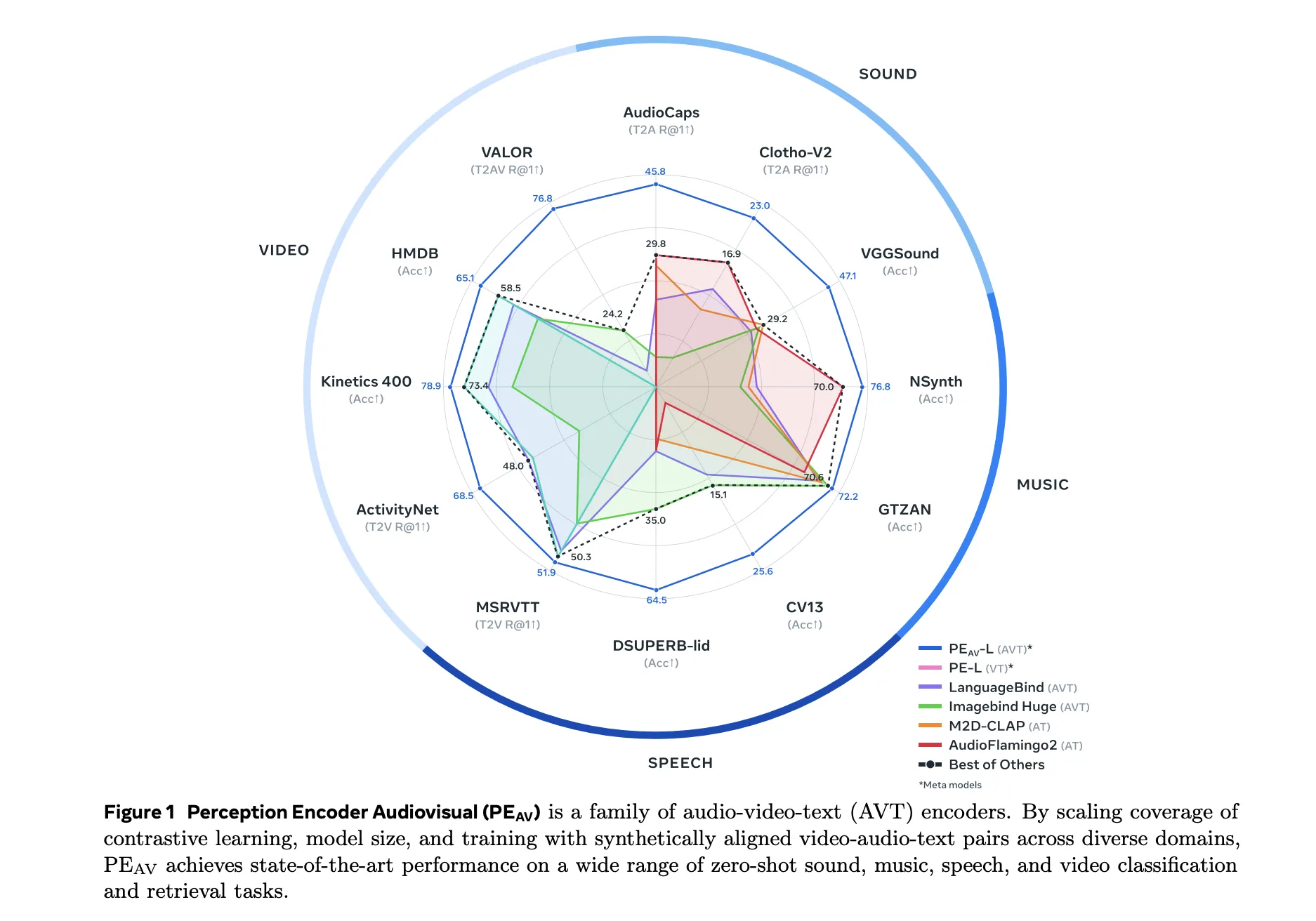
Meta AI Open-Sourced Perception Encoder Audiovisual (PE-AV): The Audiovisual Encoder Powering SAM Audio And Large Scale Multimodal RetrievalMarkTechPost Meta researchers have introduced Perception Encoder Audiovisual, PEAV, as a new family of encoders for joint audio and video understanding. The model learns aligned audio, video, and text representations in a single embedding space using large scale contrastive training on about 100M audio video pairs with text captions. From Perception Encoder to PEAV Perception Encoder,
The post Meta AI Open-Sourced Perception Encoder Audiovisual (PE-AV): The Audiovisual Encoder Powering SAM Audio And Large Scale Multimodal Retrieval appeared first on MarkTechPost.
Meta researchers have introduced Perception Encoder Audiovisual, PEAV, as a new family of encoders for joint audio and video understanding. The model learns aligned audio, video, and text representations in a single embedding space using large scale contrastive training on about 100M audio video pairs with text captions. From Perception Encoder to PEAV Perception Encoder,
The post Meta AI Open-Sourced Perception Encoder Audiovisual (PE-AV): The Audiovisual Encoder Powering SAM Audio And Large Scale Multimodal Retrieval appeared first on MarkTechPost. Read More

ChatLLM Presents a Streamlined Solution to Addressing the Real Bottleneck in AI Towards Data Science
ChatLLM Presents a Streamlined Solution to Addressing the Real Bottleneck in AITowards Data Science For the last couple of years, a lot of the conversation around AI has revolved around a single, deceptively simple question: Which model is the best? But the next question was always, the best for what? The best for reasoning? Writing? Coding? Or maybe it’s the best for images, audio, or video? That framing made
The post ChatLLM Presents a Streamlined Solution to Addressing the Real Bottleneck in AI appeared first on Towards Data Science.
For the last couple of years, a lot of the conversation around AI has revolved around a single, deceptively simple question: Which model is the best? But the next question was always, the best for what? The best for reasoning? Writing? Coding? Or maybe it’s the best for images, audio, or video? That framing made
The post ChatLLM Presents a Streamlined Solution to Addressing the Real Bottleneck in AI appeared first on Towards Data Science. Read More
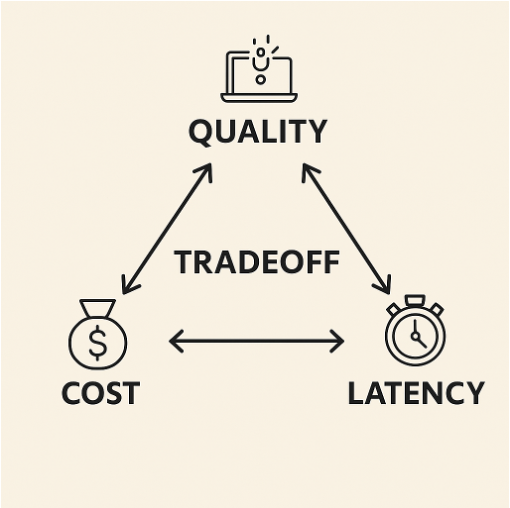
Move Beyond Chain-of-Thought with Chain-of-Draft on Amazon BedrockArtificial Intelligence This post explores Chain-of-Draft (CoD), an innovative prompting technique introduced in a Zoom AI Research paper Chain of Draft: Thinking Faster by Writing Less, that revolutionizes how models approach reasoning tasks. While Chain-of-Thought (CoT) prompting has been the go-to method for enhancing model reasoning, CoD offers a more efficient alternative that mirrors human problem-solving patterns—using concise, high-signal thinking steps rather than verbose explanations.
This post explores Chain-of-Draft (CoD), an innovative prompting technique introduced in a Zoom AI Research paper Chain of Draft: Thinking Faster by Writing Less, that revolutionizes how models approach reasoning tasks. While Chain-of-Thought (CoT) prompting has been the go-to method for enhancing model reasoning, CoD offers a more efficient alternative that mirrors human problem-solving patterns—using concise, high-signal thinking steps rather than verbose explanations. Read More
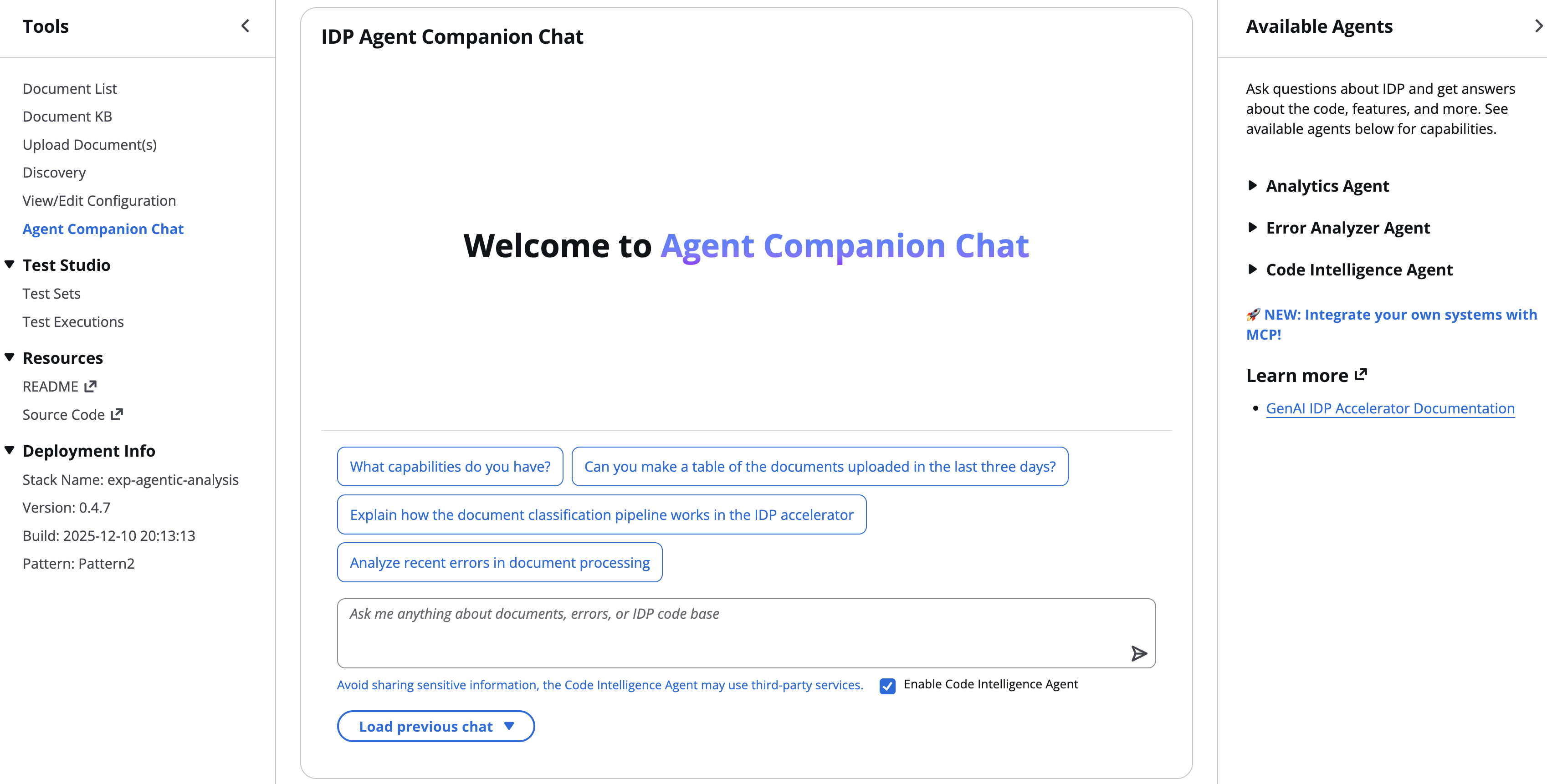
Enhance document analytics with Strands AI Agents for the GenAI IDP AcceleratorArtificial Intelligence To address the need for businesses to quickly analyze information and unlock actionable insights, we are announcing Analytics Agent, a new feature that is seamlessly integrated into the GenAI IDP Accelerator. With this feature, users can perform advanced searches and complex analyses using natural language queries without SQL or data analysis expertise. In this post, we discuss how non-technical users can use this tool to analyze and understand the documents they have processed at scale with natural language.
To address the need for businesses to quickly analyze information and unlock actionable insights, we are announcing Analytics Agent, a new feature that is seamlessly integrated into the GenAI IDP Accelerator. With this feature, users can perform advanced searches and complex analyses using natural language queries without SQL or data analysis expertise. In this post, we discuss how non-technical users can use this tool to analyze and understand the documents they have processed at scale with natural language. Read More

Build a multimodal generative AI assistant for root cause diagnosis in predictive maintenance using Amazon BedrockArtificial Intelligence In this post, we demonstrate how to implement a predictive maintenance solution using Foundation Models (FMs) on Amazon Bedrock, with a case study of Amazon’s manufacturing equipment within their fulfillment centers. The solution is highly adaptable and can be customized for other industries, including oil and gas, logistics, manufacturing, and healthcare.
In this post, we demonstrate how to implement a predictive maintenance solution using Foundation Models (FMs) on Amazon Bedrock, with a case study of Amazon’s manufacturing equipment within their fulfillment centers. The solution is highly adaptable and can be customized for other industries, including oil and gas, logistics, manufacturing, and healthcare. Read More
A new tool is revealing the invisible networks inside cancerArtificial Intelligence News — ScienceDaily Spanish researchers have created a powerful new open-source tool that helps uncover the hidden genetic networks driving cancer. Called RNACOREX, the software can analyze thousands of molecular interactions at once, revealing how genes communicate inside tumors and how those signals relate to patient survival. Tested across 13 different cancer types using international data, the tool matches the predictive power of advanced AI systems—while offering something rare in modern analytics: clear, interpretable explanations that help scientists understand why tumors behave the way they do.
Spanish researchers have created a powerful new open-source tool that helps uncover the hidden genetic networks driving cancer. Called RNACOREX, the software can analyze thousands of molecular interactions at once, revealing how genes communicate inside tumors and how those signals relate to patient survival. Tested across 13 different cancer types using international data, the tool matches the predictive power of advanced AI systems—while offering something rare in modern analytics: clear, interpretable explanations that help scientists understand why tumors behave the way they do. Read More
How to Do Evals on a Bloated RAG PipelineTowards Data Science Comparing metrics across datasets and models
The post How to Do Evals on a Bloated RAG Pipeline appeared first on Towards Data Science.
Comparing metrics across datasets and models
The post How to Do Evals on a Bloated RAG Pipeline appeared first on Towards Data Science. Read More
Optimisation of Aircraft Maintenance Schedulescs.AI updates on arXiv.org arXiv:2512.17412v1 Announce Type: cross
Abstract: We present an aircraft maintenance scheduling problem, which requires suitably qualified staff to be assigned to maintenance tasks on each aircraft. The tasks on each aircraft must be completed within a given turn around window so that the aircraft may resume revenue earning service. This paper presents an initial study based on the application of an Evolutionary Algorithm to the problem. Evolutionary Algorithms evolve a solution to a problem by evaluating many possible solutions, focusing the search on those solutions that are of a higher quality, as defined by a fitness function. In this paper, we benchmark the algorithm on 60 generated problem instances to demonstrate the underlying representation and associated genetic operators.
arXiv:2512.17412v1 Announce Type: cross
Abstract: We present an aircraft maintenance scheduling problem, which requires suitably qualified staff to be assigned to maintenance tasks on each aircraft. The tasks on each aircraft must be completed within a given turn around window so that the aircraft may resume revenue earning service. This paper presents an initial study based on the application of an Evolutionary Algorithm to the problem. Evolutionary Algorithms evolve a solution to a problem by evaluating many possible solutions, focusing the search on those solutions that are of a higher quality, as defined by a fitness function. In this paper, we benchmark the algorithm on 60 generated problem instances to demonstrate the underlying representation and associated genetic operators. Read More
SCOPE: Sequential Causal Optimization of Process Interventionscs.AI updates on arXiv.org arXiv:2512.17629v1 Announce Type: cross
Abstract: Prescriptive Process Monitoring (PresPM) recommends interventions during business processes to optimize key performance indicators (KPIs). In realistic settings, interventions are rarely isolated: organizations need to align sequences of interventions to jointly steer the outcome of a case. Existing PresPM approaches fall short in this respect. Many focus on a single intervention decision, while others treat multiple interventions independently, ignoring how they interact over time. Methods that do address these dependencies depend either on simulation or data augmentation to approximate the process to train a Reinforcement Learning (RL) agent, which can create a reality gap and introduce bias. We introduce SCOPE, a PresPM approach that learns aligned sequential intervention recommendations. SCOPE employs backward induction to estimate the effect of each candidate intervention action, propagating its impact from the final decision point back to the first. By leveraging causal learners, our method can utilize observational data directly, unlike methods that require constructing process approximations for reinforcement learning. Experiments on both an existing synthetic dataset and a new semi-synthetic dataset show that SCOPE consistently outperforms state-of-the-art PresPM techniques in optimizing the KPI. The novel semi-synthetic setup, based on a real-life event log, is provided as a reusable benchmark for future work on sequential PresPM.
arXiv:2512.17629v1 Announce Type: cross
Abstract: Prescriptive Process Monitoring (PresPM) recommends interventions during business processes to optimize key performance indicators (KPIs). In realistic settings, interventions are rarely isolated: organizations need to align sequences of interventions to jointly steer the outcome of a case. Existing PresPM approaches fall short in this respect. Many focus on a single intervention decision, while others treat multiple interventions independently, ignoring how they interact over time. Methods that do address these dependencies depend either on simulation or data augmentation to approximate the process to train a Reinforcement Learning (RL) agent, which can create a reality gap and introduce bias. We introduce SCOPE, a PresPM approach that learns aligned sequential intervention recommendations. SCOPE employs backward induction to estimate the effect of each candidate intervention action, propagating its impact from the final decision point back to the first. By leveraging causal learners, our method can utilize observational data directly, unlike methods that require constructing process approximations for reinforcement learning. Experiments on both an existing synthetic dataset and a new semi-synthetic dataset show that SCOPE consistently outperforms state-of-the-art PresPM techniques in optimizing the KPI. The novel semi-synthetic setup, based on a real-life event log, is provided as a reusable benchmark for future work on sequential PresPM. Read More
Realistic threat perception drives intergroup conflict: A causal, dynamic analysis using generative-agent simulationscs.AI updates on arXiv.org arXiv:2512.17066v1 Announce Type: new
Abstract: Human conflict is often attributed to threats against material conditions and symbolic values, yet it remains unclear how they interact and which dominates. Progress is limited by weak causal control, ethical constraints, and scarce temporal data. We address these barriers using simulations of large language model (LLM)-driven agents in virtual societies, independently varying realistic and symbolic threat while tracking actions, language, and attitudes. Representational analyses show that the underlying LLM encodes realistic threat, symbolic threat, and hostility as distinct internal states, that our manipulations map onto them, and that steering these states causally shifts behavior. Our simulations provide a causal account of threat-driven conflict over time: realistic threat directly increases hostility, whereas symbolic threat effects are weaker, fully mediated by ingroup bias, and increase hostility only when realistic threat is absent. Non-hostile intergroup contact buffers escalation, and structural asymmetries concentrate hostility among majority groups.
arXiv:2512.17066v1 Announce Type: new
Abstract: Human conflict is often attributed to threats against material conditions and symbolic values, yet it remains unclear how they interact and which dominates. Progress is limited by weak causal control, ethical constraints, and scarce temporal data. We address these barriers using simulations of large language model (LLM)-driven agents in virtual societies, independently varying realistic and symbolic threat while tracking actions, language, and attitudes. Representational analyses show that the underlying LLM encodes realistic threat, symbolic threat, and hostility as distinct internal states, that our manipulations map onto them, and that steering these states causally shifts behavior. Our simulations provide a causal account of threat-driven conflict over time: realistic threat directly increases hostility, whereas symbolic threat effects are weaker, fully mediated by ingroup bias, and increase hostility only when realistic threat is absent. Non-hostile intergroup contact buffers escalation, and structural asymmetries concentrate hostility among majority groups. Read More