


Table of Contents
Artificial Intelligence vs Augmented Intelligence
The term “Artificial Intelligence” (AI) dominates headlines and boardroom talks. It brings to mind self-driving cars, robotic warehouses, and software that seems to think on its own. Much of the attention around AI focuses on automation and autonomy. But a growing movement is focused on partnership instead of replacement. This approach is called Augmented Intelligence (IA).
AI and IA represent two very different intentions. Recognizing that difference is essential for anyone shaping the future of technology at work.

1. The Core Philosophy: Replacement vs Partnership
The easiest way to see the difference is by looking at what each system tries to achieve.
Artificial Intelligence (AI): The Push for Autonomy
- Goal: Replace human cognitive work.
- Focus: Speed and scale through full automation.
- Philosophy: AI is built to run independently. It completes tasks from start to finish with little to no human help. Think of it as a digital employee assigned to handle repetitive, high-volume jobs like scanning transactions for fraud or optimizing delivery routes.
Augmented Intelligence (IA): The Goal of Enhancement
- Goal: Strengthen and extend human capability.
- Focus: Nuance, creativity, and complex judgment.
- Philosophy: IA treats technology as a partner, not a replacement. IBM defin es this approach as using AI to “augment human intelligence” rather than operating independently of or replacing it. It processes massive datasets, spots patterns, and provides insights, freeing people to apply their intuition, empathy, and experience. As research from IEEE Digital Reality explains, augmented intelligence represents “a symbiotic relationship between man and machine,” helping doctors make better diagnoses and analysts make smarter calls.
In short, AI automates the task. IA amplifies the person.
2. The Human-in-the-Loop Advantage
The two models also diverge in how they operate.
Autonomous AI often runs as an “AI-first” system. Once deployed, it leads the process while humans monitor or troubleshoot.
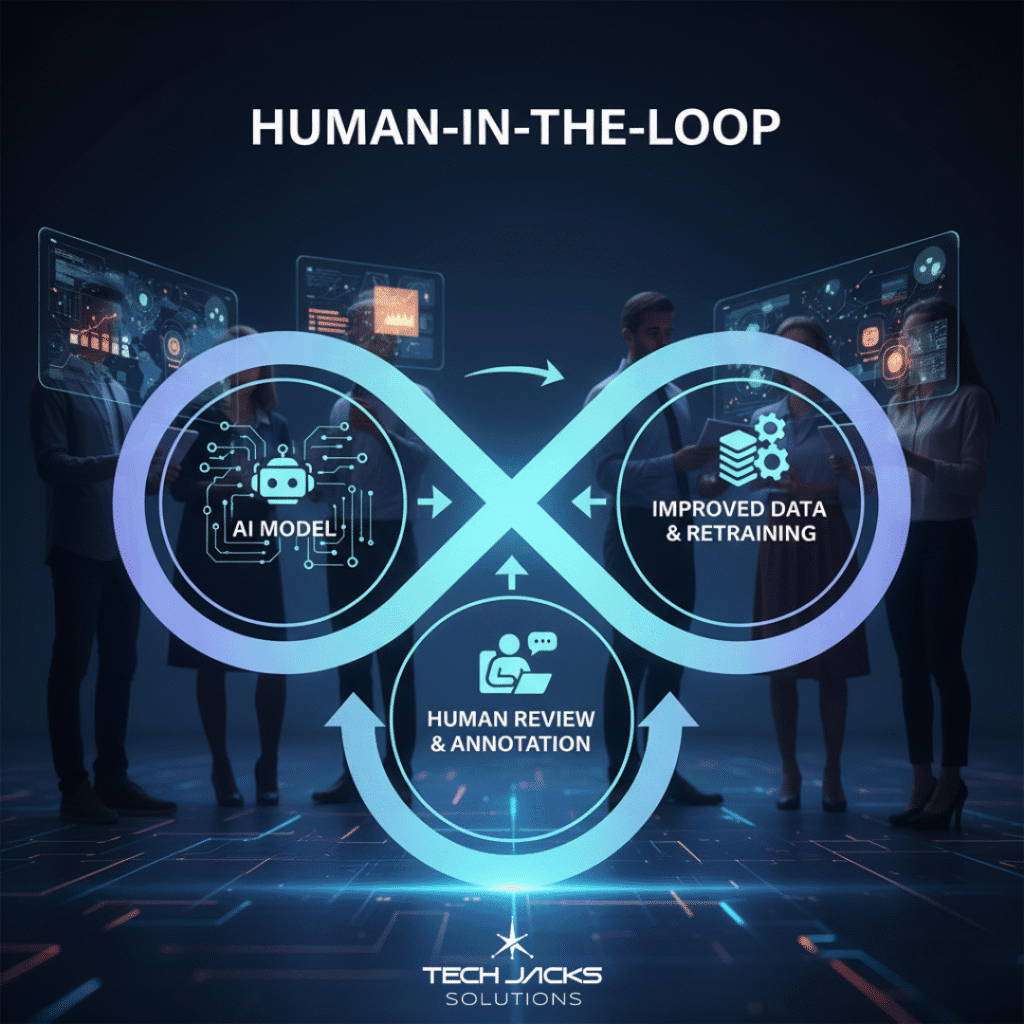
IA, on the other hand, depends on the Human-in-the-Loop (HITL) approach:
- AI Analyzes: The system processes large datasets, identifies trends, and offers predictions or recommendations.
- Human Validates: Ambiguous or high-stakes cases, those involving ethics, context, or judgment, go to a human for review.
- Human Decides: People make the final call using AI’s analysis as input, not instruction.
This partnership ensures that human experience and accountability always remain part of the process. As Google Cloud describes it, HITL is “a design approach where humans are actively involved in the training of AI systems,” combining human expertise with machine learning to create more accurate and reliable models.
3. When to Automate and When to Augment
Deciding between AI and IA isn’t about which is “better.” It’s about the nature of the task and the acceptable level of risk.
| Task Profile | Best Fit | Example |
| High-Risk, High-Complexity | Augmented Intelligence (IA) | A physician using AI to analyze a cancer scan. The AI provides possible diagnoses, but the doctor confirms and plans treatment. |
| Low-Risk, High-Volume | Autonomous AI (AI) | Automated invoice processing or high-frequency stock trading. |
| Medium-Risk, Low-Volume | Augmented Intelligence (IA) | A financial analyst using AI to generate market insights, then deciding how to act on them. |
When human judgment and machine scale combine, performance rises beyond what either could achieve on its own.
4. Building Trust Through Explainable AI
Augmented Intelligence only works if people trust the machine’s suggestions. That’s where Explainable AI (XAI) comes in.
XAI requires systems to show how they reached a conclusion, not just what the conclusion is. DARPA’s Explainable AI program, launched in 2017, was specifically designed to “enable end users to better understand, appropriately trust, and effectively manage artificially intelligent systems.” If an algorithm flags a stock as risky, the analyst needs to know why. Was it the company’s debt ratio, recent earnings, or a geopolitical factor?
This transparency matters for two reasons:
- Validation: Humans can verify the logic and catch potential errors.
- Compliance: In sectors like healthcare and finance, explainability helps companies meet regulations that demand human oversight.
Without explainability, even the best AI model becomes a black box and people won’t rely on something they don’t understand. As research published in Applied AI Letters demonstrates, careful evaluation of explanation effectiveness is critical for building appropriate trust in AI systems.
5. The Hybrid Future: AI and IA Working Together
The most forward-looking organizations aren’t choosing between AI and IA. They’re combining them.
Autonomous AI handles repetitive, data-heavy work which is the processing, categorizing, and preparing information. Augmented Intelligence takes the lead when judgment, empathy, or creativity are needed.
This hybrid model reflects how real work happens. Machines handle the logistics; people handle meaning.
By designing workflows that intentionally combine the two, we move past the fear of replacement and focus on building human-machine teams that truly perform better together.
Conclusion
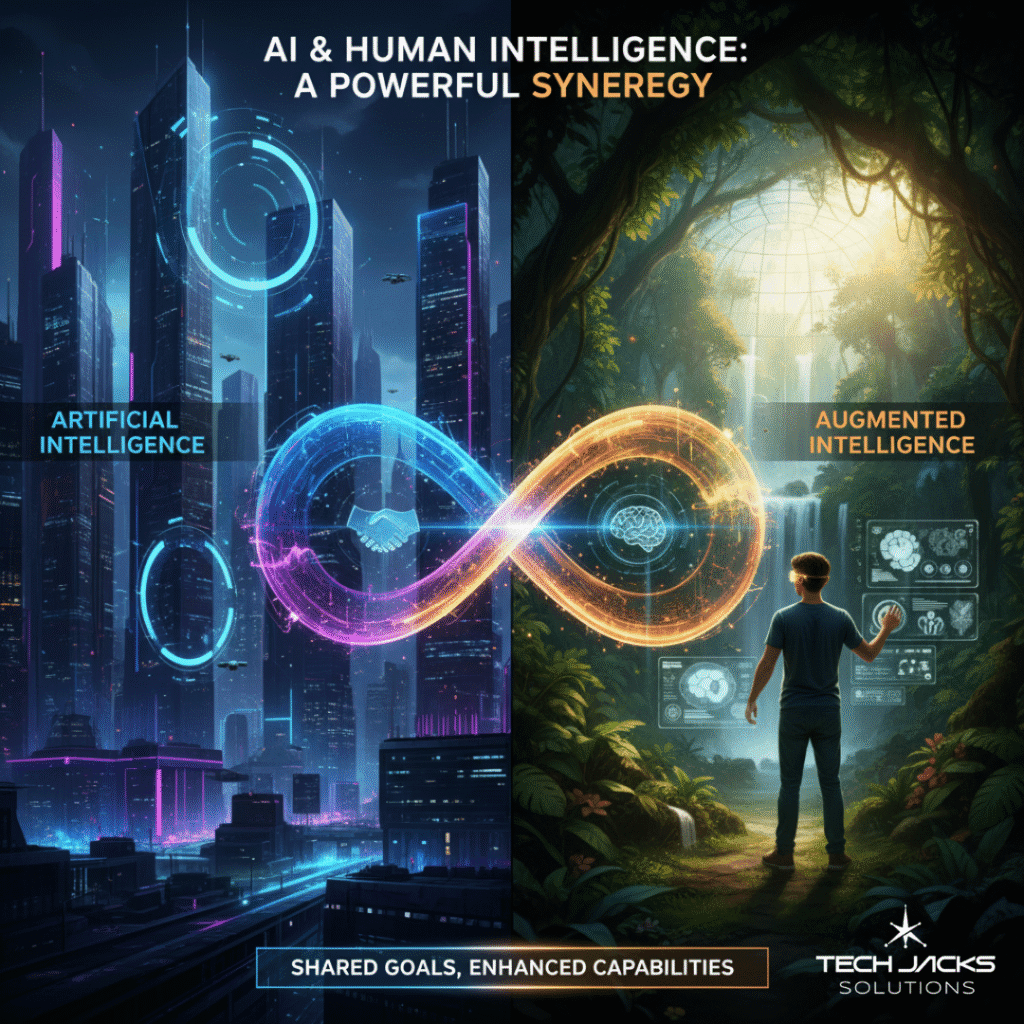
AI is extending what humans can do. It helps us see patterns we’d miss, hear details we’d overlook, and explore solutions we might never imagine on our own. A doctor working with an AI system could discover new treatments or design drugs beyond current methods. Studies referenced by IEEE have shown that when AI systems and human pathologists work together detecting lymph node cancer cells, error rates drop dramatically from 7.5% (AI alone) and 3.5% (human pathologists alone) to just 0.5% when combined. These breakthroughs could redefine health and longevity.
What matters now is how wisely we use this power. The choices we make will shape the kind of world we build with it. If we apply AI with care and intent, it can strengthen human potential and help life thrive in ways we’ve only begun to imagine.
Resource List:
- IBM AI Best Practices: https://www.ibm.com/think/insights/ai-best-practices
- IEEE Digital Reality – Augmented Intelligence: https://digitalreality.ieee.org/publications/what-is-augmented-intelligence
- IBM Human-in-the-Loop: https://www.ibm.com/think/topics/human-in-the-loop
- Google Cloud Human-in-the-Loop: https://cloud.google.com/discover/human-in-the-loop
- DARPA Explainable AI Program: https://www.darpa.mil/research/programs/explainable-artificial-intelligence
- DARPA XAI Retrospective: https://onlinelibrary.wiley.com/doi/full/10.1002/ail2.61
