Gallery

Contacts

411 University St, Seattle, USA

engitech@oceanthemes.net

+1 -800-456-478-23

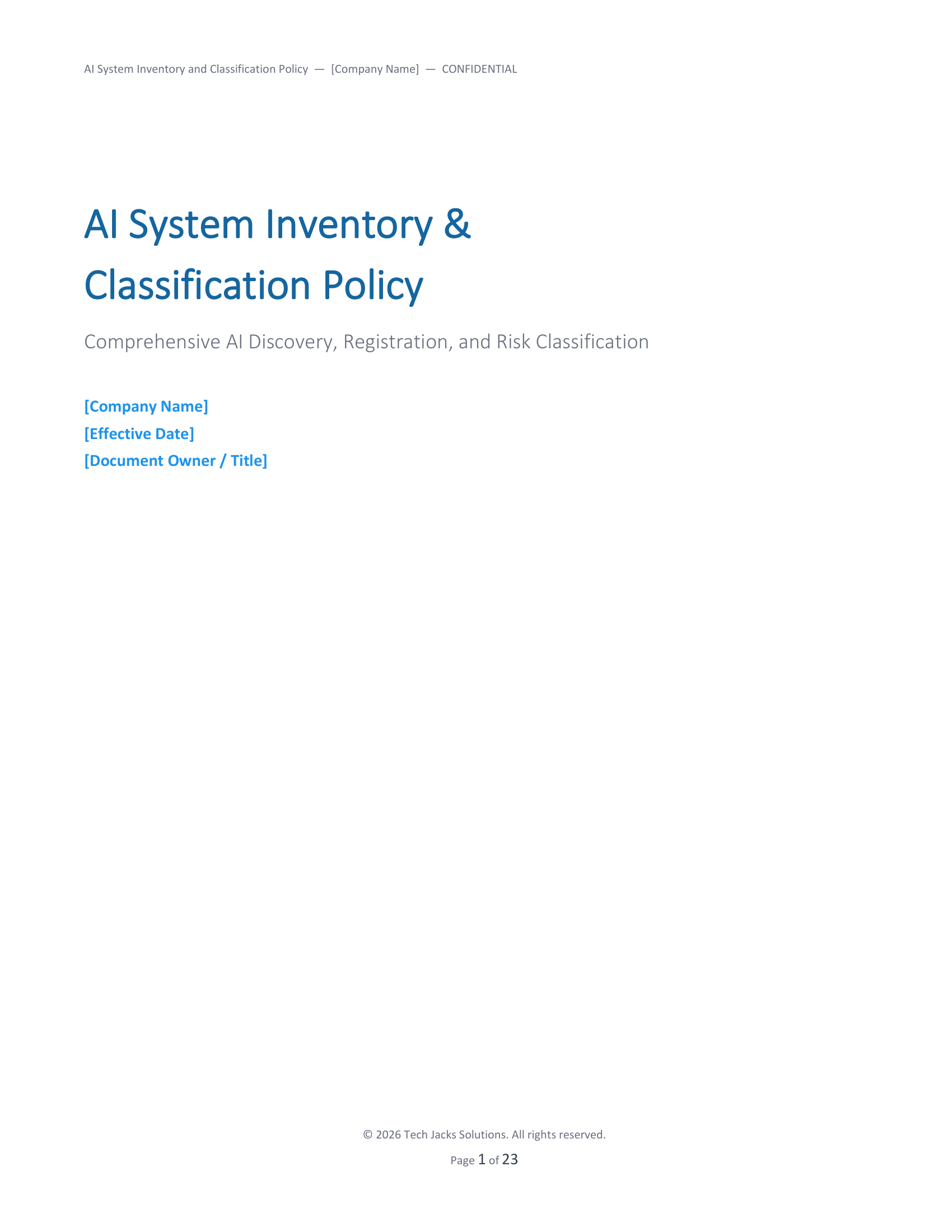
AI System Inventory Policy Cover Page
Templates / Policies / AI System Inventory & Classification Policy
.docx ✓ Professional Edition Updated Q1 2026

AI System Inventory & Classification Policy

Establish a complete AI system registry with risk-based classification tiers, agentic AI governance controls, and lifecycle tracking — your single source of truth for every AI system in your organization.

12
Sections
23
Pages
3
Frameworks
3–5hr
To Deploy
ISO 42001:2023 EU AI Act 2024 NIST AI RMF 1.0
Build vs. Buy
From scratch
Research 3 frameworks10 hrs = $150
Draft 23 pages8 hrs = $120
Internal review cycle5 hrs = $75
Classification schema design7 hrs = $105
30 hours$450
vs
This template
Purchase$15.00
Customize for your org4 hrs = $60
CitationsIncluded
Classification tiersIncluded
4 hours$75
$375 saved
26 hours back | 25:1 ROI on $15.00
At $15/hr — the price of this template as the hourly rate
“What if I use AI to write it?”
AI makes drafting faster — but it doesn’t reduce the total work. Building a risk classification schema requires understanding how the EU AI Act categorizes systems (Art. 6, Annex III), how ISO 42001 structures AI management, and how NIST AI RMF defines risk tolerance. AI hallucinates classification tiers, invents control mappings, and generates inventory schemas that look complete but miss critical metadata fields. The work shifts from writing to verification — and verification takes just as long.
~28hwith AI + expert verification
4hwith this template
4risk tiers defined
3source PDFs read
$15.00
One-time purchase · Instant download
  • Fully editable Word .docx — customize for your organization
  • 12 sections across 23 pages. 4-tier risk classification, agentic AI governance, GPAIM classification, lifecycle tracking
  • Aligned to ISO 42001:2023, EU AI Act 2024, and NIST AI RMF 1.0
  • EU AI Act risk categories with GPAIM classification for general-purpose AI models
  • Every citation verified against the published standard. Not AI-generated.
  • Updated Q1 2026. Agentic AI classification and autonomous decision boundary controls included
.docx ISO 42001 EU AI Act NIST AI RMF ✦ Q1 2026 v2
Overview
What this template does

Every organization deploying AI needs to know what AI systems it has, where they operate, and how risky they are. Without a formal inventory and classification system, you can’t demonstrate compliance with the EU AI Act’s risk-based approach, satisfy ISO 42001 asset management requirements, or make informed governance decisions.

This policy establishes a complete AI system registry with a 4-tier risk classification framework aligned to ISO 42001:2023, EU AI Act 2024, and NIST AI RMF 1.0. It covers system registration requirements, mandatory metadata fields, GPAIM classification for general-purpose AI models, agentic AI governance with autonomous decision boundaries, and lifecycle integration checkpoints from procurement through decommissioning.

The Professional Edition adds what most inventory policies miss: agentic AI classification controls with action-space bounding, a risk tolerance mapping framework tied to organizational context, and lifecycle governance gates that trigger re-classification when AI capabilities change. Each section includes framework-specific rationale and italicized customization notes.

What’s Inside
12 Sections · 23 Pages · Audit-Aligned Structure
Step-by-step implementation roadmap covering immediate actions, stakeholder identification, and deployment sequence. Prioritizes the critical path from inventory creation through classification assignment to ongoing governance integration.
ImplementationQuick Reference
Establishes the governance authority and regulatory context for maintaining a comprehensive AI system inventory. References ISO 42001 Clause 6.1 (actions to address risks) and EU AI Act Art. 6 (classification rules for high-risk systems) as the foundational mandate for systematic AI asset management.
ISO 42001 Clause 6.1EU AI Act Art. 6NIST GOVERN
Defines coverage boundaries: all AI systems developed, deployed, procured, or operated by or on behalf of the organization. Includes third-party AI services, embedded AI components, and shadow AI discovery requirements. Establishes organizational boundary definitions for inventory completeness.
ISO 42001 Clause 4.3Asset Boundaries
Measurable objectives for the inventory program: complete visibility of all AI systems, consistent risk classification, regulatory compliance demonstration, informed governance decisions, and lifecycle accountability. Aligned to ISO 42001 Clause 6.2 (AI objectives and planning).
ISO 42001 Clause 6.2NIST GOVERN 1.0
4-tier risk classification system: Prohibited, High Risk, Limited Risk, and Minimal Risk — directly mapped to EU AI Act categories. Includes GPAIM classification for general-purpose AI models, risk tolerance mapping tied to organizational context, and decision criteria for each tier with specific regulatory citations. Covers EU AI Act Art. 6 high-risk classification rules and Annex III system categories.
EU AI Act Art. 6EU AI Act Annex IIIISO 42001 A.6.2.2NIST MAP
Classification and control requirements for autonomous AI agents, multi-agent systems, and AI with tool-use capabilities. Covers agentic AI classification criteria, action-space bounding controls, autonomous decision boundaries, human oversight checkpoints, and escalation triggers. Addresses systems that independently execute multi-step tasks with real-world consequences.
NIST AI 600-1EU AI Act Art. 14ISO 42001 A.9.3Autonomous Agents
Mandatory registration requirements for every AI system. Defines the inventory schema: system name, version, vendor, intended use, data categories processed, risk tier, deployment status, system owner, EU AI Act classification, and lifecycle stage. Covers metadata standards, registration workflows, and shadow AI discovery protocols. Quarterly certification by the AI Governance Committee.
ISO 42001 A.6.2.4EU AI Act Art. 49Asset ManagementShadow AI
Governance gates at each lifecycle stage: procurement, development, testing, deployment, operation, and decommissioning. Covers re-classification triggers when AI capabilities change, version control for inventory entries, and integration with change management processes. Ensures classification remains accurate as systems evolve.
ISO 42001 A.6.2.6NIST MANAGELifecycle Governance
RACI matrix defining accountability for inventory maintenance, classification decisions, lifecycle governance, and compliance reporting. Covers AI System Owner, AI Governance Committee, IT Asset Management, CISO, Compliance Officer, and business unit responsibilities. Includes escalation paths and decision authority.
ISO 42001 A.3.2NIST GOVERN 1.7RACI Matrix
Specifies documentation standards for inventory entries, classification decisions, risk assessments, and governance reviews. Covers retention periods, access controls, audit trail requirements, and integration with the organization’s document management system. Aligned to ISO 42001 Clause 7.5 documented information requirements.
ISO 42001 Clause 7.5Document ControlAudit Trail
Training requirements for personnel involved in AI system registration, classification, and inventory maintenance. Covers role-specific modules for system owners, governance committee members, and IT asset managers. Includes awareness programs for all staff on shadow AI reporting obligations.
ISO 42001 A.4.2EU AI Act Art. 4Competence
Tiered consequence framework for inventory non-compliance: unregistered AI systems (shadow AI), incomplete metadata, missed classification reviews, and unauthorized deployment. Covers escalation procedures, remediation timelines, and alignment with organizational disciplinary processes.
ISO 42001 A.3.3NIST GOVERN 5.2Enforcement
Audience
Who deploys this template
🛡️
CISO / Security Lead
Maintains visibility into AI attack surface and risk exposure. Uses the inventory as the foundation for AI security assessments and maps each system to its risk classification tier.
⚖️
Compliance Officer
Demonstrates EU AI Act compliance through systematic risk classification. Uses the inventory to satisfy ISO 42001 asset management requirements and provides audit evidence for framework assessments.
📋
AI Program Manager
Owns the AI system registry as the single source of truth. Manages classification decisions, coordinates lifecycle governance gates, and reports inventory health to the AI Governance Committee.
🖥️
IT Asset Manager
Integrates AI inventory with existing CMDB and asset management processes. Manages system registration workflows, tracks metadata completeness, and identifies shadow AI through discovery protocols.
Framework Alignment
How this template maps to standards
42001
ISO/IEC 42001:2023
Primary framework. Fulfills Clause 6.1 (actions to address risks), Clause 6.2 (AI objectives), and Annex A controls for AI system documentation, risk assessment, and operational monitoring. The inventory serves as a foundational artifact for ISO 42001 certification.
Clause 6.1Clause 6.2A.6.2.2A.6.2.4A.6.2.6
EU
EU AI Act 2024
Implements the risk-based classification approach. Maps directly to Art. 6 (high-risk classification rules), Art. 9 (risk management), Annex III (high-risk system categories), and Art. 49 (registration obligations). GPAIM classification addresses Art. 51–55 for general-purpose AI models.
Art. 6Art. 9Annex IIIArt. 49Art. 51
NIST
NIST AI RMF 1.0
Supports the Map function — establishing context and identifying AI systems for risk assessment. Key coverage includes MAP 1.0 (context establishment), MAP 3.0 (AI capabilities), and GOVERN 1.0 (policies for AI risk management).
MAP 1.0MAP 3.0GOVERN 1.0MANAGE 4.1
Value Proposition
Build from scratch vs. use this template
✓ With This Template
4-tier risk classification framework already built and mapped to EU AI Act categories. Prohibited, High Risk, Limited Risk, Minimal Risk — with decision criteria for each.
Agentic AI governance controls included. Classification criteria, action-space bounding, autonomous decision boundaries — ready to deploy.
System registration requirements with complete metadata schema. Every field an auditor expects is already defined.
Lifecycle integration checkpoints from procurement through decommissioning. Re-classification triggers built in.
GPAIM classification for general-purpose AI models (EU AI Act Art. 51–55). Covers organizations using foundation models.
Roles & RACI matrix, documentation templates, and framework compliance crosswalk included. Customize in 3–5 hours.
✗ From Scratch
30+ hours of research across ISO 42001, EU AI Act, and NIST AI RMF just to understand how classification tiers should work.
Defining classification tiers from scratch means reading EU AI Act Art. 6, Annex III, and reconciling with ISO 42001 risk assessment requirements. Getting the boundaries right is non-trivial.
Mapping to EU AI Act risk categories requires understanding the full regulation. Art. 6 has specific conditions that determine high-risk classification beyond just Annex III.
Building an inventory schema that actually works means knowing what metadata auditors look for. Miss a field and you fail the assessment.
Agentic AI boundary controls are new territory. No established templates exist elsewhere for classifying autonomous agents within a risk framework.
The EU AI Act enforcement timeline is phased through 2026. Classification requirements will evolve as implementing acts are published. What you build today needs a maintenance plan.

Already have an inventory? Use this template to validate your classification methodology against ISO 42001 and EU AI Act requirements, and add agentic AI governance controls.

“Why is this only $15?”

I’ve been building governance documentation since 2012. That year I helped my healthcare analytics company earn its first HITRUST certification. Since then I’ve created and managed compliance documentation for SOC 2, PCI DSS, HITRUST, and ISO 27001 programs across enterprise organizations. I have a writing degree and I genuinely like this work.

HITRUST CSF SOC 2 PCI DSS ISO 27001 14 Years in GRC Writing Degree

Credentials don’t explain the price though. This does:

I want AI adopted responsibly. I don’t want my friends, my family, or my kids dealing with threats and risks that come from deploying AI without governance. Organizations will take the path that earns them the most money. That’s how business works. So I feel obligated to put quality documentation out at a price where governance isn’t something only Fortune 500 companies can afford. I don’t need to charge thousands of dollars to make a difference. I care about helping where I can.

You’re building something that matters — documentation that earns trust from your board, your customers, and your team. And it has to be right.

The citations in these templates were checked against the published standards — the actual ISO 42001:2023 PDF, the EU AI Act regulation text, the NIST AI RMF 1.0 document. Control IDs, article numbers, crosswalk mappings. This is practitioner-built documentation from someone who’s sat in the audits, written the remediation plans, and knows what survives a compliance review.

Derrick Jackson // Founder, Tech Jacks Solutions
Related Templates
Often bought together
FRAMEWORK COVERAGE
ISO 42001 EU AI Act NIST AI RMF
WHAT YOU GET
12 sections · 23 pages
4-tier risk classification
Agentic AI governance controls
GPAIM classification (EU AI Act)
RACI matrix included
Fully editable .docx
Framework citations verified
Instant download
Important

This template is a starting point, not a finished product. It’s designed to accelerate your AI governance program by giving you a professionally structured foundation with verified framework citations. It doesn’t replace legal counsel, compliance review, or organizational judgment. Every organization is different. You’ll need to customize the classification tiers, inventory metadata fields, and governance gates for your specific regulatory context, risk tolerance, and operational environment. We recommend routing your completed policy through your legal, compliance, and governance teams before adoption. What you’re buying is a jumpstart that saves you weeks of research and drafting, not a guarantee of compliance. Framework citations reflect regulations as of Q1 2026. Regulatory frameworks evolve. Check for updates to the EU AI Act, ISO 42001, and NIST AI RMF before your annual policy review. Single organization license. All purchases include a 14-day money-back guarantee — if the template does not meet your needs, contact us for a full refund.

★ BUNDLE DEAL AVAILABLE
Building a complete governance program?
This policy is included in the AI Organization Starter Bundle — 9 templates, $75, save $60.

Author

Tech Jacks Solutions