Why professionals trust our templates
- 270+ downloads by governance & compliance teams
- Built by AI governance practitioners, not generic template mills
- 14-day money-back guarantee • Instant download • Secure checkout via Stripe
AI Model Card Assessment Checklist Template
A structured framework designed to support systematic evaluation of AI model documentation quality, completeness, and alignment with major governance frameworks.
[Download Now]
Organizations deploying AI systems face increasing pressure to demonstrate responsible development practices through comprehensive model documentation. This assessment checklist template provides a structured methodology for evaluating AI model cards against established governance criteria. The template requires customization to your specific model types, organizational policies, and applicable regulatory requirements. By providing pre-built assessment categories and scoring frameworks, it may help reduce the time needed to develop evaluation criteria from scratch.
Key Benefits
✓ Provides structured assessment framework with comprehensive evaluation sections and 90+ individual checklist items
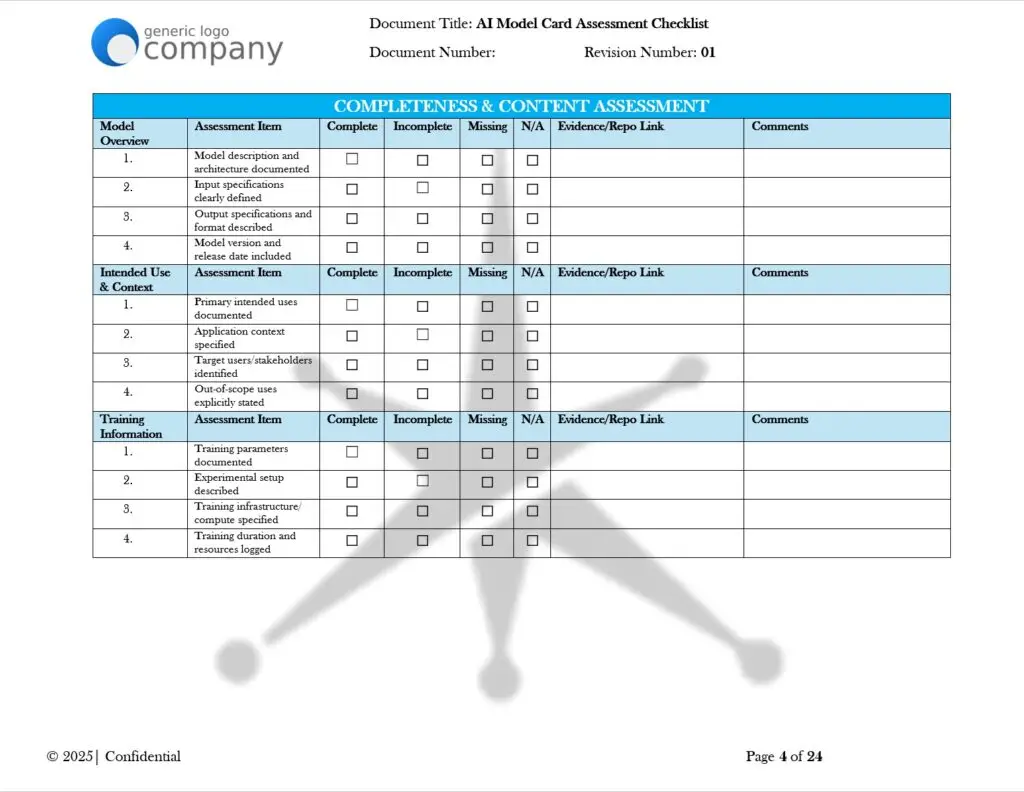
✓ Includes built-in compliance crosswalk mapping to EU AI Act, NIST AI RMF, ISO/IEC 42001, ISO/IEC 23053, and GDPR requirements
✓ Supports documentation of evidence links and repository locations for audit trail purposes
✓ Contains tiered action item tracking for critical gaps (immediate), improvement areas (30 days), and enhancement opportunities (90 days)
✓ Includes key metrics dashboard template for tracking documentation completeness and compliance alignment
✓ Features multi-level approval workflow structure with assessment team and approval chain sign-off sections
Who Uses This?
Designed for:
- AI/ML Engineers responsible for model documentation
- AI Governance and Compliance Officers
- Risk Management professionals overseeing AI deployments
- Quality Assurance teams evaluating model readiness
- Technical Leads managing model lifecycle documentation
- Organizations preparing for AI regulatory compliance assessments
What’s Included in This Template:
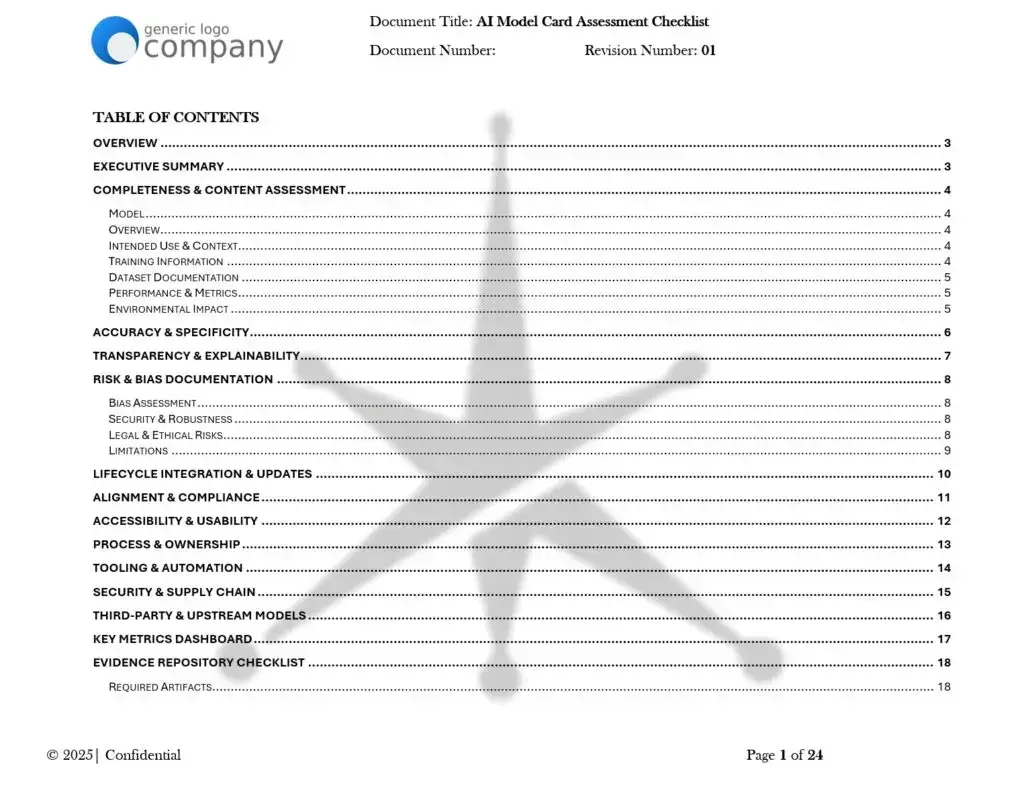
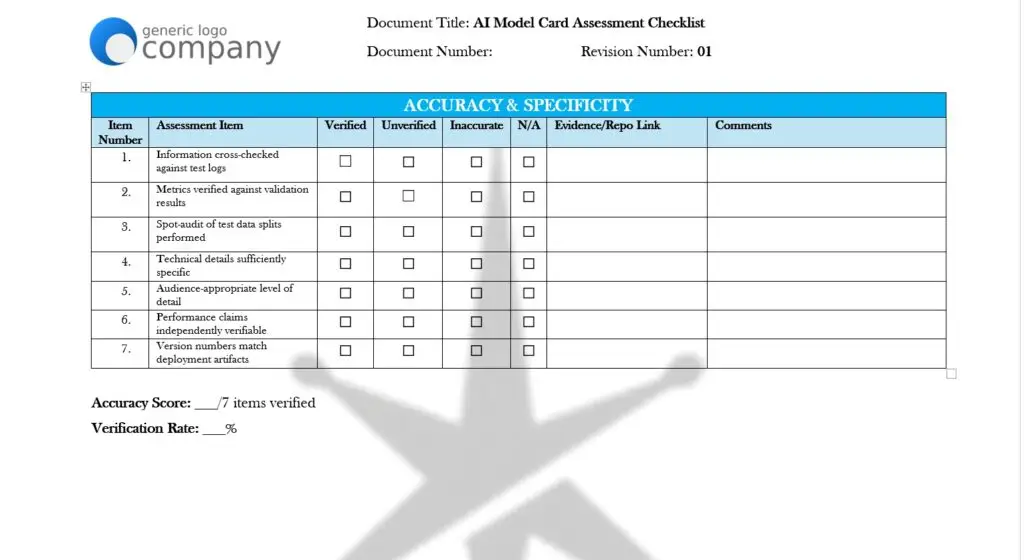
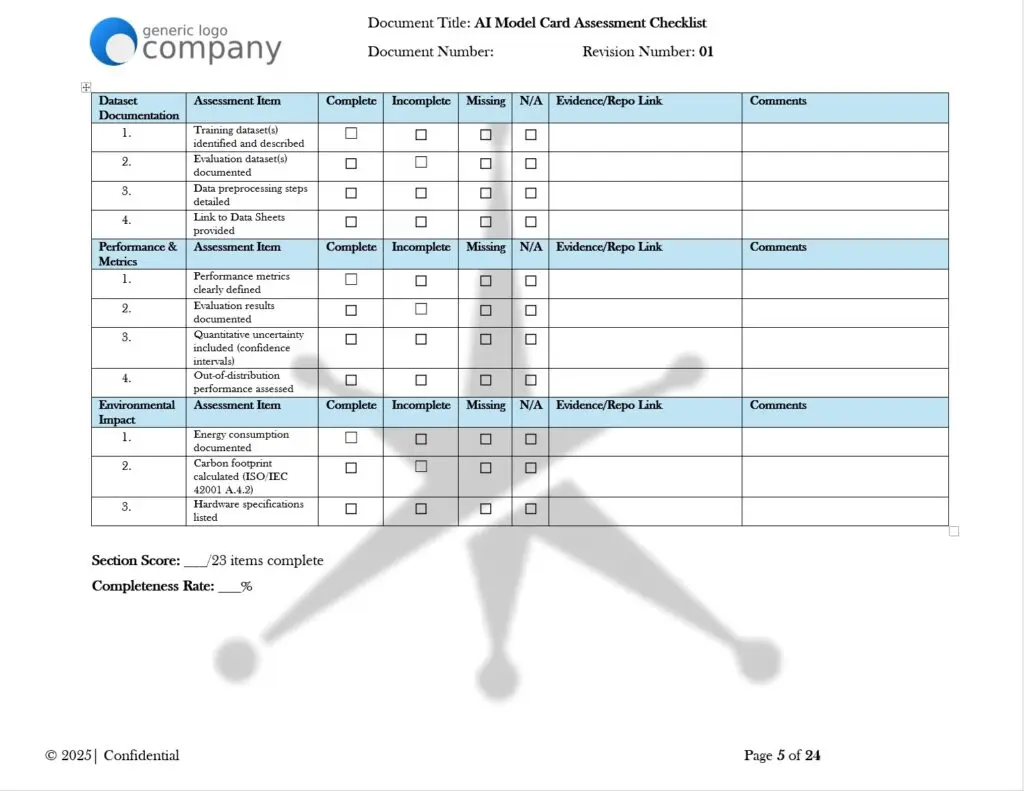
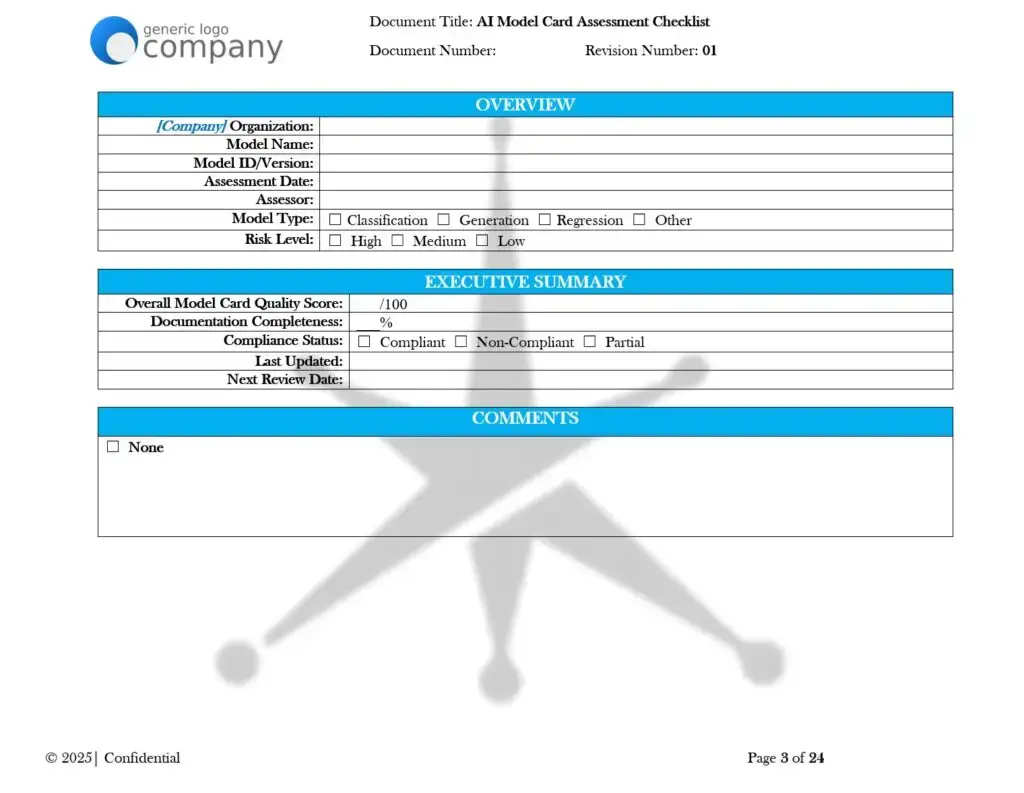
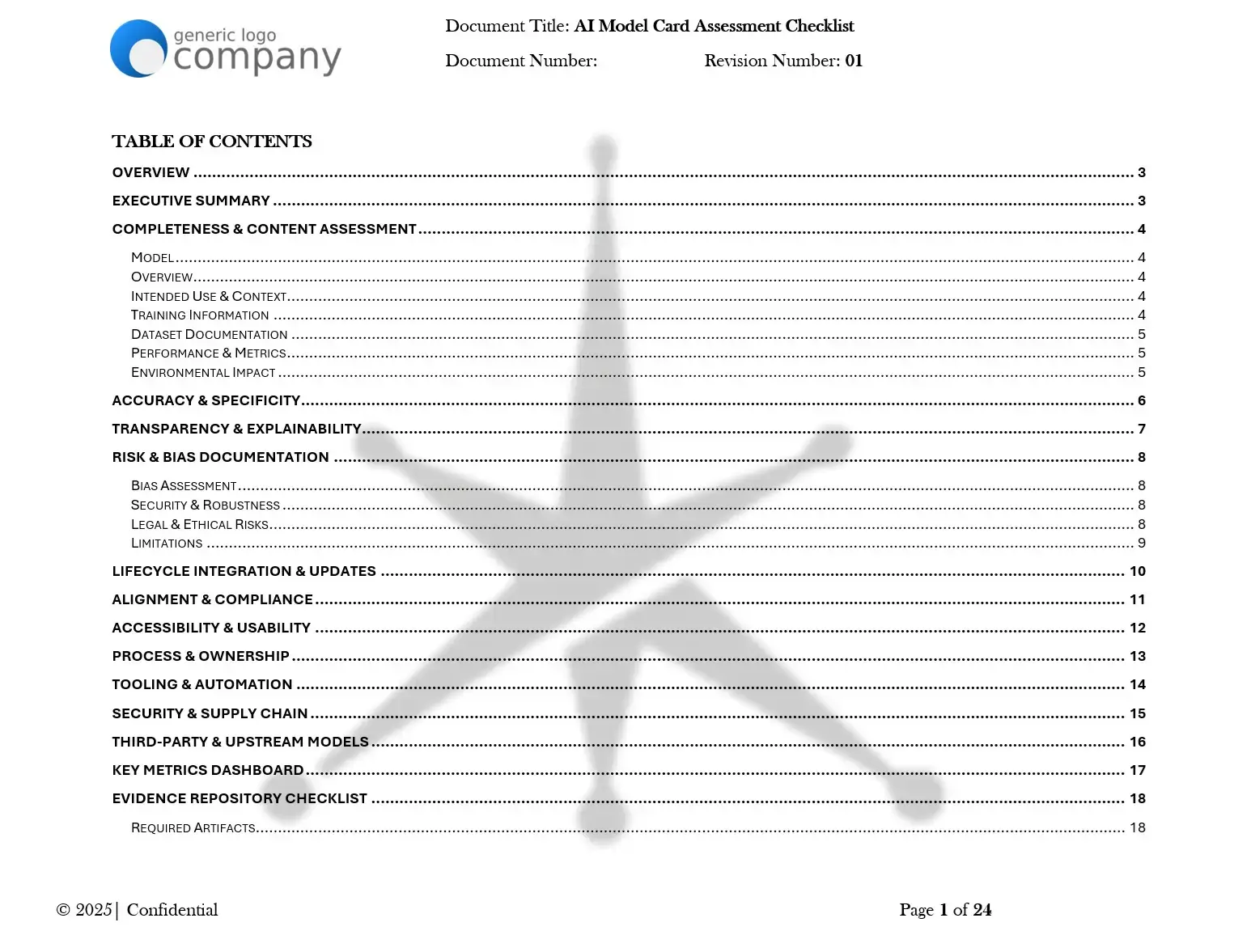
The template contains a complete Table of Contents, Executive Summary section with quality scoring, and detailed assessment categories covering model documentation, transparency, risk, compliance, and process requirements. Each category includes specific checklist items with status tracking columns (Complete, Incomplete, Missing, N/A), evidence repository links, and comment fields. Supporting appendices provide model card section standards, a compliance crosswalk table, and quality criteria definitions.
Why This Matters
AI model cards have emerged as a primary mechanism for documenting the intended use, performance characteristics, limitations, and ethical considerations of machine learning systems. As regulatory frameworks mature globally, the quality and completeness of this documentation increasingly determines an organization’s ability to demonstrate compliance and responsible AI practices.
The EU AI Act establishes specific documentation requirements for high-risk AI systems under Articles 11 and 13, including technical documentation standards and transparency obligations. The NIST AI Risk Management Framework emphasizes the importance of documenting AI system characteristics throughout the lifecycle. ISO/IEC 42001 (AI Management Systems) and ISO/IEC 23053 (ML Trustworthiness) provide additional standards that organizations may need to address.
Without a systematic approach to evaluating model documentation, organizations risk deploying AI systems with incomplete disclosures, inadequate risk documentation, or gaps in compliance alignment. This assessment template provides a structured methodology for identifying these gaps before they create compliance or operational issues.
Framework Alignment
The template includes explicit alignment checkpoints for the following frameworks referenced within the document:
- EU AI Act (Articles 11 & 13): Technical documentation and transparency obligation assessment items
- NIST AI RMF: Risk documentation evaluation criteria
- ISO/IEC 42001: AI Management System documentation alignment
- ISO/IEC 23053: Machine learning trustworthiness documentation criteria
- GDPR Article 35: Impact assessment documentation linkages
Key Features
Based on the actual template contents, the following capabilities are included:
- Executive Summary Dashboard: Overall model card quality score (out of 100), documentation completeness percentage, and compliance status tracking
- Completeness & Content Assessment: Detailed checklists for Model Overview, Intended Use & Context, Training Information, Dataset Documentation, Performance & Metrics, and Environmental Impact documentation
- Accuracy & Specificity Verification: Seven-item verification checklist for cross-checking information against test logs, validation results, and deployment artifacts
- Transparency & Explainability Assessment: Evaluation criteria for decision-making logic, metrics rationale, feature importance, and interpretability documentation
- Risk & Bias Documentation: Comprehensive sections covering bias assessment, security and robustness testing, legal and ethical risks, and known limitations
- Lifecycle Integration Tracking: Eight-item checklist for version control, change management, update triggers, and maintenance ownership
- Alignment & Compliance Crosswalk: Pre-built mapping to EU AI Act, NIST AI RMF, ISO/IEC 42001, and organizational policy alignment
- Process & Ownership Documentation: RACI matrix framework, cross-functional team involvement tracking, and review workflow documentation
- Tooling & Automation Assessment: CI/CD integration, metadata auto-population, linting/validation, and compliance checking evaluation
- Security & Supply Chain Documentation: CVE references, SBOM linkages, vulnerability disclosure, and dependency tracking
- Third-Party Model Documentation: Upstream model tracking, license documentation, modification records, and attribution compliance
- Evidence Repository Checklist: 13-item artifact checklist including architecture diagrams, training logs, bias reports, and compliance mappings
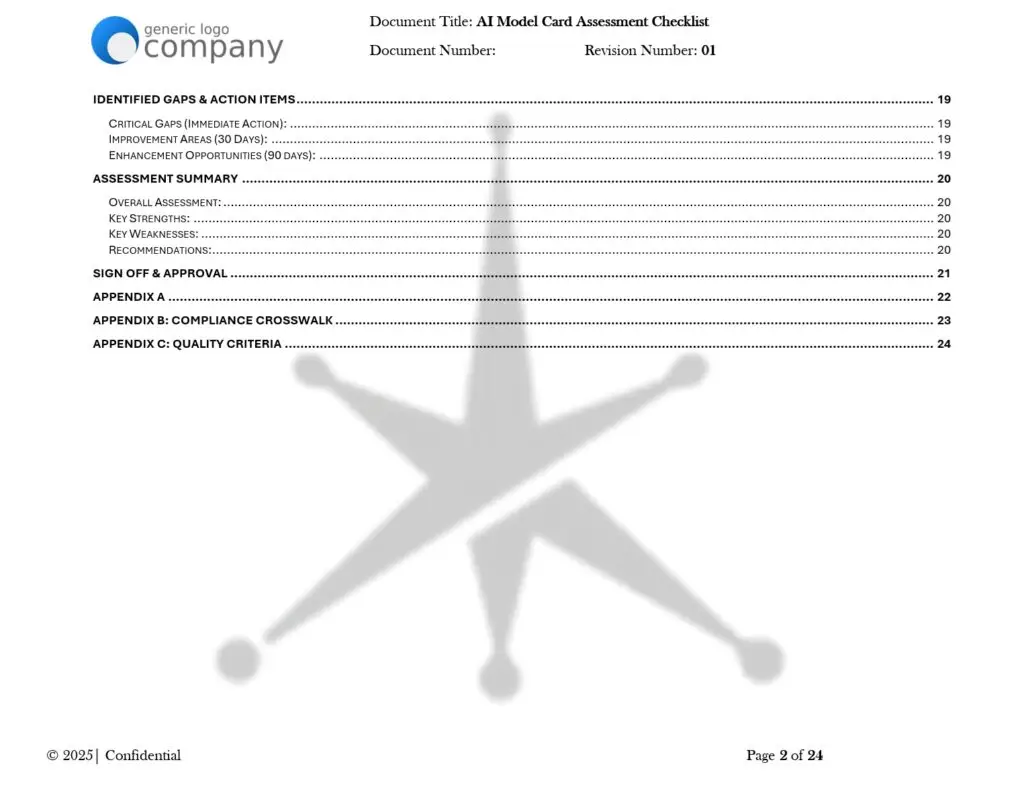
- Gap Identification & Action Planning: Structured sections for critical gaps (immediate action), improvement areas (30 days), and enhancement opportunities (90 days)
- Sign-Off & Approval Workflow: Dual approval structure with Assessment Team (Assessor, Technical Reviewer, Compliance Officer) and Approval Chain (AI Development Lead, Quality Assurance, AI Governance Committee)
- Appendix A – Model Card Sections: Reference list of 14 standard and enhanced model card sections
- Appendix B – Compliance Crosswalk Table: Pre-formatted mapping table for six regulatory/standard frameworks
- Appendix C – Quality Criteria: Definitions for Excellent Model Card and Minimum Acceptable documentation standards
Comparison Table: Basic Approach vs. Professional Assessment Template
| Aspect | Basic Approach | This Assessment Template |
|---|---|---|
| Assessment Structure | Ad-hoc review based on available resources | Comprehensive structured categories with 90+ specific checklist items |
| Compliance Mapping | Manual research for each applicable framework | Pre-built crosswalk for EU AI Act, NIST AI RMF, ISO/IEC 42001, ISO/IEC 23053, GDPR |
| Evidence Tracking | Informal documentation or spreadsheets | Built-in evidence repository links and artifact checklist |
| Gap Prioritization | Undifferentiated findings list | Tiered action items: Critical (immediate), Improvement (30 days), Enhancement (90 days) |
| Scoring Methodology | Subjective or inconsistent ratings | Section-by-section scoring with overall quality score framework |
| Approval Process | Informal sign-off | Dual-track approval workflow (Assessment Team + Approval Chain) |
FAQ Section
Q: What file format is this template provided in? A: Documents are optimized for Microsoft Word and Excel to ensure proper formatting and collaborative editing capabilities. The template requires customization to your organization’s specific model types and documentation practices.
Q: Does this template include all compliance requirements for the EU AI Act? A: The template includes assessment items aligned with EU AI Act Articles 11 and 13 documentation requirements. However, regulatory compliance depends on your specific AI system classification, use case, and implementation. Professional legal and compliance review is recommended for compliance determinations.
Q: Can this template be used for different types of AI models? A: The template includes model type checkboxes for Classification, Generation, Regression, and Other model types. The assessment criteria are designed to be adaptable, though organizations should customize checklist items based on their specific model architectures and use cases.
Q: How does this differ from creating a model card? A: This template is designed to assess existing model card documentation quality, not to create model cards from scratch. It evaluates whether required sections are present, accurate, and complete. Organizations typically use separate templates or tools for model card creation.
Q: What level of AI governance maturity is needed to use this template? A: The template is structured for organizations at various maturity levels. The Appendix C Quality Criteria section defines both “Excellent Model Card” and “Minimum Acceptable” standards, allowing organizations to assess against appropriate benchmarks for their current capabilities.
Q: Does the template include guidance for environmental impact documentation? A: Yes, the Completeness & Content Assessment section includes specific items for energy consumption documentation, carbon footprint calculation (referencing ISO/IEC 42001 A.4.2), and hardware specifications. These are included as assessment criteria, not calculation methodologies.
Ideal For Section
This template is designed for:
- AI/ML Engineering Teams evaluating model documentation before deployment
- AI Governance Officers conducting periodic model documentation audits
- Compliance Teams preparing for regulatory assessments or third-party audits
- Risk Management Professionals documenting AI system risk characteristics
- Quality Assurance Teams establishing model documentation standards
- Organizations implementing ISO/IEC 42001 AI Management Systems
- Companies preparing for EU AI Act documentation requirements
- Internal Audit Functions assessing AI governance controls
Pricing Strategy Options
Single Template: Contact for pricing based on organizational requirements and customization needs.
Bundle Option: May be combined with additional AI governance templates (AI Acceptable Use Policy, AI Risk Assessment Framework, AI Governance Charter) depending on organizational compliance scope.
Enterprise Option: Available as part of comprehensive AI governance documentation suites for organizations implementing full AI management systems.
⚖️ Differentiator
This assessment checklist template provides a structured evaluation framework specifically designed around model card documentation requirements rather than general AI governance policies. The template includes comprehensive assessment categories with over 90 individual checklist items, each mapped to specific evidence documentation requirements. The built-in compliance crosswalk addresses six major regulatory and standards frameworks (EU AI Act Articles 11 & 13, NIST AI RMF, ISO/IEC 42001, ISO/IEC 23053, and GDPR Article 35), providing organizations with a single assessment instrument that may support multiple compliance objectives. The tiered gap prioritization structure (Critical, Improvement, Enhancement) and dual approval workflow (Assessment Team and Approval Chain) support integration with existing governance processes. Organizations should customize the template based on their specific model types, applicable regulations, and internal documentation standards.
Note: This template provides a framework for assessment purposes and requires organizational customization. It does not constitute legal advice or guarantee regulatory compliance. Organizations should consult with qualified legal and compliance professionals regarding specific regulatory requirements applicable to their AI systems.