
Author: Derrick D. Jackson
Title: Founder & Senior Director of Cloud Security Architecture & Risk
Credentials: CISSP, CRISC, CCSP
Last updated October 24th, 2025
Hello Everyone, Help us grow our community by sharing and/or supporting us on other platforms. This allow us to show verification that what we are doing is valued. It also allows us to plan and allocate resources to improve what we are doing, as we then know others are interested/supportive.
Table of Contents
What Is ISO 42001 Clause 5
Establishing Accountability for Responsible AI Governance
Your organization has defined its AI governance scope and identified stakeholders. Now comes the critical question: Who’s actually accountable when things go wrong?
ISO 42001 Clause 5 addresses organizational accountability. It’s not about delegating AI governance to technical teams. It’s about establishing clear lines of responsibility from the boardroom to operational teams before deploying AI systems at scale.
Disclaimer: This article discusses general principles for AI governance. Organizations should consult ISO/IEC 42001:2023 directly for specific compliance requirements.
Executive Summary
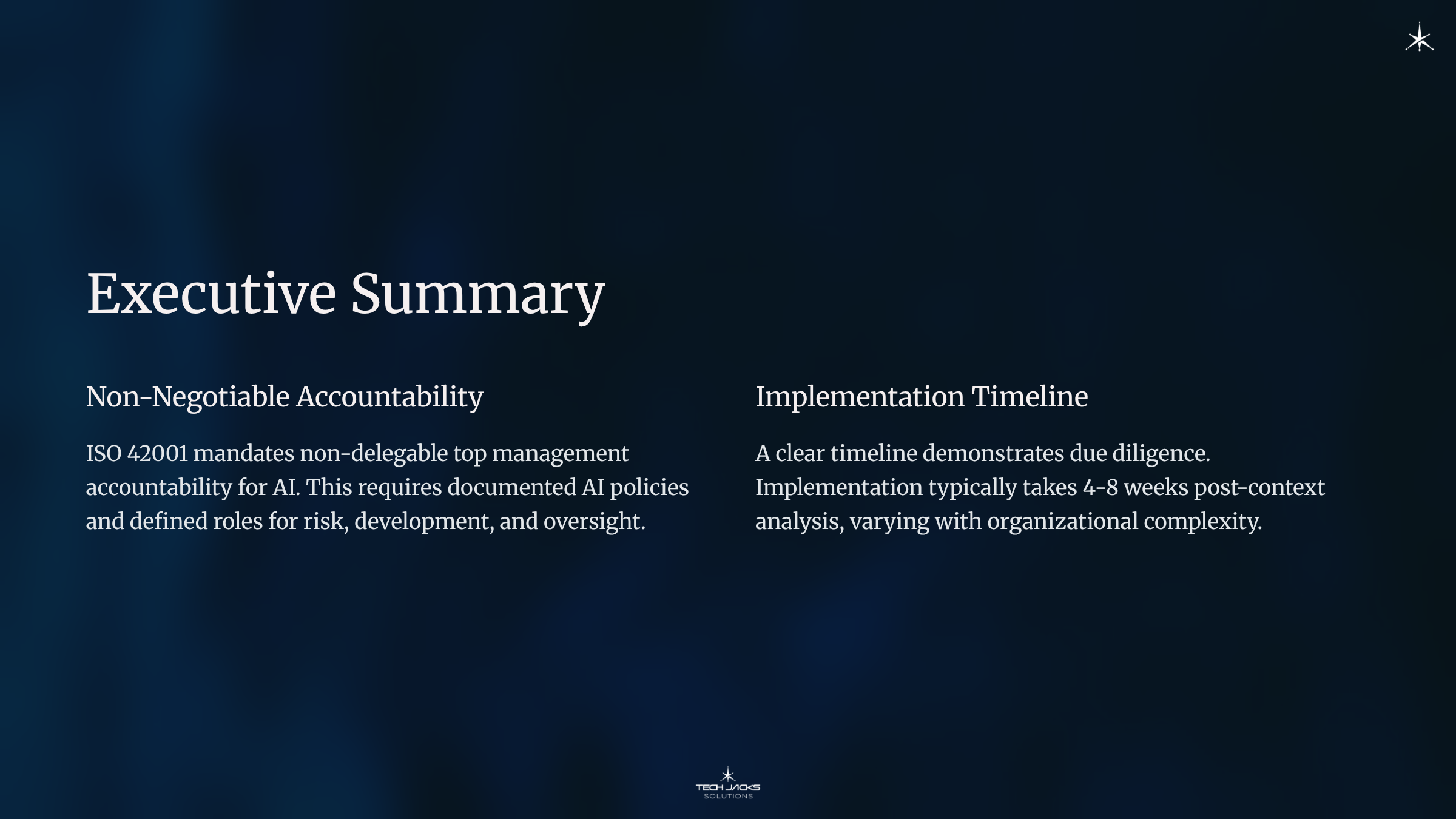
Top management accountability isn’t negotiable under ISO 42001. You can’t delegate it away.
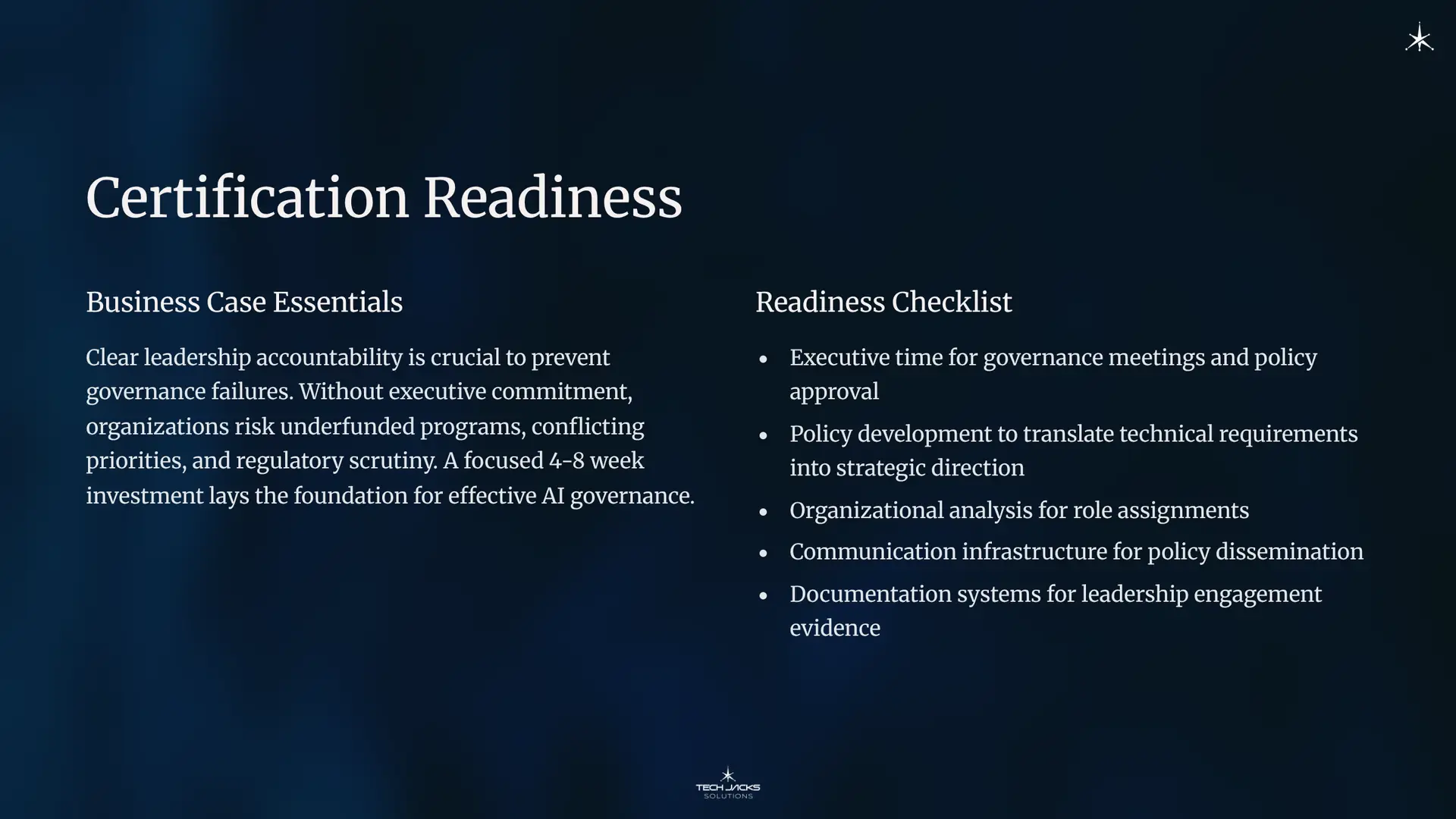
The requirements include documented AI policies communicated organization-wide and specific roles defined across risk, development, and oversight functions. This matters for demonstrating due diligence to regulators and stakeholders. Implementation takes 4-8 weeks after completing context analysis.
Why Leadership Accountability Matters
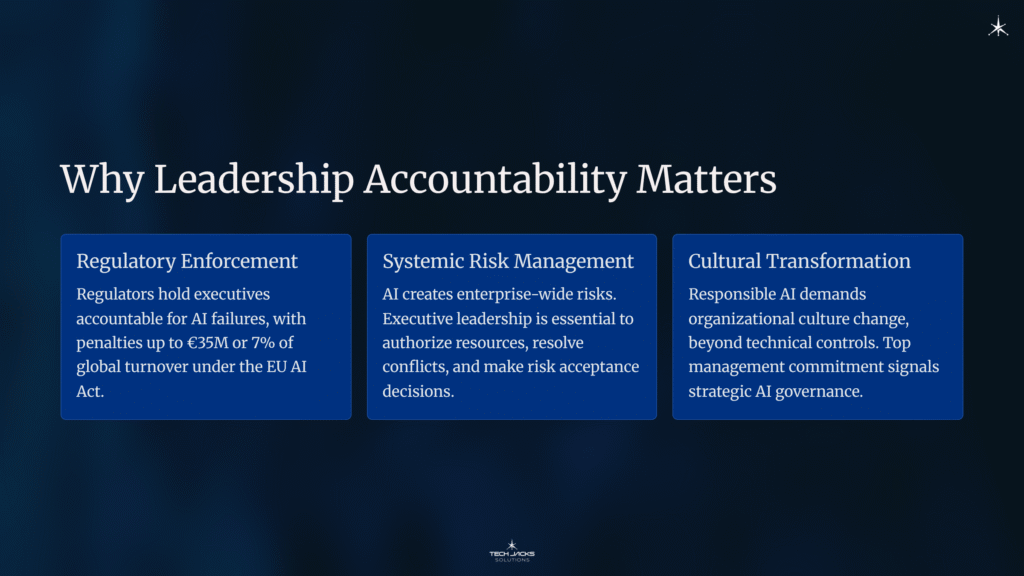
Three factors make executive leadership critically important right now.
Regulatory Enforcement: Regulators increasingly hold executives personally accountable for AI failures. The EU AI Act establishes penalties of up to €35 million or 7% of global annual turnover (whichever is higher) for serious violations. Personal accountability drives different behavior than delegated responsibility.
Systemic Risk Management: AI systems create enterprise-wide risks affecting multiple stakeholder groups. A biased hiring algorithm impacts talent acquisition, legal liability, reputation, and regulatory compliance simultaneously. Only executive leadership can authorize resources and make risk acceptance decisions at this level.
Cultural Transformation: Responsible AI requires organizational culture change, not just technical controls. Top management commitment signals that AI governance matters strategically. When executives demonstrate leadership through resource allocation and accountability structures, the entire organization responds differently.
Core Leadership Requirements
1. Top Management Commitment (Clause 5.1)
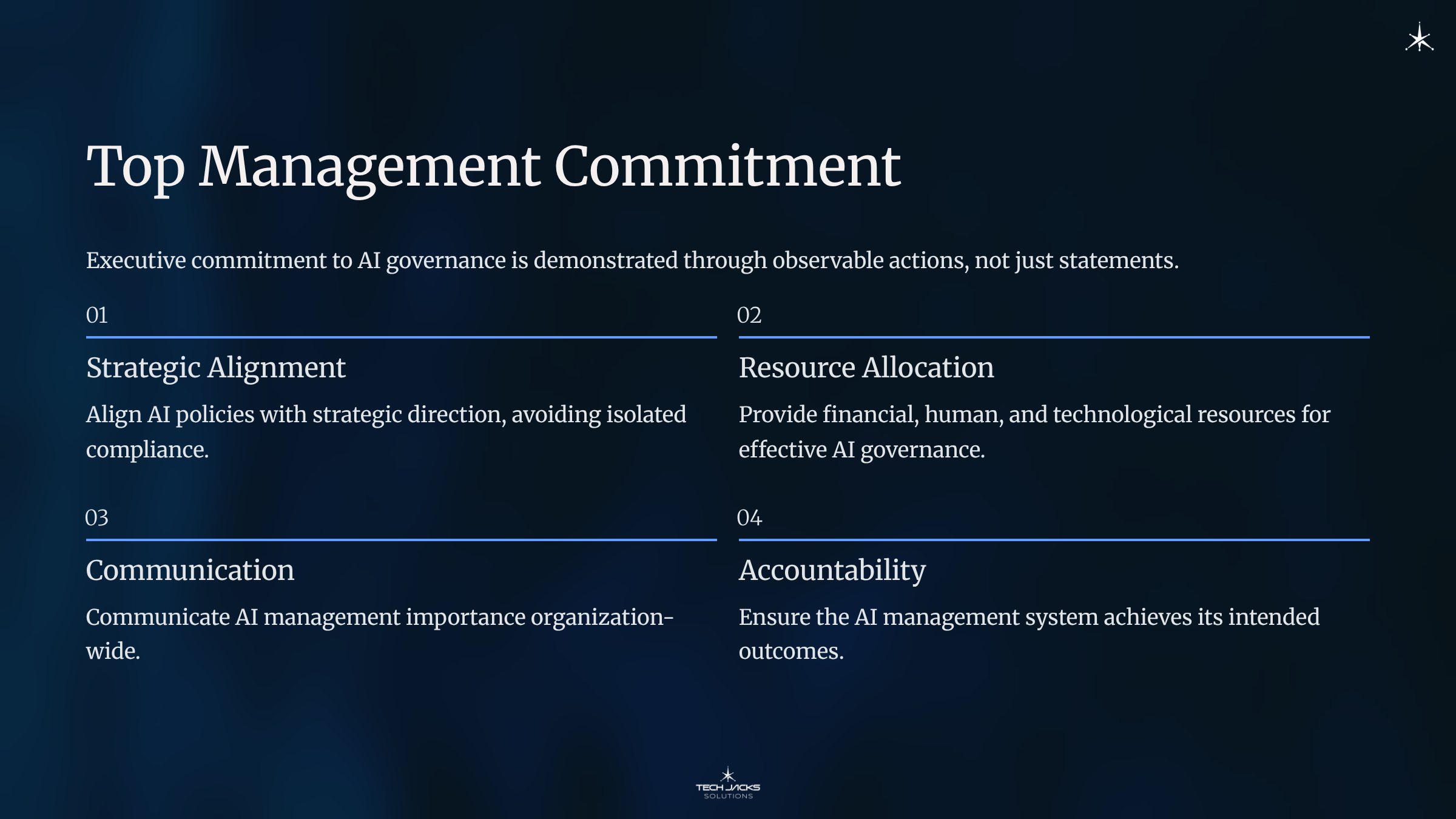
Organizations demonstrate executive commitment through specific, observable actions rather than general statements.
Top management ensures AI policies and objectives align with strategic direction. They integrate AI management system requirements into core business processes instead of treating governance as separate from operations. Executive teams ensure necessary resources are available for effective AI governance (financial, human, and technological).
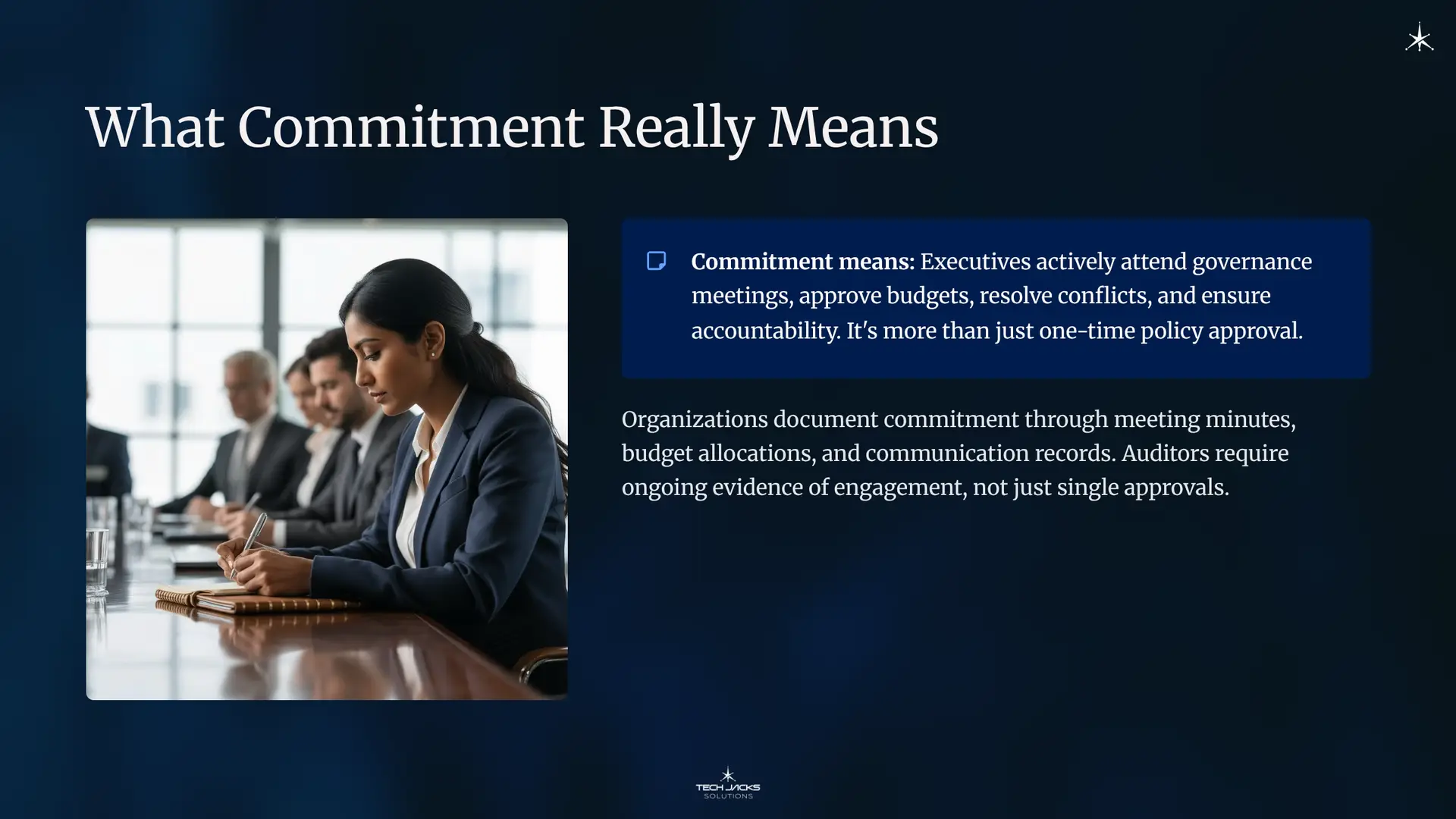
In plain English: Commitment means executives attend governance meetings, approve budgets, resolve resource conflicts, and hold people accountable. Not just signing policy documents once.
Most critically, they take responsibility for ensuring the AI management system achieves its intended outcomes. Organizations document these commitments through management meeting minutes, budget allocations, and communication records. Auditors look for ongoing evidence of engagement rather than one-time approval events.
2. AI Policy (Clause 5.2)
Organizations establish formal AI policies providing strategic direction for all AI-related activities.
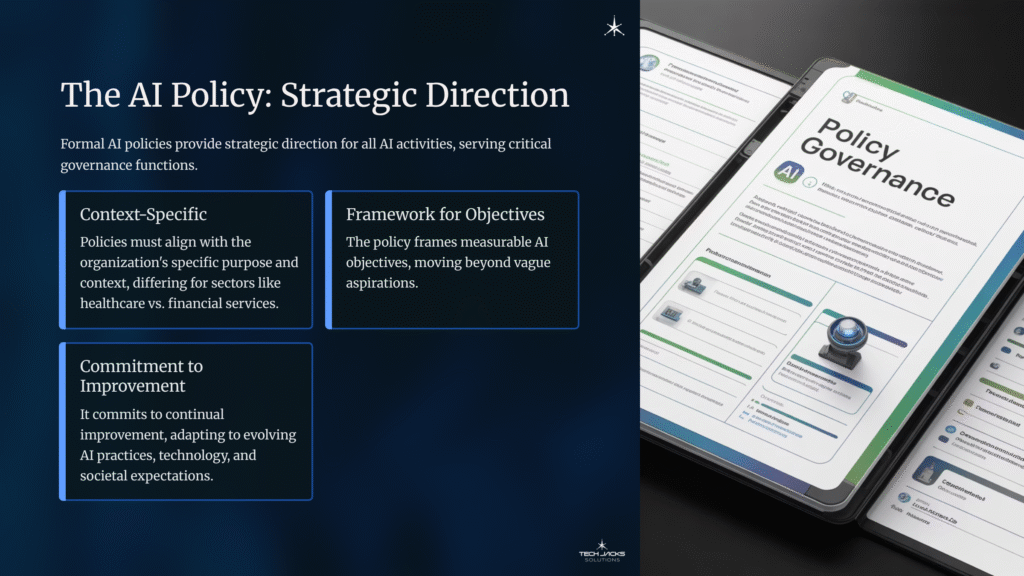
The AI policy must fit your organization’s specific purpose and context. A healthcare provider’s AI policy addresses different concerns than a financial services firm’s policy. Generic templates lack the specificity needed to guide actual decisions.
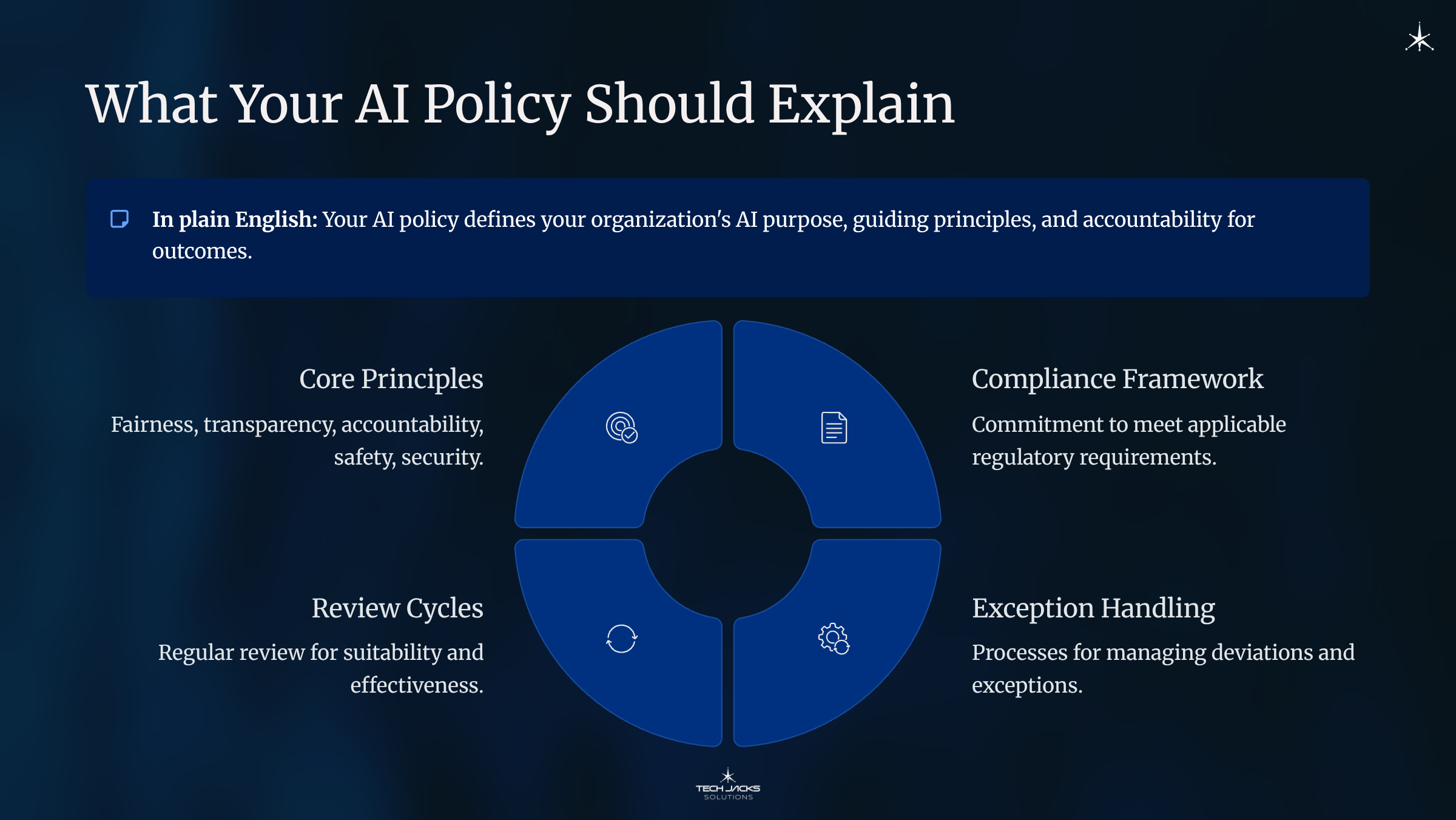
In plain English: Your AI policy explains WHY your organization uses AI, WHAT principles guide your AI work, and WHO’s accountable for outcomes. It’s written in language your specific stakeholders understand.
The policy provides a framework for setting measurable AI objectives rather than listing vague aspirations. It includes commitments to meet applicable requirements and commits to continual improvement, acknowledging that responsible AI practices evolve as technology and societal expectations change.
Effective AI policies include principles guiding all AI activities: fairness, transparency, accountability, safety, security. They establish processes for handling deviations and exceptions rather than creating rigid rules. Policies typically span 2-5 pages based on organizational complexity.
Organizations make AI policies available as documented information and communicate them within the organization. The policy references other relevant organizational policies where appropriate, linking AI governance to existing quality, security, privacy, or safety frameworks.
3. Roles, Responsibilities, and Authorities (Clause 5.3)
Organizations define and assign specific responsibilities and authorities for AI governance activities. This establishes clear accountability for every aspect of AI system management.
Top management ensures responsibilities and authorities for relevant roles are assigned and communicated within the organization. This includes documenting roles, providing training, obtaining acknowledgment of responsibilities, and verifying understanding.
Two specific assignments aren’t negotiable: someone must be responsible for ensuring the AI management system conforms to ISO 42001 requirements, and someone must be responsible for reporting AI management system performance to top management.
In plain English: Someone specific must own “does our AI governance actually work?” and someone specific must tell executives “here’s how our AI governance performed this quarter.” No shared responsibility that becomes no responsibility.
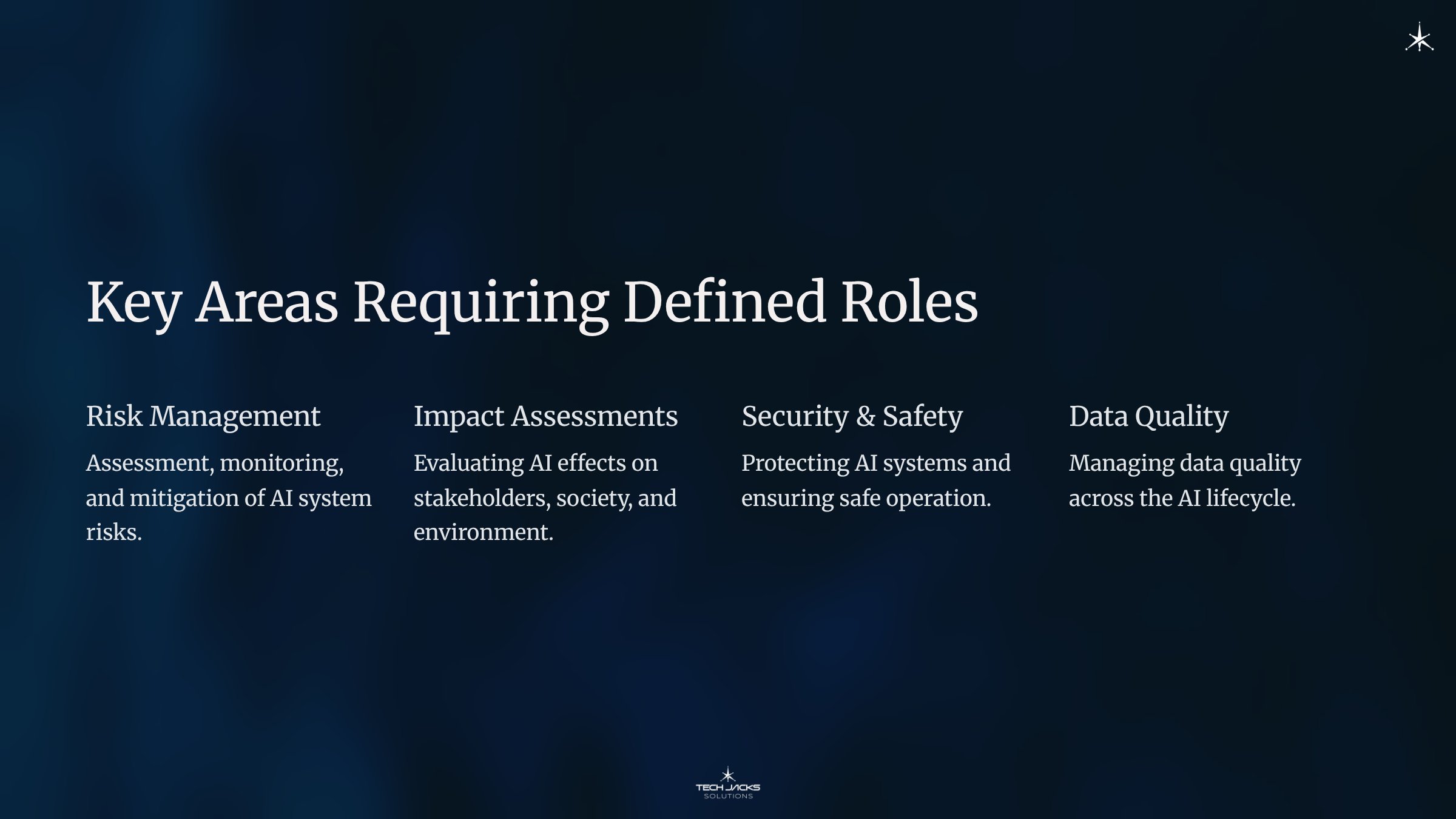
Organizations consider multiple areas requiring defined roles: risk management activities, AI system impact assessments, security, safety, privacy, development, performance monitoring, human oversight, supplier relationships, and data quality management throughout the AI lifecycle.
Clear role definition prevents gaps where critical activities lack ownership and overlaps where multiple teams create conflicts without resolution mechanisms.
Implementation Essentials
Getting Executive Commitment: Frame AI governance in terms executives understand: regulatory compliance, risk management, competitive advantage, and stakeholder trust. Connect to existing enterprise risk management frameworks rather than presenting it as entirely new territory.
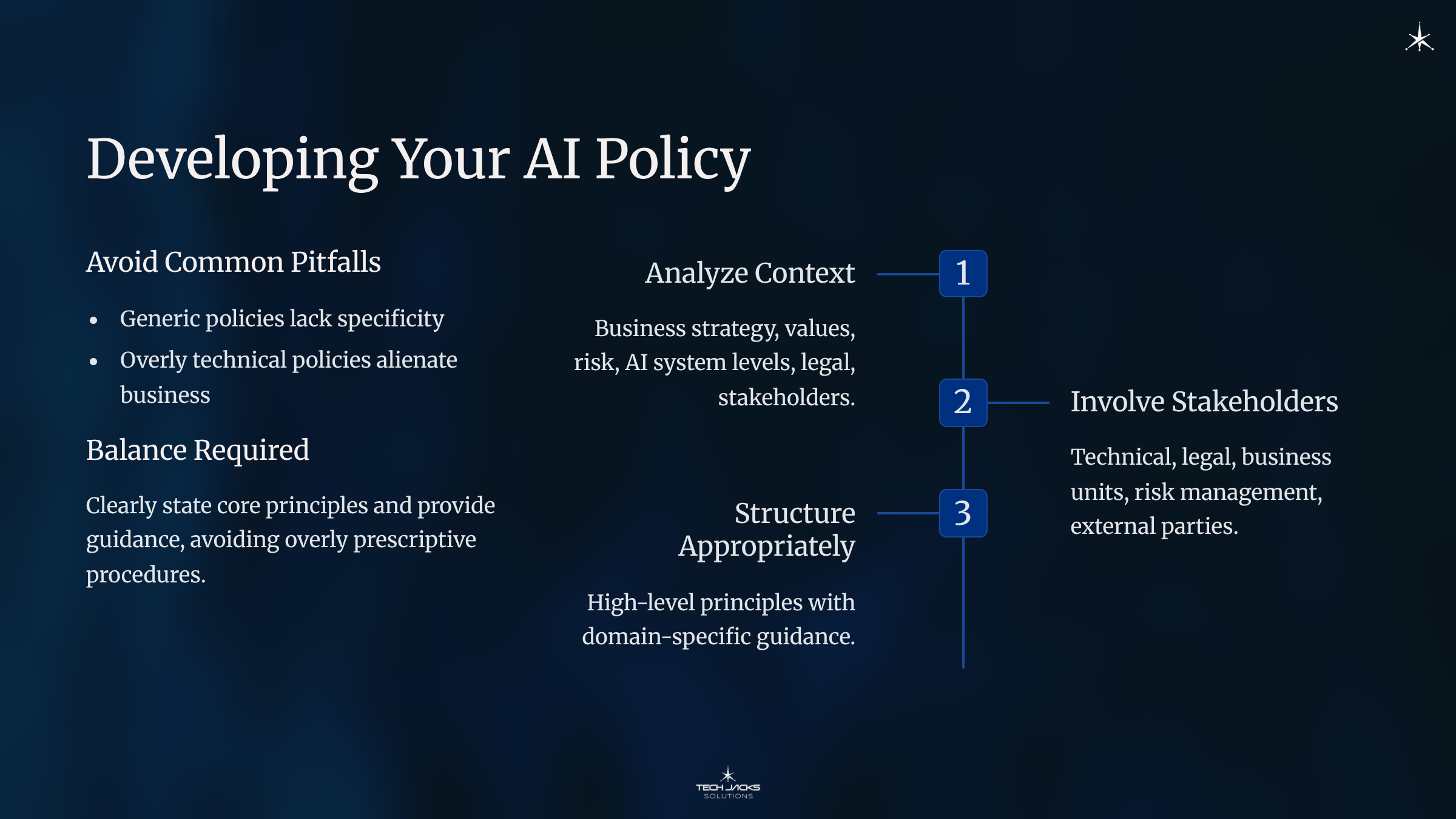
Developing Your AI Policy: Start by analyzing business strategy, organizational values, risk tolerance, AI system risk levels, legal requirements, and stakeholder impacts. Strong policies balance principles with practicality. State core principles clearly, then provide enough guidance that teams understand how principles apply to specific situations.
Defining Roles: Map existing responsibilities before creating new positions. Identify gaps where required functions lack clear ownership (commonly AI system impact assessments, fairness evaluations, and cross-functional governance oversight). Assign roles to specific individuals by name rather than titles for personal accountability.
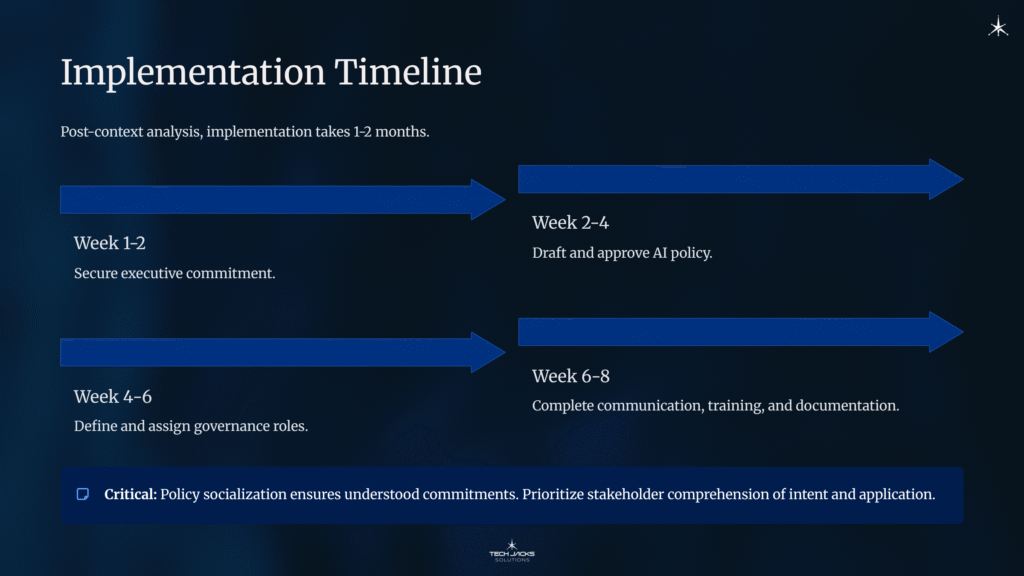
Timeline: Organizations with completed context analysis typically need 4-8 weeks to implement leadership requirements. Week 1-2: secure executive commitment. Week 2-4: draft and approve AI policy. Week 4-6: define and assign roles. Week 6-8: communicate, train, and document.
Frequently Asked Questions
Can leadership responsibilities be delegated?
Top management can delegate operational responsibilities but can’t delegate ultimate accountability. The CEO can assign someone to manage the AI governance program daily, but the CEO remains accountable for ensuring the program works. This parallels other ISO management system standards where accountability remains with top management.
How detailed should the AI policy be?
AI policies should provide sufficient guidance for decision-making without becoming operational procedures. Policies typically span 2-5 pages based on organizational complexity. A good test: could someone unfamiliar with your organization read the policy and understand your AI principles and approach?
What if our organization has no single “top management”?
ISO 42001 recognizes that “top management” can be a person or group. Partnership structures, cooperatives, academic institutions, and government agencies may have collective leadership. Define clearly who constitutes top management for your organization and ensure all members understand their collective accountability.
How does this integrate with existing ISO certifications?
Organizations already certified to ISO 27001 or ISO 9001 can extend existing leadership structures to cover AI-specific considerations. The leadership clause parallels requirements in these standards, enabling organizations to add AI elements to existing policies and management reviews rather than creating entirely parallel structures.
Standards and Resources
Official Standards:
- ISO/IEC 42001:2023 – AI Management System (Clauses 5.1-5.3)
- ISO/IEC 38507:2022 – Governance of AI for Organizations
- ISO/IEC 23894:2023 – AI Risk Management
Regulatory Documents:
- EU AI Act (Regulation 2024/1689) – European AI regulation
- NIST AI Risk Management Framework – US framework
Your Next Steps
This Week:
- Schedule executive briefing on AI governance accountability
- Identify current AI-related responsibilities across organization
- Review existing policies potentially affected by AI policy
This Month:
- Develop AI policy draft with cross-functional input
- Define governance role descriptions and authorities
- Establish executive commitment through formal policy approval
Leadership accountability isn’t optional. For organizations serious about AI governance, executive commitment, formal policies, and clear role assignments establish the foundation for everything that follows. Without leadership accountability, governance remains theoretical rather than operational.
Related: What Is ISO 42001 Clause 4: Context of the Organization | What Is ISO 42001 Clause 6: Planning
Ready to Test Your Knowledge?
