
Claims administration and risk management company Sedgwick has confirmed that its federal contractor subsidiary, Sedgwick Government Solutions, was the victim of a security breach. […] Read More

The CERT Coordination Center (CERT/CC) has disclosed details of an unpatched security flaw impacting TOTOLINK EX200 wireless range extender that could allow a remote authenticated attacker to gain full control of the device. The flaw, CVE-2025-65606 (CVSS score: N/A), has been characterized as a flaw in the firmware-upload error-handling logic, which could cause the device […]

Threat actors are exploiting a recently discovered command injection vulnerability that affects multiple D-Link DSL gateway routers that went out of support years ago. […] Read More
Microsoft announced today that it has canceled plans to impose a daily limit of 2,000 external recipients on Exchange Online bulk email senders. […] Read More
OpenAI is testing a new model for Codex, and it could be the company’s best coding model yet. […] Read More

Threat actors are using the social engineering technique and a legitimate Microsoft tool to deploy the DCRat remote access Trojan against targets in the hospitality sector. Read More
The National Security Bureau in Taiwan says that China’s attacks on the country’s energy sector increased tenfold in 2025 compared to the previous year. […] Read More
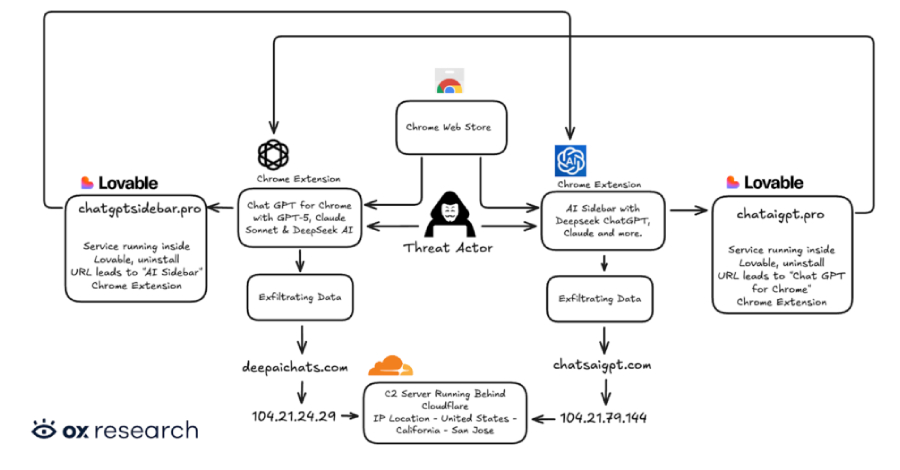
Cybersecurity researchers have discovered two new malicious extensions on the Chrome Web Store that are designed to exfiltrate OpenAI ChatGPT and DeepSeek conversations alongside browsing data to servers under the attackers’ control. The names of the extensions, which collectively have over 900,000 users, are below – Chat GPT for Chrome with GPT-5, Claude Sonnet & […]
The Kimwolf botnet, an Android variant of the Aisuru malware, has grown to more than two million hosts, most of them infected by exploiting vulnerabilities in residential proxy networks to target devices on internal networks. […] Read More
Microsoft has pushed back against claims that multiple prompt injection and sandbox-related issues raised by a security engineer in its Copilot AI assistant constitute security vulnerabilities. The development highlights a growing divide between how vendors and researchers define risk in generative AI systems. […] Read More