NIST MANAGE Function SOP
Designed to support organizations in implementing systematic procedures for managing AI risks, operating AI systems, responding to incidents, and maintaining systems throughout their operational lifecycle.
[Download Now – $5.00]
What This Template Provides
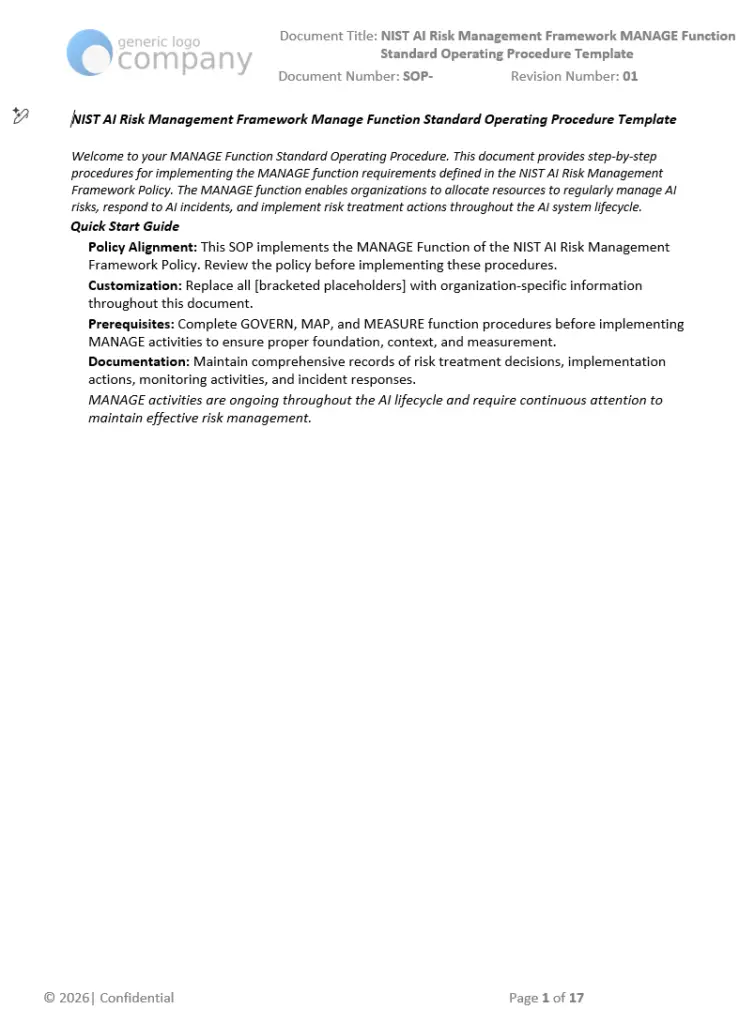
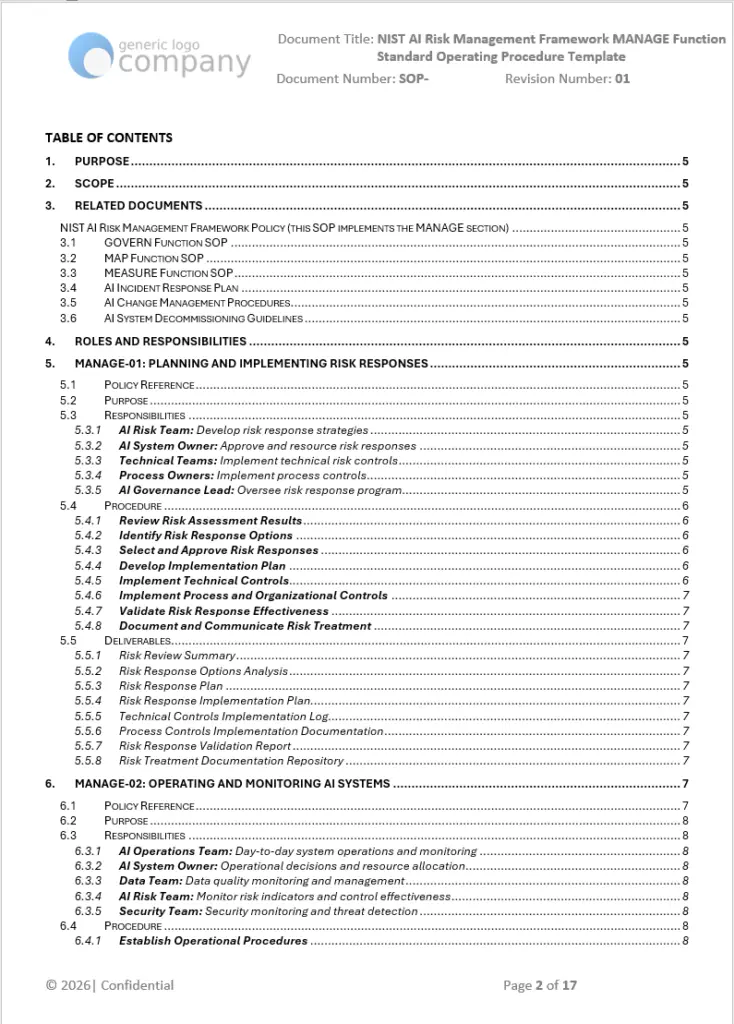
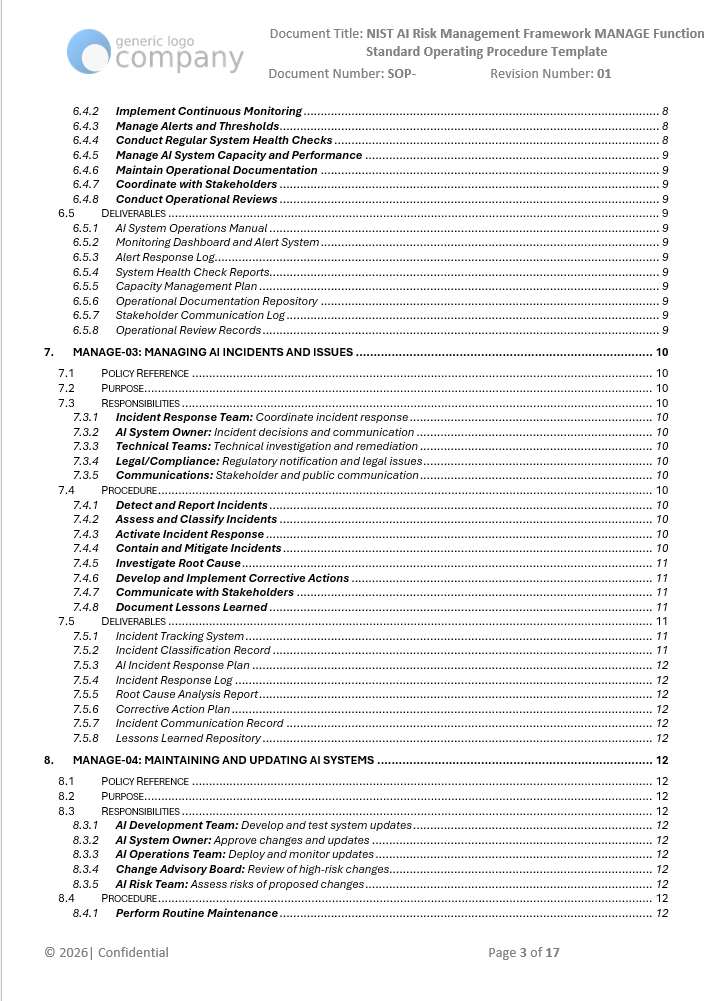
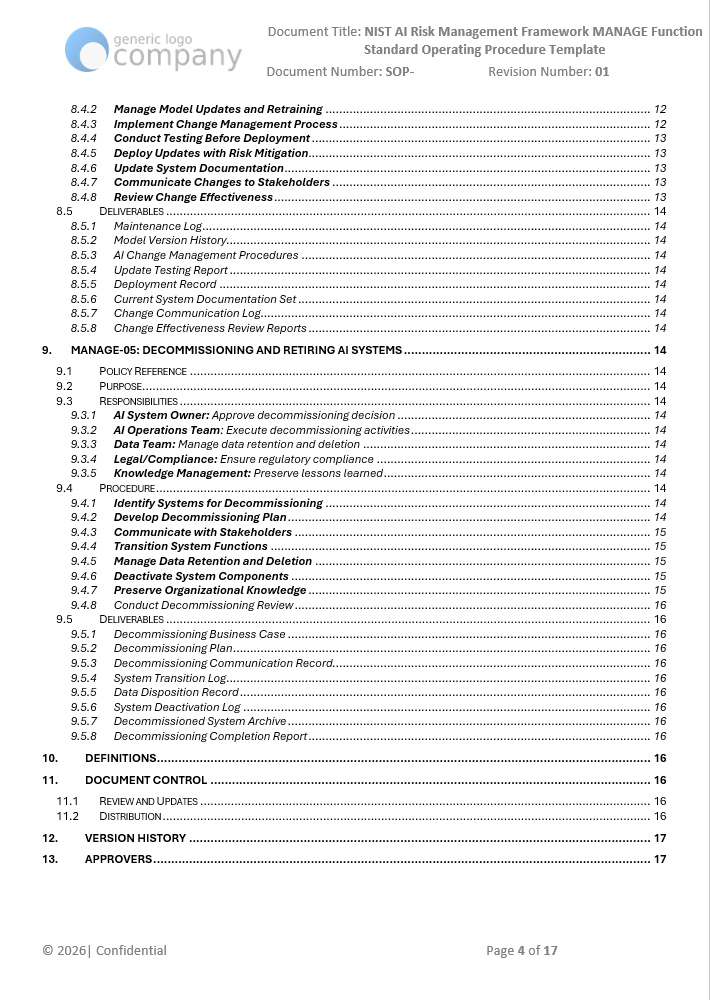
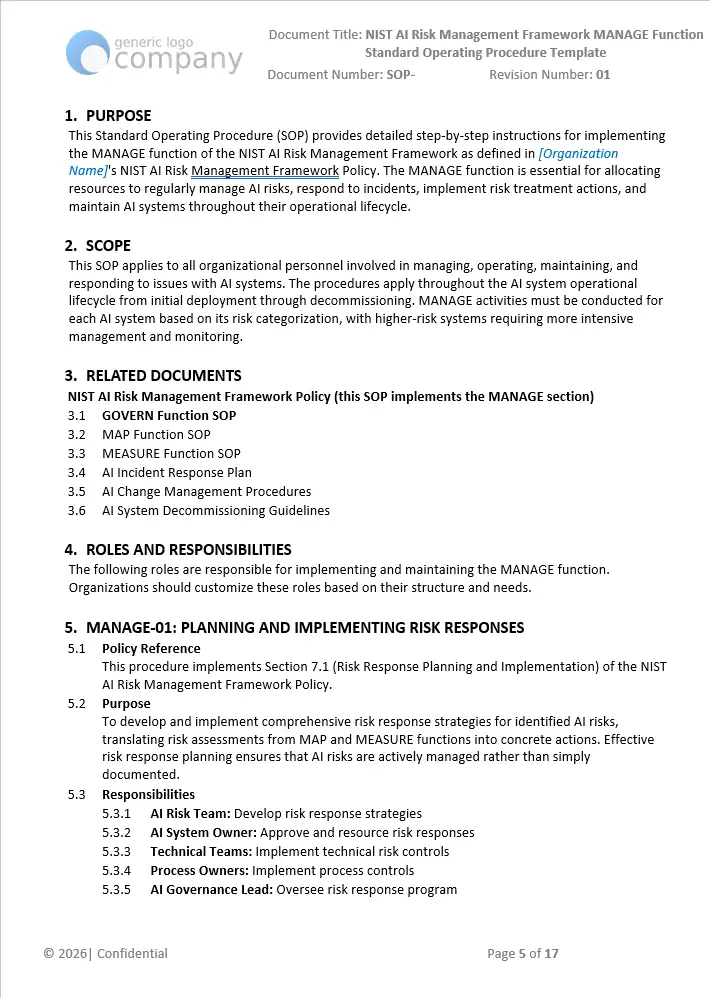
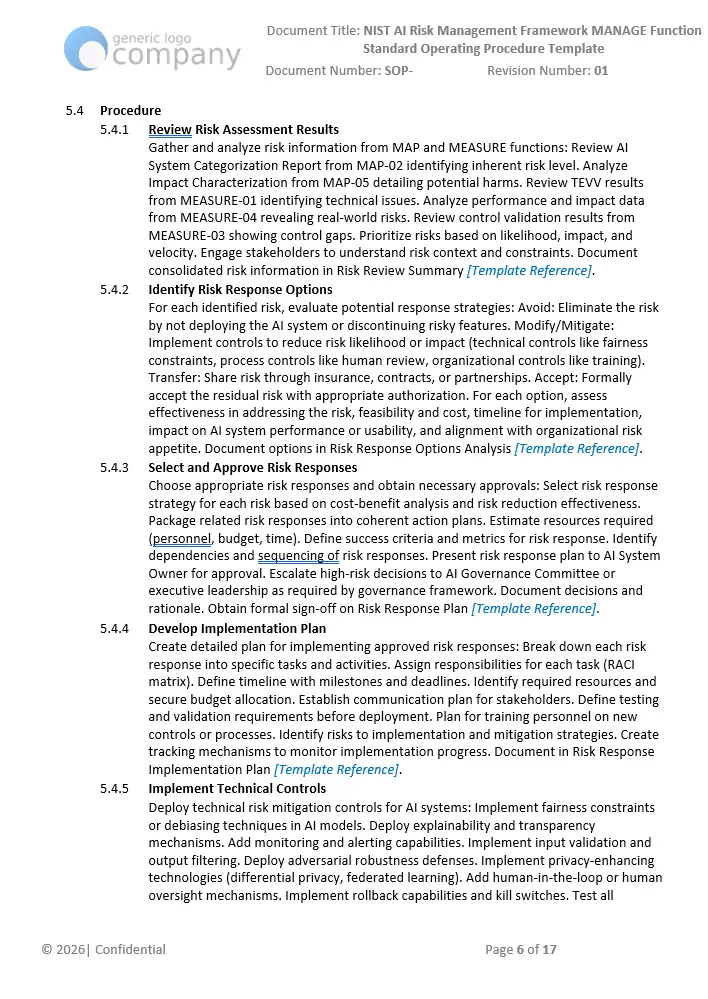
This Standard Operating Procedure (SOP) template provides detailed, step-by-step procedures for implementing the MANAGE function of the NIST AI Risk Management Framework. The template includes five comprehensive procedure sections covering risk response planning and implementation (MANAGE-01), AI system operations and monitoring (MANAGE-02), incident and issue management (MANAGE-03), system maintenance and updates (MANAGE-04), and system decommissioning (MANAGE-05). Organizations can customize this template by replacing bracketed placeholders with organization-specific information, adapting role assignments based on internal structure, and tailoring procedures to match existing operational frameworks.
The template is designed to save implementation time by providing pre-structured procedures that translate risk assessments into concrete management actions, establish operational monitoring frameworks, and create incident response protocols. Rather than starting from scratch, teams can adapt proven frameworks to their specific organizational context and AI system requirements.
Key Benefits
✓ Provides comprehensive framework for implementing all five MANAGE function subcategories aligned with NIST AI RMF operational guidance
✓ Includes detailed operational procedures defining systematic approaches to risk response implementation, continuous monitoring, incident management, and system maintenance
✓ Contains structured deliverable requirements for each MANAGE procedure including risk response plans, monitoring dashboards, incident logs, and decommissioning records
✓ Supports integration with GOVERN, MAP, and MEASURE functions by building on risk assessments and translating them into operational risk management actions
✓ Designed for ongoing operations with procedures covering the complete AI system lifecycle from deployment through decommissioning
✓ Facilitates documentation through referenced template frameworks for operational records, incident tracking, and change management
Who Uses This?
Designed for:
- AI Operations Teams responsible for day-to-day AI system management and monitoring
- Risk Management Professionals implementing systematic AI risk response strategies
- Incident Response Teams managing AI system issues and failures
- IT Operations and DevOps Teams maintaining AI system infrastructure and deployments
- Organizations seeking to establish structured MANAGE function procedures across AI systems
What’s Included
This downloadable template includes the complete Standard Operating Procedure document covering:
- Purpose, scope, and related documents sections
- Five detailed MANAGE procedures (MANAGE-01 through MANAGE-05) with step-by-step instructions
- Deliverable specifications for each procedure (40 total deliverables)
- Integration guidance with other NIST AI RMF functions
- Document control, version history, and approver sections
- Customizable placeholders throughout for organizational adaptation
Document Format: Microsoft Word (.docx) optimized for collaborative editing and organizational customization.
Why This Matters
Organizations deploying AI systems face ongoing challenges in translating risk assessments into operational reality. The MANAGE function represents where AI governance frameworks meet day-to-day operations—allocating resources to manage identified risks, responding when systems behave unexpectedly, and maintaining AI systems as requirements evolve.
Without structured procedures for the MANAGE function, organizations often struggle with inconsistent risk response implementation across different systems, reactive rather than proactive incident management, uncoordinated system maintenance that introduces new risks, and inadequate documentation of operational decisions and actions. These gaps can result in identified risks remaining unaddressed despite assessment efforts, incident response that escalates rather than contains problems, system changes that degrade trustworthy AI characteristics, and insufficient knowledge preservation when systems are retired.
This Standard Operating Procedure template addresses these operational challenges by providing detailed implementation guidance for the MANAGE function based on NIST AI RMF framework principles. Rather than developing operational procedures independently, organizations can adapt proven approaches that align with NIST’s guidance while customizing for their specific operational context and system requirements.
Framework Alignment
This SOP template is designed to support implementation of the following framework requirements:
- NIST AI Risk Management Framework (AI RMF 1.0): Provides detailed procedures for the five MANAGE function subcategories as defined in the official NIST framework documentation
- ISO/IEC 42001 AI Management System: MANAGE procedures can support organizations implementing AI management system requirements for operational control, incident management, and continual improvement
- ISO/IEC 27001 Information Security: Incident management and operational monitoring procedures align with information security management system controls
Key Features
The template includes features mapped directly to the document structure and content:
Comprehensive MANAGE Function Coverage
- Five detailed procedure sections covering all MANAGE subcategories: Risk Response Planning and Implementation (MANAGE-01), AI System Operations and Monitoring (MANAGE-02), Incident and Issue Management (MANAGE-03), System Maintenance and Updates (MANAGE-04), and System Decommissioning (MANAGE-05)
Operational Risk Response Procedures
- Step-by-step instructions for translating risk assessments from MAP and MEASURE functions into concrete risk treatment actions, including technical controls, process controls, and organizational controls implementation
Continuous Monitoring Framework
- Procedures for establishing operational monitoring including real-time performance tracking, data quality monitoring, drift detection, control effectiveness assessment, and alert management
Incident Management Protocol
- Structured approach to AI incident detection, classification, response activation, containment, root cause analysis, corrective action development, and lessons learned documentation
Change Management Integration
- Procedures for routine maintenance, model retraining and updates, risk assessment of changes, testing requirements, controlled deployment strategies, and change effectiveness review
System Lifecycle Management
- Complete procedures for AI system decommissioning including transition planning, data retention and deletion, knowledge preservation, and decommissioning completion verification
Cross-Function Integration
- Explicit integration points with GOVERN, MAP, and MEASURE functions ensuring MANAGE procedures build on established governance, context, and measurement foundations
Comprehensive Deliverables Specification
- Forty deliverables across the five MANAGE procedures with explicit requirements for operational records, incident documentation, change logs, and decommissioning archives
Comparison: Generic Approach vs. Professional Template
| Aspect | Generic Approach | NIST MANAGE Function SOP Template |
|---|---|---|
| Risk Response Translation | Organizations interpret risk assessments independently with inconsistent implementation of risk treatments | Provides structured procedures for translating MAP and MEASURE outputs into concrete risk response actions with technical and process controls |
| Operational Monitoring | Ad-hoc monitoring approaches with reactive responses to issues | Includes comprehensive continuous monitoring framework with defined metrics, alert management, and systematic health checks |
| Incident Management | Informal incident response with inconsistent documentation and learning | Provides complete incident management protocol from detection through root cause analysis to corrective actions and lessons learned |
| Change Management | Unstructured system updates introducing unanticipated risks | Includes risk-based change management procedures with testing requirements, controlled deployment strategies, and effectiveness validation |
| Decommissioning Planning | Systems retired without structured approach to data handling or knowledge preservation | Provides systematic decommissioning procedures covering transition planning, data disposition, knowledge capture, and completion verification |
| Cross-Function Integration | MANAGE activities disconnected from governance and assessment functions | Designed with explicit integration to GOVERN, MAP, and MEASURE functions supporting comprehensive NIST AI RMF implementation |
Frequently Asked Questions
Q: What is included in this template? A: This template includes a complete Standard Operating Procedure document for implementing the MANAGE function of the NIST AI Risk Management Framework. It covers five detailed procedures (MANAGE-01 through MANAGE-05) with step-by-step instructions, forty deliverable specifications, integration guidance with other NIST AI RMF functions, and document control sections. The template is provided in Microsoft Word format with customizable placeholders throughout. Documents are optimized for Microsoft Word and Excel to ensure proper formatting and collaborative editing capabilities.
Q: How does this template integrate with other NIST AI RMF functions? A: The MANAGE function builds directly on outputs from other framework functions. The template includes explicit integration guidance showing how MANAGE procedures use risk assessments from MAP function, leverage measurement data from MEASURE function, and operate within governance structures from GOVERN function. Organizations should implement GOVERN, MAP, and MEASURE procedures before implementing MANAGE activities to ensure proper foundation.
Q: Does this template include incident response procedures? A: Yes. The template includes comprehensive AI incident management procedures (MANAGE-03) covering incident detection and reporting, severity assessment and classification, response activation, containment and mitigation, root cause investigation, corrective action development, stakeholder communication, and lessons learned documentation. Organizations should adapt these procedures based on their incident response capabilities and regulatory requirements.
Q: Can this template be used for different types of AI systems? A: The template is designed to support MANAGE function implementation across different types of AI systems. Procedures include guidance for tailoring management activities based on system risk categorization, with higher-risk systems requiring more intensive monitoring, incident response, and change management. Organizations should adapt procedures based on their specific AI system characteristics and operational contexts.
Q: What customization is required? A: The template includes bracketed placeholders throughout that organizations should replace with their specific information including organization name, role titles, template references, system names, monitoring thresholds, escalation procedures, and approval authorities. Organizations should also review and adapt procedure steps to align with their existing operational processes, incident response frameworks, and change management systems.
Q: Does this cover AI system decommissioning? A: Yes. The template includes detailed procedures for AI system decommissioning (MANAGE-05) covering decommissioning decision criteria, planning, stakeholder communication, function transition, data retention and deletion requirements, system deactivation, knowledge preservation, and decommissioning completion verification. This ensures responsible system retirement when AI systems reach end of life.
Ideal For
This template is designed for:
- AI Operations Teams requiring structured procedures for day-to-day AI system management and monitoring
- Risk Management Professionals implementing systematic approaches to AI risk response and treatment
- Incident Response Teams establishing AI-specific incident management protocols and documentation
- IT Operations and DevOps Teams managing AI system maintenance, updates, and change control
- Organizations implementing comprehensive NIST AI RMF programs requiring MANAGE function procedures that integrate with governance, mapping, and measurement activities
- Multi-system environments requiring consistent operational procedures applied across diverse AI applications
Single Template Purchase: $5.00
This one-time purchase provides immediate download access to the complete NIST MANAGE Function Standard Operating Procedure template in Microsoft Word format.
Bundle Considerations: Organizations implementing comprehensive NIST AI RMF programs benefit from coordinating MANAGE function procedures with complementary templates for other framework functions (GOVERN, MAP, MEASURE). The MANAGE function specifically builds on outputs from MAP and MEASURE functions, making integrated implementation valuable for operational effectiveness.
Enterprise Implementation: Organizations requiring assistance with template customization, integration with existing operational frameworks, incident response planning, or staff training on MANAGE function implementation may contact us regarding professional services support.
⚖️ Differentiator
This Standard Operating Procedure template provides what many organizations spend months developing: detailed, actionable procedures for translating AI risk assessments into operational reality. The MANAGE function represents where governance frameworks meet day-to-day operations—this template bridges that gap with structured procedures that organizations can immediately adapt to their contexts.
The template addresses a critical implementation challenge: organizations complete risk assessments through MAP and MEASURE functions but struggle to systematically implement risk responses, monitor operations, manage incidents, and maintain systems. This template provides the operational infrastructure many organizations lack, with procedures spanning the complete AI system lifecycle from deployment through decommissioning.
The comprehensive coverage includes forty deliverables across five MANAGE procedures—risk response plans, operational monitoring dashboards, incident tracking systems, change management records, and decommissioning documentation. This level of operational detail supports organizations in establishing consistent, repeatable management processes across multiple AI systems while allowing customization for specific operational contexts.
For $5.00, organizations receive operational procedures that can support consistent MANAGE function implementation, reducing the time required to translate NIST guidance into day-to-day AI risk management practices. The template is designed to support, not replace, the operational expertise required for effective AI system management, providing structure that teams can build upon rather than starting from scratch.