NIST Govern Function SOP
A structured framework designed to support implementation of foundational AI governance requirements across your organization
[Download Now – $5.00]
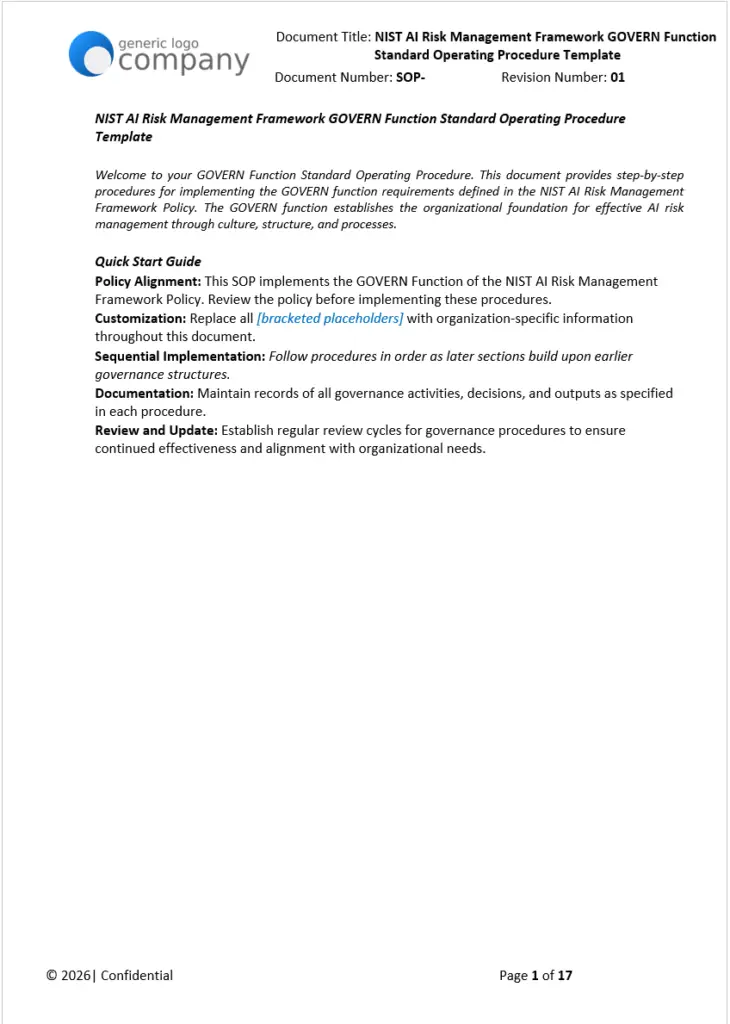
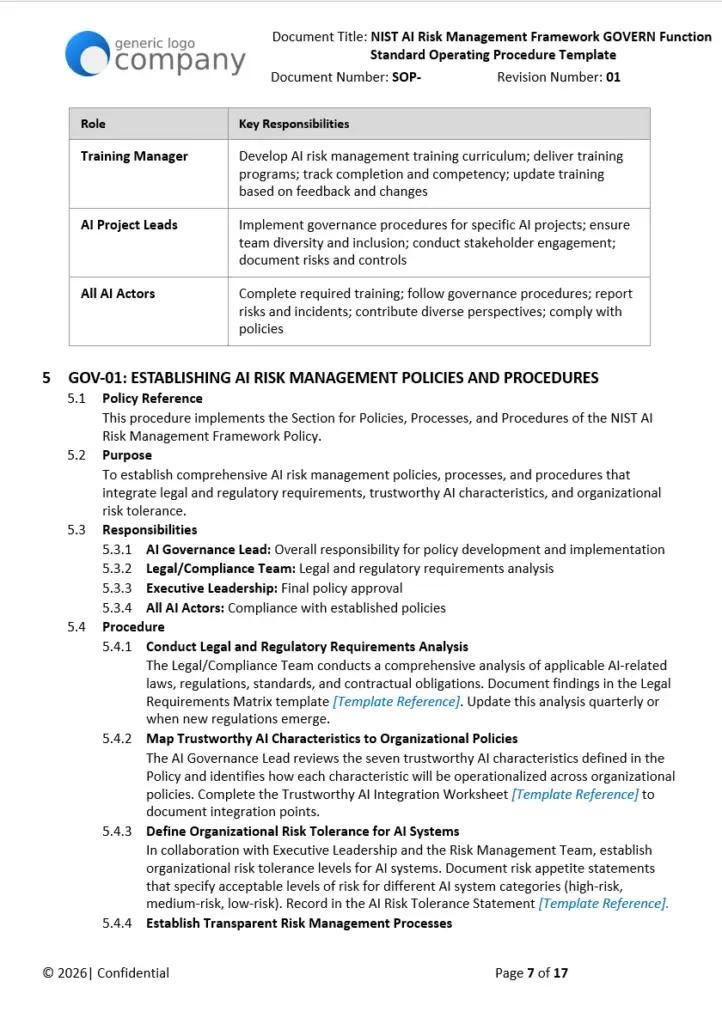
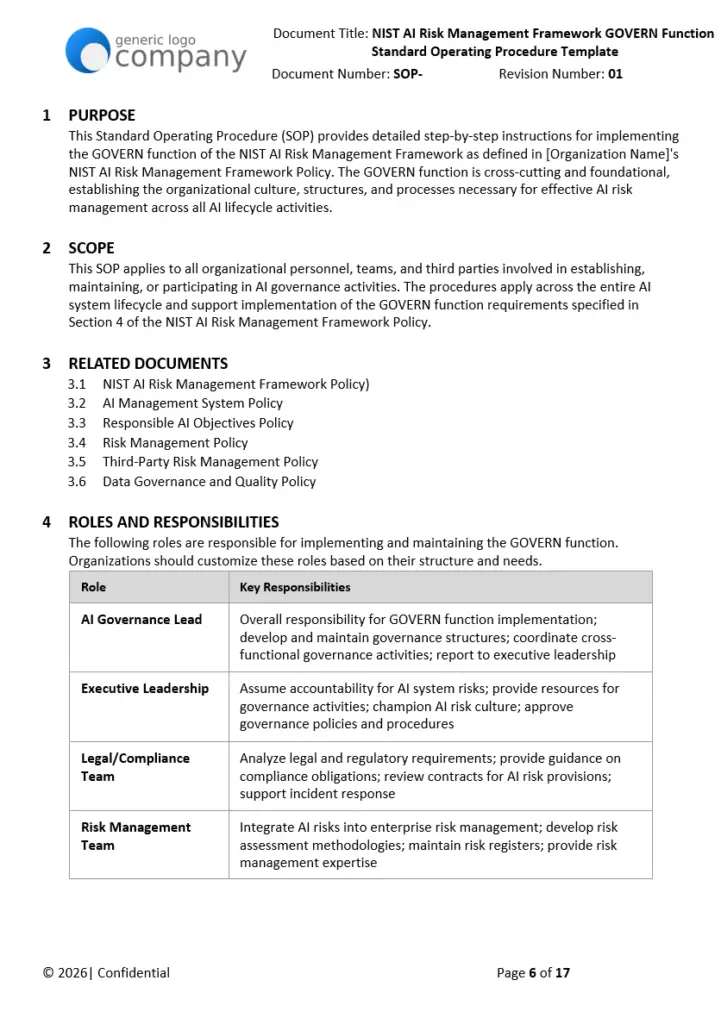
This Standard Operating Procedure (SOP) template provides detailed, step-by-step procedures for implementing the GOVERN function of the NIST AI Risk Management Framework. The GOVERN function establishes the organizational foundation necessary for effective AI risk management through culture, structure, and processes that support trustworthy AI development and deployment.
The template requires customization with organization-specific information, roles, and requirements. All bracketed placeholders need replacement with your organizational details. This structured approach provides a comprehensive procedural framework aligned with NIST AI RMF guidelines, offering pre-built procedure sections, deliverable specifications, and RACI matrix templates that organizations can customize rather than developing governance documentation from scratch.
Key Benefits
✓ Comprehensive procedural framework – Includes detailed procedures for all six GOVERN subcategories (GOV.01 through GOV.06)
✓ Ready-to-customize structure – Pre-formatted document with clear placeholders for organizational adaptation
✓ RACI matrix templates – Built-in responsibility assignment matrices for defining accountability across AI governance activities
✓ Deliverable specifications – Each procedure includes specific deliverables with frequency and format requirements
✓ Training framework guidance – Role-based training curriculum specifications and tracking requirements
✓ Stakeholder engagement processes – Structured approaches for collecting, analyzing, and integrating stakeholder feedback
✓ Third-party risk procedures – Detailed processes for managing AI risks from external vendors and partners
Who Uses This?
This template is designed for:
- AI Governance Leads establishing organizational AI governance frameworks
- Compliance Officers implementing NIST AI RMF policy requirements
- Risk Managers developing AI-specific risk management procedures
- Chief Information Officers structuring AI oversight mechanisms
- Executive Leadership teams establishing AI accountability structures
- Organizations of all sizes seeking structured AI governance implementation guidance
What’s Included
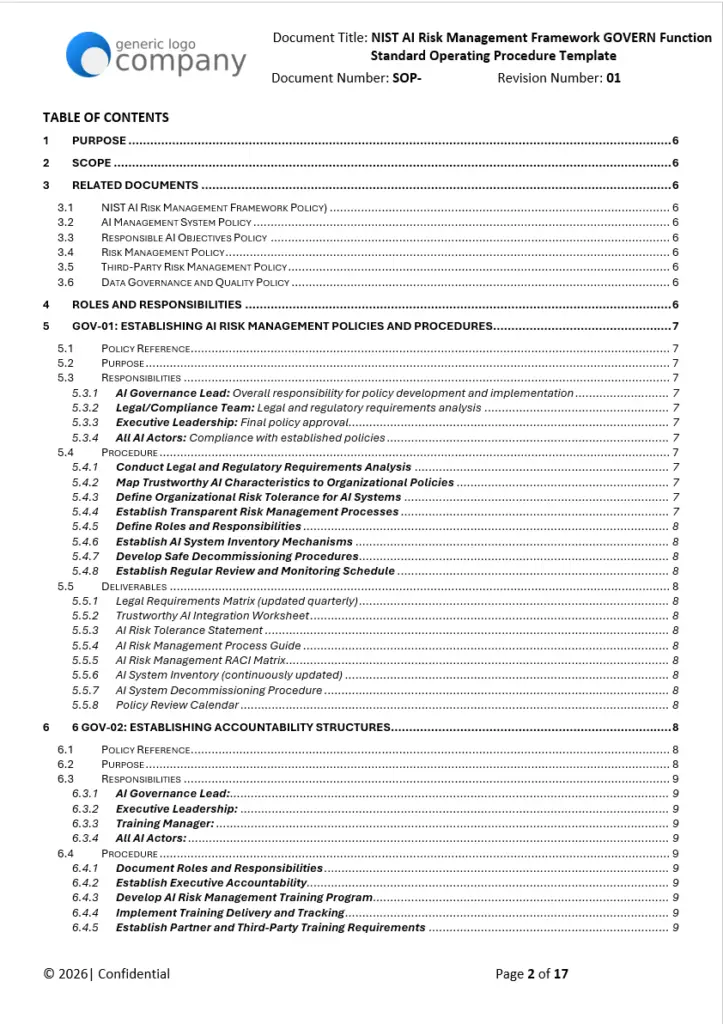
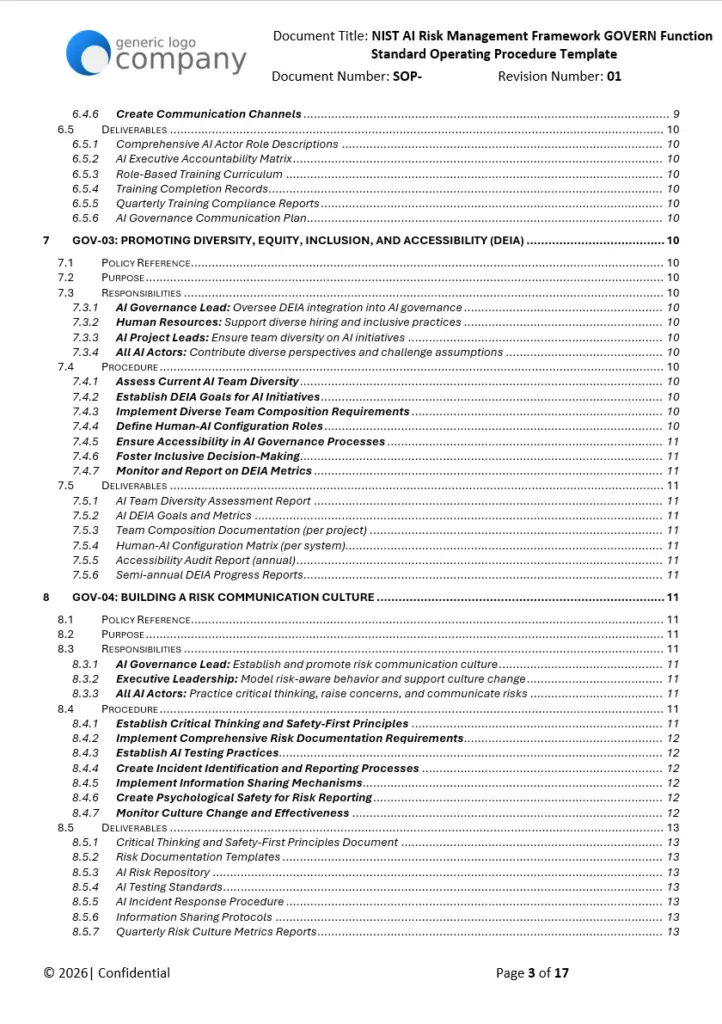
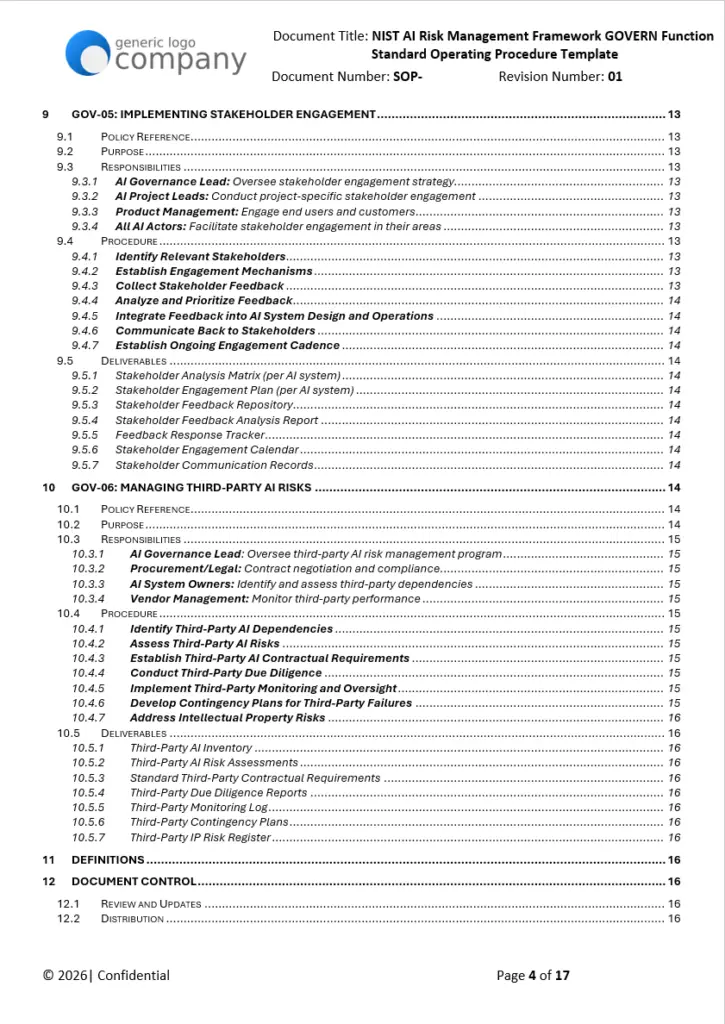
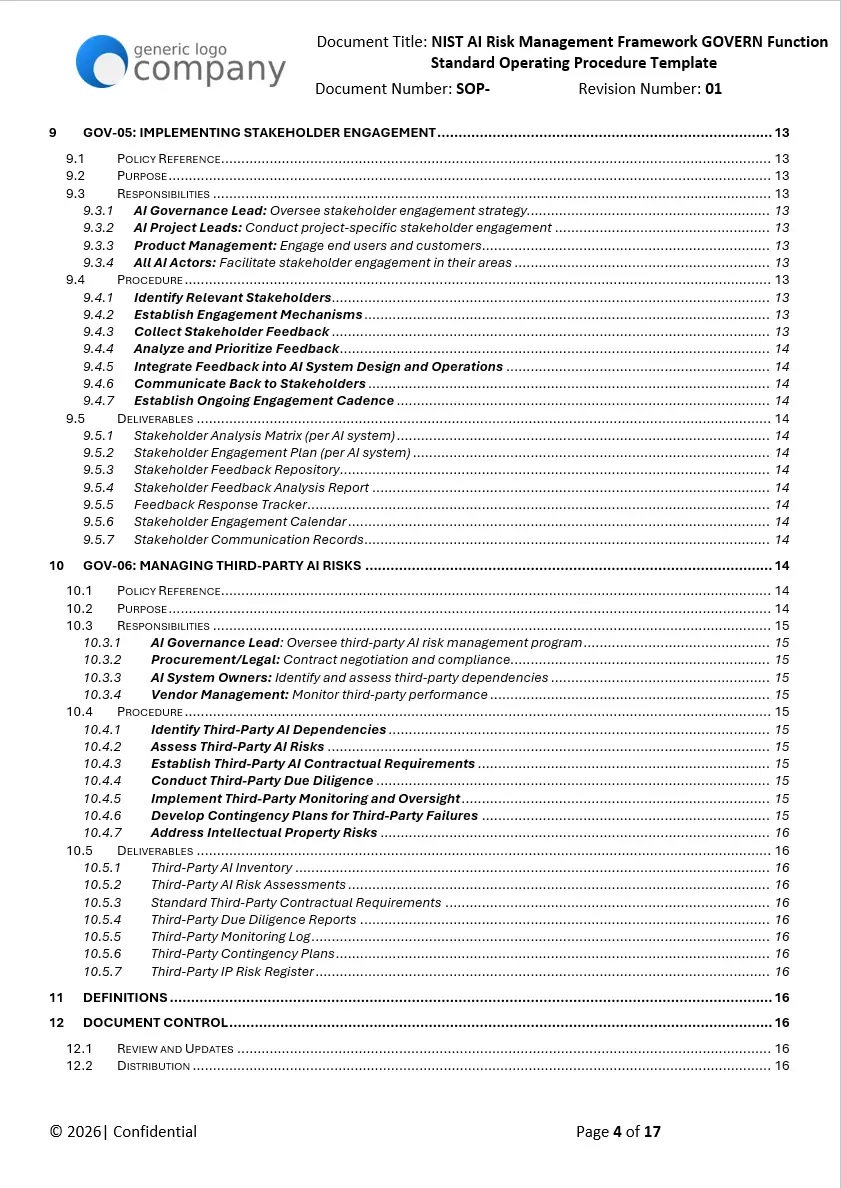
The template contains 13 structured sections covering:
- Complete procedures for establishing AI risk management policies (GOV.01)
- Accountability structure implementation guidance (GOV.02)
- Diversity, equity, inclusion, and accessibility (DEIA) procedures (GOV.03)
- Risk communication culture development processes (GOV.04)
- Stakeholder engagement implementation framework (GOV.05)
- Third-party AI risk management procedures (GOV.06)
Each procedure section includes: policy reference, purpose statement, role responsibilities, step-by-step procedures, required deliverables with frequency specifications, and documentation requirements.
Why This Matters
The NIST AI Risk Management Framework identifies GOVERN as a cross-cutting function that establishes the foundation for all other AI risk management activities. Without proper governance structures, organizations may struggle to implement effective AI risk controls, maintain accountability for AI system outcomes, or ensure consistent application of trustworthy AI principles.
Organizations developing or deploying AI systems face increasing expectations from regulators, stakeholders, and end users regarding responsible AI practices. The GOVERN function addresses these expectations by establishing clear policies, accountability structures, diverse team composition requirements, risk communication processes, stakeholder engagement mechanisms, and third-party oversight procedures.
Standard operating procedures provide the operational detail necessary to translate high-level governance policies into repeatable, auditable organizational processes. This template bridges the gap between policy intent and practical implementation, offering a structured approach to establishing AI governance capabilities aligned with NIST AI RMF guidance.
Framework Alignment
This template explicitly aligns with:
- NIST AI Risk Management Framework 1.0 – Implements all GOVERN function subcategories (GOV.01 through GOV.06)
- NIST AI 600-1 – References trustworthy AI characteristics including safety, security, resilience, fairness, privacy, explainability, and transparency
- ISO/IEC 42001 – Supports AI management system documentation requirements
- OECD AI Principles – Incorporates responsible stewardship, human-centered values, and transparency principles
- General Management Systems – Procedural structure can support organizations with existing governance frameworks
Key Features
Policy Implementation Procedures Detailed steps for conducting legal and regulatory requirements analysis, mapping trustworthy AI characteristics to organizational policies, defining risk tolerance levels, establishing transparent risk management processes, and implementing AI system inventory mechanisms.
Accountability Framework Guidance Procedures for documenting roles and responsibilities across AI lifecycle activities, establishing executive accountability for AI systems, developing role-based training programs with tracking requirements, and creating communication channels for AI governance activities.
DEIA Integration Requirements Specific procedures for assessing AI team diversity, establishing measurable DEIA goals, implementing diverse team composition requirements, defining human-AI configuration roles, ensuring accessibility in governance processes, and monitoring progress through quantitative metrics.
Risk Communication Culture Development Structured approach for establishing critical thinking and safety-first principles, implementing comprehensive risk documentation requirements, creating AI testing practices, developing incident identification and reporting processes, and fostering psychological safety for risk reporting.
Stakeholder Engagement Framework Step-by-step processes for identifying relevant stakeholders, establishing engagement mechanisms, collecting and analyzing feedback, integrating stakeholder input into AI system design, and maintaining ongoing engagement cadence with documented communication records.
Third-Party Risk Management Procedures Detailed guidance for identifying third-party AI dependencies, conducting risk assessments, establishing contractual requirements, performing due diligence, implementing monitoring and oversight mechanisms, and addressing intellectual property risks from external AI components.
Documentation and Deliverable Specifications Each procedure section includes specific deliverable requirements with recommended formats, update frequencies, and storage locations. Examples include Legal Requirements Matrix (updated quarterly), AI Risk Tolerance Statement, RACI matrices, training completion records, stakeholder feedback repositories, and third-party risk assessments.
Customization Flexibility Template structure supports organizational adaptation through bracketed placeholders for organization-specific information, scalable role definitions accommodating various organizational sizes and structures, and modular procedure sections that can be implemented sequentially or selectively based on organizational maturity.
Comparison Table: Basic Approach vs. Professional Template
| Aspect | Basic DIY Approach | Professional SOP Template |
|---|---|---|
| Structure | Ad-hoc procedures developed as issues arise | Comprehensive framework covering all six GOVERN subcategories with pre-defined procedure sequences |
| Role Definition | Vague accountability assignments | Detailed RACI matrices specifying Responsible, Accountable, Consulted, and Informed parties for each activity |
| Deliverables | Unclear documentation requirements | Specific deliverable specifications for each procedure with format guidance and update frequencies |
| Stakeholder Engagement | Inconsistent or reactive engagement | Structured engagement framework with analysis matrices, feedback repositories, and response tracking mechanisms |
| Training Requirements | Generic awareness training | Role-based training curriculum specifications with competency requirements and completion tracking protocols |
| Third-Party Oversight | Contract-focused risk transfer | Comprehensive risk assessment procedures including due diligence, monitoring logs, contingency planning, and IP risk registers |
| Audit Trail | Documentation gaps requiring retrospective reconstruction | Built-in documentation requirements creating continuous audit trail for governance activities |
| Implementation Guidance | Learning through trial and error | Step-by-step procedures with decision criteria, escalation paths, and communication protocols |
FAQ Section
Q: Does this template guarantee compliance with NIST AI RMF requirements?
A: This template provides a procedural framework designed to support NIST AI RMF GOVERN function implementation. Compliance depends on organizational customization, consistent execution of procedures, and adaptation to specific regulatory requirements applicable to your context. The template serves as implementation guidance, not a compliance guarantee.
Q: How much customization is required?
A: All bracketed placeholders throughout the document require replacement with organization-specific information. This includes organization name, specific role titles, system/tool names, template references, storage locations, and review frequencies. Additionally, organizations should assess each procedure for alignment with existing processes and adjust accordingly. Customization time varies based on organizational size and existing governance maturity.
Q: Can this template be used for organizations without existing AI governance structures?
A: The template is designed to support organizations at various AI governance maturity levels. Organizations without existing structures can implement procedures sequentially, starting with GOV.01 (policies and procedures) to establish foundational requirements before progressing to subsequent sections. Organizations with partial governance structures can adapt relevant sections to enhance existing processes.
Q: What file format is the template provided in?
A: Documents are optimized for Microsoft Word to ensure proper formatting and collaborative editing capabilities. The .docx format supports organizational version control, comment tracking, and iterative refinement as procedures are customized and tested.
Q: How does this template integrate with other NIST AI RMF functions?
A: The GOVERN function is cross-cutting and provides foundational structures supporting all other AI RMF functions (MAP, MEASURE, MANAGE). Procedures in this template establish the governance framework within which specific risk identification, assessment, treatment, and monitoring activities occur. Organizations typically implement GOVERN procedures before or concurrently with other function-specific processes.
Q: Are example deliverables included in the template?
A: The template specifies required deliverables for each procedure with format guidance and update frequency recommendations. Organizations need to develop actual deliverables based on their specific context. The template provides structure and requirements rather than pre-populated deliverable content, as effective deliverables require organization-specific information and risk considerations.
Ideal For
- Organizations implementing comprehensive AI governance programs aligned with NIST AI RMF guidance
- Compliance teams translating AI governance policies into operational procedures
- Risk management professionals establishing AI-specific risk processes and controls
- Executive leadership requiring structured accountability frameworks for AI system oversight
- AI governance leads developing training programs and stakeholder engagement mechanisms
- Organizations preparing for AI governance audits or assessments requiring documented procedures
- Enterprises managing third-party AI dependencies and requiring vendor oversight processes
- Teams establishing baseline AI governance capabilities before pursuing formal certifications
Pricing Strategy
Single Template – $5.00
Immediate download access upon purchase. Single-user organizational license for customization and internal use.
Bundle Option
This GOVERN Function SOP template may be combined with other NIST AI RMF function templates (MAP, MEASURE, MANAGE) and supporting documentation depending on organizational AI governance implementation scope and complexity.
Enterprise Option
Organizations requiring multiple licenses, implementation support, or comprehensive governance documentation suites should contact us for enterprise pricing and customization services.
⚖️ Differentiator
This template provides comprehensive procedural detail for all six GOVERN function subcategories with specific step-by-step implementation guidance, deliverable specifications, and documentation requirements. Unlike generic AI governance guidance that remains at the policy level, this SOP template bridges the gap between high-level principles and operational execution by including detailed procedures for establishing policies, accountability structures, DEIA requirements, risk communication culture, stakeholder engagement, and third-party oversight.
The template’s structured approach supports consistent implementation across organizational units while maintaining flexibility for organizational adaptation. Built-in RACI matrices, deliverable specifications with update frequencies, and sequential procedure organization provide a clear implementation path for organizations at various AI governance maturity levels. The comprehensive coverage of GOVERN function requirements in a single document can help organizations avoid procedural gaps while establishing auditable governance processes aligned with NIST AI RMF guidance.
Implementation Notes
Getting Started
Organizations should review the entire template before beginning customization to understand the relationships between procedures and required deliverables. The Quick Start Guide section provides implementation sequence recommendations and highlights dependencies between procedures.
Customization Best Practices
- Replace all bracketed placeholders with organization-specific information systematically
- Review role definitions and adjust to match organizational structure and titles
- Assess existing processes and integrate SOP procedures rather than creating parallel structures
- Validate deliverable formats and storage locations with organizational documentation standards
- Pilot procedures in limited scope before organization-wide rollout
- Establish review cycles for continuous improvement based on implementation feedback
Document Control
The template includes document control sections for version history tracking, approver signatures, and review schedules. Organizations should establish change management processes for SOP updates as AI governance practices evolve or regulatory requirements change.
Note: This template provides procedural guidance designed to support NIST AI RMF GOVERN function implementation. Effective governance requires organizational commitment, resource allocation, executive sponsorship, and consistent execution of procedures. The template serves as a structured starting point requiring customization to organizational context, risk tolerance, and regulatory requirements.
Product Type: Digital Download (Microsoft Word .docx format)
Version: 1.0
Last Updated: February 2026
License: Single organization use with rights to customize and adapt for internal governance purposes
Legal Disclaimer
This template is provided for informational and implementation guidance purposes. It does not constitute legal, compliance, or professional advice. Organizations should consult with qualified professionals to ensure AI governance procedures meet applicable regulatory requirements and organizational risk management needs. Effectiveness of procedures depends on proper customization, consistent implementation, and ongoing monitoring and improvement.