NIST AI Risk Management Framework NIST AI RMF Guidance Policy
A comprehensive, customizable NIST AI RMF Policy designed to support organizations in implementing the NIST AI Risk Management Framework 1.0, providing structured guidance for establishing trustworthy AI systems through the four core functions: GOVERN, MAP, MEASURE, and MANAGE.
Implement NIST AI RMF 1.0 with this ready-to-customize NIST AI RMF Policy Template covering governance, risk assessment, and trustworthy AI.
Instant Access! Start customizing within minutes of purchase
NIST AI Risk Management Framework Policy Template
Structured Documentation for Implementing Trustworthy AI Risk Management
This NIST AI RMF Template is designed to support organizations in establishing a comprehensive, risk-based approach to artificial intelligence governance aligned with NIST AI RMF 1.0.
This NIST AI RMF Policy provides organizations with a structured framework for implementing the NIST AI Risk Management Framework 1.0. The template includes pre-written sections covering all four NIST AI RMF core functions (GOVERN, MAP, MEASURE, and MANAGE), along with implementation guidance, definitions, and approval workflows. Organizations need to customize bracketed placeholders with organization-specific information, roles, and processes. This NIST AI RMF Template is designed to help reduce documentation development time by providing a foundational structure aligned with NIST AI RMF 1.0 principles.
Key Benefits
✓ Comprehensive Framework Coverage – Includes structured sections for all four NIST AI RMF functions: GOVERN, MAP, MEASURE, and MANAGE
✓ Seven Trustworthy AI Characteristics – Provides guidance on implementing Valid and Reliable, Safe, Secure and Resilient, Accountable and Transparent, Explainable and Interpretable, Privacy-Enhanced, and Fair AI systems
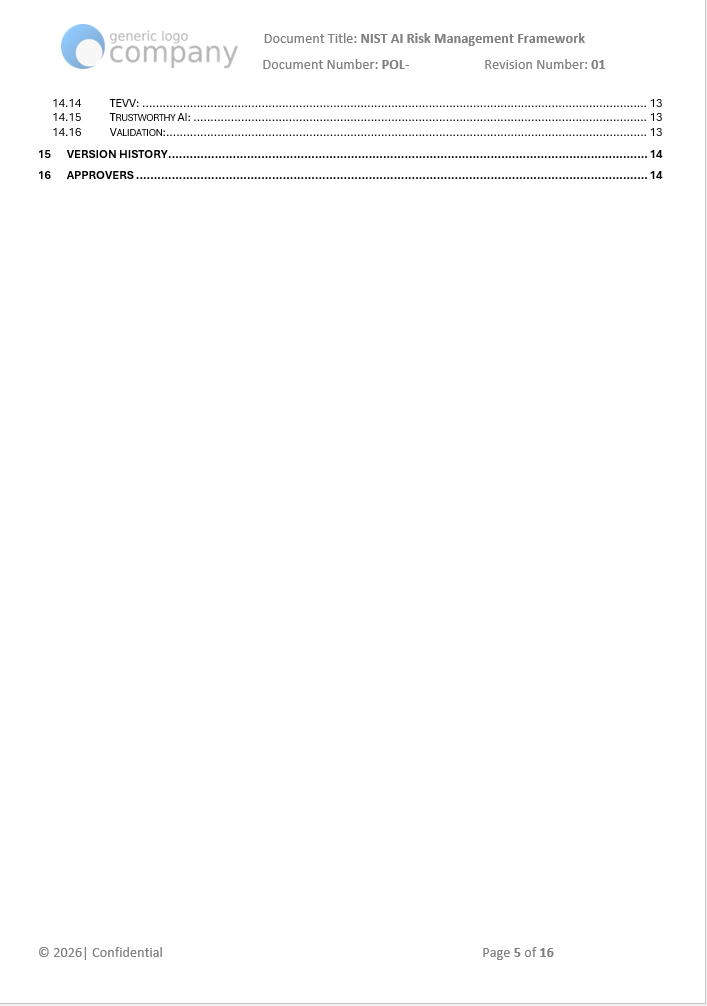
✓ Ready-to-Customize Structure – Includes 16 main sections with over 400 paragraphs of policy guidance requiring organizational customization
✓ Implementation Guidance Included – Contains Quick Start Guide, implementation framework, compliance monitoring approach, and training requirements
✓ Approval Workflow Templates – Includes version history tracking table and approval signature section for organizational governance
✓ Microsoft Word Format – Delivered as an editable .docx file for easy customization and integration with existing documentation systems
Who Uses This?
Designed for:
- Organizations developing or deploying AI systems internally
- Companies integrating third-party AI solutions and services
- AI research and development teams requiring governance structure
- Businesses delivering AI-enabled products and services to customers
- Technology leaders establishing AI risk management frameworks
- Compliance officers building AI governance programs
What”s Included
The NIST AI RMF Policy contains the following main sections:
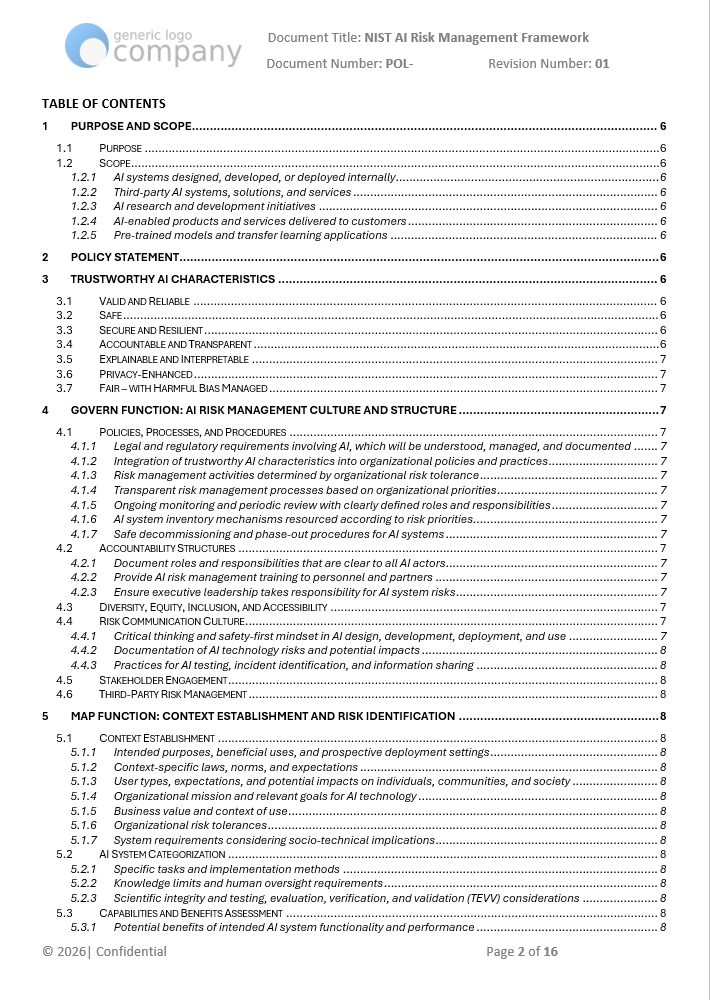
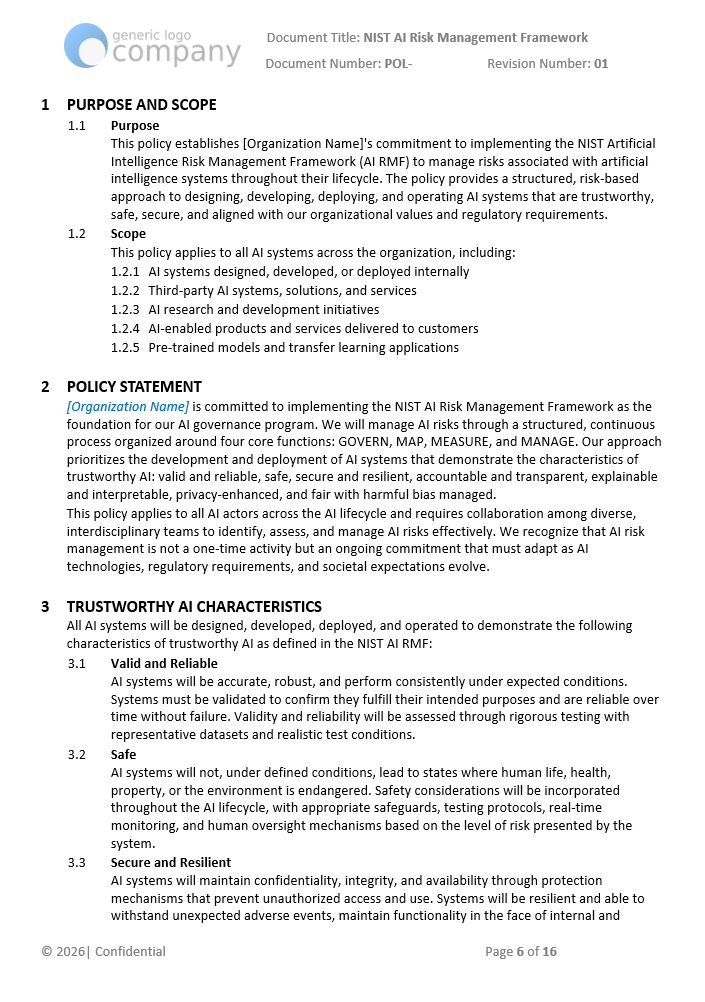
- Purpose and Scope – Defines policy applicability across internal AI systems, third-party solutions, R&D initiatives, customer-facing AI products, and pre-trained models
- Policy Statement – Framework for organizational AI risk management commitment
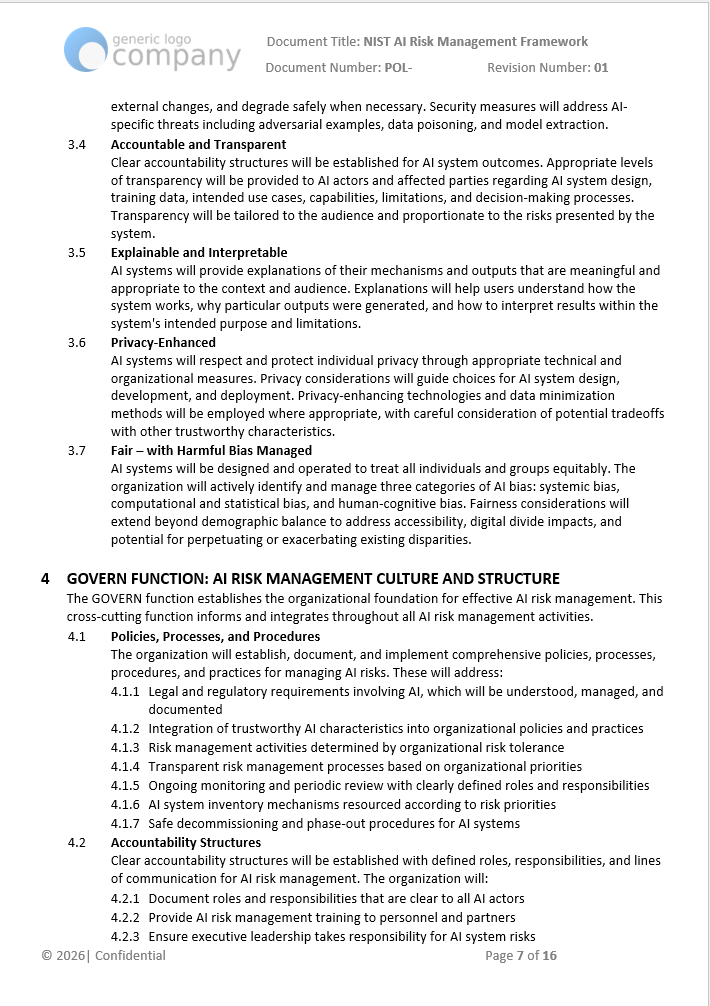
- Trustworthy AI Characteristics – Detailed guidance on seven characteristics including validity, safety, security, accountability, explainability, privacy, and fairness
- GOVERN Function – Sections on policies, accountability structures, diversity and inclusion, risk communication culture, stakeholder engagement, and third-party risk management
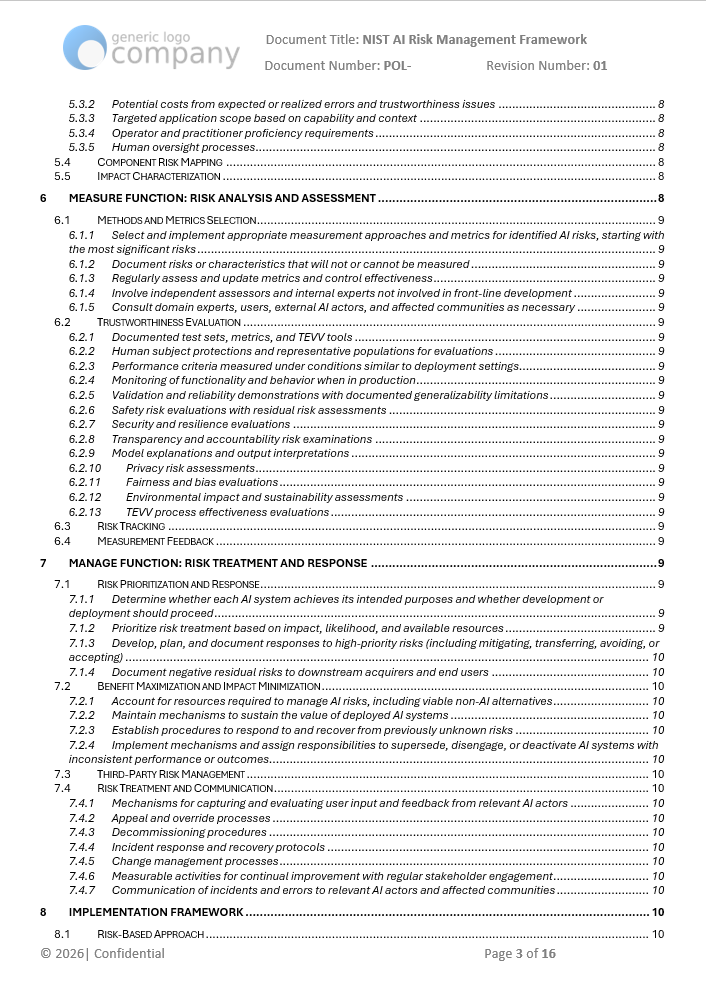
- MAP Function – Context establishment, AI system categorization, capabilities assessment, component risk mapping, and impact characterization
- MEASURE Function – Methods and metrics selection, trustworthiness evaluation (covering 13 evaluation areas), risk tracking, and measurement feedback
- MANAGE Function – Risk prioritization and response, benefit maximization, incident management, and feedback integration
- Implementation Framework – Guidance on phased implementation approach
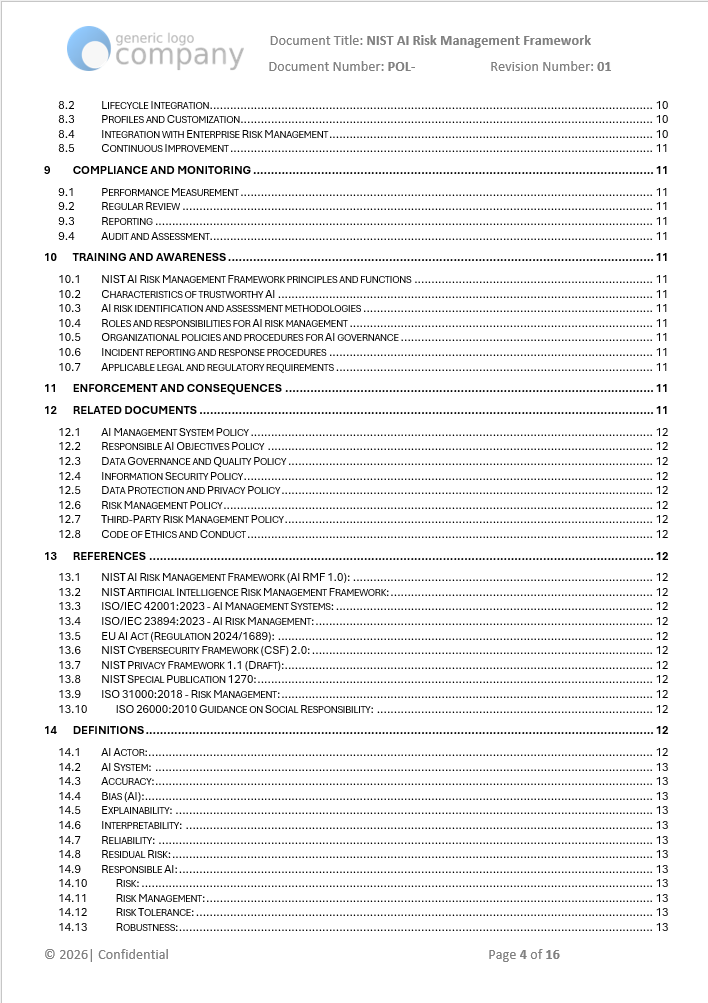
- Compliance and Monitoring – Framework for ongoing compliance verification
- Training and Awareness – Requirements for AI risk management training programs
- Enforcement and Consequences – Policy enforcement approach
- Related Documents – Section for linking to supporting policies and procedures
- References – Space for citing relevant standards and regulations
- Definitions – Comprehensive definitions section covering AI actors, risk management terms, and trustworthy AI concepts
- Version History – Table for tracking document revisions
- Approvers – Signature table for organizational approval workflow
Why You Should Buy
Organizations developing, deploying, or procuring artificial intelligence systems face increasing expectations to demonstrate responsible AI practices. The NIST AI Risk Management Framework 1.0, released by the National Institute of Standards and Technology, provides a voluntary consensus standard for managing AI-related risks. However, many organizations lack the internal expertise or resources to translate the framework”s principles into actionable policies.
This NIST AI RMF Policy is designed to address that gap by providing structured documentation that organizations can customize to their specific context. Rather than starting from a blank page, teams can work from a pre-structured format that covers the framework”s core functions and requirements, potentially reducing the time and expertise required to establish baseline AI governance documentation.
The NIST AI RMF Template is based on the four core NIST AI RMF functions that provide a lifecycle approach to AI risk management: GOVERN establishes organizational culture and structure; MAP identifies context and risks; MEASURE analyzes and assesses risks; and MANAGE treats and responds to risks. By following this structure, organizations can work toward establishing a systematic approach to AI risk management. Save Hours of manual policy drafting or contracting/consulting. Our Policy covers 95% of what a much more expensive solution would cost – and you help support a community driven by providing cost effective and free tools to help individuals, small businesses, and organizations solve their issues affordably.
Framework Alignment
This NIST AI RMF Policy Template is specifically structured around:
- NIST AI Risk Management Framework 1.0 – All four core functions (GOVERN, MAP, MEASURE, MANAGE) with detailed sub-categories
- Trustworthy AI Characteristics – Seven characteristics defined by NIST AI RMF including validity, safety, security, accountability, explainability, privacy enhancement, and fairness
The template references NIST AI RMF 1.0 as its primary framework and is designed to support organizations in documenting their approach to implementing the framework”s voluntary guidance.
Key Features
The NIST AI RMF Template includes the following components mapped directly to the source document:
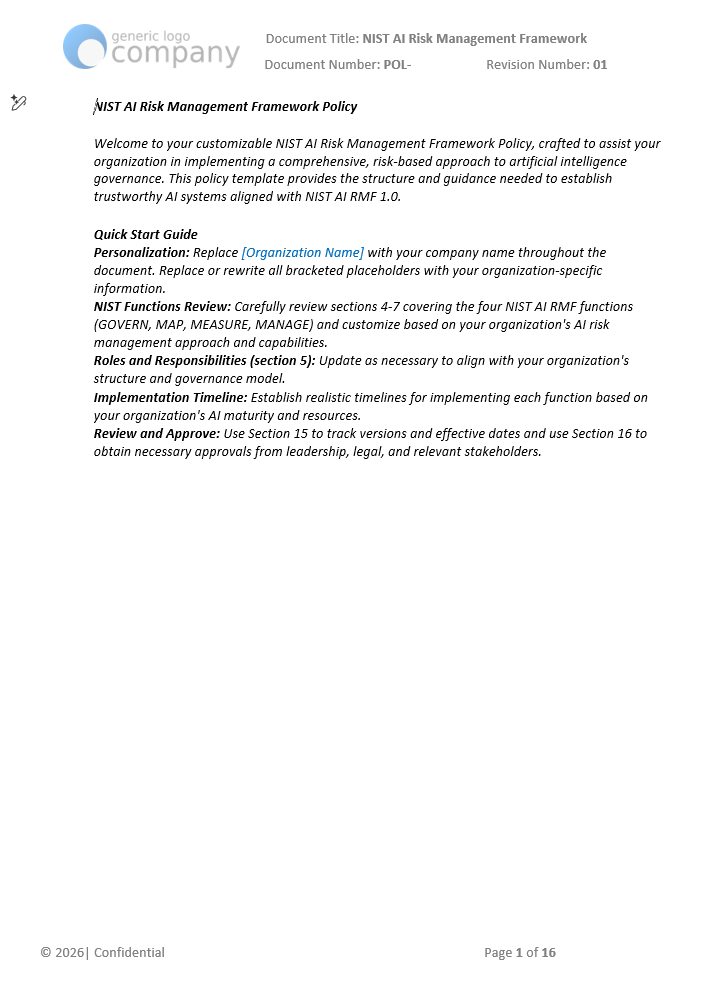
- Quick Start Personalization Guide – Step-by-step instructions for customizing the template including replacing organization name, reviewing NIST functions, updating roles, establishing timelines, and obtaining approvals
- GOVERN Function Documentation (7 major subsections)
- Policies, processes, and procedures for legal and regulatory requirements
- Accountability structures with roles and responsibilities
- Diversity, equity, inclusion, and accessibility considerations
- Risk communication culture framework
- Stakeholder engagement approach
- Third-party risk management provisions
- MAP Function Documentation (5 major subsections)
- Context establishment guidance covering intended purposes, legal requirements, user expectations, organizational mission, and risk tolerances
- AI system categorization framework
- Capabilities and benefits assessment
- Component risk mapping approach
- Impact characterization methods
- MEASURE Function Documentation (4 major subsections)
- Methods and metrics selection guidance
- Comprehensive trustworthiness evaluation framework covering 13 areas: test sets and TEVV tools, human subject protections, performance criteria, production monitoring, validation demonstrations, safety risk evaluations, security assessments, transparency examinations, model explanations, privacy assessments, fairness evaluations, environmental impact, and TEVV effectiveness
- Risk tracking mechanisms
- Measurement feedback loops
- MANAGE Function Documentation (6 major subsections)
- Risk prioritization and response procedures
- Benefit maximization and impact minimization
- Incident response and recovery
- Continuous improvement processes
- Change management
- Feedback integration
- Implementation and Operational Sections
- Implementation framework with phased approach
- Compliance and monitoring requirements
- Training and awareness program structure
- Enforcement and consequences framework
- Related documents reference section
- References section for citing applicable standards
- Supporting Materials
- Comprehensive definitions section covering AI actors, AI systems, AI risk management terminology, and trustworthy AI characteristics
- Version history tracking table
- Approval signature table for governance workflow
Comparison Table: Generic Policy vs. Professional NIST AI RMF Template
| Aspect | Starting from Scratch | This NIST AI RMF Policy |
|---|---|---|
| Framework Coverage | Requires research and interpretation of NIST AI RMF 1.0 | Pre-structured with all four core functions mapped to framework categories |
| Trustworthy AI Guidance | Must develop from first principles | Includes pre-written guidance on all seven NIST-defined trustworthy AI characteristics |
| Documentation Structure | Building outline and organization from blank document | 16 pre-organized sections with 400+ paragraphs of structured policy language |
| Definitions | Researching and authoring AI terminology | Comprehensive definitions section included covering AI actors, systems, and risk concepts |
| Implementation Guidance | Developing implementation approach independently | Quick Start Guide and Implementation Framework sections included |
| Approval Workflow | Creating governance documentation from scratch | Version history table and approvers table included for tracking |
FAQ Section
Q: What format is this NIST AI RMF Template provided in? A: The NIST AI RMF Policy is delivered as a Microsoft Word (.docx) file for easy editing and customization. This format is optimized for compatibility and collaborative editing within most organizational environments.
Q: How much customization is required? A: Organizations need to replace all bracketed placeholders [like this] with their specific information, including organization name, specific roles and responsibilities, relevant AI systems and applications, risk tolerances, implementation timelines, and related documentation references. The level of customization depends on organizational complexity and AI maturity.
Q: Does this NIST AI RMF Template guarantee NIST AI RMF compliance? A: No. This NIST AI RMF Policy provides a structured documentation framework designed to support organizations in implementing NIST AI RMF 1.0 principles. Organizations are responsible for customizing the content to their specific context, implementing the documented controls and processes, and ensuring the policy accurately reflects their actual practices. NIST AI RMF 1.0 is a voluntary framework, not a certification standard.
Q: What AI systems does this policy cover? A: The template”s scope section is designed to cover AI systems designed, developed, or deployed internally; third-party AI systems, solutions, and services; AI research and development initiatives; AI-enabled products and services delivered to customers; and pre-trained models and transfer learning applications. Organizations customize the scope based on their specific AI activities.
Q: Is technical AI expertise required to use this template? A: While the NIST AI RMF Template provides structured guidance, organizations typically need personnel with understanding of both NIST AI RMF concepts and their organization”s AI systems to effectively customize the policy. The template includes definitions and framework references but assumes users will adapt content based on organizational capabilities and context.
Q: How does this relate to other AI regulations and standards? A: This NIST AI RMF Policy focuses specifically on NIST AI RMF 1.0. Organizations may need to develop additional or modified policies for specific regulatory requirements such as the EU AI Act, ISO/IEC 42001, or sector-specific AI regulations. The template includes a “Related Documents” section where organizations can reference complementary policies.
Q: What file format is recommended for this template? A: Documents are optimized for Microsoft Word to ensure proper formatting and collaborative editing capabilities. Organizations can convert to other formats after customization if needed for their documentation management systems.
Ideal For
This NIST AI RMF Policy Template is designed for:
- Technology Companies developing or deploying AI systems requiring structured risk management frameworks
- AI Development Teams needing governance documentation for internal AI projects
- Compliance Officers building AI governance programs aligned with NIST guidance
- Risk Management Professionals establishing AI-specific risk assessment and treatment processes
- Product Teams delivering AI-enabled products or services requiring trustworthy AI documentation
- Procurement Teams evaluating third-party AI solutions and requiring vendor risk management frameworks
- Research Organizations conducting AI research and development with governance requirements
- Organizations of Any Size seeking to implement voluntary NIST AI RMF 1.0 principles
This NIST AI RMF Policy Template is available for a one-time purchase. The price includes:
- Complete NIST AI RMF Policy Template in Microsoft Word format (.docx)
- 16 comprehensive policy sections with 400+ paragraphs
- All four NIST AI RMF core functions (GOVERN, MAP, MEASURE, MANAGE)
- Seven trustworthy AI characteristics guidance
- Implementation framework and Quick Start Guide
- Definitions, version history table, and approval workflow templates
- Lifetime access to purchased template
Bundle Options Available:
- Combine with additional AI governance templates (AI incident response, AI vendor assessment, AI ethics framework)
- Contact for enterprise pricing for comprehensive AI governance documentation suites
⚖️ Differentiator & Value
This NIST AI RMF Policy Template provides organizations with a comprehensive, pre-structured documentation framework specifically designed around the four core functions of NIST AI RMF 1.0. Unlike generic AI policy templates, this NIST AI RMF Template includes detailed subsections mapped directly to framework categories, covering structured policy guidance across GOVERN, MAP, MEASURE, and MANAGE functions.
The NIST AI RMF Policy is designed to support organizations in reducing the time and expertise required to create foundational AI risk management documentation. It includes seven trustworthy AI characteristics as defined by NIST (Valid and Reliable, Safe, Secure and Resilient, Accountable and Transparent, Explainable and Interpretable, Privacy-Enhanced, and Fair), comprehensive definitions, implementation guidance, and approval workflows.
The template requires organizational customization to reflect specific AI systems, processes, roles, and risk tolerances. It provides a structural starting point rather than a turnkey solution, acknowledging that effective AI risk management requires adaptation to organizational context and capabilities.