Free AI Bias Assessment Spreadsheet
A lifecycle-based assessment framework designed to support identification of AI bias risks across governance, data, model development, testing, deployment, and ongoing monitoring activities.
[Download Now – Free]
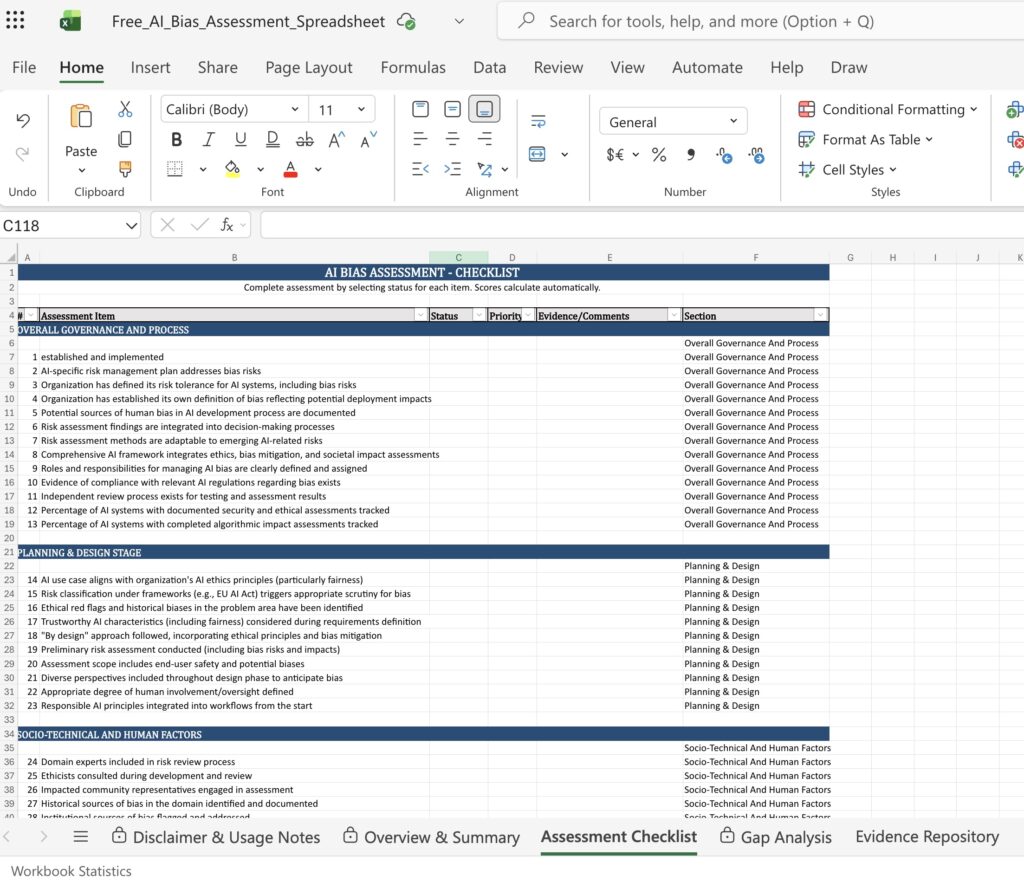
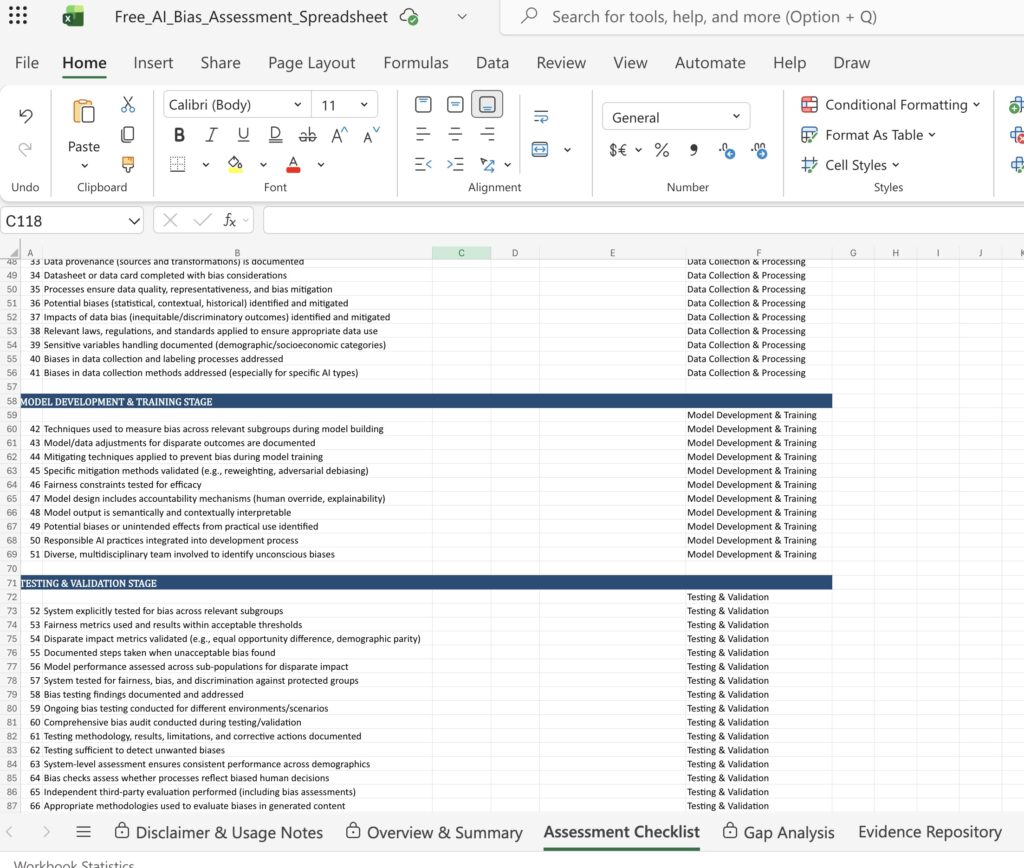
This free spreadsheet provides a structured framework for conducting basic assessments of AI bias risks across nine lifecycle stages. The tool includes 96 assessment items organized into categories covering overall governance processes, planning and design considerations, socio-technical factors, data collection and processing, model development and training, testing and validation, deployment and integration, operational monitoring, and vendor/third-party AI systems.
Organizations using this tool will need to customize assessment priorities based on their specific AI systems, risk classifications, and operational contexts. The spreadsheet includes dropdown menus for status tracking and automated scoring calculations to support gap identification and remediation planning.
Key Benefits
- Provides structured framework covering 96 assessment items across 9 lifecycle sections
- Includes automated compliance dashboard with real-time scoring calculations
- Supports gap analysis through automatic filtering of non-compliant items
- Contains evidence repository template for documentation tracking
- Designed for Microsoft Excel with dropdown menus and formula-based calculations
Who Uses This?
This assessment framework is designed for:
- AI Governance Officers evaluating bias management programs
- Data Scientists assessing training data representativeness
- ML Engineers reviewing model fairness during development
- Risk Managers conducting AI system assessments
- Compliance Teams documenting bias mitigation efforts
- Ethics Committees evaluating AI deployment decisions
- Internal Audit Teams reviewing AI governance controls
Preview: What’s Included
The spreadsheet contains five worksheets:
- Disclaimer & Usage Notes – Terms of use and implementation guidance
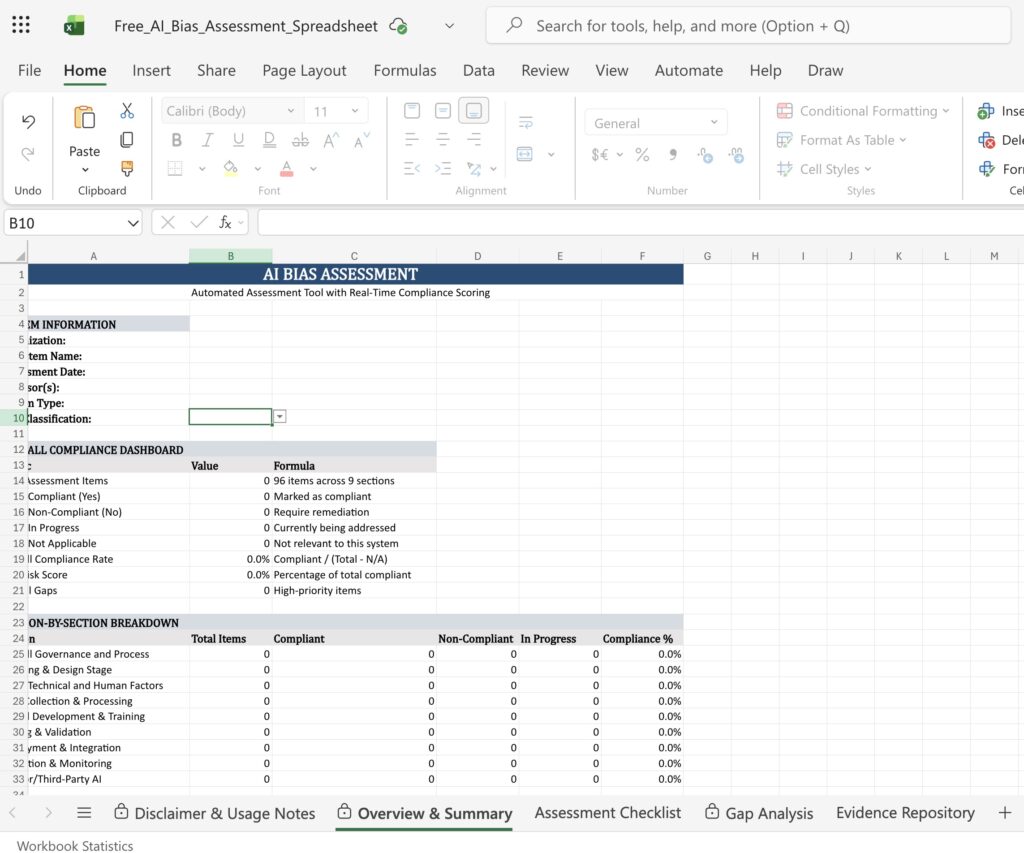
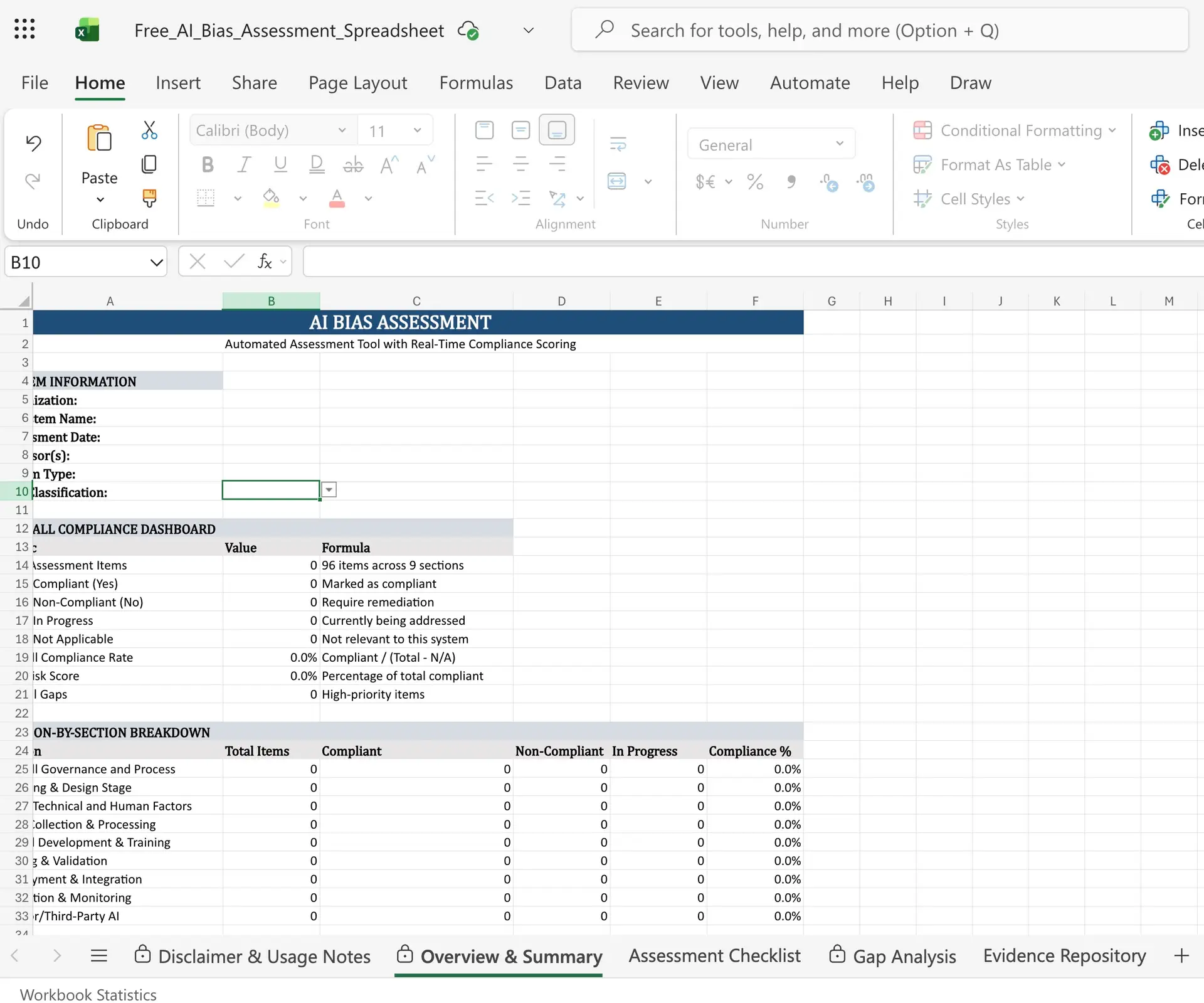
- Overview & Summary – System information fields and automated compliance dashboard
- Assessment Checklist – 96 assessment items with status dropdowns and priority fields
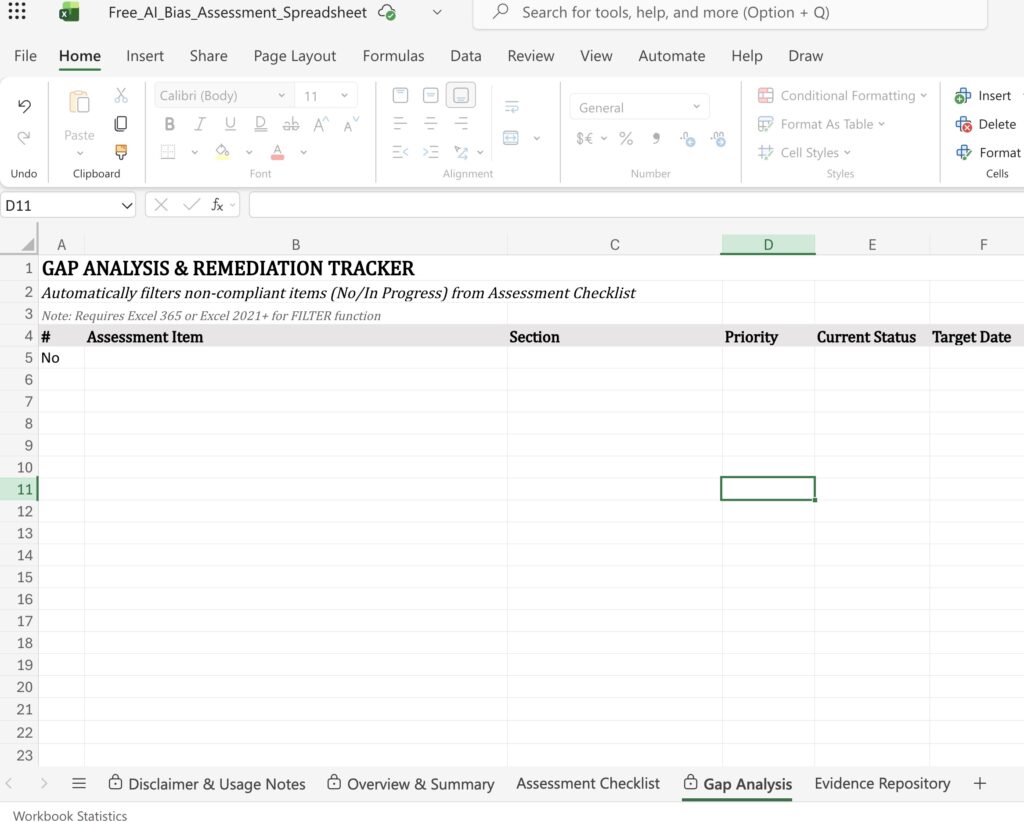
- Gap Analysis – Automatic filtering of non-compliant items for remediation tracking
- Evidence Repository – Documentation requirements organized by evidence category
Why This Matters
AI bias represents a significant operational and reputational risk for organizations deploying machine learning systems. Biased AI systems may produce discriminatory outcomes, create regulatory exposure, damage stakeholder trust, and generate negative impacts for affected communities. The EU AI Act, NIST AI Risk Management Framework, and ISO/IEC 42001 all emphasize the importance of bias assessment and fairness evaluation throughout the AI lifecycle.
Organizations implementing AI systems face challenges in systematically evaluating bias risks across multiple stages (from initial data collection through ongoing operational monitoring). Assessment activities require consideration of technical factors (dataset representativeness, model performance across subgroups), governance processes (defined roles, risk tolerance), and socio-technical elements (stakeholder engagement, historical bias patterns).
This spreadsheet provides a structured starting point for organizations beginning their bias assessment activities, though it requires customization to reflect specific system characteristics, regulatory requirements, and organizational risk appetites.
Framework Alignment
The assessment items in this spreadsheet draw from concepts referenced in:
- EU AI Act – Provisions related to high-risk AI systems, bias mitigation requirements, and quality management obligations
- NIST AI Risk Management Framework – Guidance on identifying and managing AI risks including fairness and bias concerns
- ISO/IEC 42001:2023 – AI management system requirements for responsible AI development
- OECD AI Principles – Recommendations for trustworthy AI including fairness and accountability
The tool is not designed to guarantee compliance with any specific regulation but may support organizations in structuring their assessment approach.
Key Features
Based on the spreadsheet content:
- 96 assessment items organized across 9 lifecycle sections
- Automated compliance dashboard calculating overall compliance rate and bias risk score
- Section-by-section breakdown showing compliance percentages for each lifecycle stage
- Status dropdown options (Yes, No, In Progress, N/A) for each assessment item
- Priority classification fields (Critical, High, Medium, Low) for gap prioritization
- Evidence/comments column for documentation references
- Gap analysis worksheet with automatic filtering of non-compliant items
- Evidence repository template covering five documentation categories
- System information fields for organization name, AI system details, and risk classification
- Formula-based calculations that update automatically as assessment progresses
Comparison Table: Basic Approach vs. Structured Assessment Tool
| Feature | Ad-Hoc Bias Review | This Assessment Spreadsheet |
|---|---|---|
| Lifecycle Coverage | Varies by team expertise | Covers 9 standardized lifecycle sections |
| Assessment Scope | Inconsistent across projects | 96 defined assessment items |
| Progress Tracking | Manual documentation | Automated compliance scoring |
| Gap Identification | Requires manual review | Automatic filtering to gap analysis sheet |
| Evidence Management | Scattered documentation | Centralized evidence repository template |
| Reusability | Requires recreation for each system | Template structure supports multiple assessments |
FAQ Section
Q: What file format is this tool provided in? A: The tool is delivered as a Microsoft Excel spreadsheet (.xlsx format). Documents are optimized for Microsoft Word and Excel to ensure proper formatting and collaborative editing capabilities.
Q: Does this tool guarantee compliance with AI regulations? A: No. This tool provides a structured framework for identifying potential gaps but does not guarantee compliance with any specific regulation. Organizations must customize the assessment based on applicable regulatory requirements and verify that all assessment items address their specific obligations.
Q: Can this spreadsheet be modified for our organization’s needs? A: Yes. The terms of use permit modification for internal organizational use. However, modified versions may not be redistributed, resold, or repackaged. The Tech Jacks Solutions branding and attribution must remain intact.
Q: What level of Excel expertise is required to use this tool? A: The tool includes dropdown menus for status and priority selection, with automated calculations built into the dashboard. Basic Excel skills (cell navigation, dropdown selection, text entry) are sufficient. Advanced features like the gap analysis automatic filtering require Excel 365 or Excel 2021+.
Q: How long does a typical assessment take? A: Assessment duration varies based on system complexity, available documentation, and team familiarity with bias evaluation concepts. Organizations should plan for sufficient time to review all 96 items, consult relevant documentation, and engage appropriate stakeholders.
Q: Is this tool suitable for high-risk AI systems under the EU AI Act? A: This tool provides a basic assessment framework that may support initial gap identification. High-risk AI systems under the EU AI Act require comprehensive conformity assessments conducted according to specific regulatory procedures. Organizations should consult with qualified legal and compliance professionals to determine appropriate assessment methodologies for their risk classification.
Q: What documentation should we have ready before starting the assessment? A: The Evidence Repository worksheet lists documentation categories including bias assessment reports, data provenance records, fairness metrics, model cards, testing results, governance policies, and monitoring reports. Gathering available documentation before beginning the assessment will support more efficient completion.
Ideal For Section
This tool is designed for:
- Organizations conducting initial AI bias assessments without existing frameworks
- Teams establishing baseline bias evaluation processes
- Risk management professionals scoping AI governance requirements
- Compliance teams documenting bias mitigation efforts
- Ethics committees reviewing AI deployment decisions
- Internal audit functions evaluating AI controls
- Consultants supporting clients with AI governance programs
- Educational institutions teaching AI ethics and fairness concepts
Pricing Strategy Options
Single Template: Free download. No purchase required.
Premium Editions: Tech Jacks Solutions offers premium editions with additional features including enhanced reporting, conditional formatting, visual dashboards, guided remediation workflows, and regulatory mapping. Contact Tech Jacks Solutions for information on premium edition availability and organizational licensing.
⚖️ Differentiator
This spreadsheet provides a lifecycle-based assessment structure covering 96 items across governance, technical, and socio-technical dimensions of AI bias. Unlike generic checklists that focus solely on model metrics, this tool includes assessment items addressing organizational processes, stakeholder engagement, documentation practices, and ongoing monitoring—reflecting the comprehensive approach required by frameworks like the NIST AI RMF and EU AI Act.
The automated compliance dashboard calculates real-time scores as assessments progress, while the gap analysis worksheet automatically filters non-compliant items to support remediation prioritization. The evidence repository template helps organizations track the documentation required to demonstrate bias mitigation efforts.
The tool is designed to support organizations beginning their bias assessment journey, though customization based on specific AI systems, risk classifications, and regulatory requirements is necessary. Organizations with limited internal expertise should consider engaging qualified professionals to interpret assessment results and develop appropriate remediation plans.