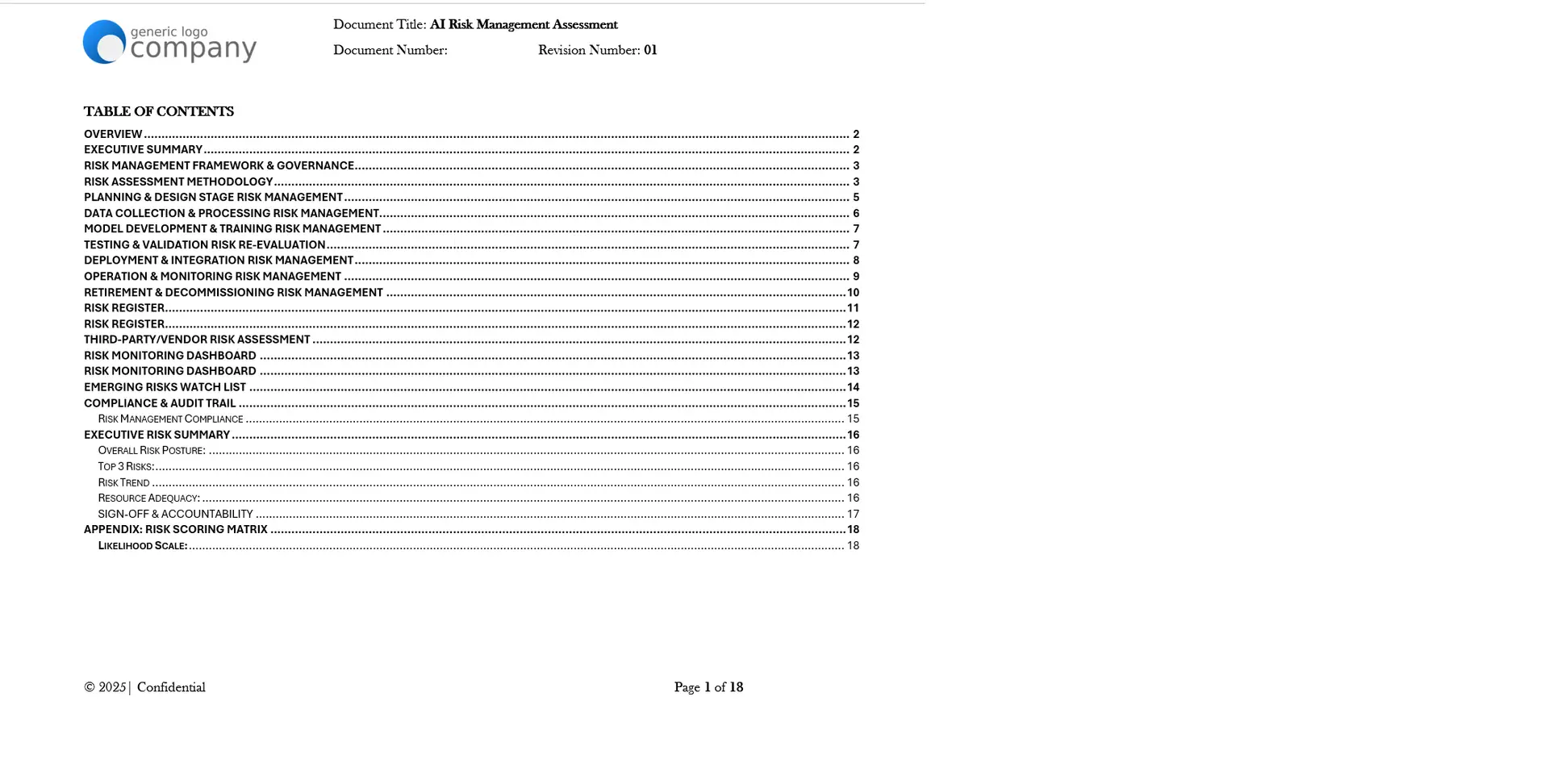
AI Risk Management Assessment Checklist Template
Structured lifecycle-based risk assessment framework designed to support compliance with EU AI Act, ISO 42001, ISO 23894, and NIST AI RMF requirements
[Download Now]
This template provides a structured framework for conducting comprehensive AI risk assessments across the complete system lifecycle. The checklist covers nine distinct lifecycle phases with over 65 assessment items, each with status tracking, risk ownership assignment, and evidence documentation fields. Organizations will need to customize the template to reflect their specific AI systems, risk tolerance levels, and operational context.
Key Benefits
- ✓ Provides framework for lifecycle-based risk assessment covering planning through decommissioning
- ✓ Includes 9 lifecycle phase sections with 65+ assessment items
- ✓ Supports risk scoring using Likelihood × Impact methodology with defined scales
- ✓ Contains fields for EU AI Act risk classification and high-risk system requirements
- ✓ Includes risk register template for tracking identified risks and treatments
- ✓ Provides third-party/vendor risk assessment section
- ✓ Contains risk monitoring dashboard template for ongoing tracking
- ✓ Includes compliance and audit trail documentation section
- ✓ Provides executive risk summary template for leadership reporting
Who Uses This
Designed for:
- AI Program Managers establishing governance frameworks
- Risk and Compliance Officers implementing AI oversight
- IT Security teams assessing AI system risks
- Organizations deploying high-risk AI systems under EU AI Act
- Teams pursuing ISO 42001 certification
Preview Mention
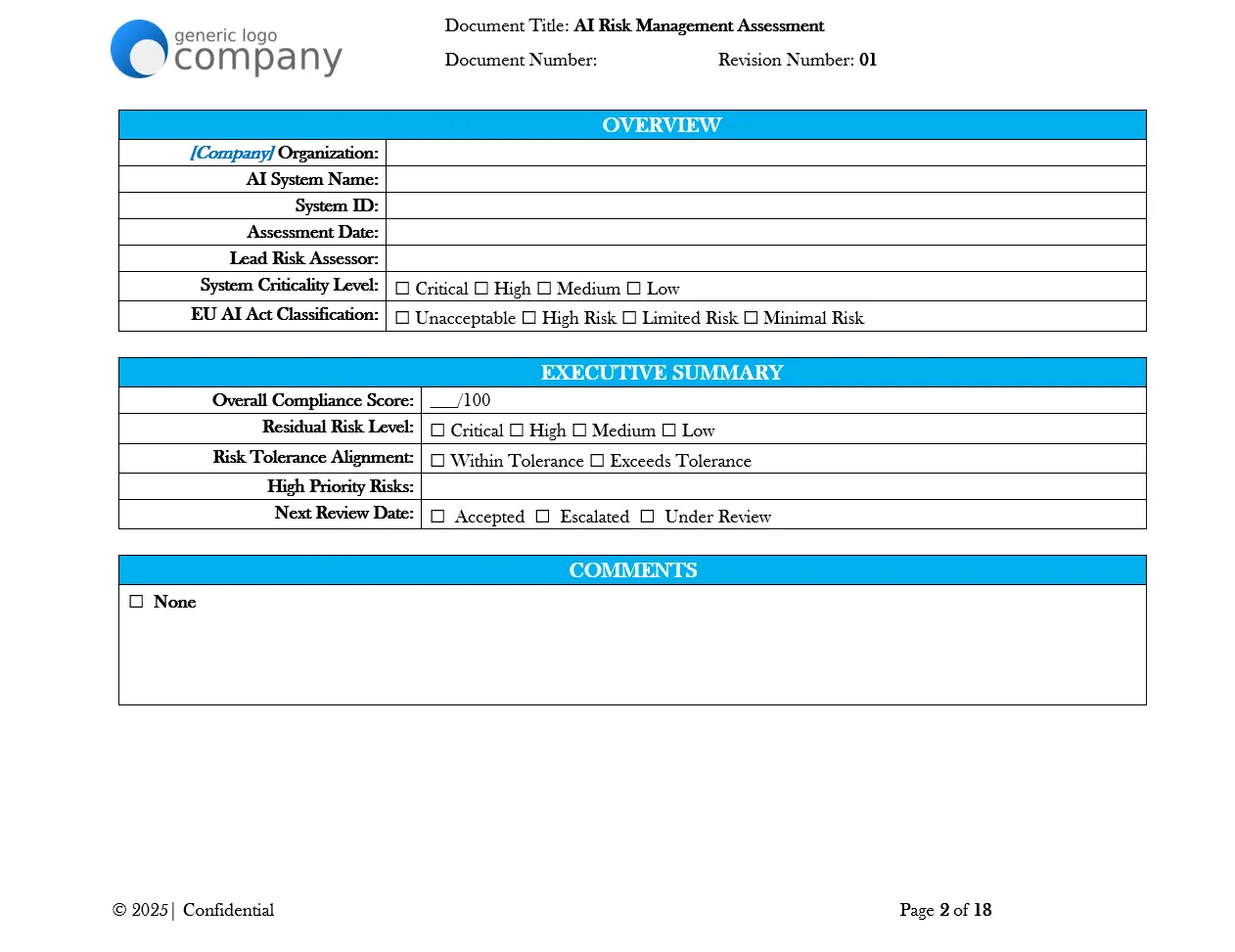
The template includes a complete table of contents, executive summary section with compliance scoring fields, risk scoring matrix appendix with defined likelihood and impact scales, and sign-off accountability tables for risk assessment teams and acceptance authorities.
Why This Matters
Organizations deploying AI systems face increasing pressure to demonstrate responsible governance. The EU AI Act establishes binding requirements for high-risk AI systems, including mandates for risk management systems that operate throughout the AI system lifecycle. Article 9 of the Act requires providers of high-risk systems to establish and maintain documented risk management processes.
ISO/IEC 42001 provides a framework for AI management systems, with Section 6.1 specifically addressing planning requirements for risk assessment and treatment. The standard calls for organizations to determine risks and opportunities that need to be addressed and to plan actions to address those risks. Similarly, ISO/IEC 23894 provides specific guidance on AI risk management practices.
The NIST AI Risk Management Framework offers a voluntary approach to managing AI risks throughout the AI lifecycle. It emphasizes the importance of mapping, measuring, and managing risks in a manner proportionate to the identified risk levels. Organizations pursuing multiple frameworks can benefit from structured documentation that addresses overlapping requirements.
Framework Alignment
The template includes specific references to support compliance efforts with:
- EU AI Act: High-risk system classification, Article 10 data governance requirements, post-market monitoring obligations, continuous iterative risk management requirements
- ISO 42001 §6.1: Planning requirements for addressing risks and opportunities in AI management systems
- ISO 23894: AI-specific risk management methodology alignment
- NIST AI RMF: Risk identification, assessment, and treatment processes
Key Features
The template contains the following sections mapped directly to the document structure:
- Overview Section: Organization details, AI system identification, criticality classification, and EU AI Act risk classification fields
- Executive Summary: Overall compliance scoring, residual risk level assessment, risk tolerance alignment status
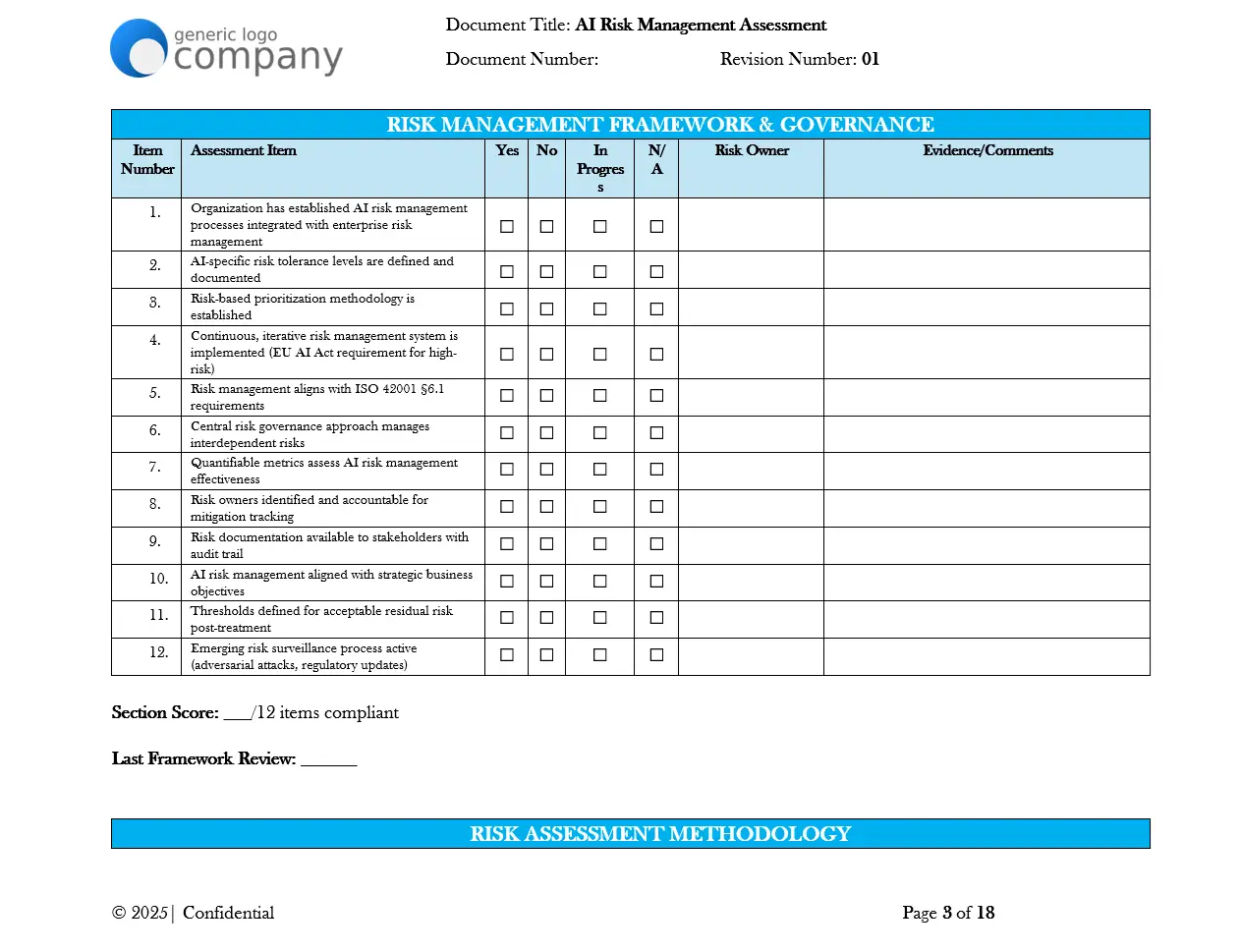
- Risk Management Framework & Governance: 12 assessment items covering enterprise risk integration, risk tolerance definition, governance approaches, and emerging risk surveillance
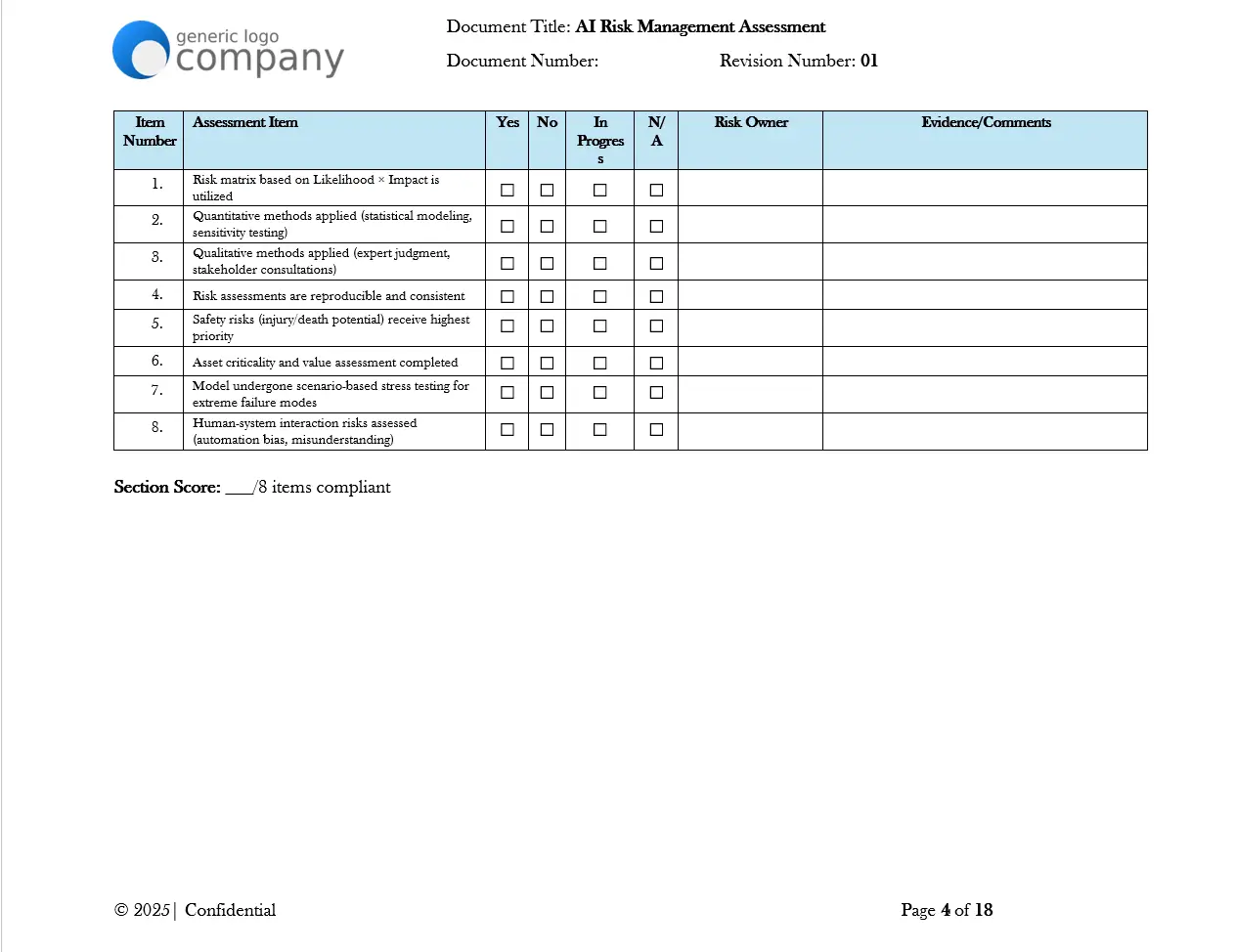
- Risk Assessment Methodology: 8 items addressing quantitative/qualitative methods, reproducibility, safety prioritization, and human-system interaction risks
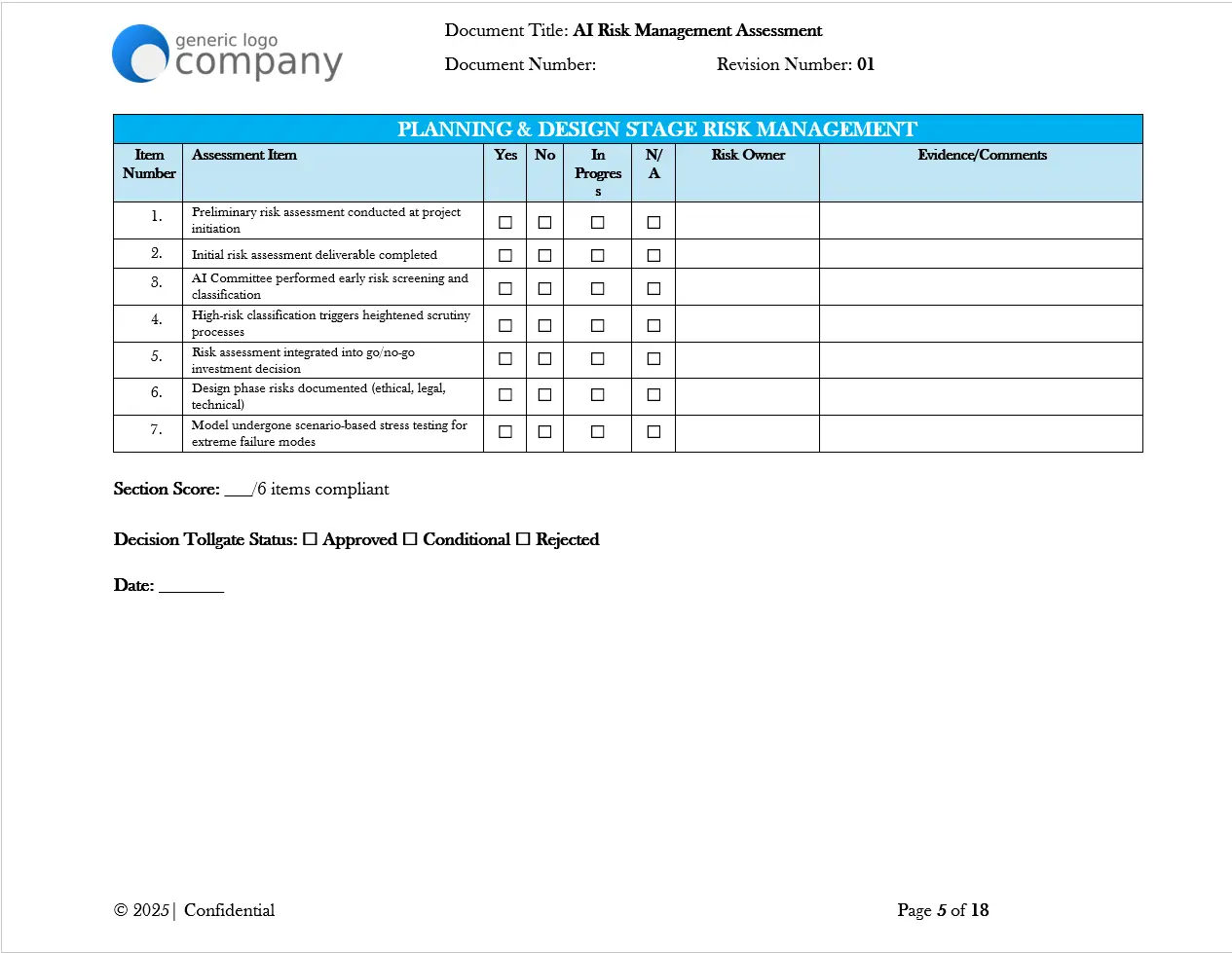
- Planning & Design Stage Risk Management: 6 items for preliminary assessments, AI Committee screening, go/no-go decision integration
- Data Collection & Processing Risk Management: 6 items covering data bias, privacy violations per EU AI Act Art. 10, regulatory compliance, data quality, and third-party data sources
- Model Development & Training Risk Management: 6 items addressing algorithmic bias, robustness, adversarial attacks, performance failures, explainability
- Testing & Validation Risk Re-evaluation: 6 items for empirical validation of risk severity, performance, bias, privacy, and security testing
- Deployment & Integration Risk Management: 6 items covering operational risks, governance controls confirmation, go-live approval, integration risks, rollback/contingency plans
- Operation & Monitoring Risk Management: 8 items addressing post-market monitoring, risk profile evolution tracking, AI Committee re-evaluation, continuous monitoring, escalation thresholds
- Retirement & Decommissioning Risk Management: End-of-life risk considerations
- Risk Register: Structured template for documenting identified risks with treatment plans
- Third-Party/Vendor Risk Assessment: Section for evaluating external provider risks
- Risk Monitoring Dashboard: Template for ongoing risk status tracking
- Emerging Risks Watch List: Section for tracking new and evolving risks
- Compliance & Audit Trail: Documentation for ISO 42001, ISO 23894, NIST AI RMF, EU AI Act compliance status
- Executive Risk Summary: Leadership reporting template with overall risk posture, top risks, trends, resource adequacy
- Sign-off & Accountability: Tables for risk assessment team and risk acceptance authorities
- Appendix: Risk Scoring Matrix: Defined scales for Likelihood (1-5) and Impact (1-5) with risk score calculation guidance
Comparison Table: Basic Approach vs. This Template
| Aspect | Basic Approach | This Professional Template |
|---|---|---|
| Lifecycle Coverage | Ad-hoc assessments at project milestones | 9 structured lifecycle phases with specific assessment items |
| Framework Alignment | Generic risk categories | Specific references to EU AI Act, ISO 42001, ISO 23894, NIST AI RMF |
| Assessment Tracking | Informal documentation | Standardized status fields (Yes/No/In Progress/N/A), risk owners, evidence columns |
| Risk Quantification | Qualitative descriptions only | Defined Likelihood × Impact scoring matrix with 5-point scales |
| Governance Integration | Separate from enterprise risk | Includes enterprise risk management integration assessment items |
| Third-Party Risk | Often overlooked | Dedicated vendor risk assessment section |
| Leadership Reporting | Manual summary creation | Executive risk summary template with defined categories |
| Audit Support | Documentation scattered | Compliance and audit trail section with checkbox tracking |
FAQ Section
Q: What format is the template delivered in? A: The template is delivered as a Microsoft Word document (.docx) to ensure proper formatting and enable collaborative editing. The format supports easy customization of fields, tables, and assessment items.
Q: Does using this template guarantee compliance with EU AI Act or other regulations? A: No. This template provides a structured framework designed to support compliance efforts, but organizations must customize it to their specific systems, obtain appropriate legal review, and ensure implementation aligns with current regulatory requirements. Regulatory interpretation and application varies by jurisdiction and organization.
Q: How much customization is required? A: Significant customization is expected. Organizations should adapt assessment items to reflect their specific AI systems, risk tolerance thresholds, governance structures, and operational context. The template provides a starting framework rather than a ready-to-use solution.
Q: Can this template be used for both high-risk and lower-risk AI systems? A: Yes. The template includes EU AI Act classification fields for Unacceptable, High Risk, Limited Risk, and Minimal Risk categories. Organizations can scale the depth of assessment based on their system’s risk classification.
Q: Does the template include the actual framework requirements? A: The template references specific framework sections (such as EU AI Act Art. 10, ISO 42001 §6.1) to guide assessment, but users should obtain the official framework documents separately for complete requirement details.
Q: How often should risk assessments be updated using this template? A: The template includes fields for continuous monitoring frequency (Daily/Weekly/Monthly/Quarterly) and notes that ISO 42001 requires assessments at planned intervals. Organizations should determine assessment frequency based on their risk profile, regulatory requirements, and operational context.
Ideal For Section
This template is designed for:
- AI/ML Program Managers establishing systematic risk governance across AI initiatives
- Chief Risk Officers integrating AI-specific risks into enterprise risk management
- Compliance Officers documenting evidence for regulatory requirements
- IT Security Managers extending security risk practices to AI systems
- Data Protection Officers addressing AI-related privacy and data risks
- Consultants supporting client AI governance implementations
- Internal Auditors assessing AI risk management program maturity
- Organizations pursuing ISO 42001 certification needing documented risk assessment processes
Pricing Strategy Options
Single Template: Contact for pricing based on organizational requirements and customization needs.
Bundle Option: May be combined with additional AI governance templates (acceptable use policies, AI ethics frameworks, impact assessments) depending on organizational compliance scope.
Enterprise Option: Available as part of comprehensive AI governance documentation suites with volume considerations for multi-business-unit deployments.
Differentiator
This template provides a lifecycle-oriented approach to AI risk assessment that addresses the complete span from initial planning through system retirement. Rather than focusing on a single compliance framework, the structure incorporates assessment items aligned with multiple regulatory and standards requirements (EU AI Act, ISO 42001, ISO 23894, NIST AI RMF), which may help organizations working toward multiple frameworks streamline their documentation efforts. The template includes quantitative risk scoring guidance with defined scales, third-party risk assessment coverage, and executive reporting sections often missing from basic checklists. Organizations should expect to invest time in customization to adapt the framework to their specific systems and governance context.
Documents are optimized for Microsoft Word to ensure proper formatting and collaborative editing capabilities. Professional review and customization is recommended before implementation.