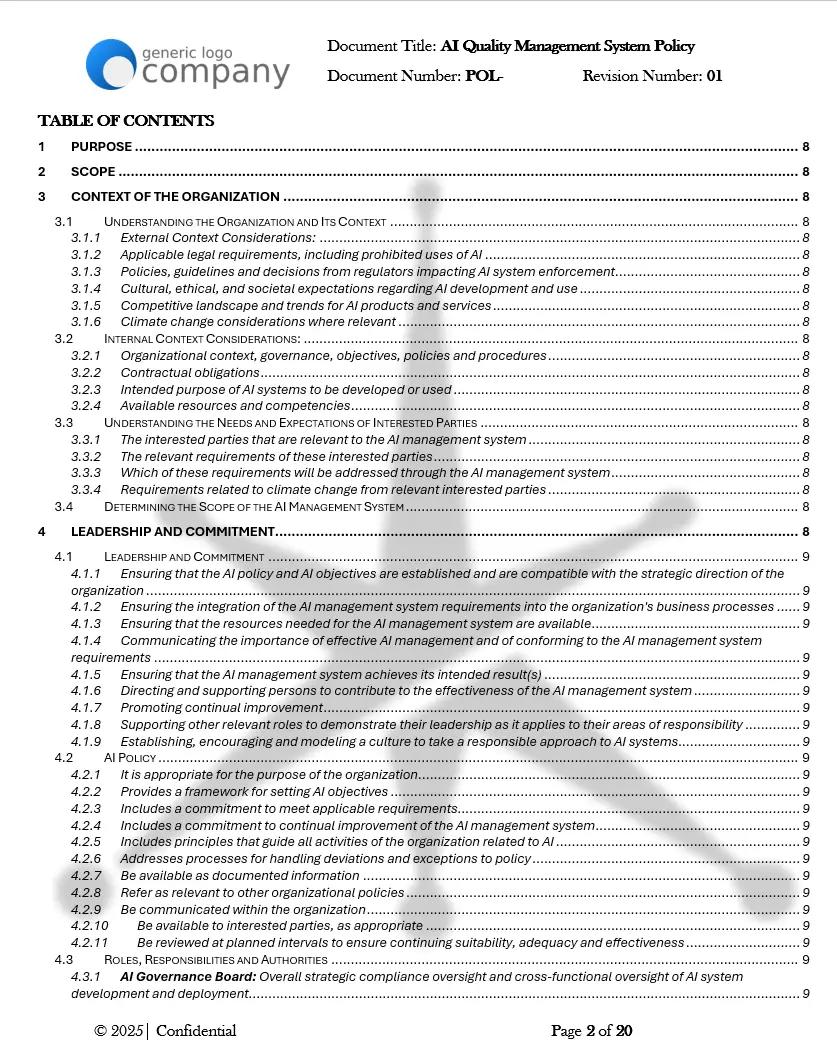
AI Quality Management System Policy Template
A structured framework designed to support organizations in developing quality management systems for high-risk AI systems, aligned with EU AI Act Article 17 and ISO/IEC 42001:2023 requirements.
[Download Now]
What This Template Provides
This AI Quality Management System Policy template offers a comprehensive starting point for organizations establishing quality management frameworks for AI systems. The document provides structured guidance across sixteen core sections covering organizational context, leadership requirements, planning processes, operational controls, performance evaluation, and AI-specific control frameworks.
The template requires customization to align with your organization’s specific structure, AI systems, and regulatory context. Placeholders throughout the document (indicated by brackets such as [Company] or [Product]) need to be replaced with organization-specific information. Organizations should allocate time for thorough review and adaptation before implementation.
Key Benefits
✓ Provides a structured framework addressing EU AI Act Article 17 QMS requirements for high-risk AI systems
✓ Includes guidance aligned with ISO/IEC 42001:2023 AI management system clauses
✓ Contains a regulatory compliance reference table mapping policy sections to specific EU AI Act articles
✓ Includes a definitions section with 27 AI governance and compliance terms
✓ Features a customizable roles and responsibilities section with six defined organizational functions
✓ Provides a quick start guide for document personalization and implementation
✓ Covers full AI system lifecycle from design and development through post-market monitoring
Who This Template Is Designed For
This template is designed for organizations that develop, deploy, or maintain AI systems that may be classified as high-risk under the EU AI Act. It may be particularly relevant for:
- AI Compliance Officers establishing quality management frameworks
- Governance professionals implementing AI management systems
- Risk managers developing AI risk assessment processes
- Organizations preparing for EU AI Act conformity assessment
- Quality managers integrating AI governance with existing management systems
- Providers of high-risk AI systems requiring Article 17 compliance
What’s Included in This Template
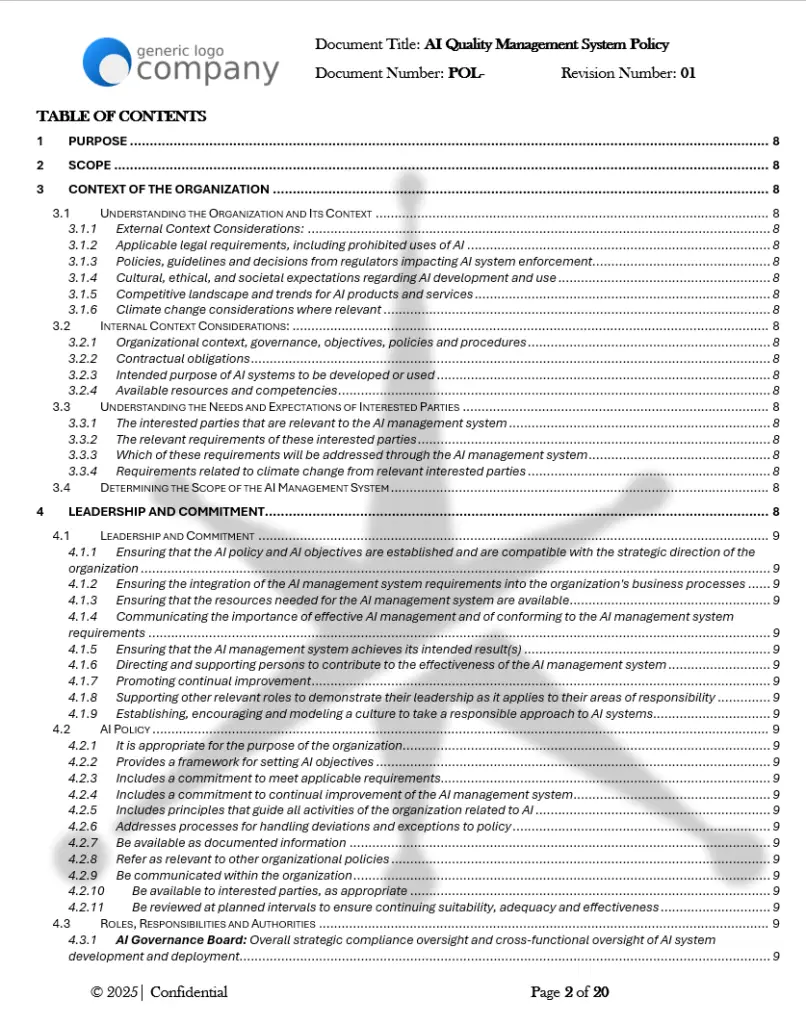
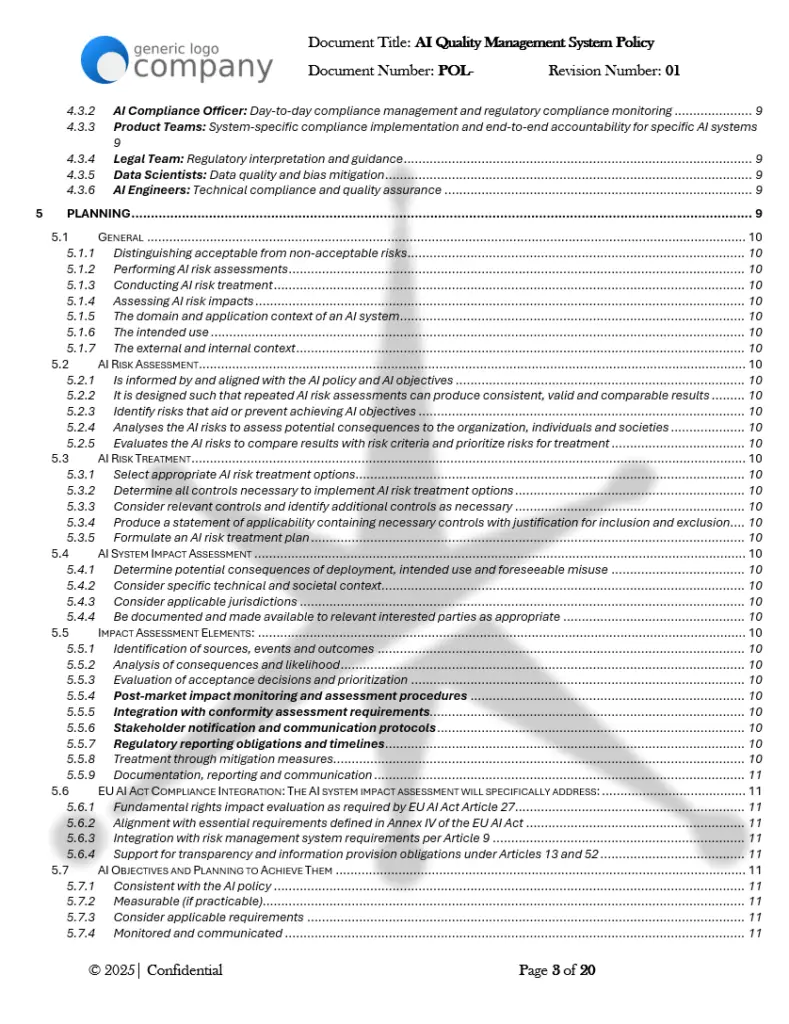
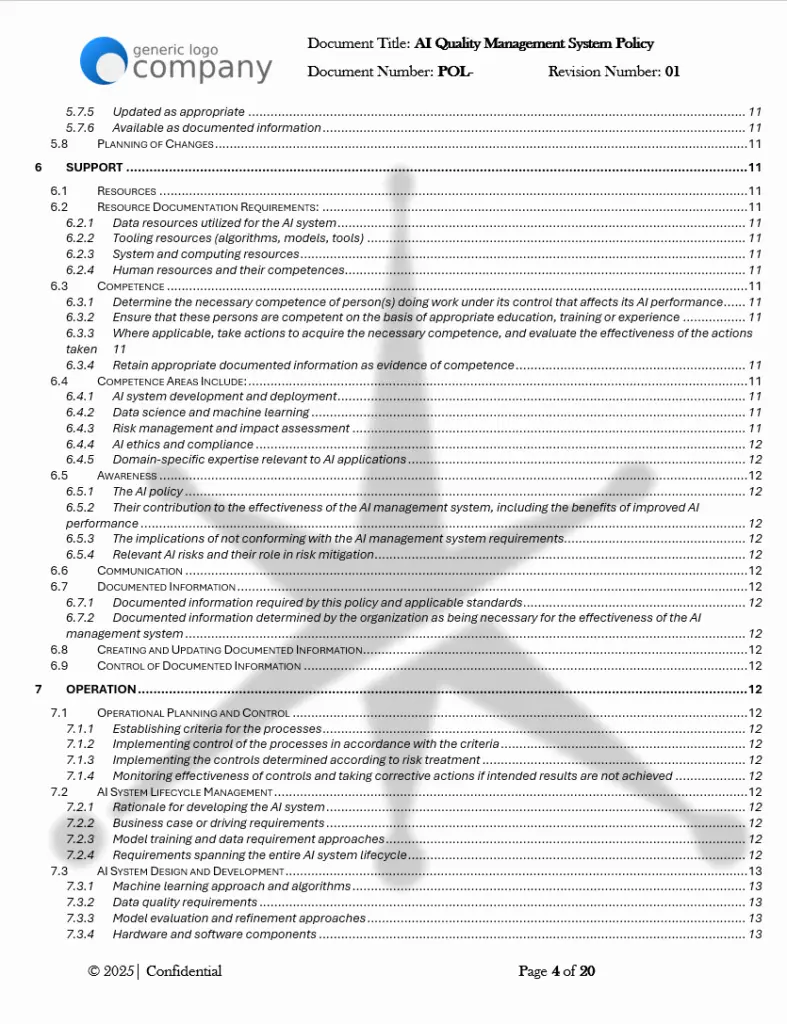
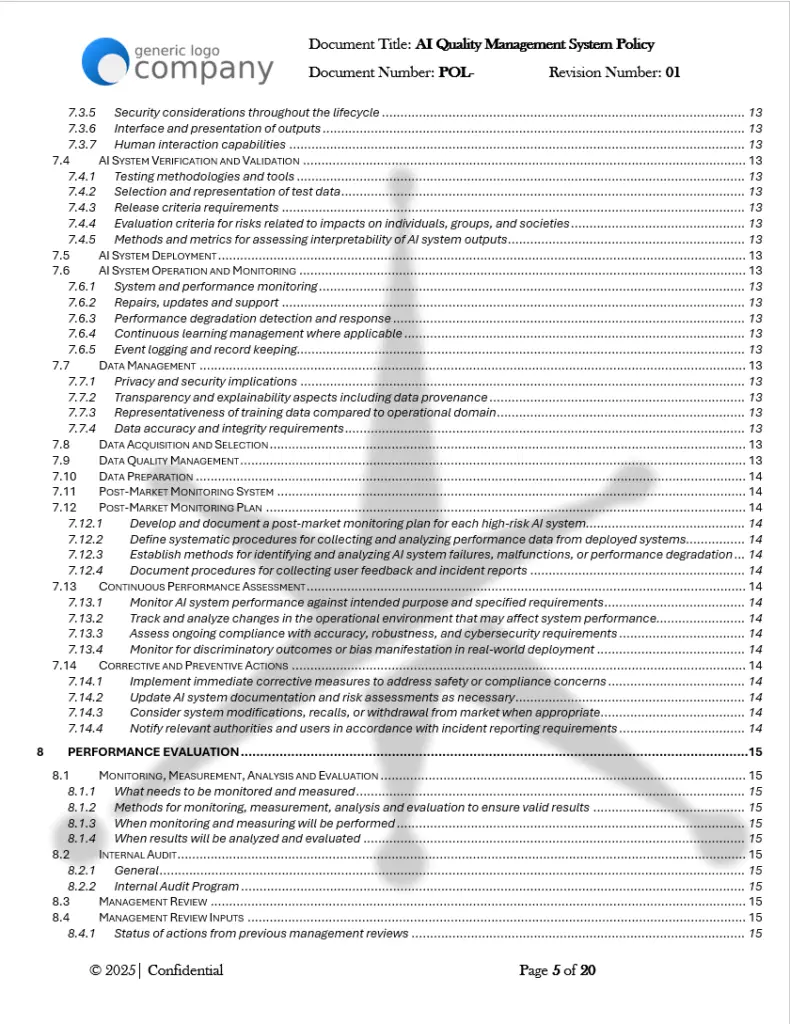
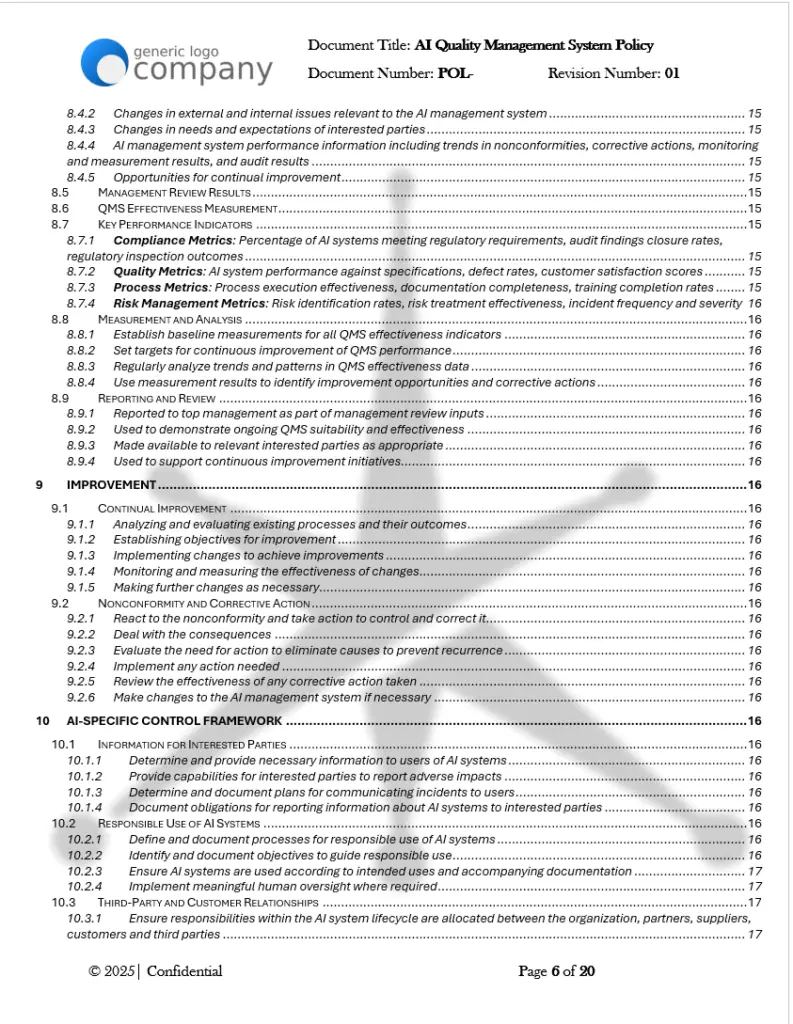
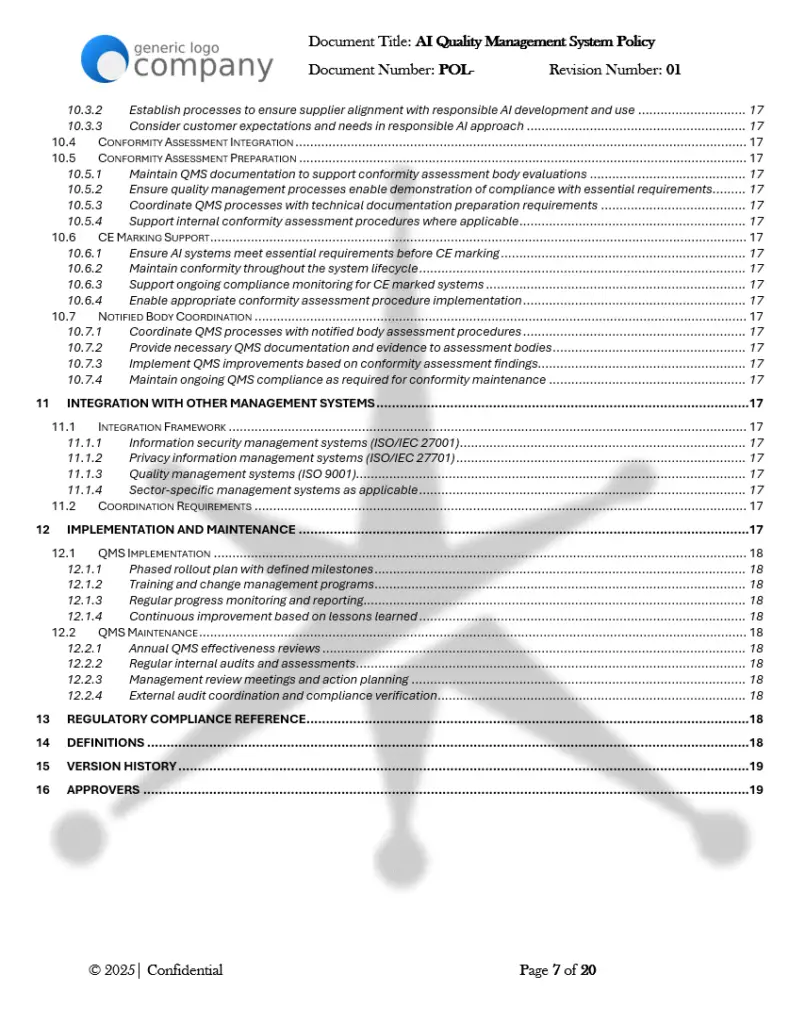
The document contains the following sections as outlined in the table of contents:
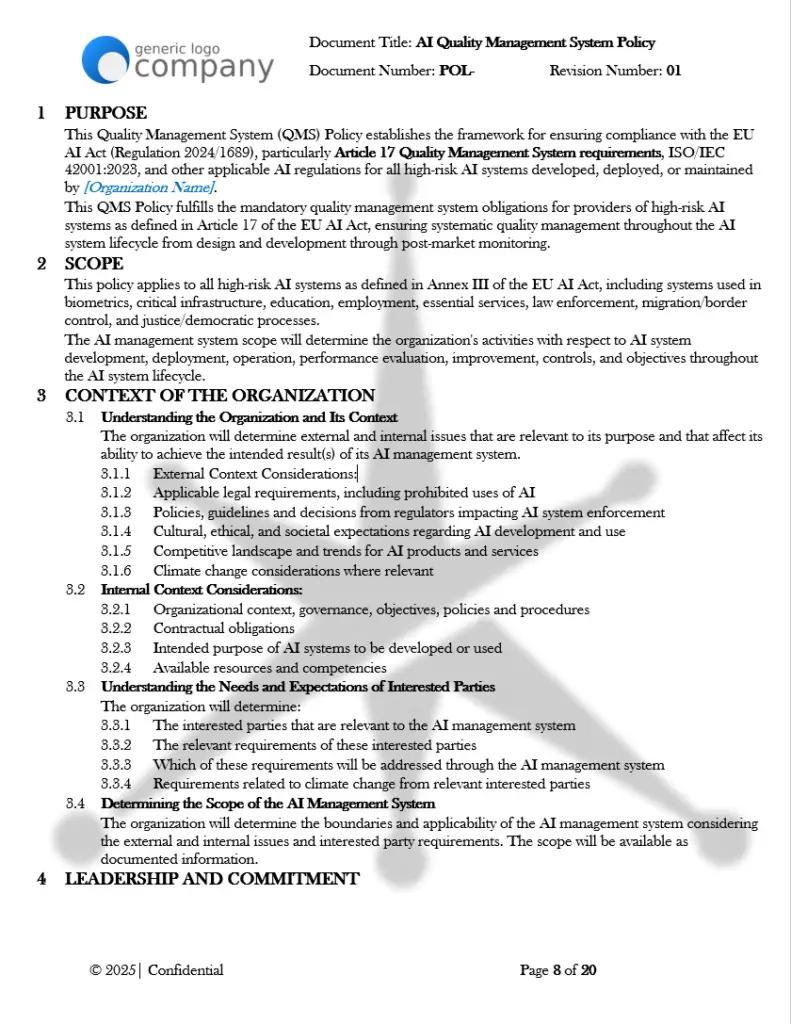
Section 1-2: Purpose and Scope
- Defines QMS framework for EU AI Act and ISO 42001 compliance
- Establishes scope for high-risk AI systems per Annex III categories (biometrics, critical infrastructure, education, employment, essential services, law enforcement, migration/border control, justice/democratic processes)
Section 3: Context of the Organization
- External context considerations (legal requirements, regulatory policies, ethical expectations, competitive landscape)
- Internal context considerations (governance, contractual obligations, resources, competencies)
- Interested party requirements and scope determination
Section 4: Leadership and Commitment
- AI policy framework with eleven documented requirements
- AI risk assessment process guidance
- Roles and responsibilities for six organizational functions (AI Governance Board, AI Compliance Officer, Product Teams, Legal Team, Data Scientists, AI Engineers)
Section 5: Planning
- AI risk assessment process
- AI risk treatment procedures including statement of applicability
- AI system impact assessment with EU AI Act compliance integration
- AI objectives and change planning
Section 6: Support
- Resource documentation requirements (data, tooling, system, human resources)
- Competence requirements across five areas
- Awareness, communication, and documented information controls
Section 7: Operation
- AI system lifecycle management (requirements, design, development, verification, validation, deployment)
- Data management processes (acquisition, quality, preparation)
- Post-market monitoring system with monitoring plan, continuous assessment, and corrective actions
Section 8: Performance Evaluation
- Monitoring, measurement, analysis and evaluation
- Internal audit program guidance
- Management review inputs and outputs
- QMS effectiveness measurement with four KPI categories
Section 9: Improvement
- Continual improvement process
- Nonconformity and corrective action procedures
Section 10: AI-Specific Control Framework
- Information for interested parties
- Responsible use of AI systems
- Third-party and customer relationships
- Conformity assessment integration, CE marking support, and notified body coordination
Section 11: Integration with Other Management Systems
- Integration framework for ISO/IEC 27001, ISO/IEC 27701, ISO 9001
- Coordination requirements
Section 12: Implementation and Maintenance
- QMS implementation guidance (phased rollout, training, progress monitoring)
- QMS maintenance procedures (annual reviews, internal audits, management reviews)
Section 13: Regulatory Compliance Reference
- Mapping table linking EU AI Act articles to policy sections
Section 14: Definitions
- 27 defined terms including AI System, High-risk AI System, Post-market Monitoring, Conformity Assessment, and more
Sections 15-16: Version History and Approvers
- Document control tables for tracking versions and approvals
Why This Matters
Organizations developing or deploying high-risk AI systems face specific quality management requirements under the EU AI Act. Article 17 of the regulation establishes that providers of high-risk AI systems shall put a quality management system in place. This system must include policies, procedures, and instructions that cover strategies for regulatory compliance, design and development techniques, quality control processes, resource management, risk management procedures, and post-market monitoring arrangements.
High-risk AI systems, as defined in Annex III of the EU AI Act, include systems used in areas such as biometrics and biometrics-based categorization, management of critical infrastructure, education and vocational training, employment and worker management, access to essential services, law enforcement, migration and border control, and administration of justice and democratic processes.
ISO/IEC 42001:2023 provides an international framework for AI management systems that organizations can use to structure their governance approach. This standard establishes requirements for establishing, implementing, maintaining, and continually improving an AI management system within an organization.
This template incorporates elements from both the EU AI Act requirements and ISO 42001 guidance to provide a foundation for organizational adaptation. Professional review may be needed to ensure the adapted policy meets specific regulatory obligations.
Framework Alignment
This template references and incorporates guidance from the following frameworks as documented in Section 13:
EU AI Act (Regulation 2024/1689):
- Article 17 (Quality Management System requirements) – Entire Document
- Article 9 (Risk Management System) – Sections 4.1.2-4.1.3
- Article 61 (Post-Market Monitoring) – Section 6.4
- Article 27 (Fundamental Rights Impact Assessment) – Section 4.1.4
- Annex IV (Essential Requirements Support) – Sections 6.2, 9.4
- Annex III (High-risk AI system categories) – Referenced in Scope
ISO/IEC 42001:2023:
- AI Management System requirements (all clauses addressed in aligned sections)
Integration References (Section 11):
- ISO/IEC 27001 (Information Security Management Systems)
- ISO/IEC 27701 (Privacy Information Management Systems)
- ISO 9001 (Quality Management Systems)
Key Features
The template includes the following documented elements:
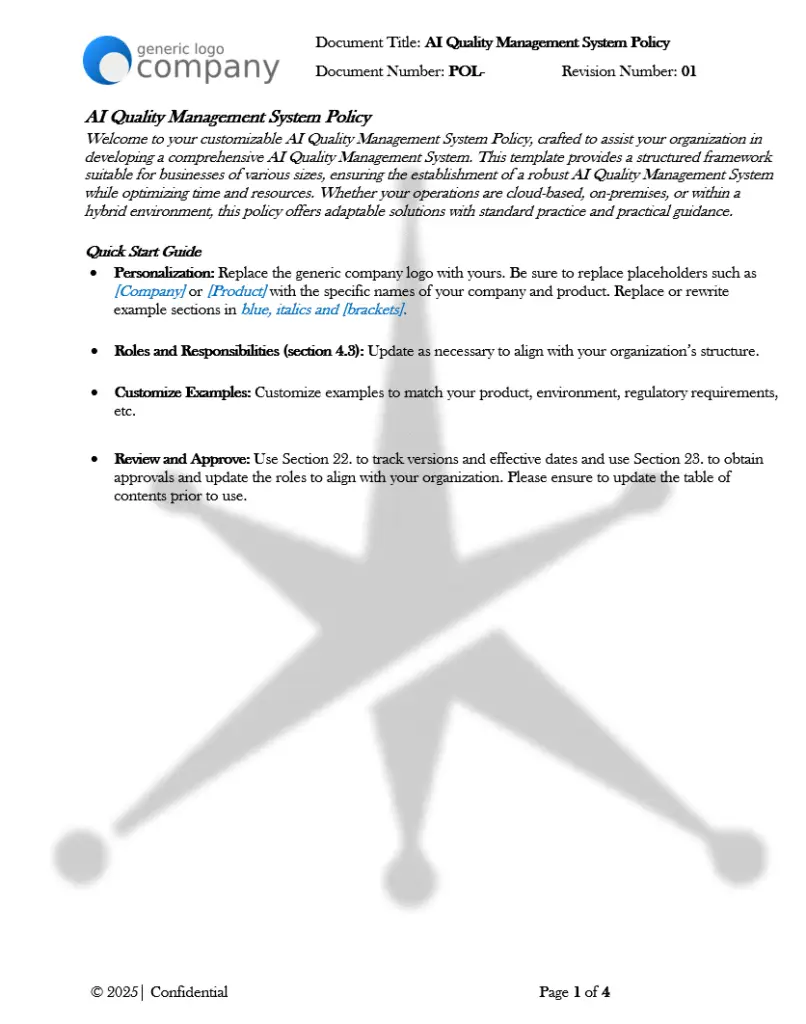
- Quick Start Guide: Four-step personalization guidance for customizing placeholders, updating roles, adapting examples, and obtaining approvals
- Organizational Context Framework: Guidance for documenting external context (legal requirements, regulatory policies, cultural and ethical expectations, competitive landscape, climate considerations) and internal context (governance, objectives, contractual obligations, resources)
- AI Risk Assessment Process: Structured approach covering risk identification (data quality uncertainty, impact uncertainty), risk analysis (domain context, data considerations, system capabilities, intended use, foreseeable misuse), and risk evaluation and prioritization
- AI System Impact Assessment: Process guidance for assessing consequences to individuals, groups, and societies, including nine impact assessment elements and four EU AI Act compliance integration points
- Roles and Responsibilities Matrix: Six defined organizational functions with documented responsibilities:
- AI Governance Board: Strategic compliance oversight
- AI Compliance Officer: Day-to-day compliance management
- Product Teams: System-specific compliance implementation
- Legal Team: Regulatory interpretation
- Data Scientists: Data quality and bias mitigation
- AI Engineers: Technical compliance and quality assurance
- AI System Lifecycle Coverage: Sections addressing requirements specification, design and development (seven elements), verification and validation (five elements), deployment, and operation and monitoring (five elements)
- Post-Market Monitoring System: Guidance aligned with EU AI Act Article 61 including:
- Post-market monitoring plan development
- Systematic procedures for performance data collection
- Failure and malfunction analysis methods
- User feedback collection procedures
- Continuous performance assessment against four criteria
- Corrective and preventive action procedures
- QMS Effectiveness Measurement: Four KPI categories (compliance metrics, quality metrics, process metrics, risk management metrics) with measurement, analysis, and reporting guidance
- Conformity Assessment Support: Sections covering preparation for conformity assessment, CE marking support (four elements), and notified body coordination (four elements)
- Regulatory Compliance Reference Table: Direct mapping between EU AI Act articles/sections and corresponding policy sections
- Definitions Section: 27 standardized terms including AI System, AI Management System, High-risk AI System, Conformity Assessment, Post-market Monitoring, Data Provenance, Bias, Robustness, Transparency, and more
- Document Control: Version history and approvers tables for change management
Comparison: Starting from Scratch vs. Using This Template
| Aspect | Starting from Scratch | Using This Template |
|---|---|---|
| Document Structure | Requires researching EU AI Act and ISO 42001 requirements to determine document organization | Provides pre-structured sixteen sections aligned with Article 17 and ISO 42001 clauses |
| Regulatory Mapping | Must manually identify which EU AI Act articles apply to QMS elements | Includes regulatory compliance reference table with article-to-section mapping |
| Terminology | Must develop consistent terminology across documentation | Includes definitions section with 27 standardized terms |
| Organizational Roles | Must define organizational functions from scratch | Provides six defined roles with documented responsibilities as starting point |
| Lifecycle Coverage | Must determine which lifecycle phases to address | Covers full AI system lifecycle from conception through post-market monitoring |
| Risk Assessment | Must develop risk assessment methodology | Includes structured AI risk assessment and impact assessment processes |
| Customization Guidance | No guidance on adaptation approach | Includes quick start guide identifying placeholders and customization areas |
Frequently Asked Questions
Q: What format is this template provided in?
A: The template is provided as an editable Microsoft Word document (.docx) to ensure proper formatting and enable collaborative editing. Documents are optimized for Microsoft Word to ensure proper formatting and collaborative editing capabilities.
Q: Does this template guarantee compliance with the EU AI Act?
A: No. This template provides a structured framework designed to support compliance efforts. Organizations must customize the template to their specific context, implement the documented processes, and may need professional review to ensure the adapted policy meets their regulatory obligations. The template does not guarantee compliance or regulatory approval.
Q: What customization is required before using this template?
A: The template includes placeholders indicated in brackets (such as [Company], [Product], [Date]) that must be replaced with organization-specific information. The Quick Start Guide identifies four customization areas: personalization of company details, updating roles and responsibilities to align with organizational structure, customizing examples to match your environment, and completing review and approval processes.
Q: Does this template cover all high-risk AI system categories?
A: The template provides a general framework applicable to high-risk AI systems as defined in EU AI Act Annex III. The Scope section identifies eight categories: biometrics, critical infrastructure, education, employment, essential services, law enforcement, migration/border control, and justice/democratic processes. Organizations may need to add sector-specific requirements depending on their AI system applications.
Q: How does this template relate to ISO 42001 certification?
A: The template incorporates guidance aligned with ISO/IEC 42001:2023 clauses as indicated in the regulatory compliance reference table. Organizations pursuing ISO 42001 certification would use this as a foundation and work with certification bodies to ensure their implemented system meets certification requirements.
Q: What record retention period does this template specify?
A: Section 6.9 specifies that critical AI system records should be retained for a minimum of 10 years.
Q: Can this template integrate with existing management systems?
A: Yes. Section 11 specifically addresses integration with existing management systems including ISO/IEC 27001 (information security), ISO/IEC 27701 (privacy), ISO 9001 (quality), and sector-specific systems. The coordination requirements section provides guidance for avoiding duplication and ensuring consistency.
Ideal For
- Organizations developing high-risk AI systems subject to EU AI Act requirements
- Providers of AI systems used in biometrics, critical infrastructure, education, employment, or essential services
- Companies establishing AI quality management systems for the first time
- Compliance teams needing a structured starting point for AI governance documentation
- Organizations integrating AI management with existing ISO 27001 or ISO 9001 systems
- Providers preparing for conformity assessment of high-risk AI systems
- Risk managers implementing AI risk assessment and treatment processes
- Organizations requiring post-market monitoring documentation for deployed AI systems
Pricing Strategy Options
Single Template: Contact for pricing based on organizational requirements and customization needs.
Bundle Option: May be combined with additional AI governance templates depending on organizational compliance scope.
Enterprise Option: Available as part of comprehensive AI governance documentation suites.
Differentiator
This AI Quality Management System Policy template provides a comprehensive foundation that addresses the specific QMS requirements of EU AI Act Article 17 while incorporating ISO/IEC 42001:2023 management system guidance. The template includes a regulatory compliance reference table that directly maps policy sections to specific EU AI Act articles (9, 17, 27, 61, Annex IV), providing organizations with documented alignment between their QMS and regulatory obligations. The inclusion of six defined organizational roles, a 27-term definitions section, four categories of QMS effectiveness KPIs, and coverage spanning the complete AI system lifecycle from design through post-market monitoring offers a structured starting point that organizations can adapt to their specific context and requirements.