AI Model Card Development and Management Procedure Template
A structured framework designed to support organizations in establishing standardized processes for AI model documentation, transparency, and regulatory alignment.
[Download Now]
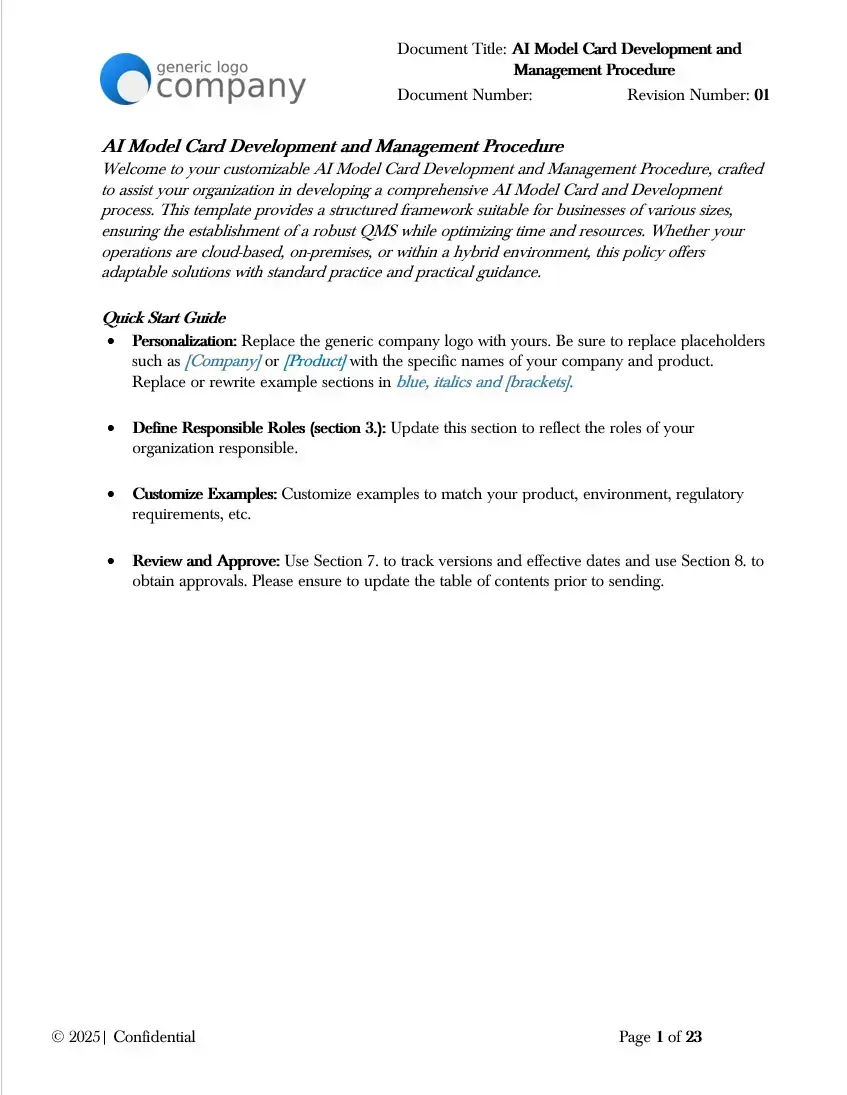
This AI Model Card Development and Management Procedure Template provides organizations with a structured framework for creating, reviewing, and maintaining documentation for AI and machine learning models. The template requires customization to match your specific organizational structure, technologies, and regulatory requirements.
Organizations implementing AI systems face increasing pressure to demonstrate transparency and accountability. This template provides a starting point for building documentation processes that address these needs, though successful implementation depends on organizational commitment and appropriate professional guidance.
Key Benefits
✓ Provides a structured procedure covering the full Model Card lifecycle from initiation through maintenance
✓ Includes nine defined organizational roles with specific responsibilities for Model Card development
✓ Contains appendices with checklists, review forms, and compliance mapping tables
✓ References regulatory frameworks including EU AI Act, NIST AI RMF, and ISO/IEC 42001
✓ Offers customizable sections for organizational adaptation
✓ Includes workflow guidance for technical, ethical, legal, and business reviews
Who Uses This?
This template is designed for:
- AI/ML teams seeking to formalize model documentation practices
- Compliance and governance professionals working with AI systems
- Organizations developing or deploying AI systems that require transparency documentation
- Risk management teams implementing AI governance frameworks
- Technical leads responsible for AI model lifecycle management
Preview Content
The template includes:
- Quick Start Guide with customization instructions
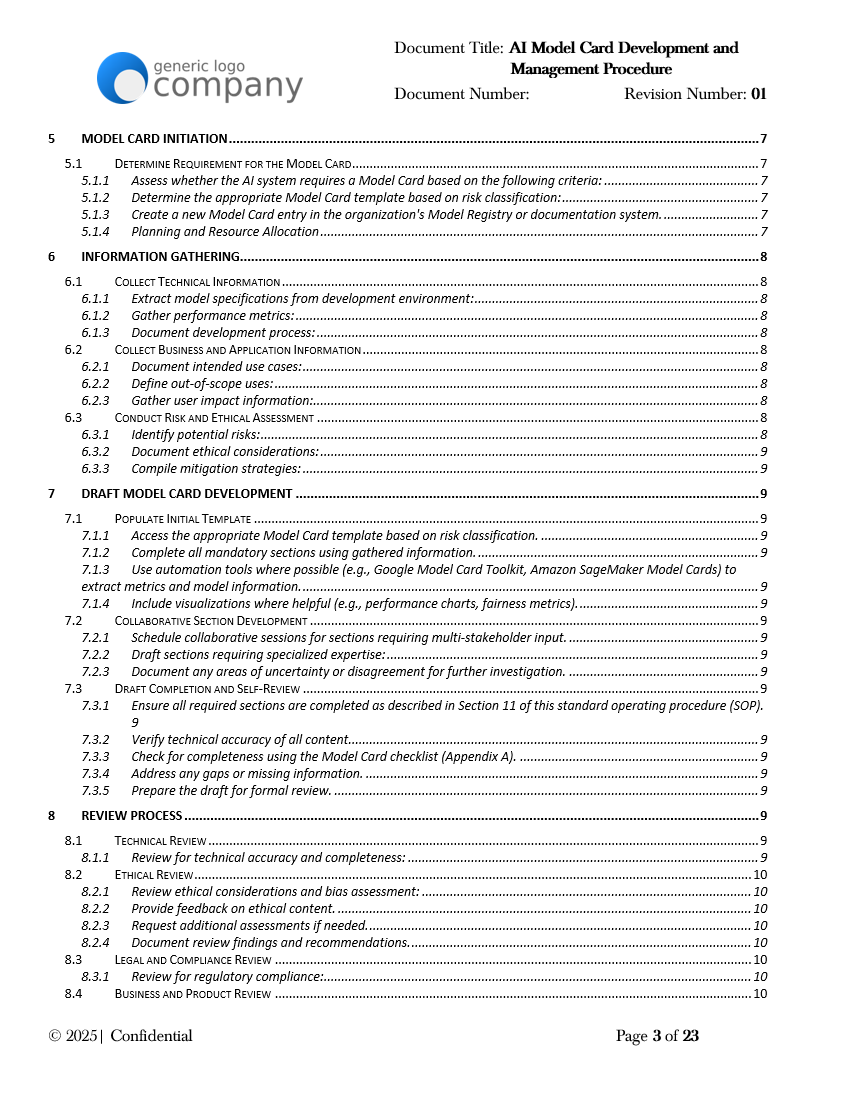
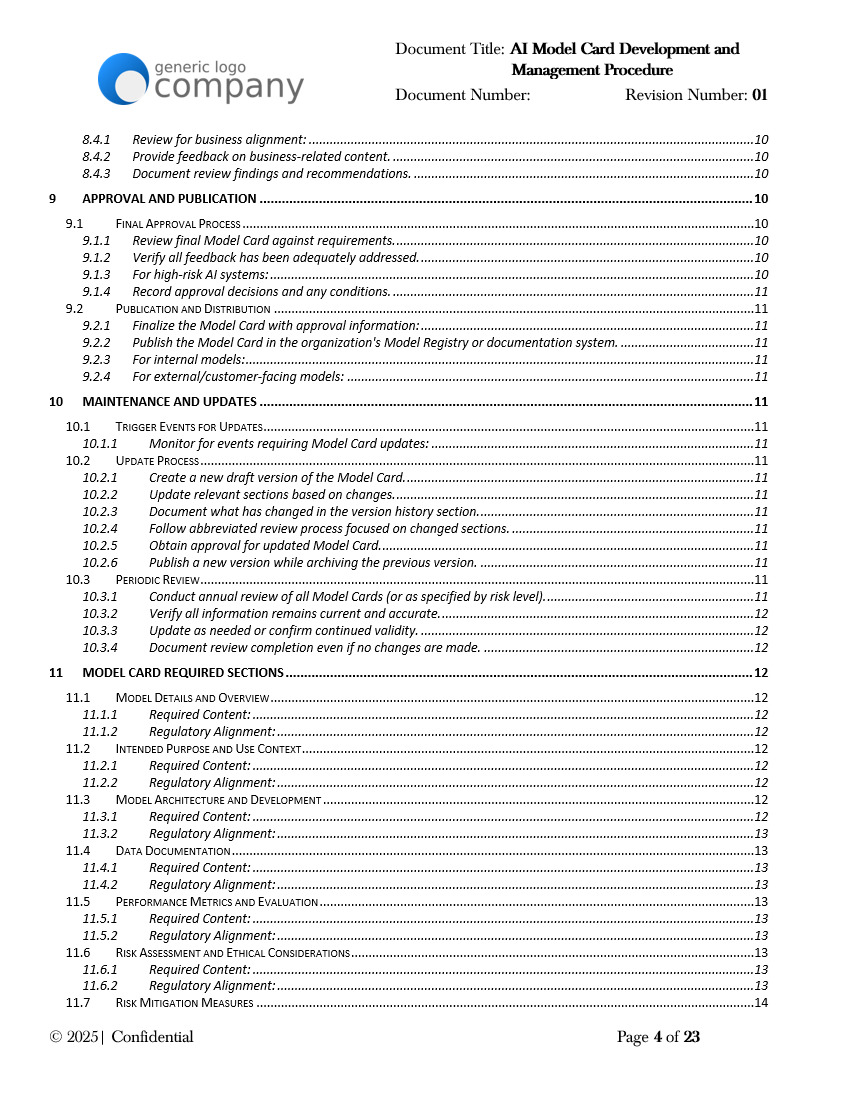
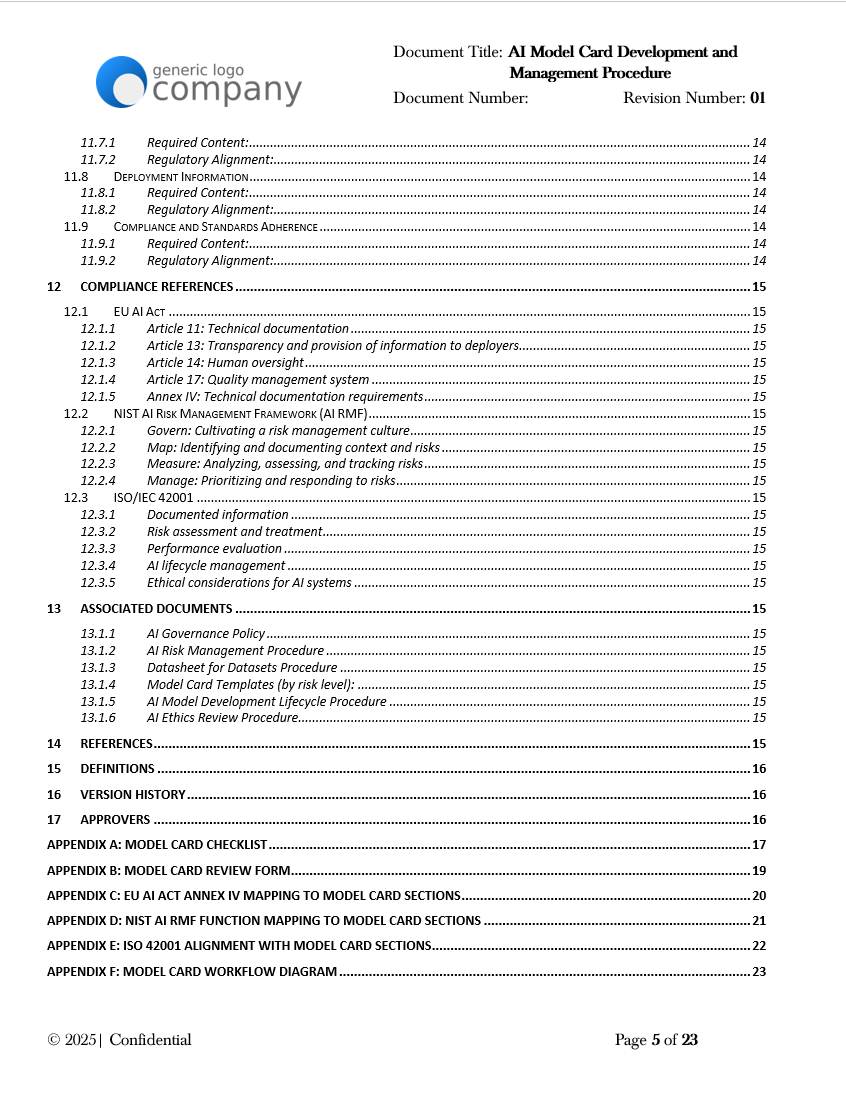
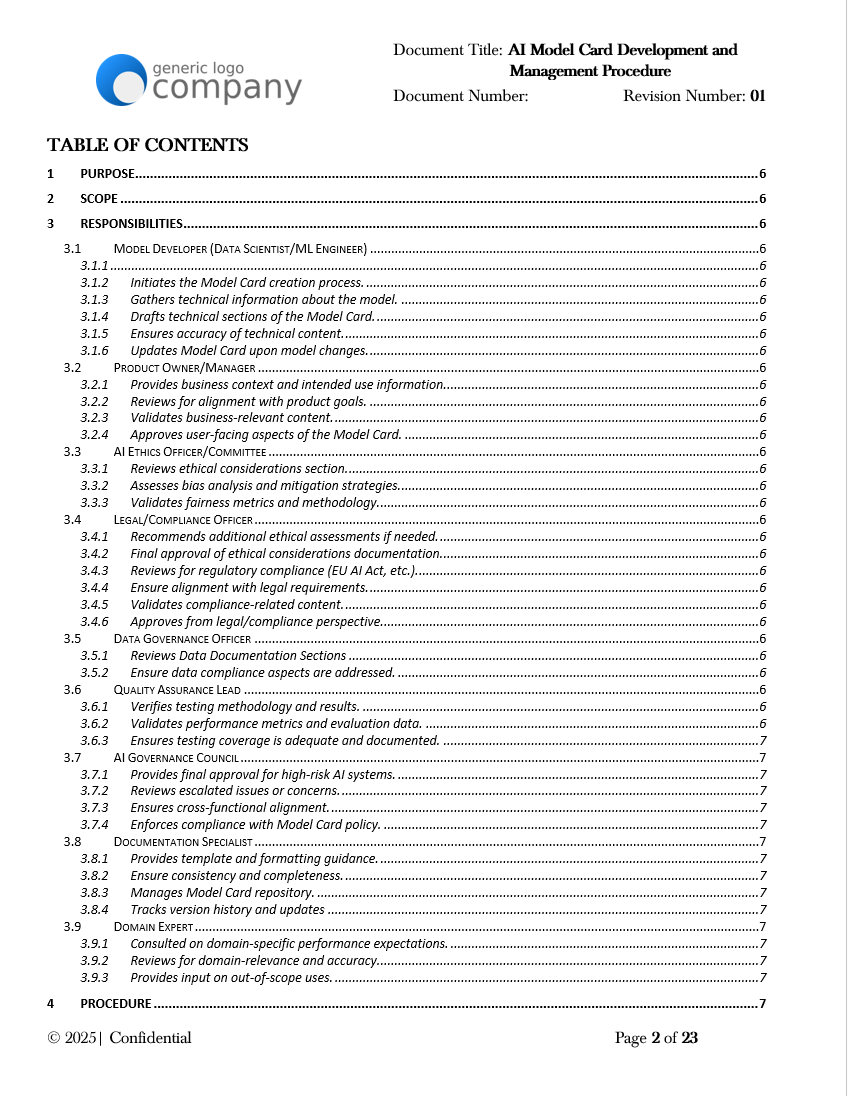
- Detailed Table of Contents spanning 17 main sections
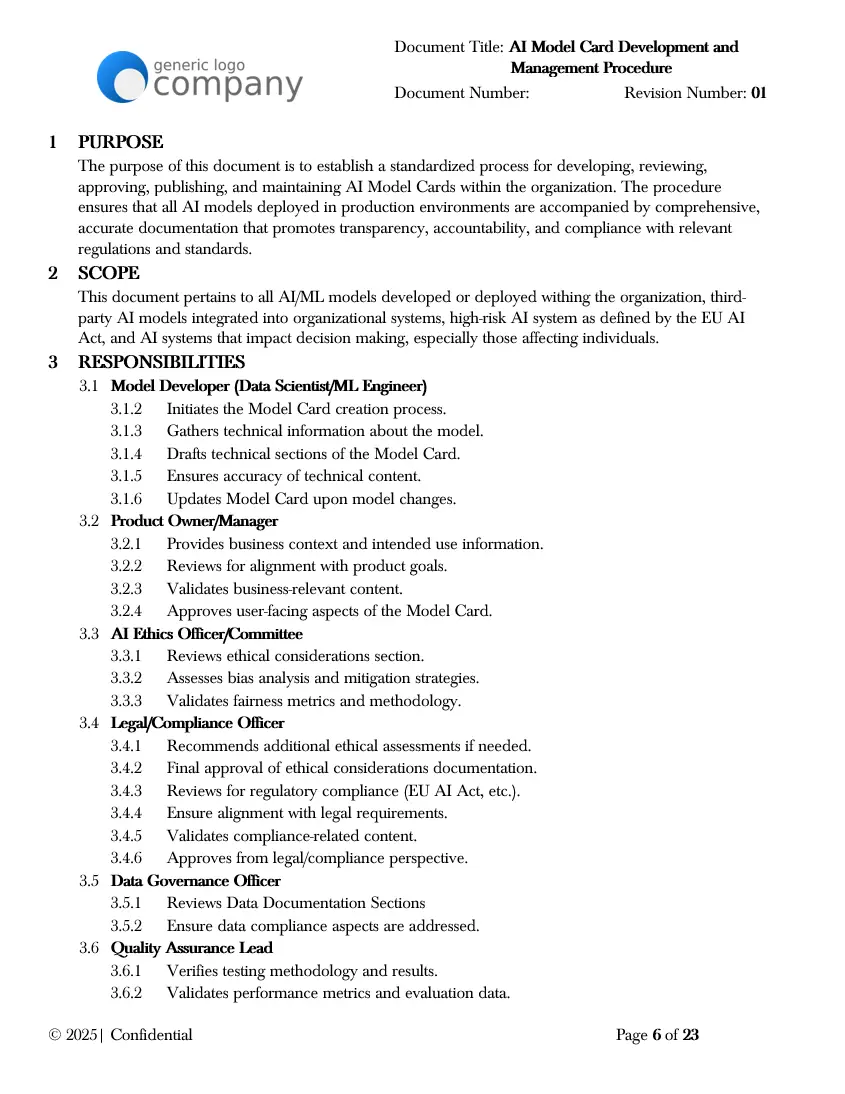
- Nine defined responsibility roles (Model Developer, Product Owner, AI Ethics Officer, Legal/Compliance Officer, Data Governance Officer, QA Lead, AI Governance Council, Documentation Specialist, Domain Expert)
- Complete procedure workflow covering initiation, information gathering, draft development, review, approval, publication, and maintenance
- Nine required Model Card sections with regulatory alignment references
- Six appendices (Checklist, Review Form, EU AI Act Annex IV Mapping, NIST AI RMF Mapping, ISO 42001 Alignment, Workflow Diagram placeholder)
Why This Matters
Organizations deploying AI systems increasingly need structured documentation to demonstrate transparency about model capabilities, limitations, and appropriate use contexts. Model Cards serve as a standardized format for communicating essential information about AI systems to stakeholders, users, and regulators.
The EU AI Act introduces specific technical documentation requirements for high-risk AI systems, including detailed information about model architecture, training data, performance metrics, and risk assessments. Similarly, the NIST AI Risk Management Framework emphasizes documentation as a core component of AI governance practices.
Developing Model Cards without a standardized procedure can result in inconsistent documentation quality, missing information, and gaps in review processes. This template provides a procedural framework that organizations can adapt to establish consistent practices for Model Card creation and maintenance.
Framework Alignment
The template includes explicit mapping to the following frameworks referenced in the source document:
- EU AI Act: Article 11 (Technical documentation), Article 13 (Transparency), Article 14 (Human oversight), Article 17 (Quality management system), Annex IV (Technical documentation requirements)
- NIST AI Risk Management Framework: Govern, Map, Measure, and Manage functions
- ISO/IEC 42001: Documented information requirements, risk assessment, performance evaluation, AI lifecycle management, and ethical considerations
Key Features
The template includes the following components as documented in its table of contents:
- Purpose and Scope Sections: Define the document’s objectives and applicability to AI/ML models
- Responsibilities Section: Nine organizational roles with specific duties for Model Card development
- Procedure Section: Step-by-step workflow covering Model Card initiation, information gathering, draft development, review processes, approval, publication, and maintenance
- Model Card Required Sections: Nine content areas (Model Details, Intended Purpose, Architecture, Data Documentation, Performance Metrics, Risk Assessment, Risk Mitigation, Deployment Information, Compliance and Standards)
- Compliance References Section: Documentation of EU AI Act, NIST AI RMF, and ISO/IEC 42001 alignment
- Associated Documents Section: References to related organizational documents
- Appendix A: Model Card Checklist with items organized by section
- Appendix B: Model Card Review Form template
- Appendix C: EU AI Act Annex IV Mapping to Model Card Sections
- Appendix D: NIST AI RMF Function Mapping to Model Card Sections
- Appendix E: ISO 42001 Alignment with Model Card Sections
- Appendix F: Placeholder for Model Card Workflow Diagram
Comparison Table: Starting from Scratch vs. Professional Template
| Aspect | Starting from Scratch | This Template |
|---|---|---|
| Structure | Must research and design procedure format | Provides structured 17-section framework |
| Role Definition | Requires identification of all stakeholders | Includes nine pre-defined roles with responsibilities |
| Regulatory Research | Must independently map requirements | Contains EU AI Act, NIST, and ISO 42001 mappings |
| Checklist Development | Must create verification items | Includes Model Card checklist in Appendix A |
| Review Process | Must design review workflow | Provides technical, ethical, legal, and business review procedures |
| Compliance Mapping | Must develop framework crosswalks | Contains three compliance mapping appendices |
FAQ Section
Q: What file format is the template provided in? A: The template is optimized for Microsoft Word (.docx) to support proper formatting and collaborative editing capabilities.
Q: Does this template provide compliance with the EU AI Act? A: The template includes mappings to EU AI Act requirements and provides a framework for documentation practices. However, compliance depends on proper implementation, customization to your specific systems, and appropriate legal review. The template supports compliance efforts but does not guarantee regulatory compliance.
Q: What customization is required? A: Organizations need to replace placeholder text (company name, product names, example sections), adapt role definitions to their organizational structure, customize examples to match their environment and regulatory requirements, and complete approval and version tracking sections.
Q: Does this template work for all types of AI systems? A: The template is designed for AI/ML models generally, with specific guidance for high-risk systems. Organizations should assess whether the template scope aligns with their specific AI system types and regulatory obligations.
Q: Are the compliance mappings (EU AI Act, NIST, ISO) part of the template content? A: Yes, the template includes three appendices (C, D, E) that map Model Card sections to specific requirements from EU AI Act Annex IV, NIST AI RMF functions, and ISO 42001 requirement areas.
Q: What associated documents does this template reference? A: The template references related documents that organizations may need separately, including: AI Governance Policy, AI Risk Management Procedure, Datasheet for Datasets Procedure, Model Card Templates (by risk level), AI Model Development Lifecycle Procedure, and AI Ethics Review Procedure. These are referenced as separate organizational documents, not included in this template.
Ideal For
- AI/ML Engineers and Data Scientists responsible for model documentation
- Compliance Officers implementing AI governance programs
- Risk Management professionals addressing AI system risks
- Product Managers overseeing AI-enabled products
- AI Ethics Committee members
- Documentation Specialists managing technical documentation
- Organizations beginning to formalize AI governance practices
- Teams preparing for EU AI Act compliance requirements
Pricing Strategy Options
Single Template: Contact for pricing based on organizational requirements and customization needs.
Bundle Option: May be combined with related AI governance templates depending on organizational compliance scope.
Enterprise Option: Available as part of comprehensive governance documentation suites.
Differentiator
This template provides a procedural framework rather than just a blank Model Card form. It includes the organizational process for who does what, when, and how throughout the Model Card lifecycle. The inclusion of three separate compliance mapping appendices (EU AI Act Annex IV, NIST AI RMF functions, and ISO 42001 requirements) provides organizations with documented crosswalks that support alignment efforts with multiple frameworks simultaneously. The nine defined roles with specific responsibilities help organizations establish clear accountability for Model Card creation and maintenance.
Important Notes
- This template requires customization to your organization’s specific structure, processes, and regulatory requirements
- Professional legal and compliance review is recommended before implementation
- The template supports compliance efforts but does not guarantee regulatory compliance
- Referenced associated documents (AI Governance Policy, AI Risk Management Procedure, etc.) are separate materials not included in this template
- Implementation timelines and effort vary based on organizational complexity and existing practices
Document format: Microsoft Word (.docx) for proper formatting and collaborative editing capabilities.