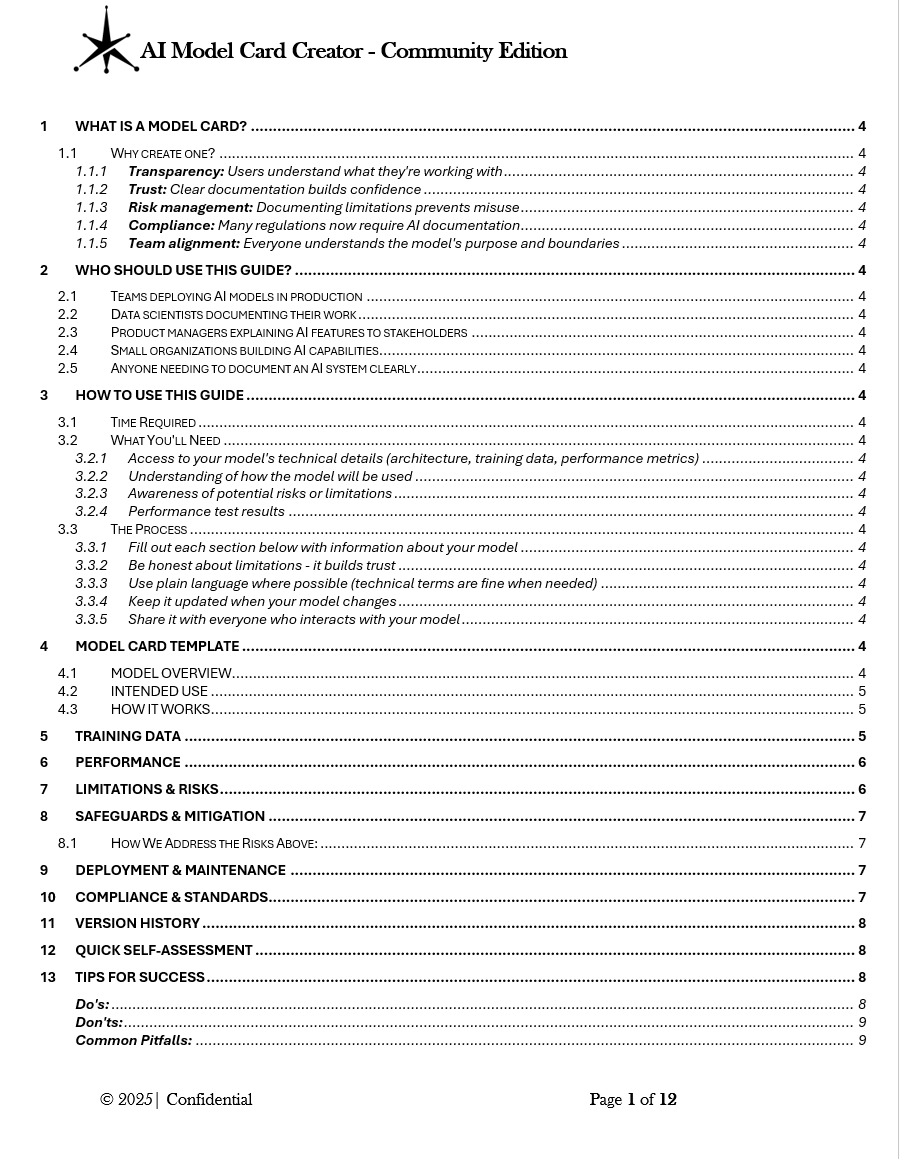
A practical Free AI Model Card Creator Guide documentation framework designed to support transparent AI model reporting and risk documentation efforts.
[Download Now]
This template provides an 18-section framework for documenting AI models, from initial overview through deployment and maintenance. Organizations need to customize all sections with their specific model details, performance data, and risk assessments. The template includes two worked examples and requires approximately 3-5 hours for initial completion, which can be done in stages rather than as a single session.
Key Benefits
✓ Provides framework for documenting model purpose, performance metrics, and known limitations
✓ Includes guidance on addressing transparency requirements through structured sections
✓ Supports efforts to identify and document potential biases and mitigation strategies
✓ Contains checklist covering foundation, technical, risk, compliance, and accessibility considerations
✓ Offers two example scenarios showing documentation approaches for different model types
✓ Includes references to established frameworks like NIST AI RMF and regulatory considerations
Who Uses This?
Designed for data scientists documenting model development, teams deploying AI systems in production environments, product managers explaining AI features to stakeholders, and small to mid-size organizations building initial AI governance capabilities.
What’s Inside
The template contains Model Overview section (name, version, type, quick summary), Intended Use section (primary purpose, decision-making role, out-of-scope uses), How It Works section (architecture, inputs/outputs, training approach), Training Data section (sources, size, characteristics, limitations), Performance section (metrics, group comparisons, confidence levels), Limitations & Risks section (known weaknesses, biases, privacy concerns), Safeguards & Mitigation section (risk responses, monitoring approach), Deployment & Maintenance section (environment, update procedures), Compliance & Standards section (regulatory checklist, assessment status), Version History tracking, Quick Self-Assessment tool, and Final Checklist with 20+ verification items.
Why This Matters
AI systems operate without inherent transparency. Users interact with models without understanding training data sources, performance boundaries, or failure modes. This gap creates risk.
When a fraud detection model flags legitimate transactions at different rates across customer segments, that’s not just a technical issue. When a sentiment classifier trained on English reviews gets deployed for multilingual feedback, performance drops matter. Documentation isn’t paperwork. It’s the mechanism for communicating actual system behavior.
According to the original Model Cards paper by Mitchell et al., structured documentation addresses three problems: users deploying models in inappropriate contexts, stakeholders lacking visibility into model limitations, and teams struggling to track changes across versions. The EU AI Act now requires technical documentation for high-risk AI systems. GDPR mandates information about automated decision-making. Organizations need documentation approaches that work.
This template addresses those requirements by providing fill-in-the-blank structure. It doesn’t generate documentation automatically or guarantee compliance. It offers a starting point based on established model card concepts, adapted for practical use by teams without dedicated governance resources.
Framework Alignment
The template includes references to:
- NIST AI Risk Management Framework (mentioned in resources section)
- EU AI Act technical documentation requirements (referenced for high-risk systems)
- GDPR considerations (included in privacy concerns and compliance checklist)
- Original “Model Cards for Model Reporting” paper by Mitchell et al. (cited in resources)
The template provides checkbox items for users to indicate which regulations apply to their specific models. It does not interpret regulatory requirements or provide legal compliance guidance.
Key Features
18-Section Documentation Structure: Covers model overview (name, version, type, contact), intended use (primary purpose, target users, out-of-scope applications), architecture description (algorithm type, inputs, outputs, key parameters), training data (sources, size, time period, geographic coverage, preprocessing steps, known limitations), performance metrics (measurement approach, scores with plain language explanations, performance variations across groups), limitations and risks (known weaknesses, potential biases, privacy concerns, security considerations, potential harms), safeguards (mitigation strategies for each identified risk, bias reduction steps, human oversight mechanisms), deployment information (production environment, integration points, monitoring frequency), and compliance considerations (regulatory checkboxes for EU AI Act, GDPR, industry-specific requirements).
Two Worked Examples: Includes Customer Sentiment Classifier example showing 85% accuracy documentation, acknowledged struggles with sarcasm detection, documented bias toward longer reviews, and specification of assistive rather than autonomous decision-making role. Fraud Detection Model example demonstrates emphasis on human review requirements, clear false positive rate documentation, impact analysis across customer segments, and transparency about training data limitations.
Quick Self-Assessment Tool: Provides mid-process checkpoint covering completeness (all sections filled or marked not applicable, technical accuracy, honest limitation documentation, risk mitigation strategies, contact information), clarity (stakeholder comprehension, technical team understanding, appropriate use guidance, plain language usage), and quality (current performance metrics, documented known issues, completed bias assessment, specific mitigation strategies).
Final Comprehensive Checklist: Contains 20+ verification items organized into Foundation category (model purpose clarity, intended user specification, out-of-scope use documentation, contact information), Technical category (architecture description, training data documentation, performance metrics, evaluation methodology), Risk & Ethics category (acknowledged limitations, identified biases, documented mitigation strategies, defined monitoring approach), Compliance category (considered regulations, addressed privacy implications, completed required assessments, maintained version history), and Accessibility category (target audience readability, accessible storage location, easy reference capability, established review schedule).
Time and Resource Guidance: Specifies 3-5 hours for initial documentation completion, can be completed in stages rather than single session, requires access to model technical details and performance test results, needs understanding of intended use cases and awareness of potential risks. Includes guidance on when to seek additional help such as legal review for models making decisions about people, ethics review for models impacting vulnerable populations, and technical validation for complex architectures.
Version Control Framework: Provides table structure for tracking version number, date, changes description, and responsible party. Includes specific triggers for updates such as model retraining with new data, significant performance changes, new use cases, discovered limitations or risks, changed mitigation strategies, changed regulatory requirements, and minimum annual review requirement.
Resource References: Lists specific tools including Google Model Card Toolkit (identified as open source), Hugging Face Model Cards (examples and templates), Microsoft’s Model Card documentation. Further reading includes Mitchell et al. original paper, NIST AI Risk Management Framework, EU AI Act technical documentation requirements. Community examples reference Hugging Face model hub, Google AI Model Cards gallery, Papers With Code research documentation.
Tips and Common Pitfalls: Documents five specific do’s (be honest about limitations, use real examples, update regularly, share widely, keep it living), five don’ts (don’t oversell performance, don’t hide known issues, don’t use unnecessary jargon, don’t skip risks section, don’t delay sharing while pursuing perfection), and five common pitfalls (too technical for non-technical stakeholders, too vague with metrics, outdated information, missing limitations documentation, no contact information).
Comparison Table: Generic Approach vs. Free Template & Guide
| Feature | Ad Hoc Documentation | AI Model Card Creator Template |
|---|---|---|
| Structure | Varies by individual, often incomplete | 18 pre-defined sections with fillable fields and guidance |
| Risk Documentation | Often omitted or vague | Dedicated Limitations & Risks section with specific prompts for biases, privacy, security, and potential harms |
| Performance Reporting | May lack group comparisons | Includes prompts for performance across different groups and conditions where performance drops |
| Compliance Tracking | Scattered across multiple documents | Dedicated compliance section with regulatory checkboxes and assessment status tracking |
| Version Management | Unclear change history | Built-in version history table structure |
| Time to Complete | Unknown, often inconsistent | Estimated 3-5 hours with staged completion option |
FAQ Section
Q: What file format is this template provided in? A: Documents are optimized for Microsoft Word to ensure proper formatting and collaborative editing capabilities. The template includes checkboxes and fillable fields that work best in Word format.
Q: Does using this template guarantee regulatory compliance? A: No. The template provides structure for documenting AI models and includes checkboxes for relevant regulations, but it does not provide legal advice or guarantee compliance with specific requirements. Organizations should consult legal and compliance professionals for regulatory interpretation, particularly for high-risk AI systems.
Q: Can I modify the template for my organization’s needs? A: Yes. This Community Edition is free to use and modify. Organizations can add sections, adjust language, or customize the structure to match internal governance requirements.
Q: How does this differ from the Enterprise version mentioned in the document? A: The Community Edition provides general guidance and self-assessment framework. The document references an “Enterprise AI Model Card Development and Management Procedure Template” that may include detailed regulatory mapping and audit trails, but specific features of that version are not documented in this source material.
Q: What expertise is required to complete this template? A: Users need access to model technical details (architecture, training data, performance metrics), understanding of intended use cases, awareness of potential risks or limitations, and performance test results. The template includes guidance on when to seek additional help from legal, ethics, or technical experts.
Q: How often should model cards be updated? A: The template recommends updates when models are retrained with new data, performance changes significantly, new use cases are added, new limitations or risks are discovered, mitigation strategies change, regulatory requirements change, or at minimum during annual review.
Ideal For
- Data scientists and ML engineers documenting model development and performance characteristics
- AI product teams deploying models in production environments requiring stakeholder communication
- Compliance officers establishing initial AI documentation practices without extensive governance infrastructure
- Small to mid-size organizations building AI capabilities and needing practical documentation approaches
- Product managers explaining AI system functionality and limitations to technical and non-technical audiences
- Teams subject to AI documentation requirements under GDPR, EU AI Act, or internal governance policies


