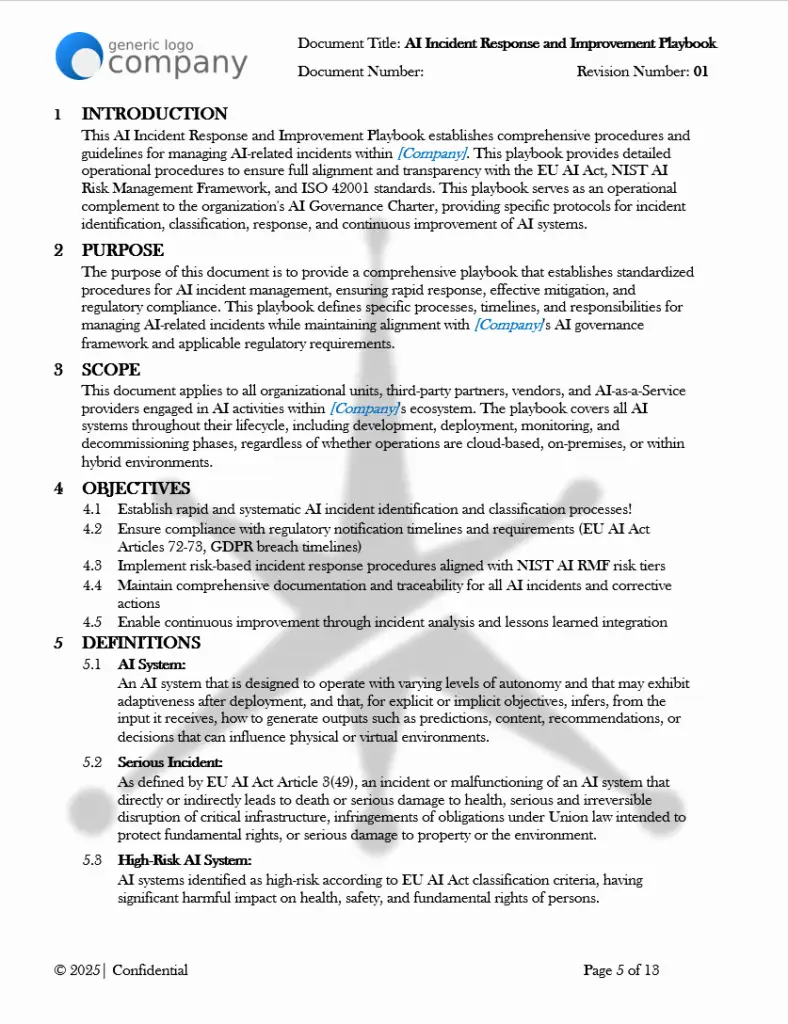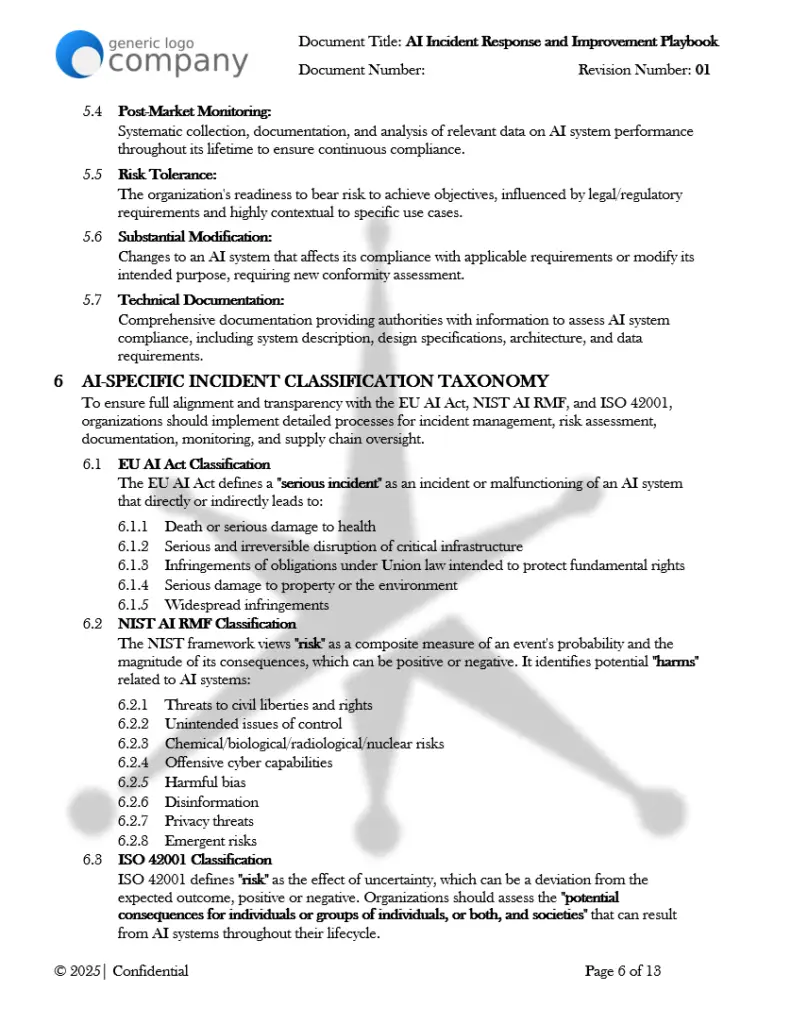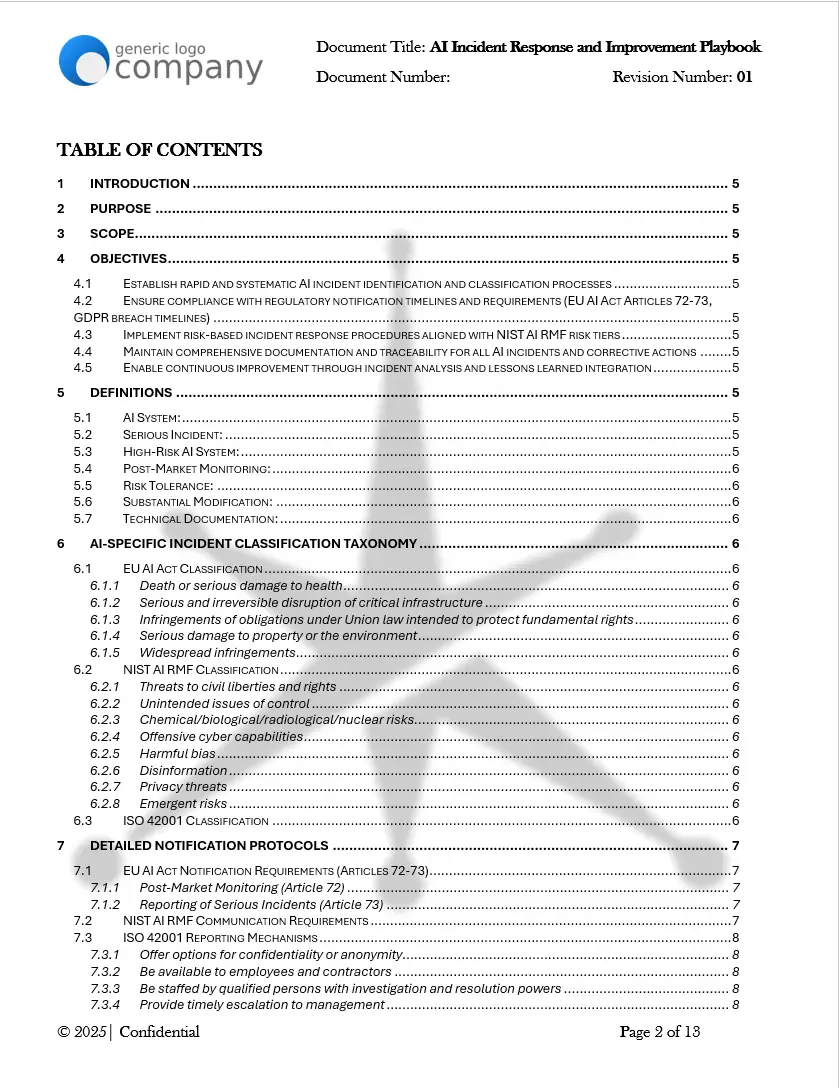
AI Incident Response & Improvement Template
A structured framework designed to support organizations in developing consistent approaches to AI incident investigation, resolution, and continuous improvement, with alignment to ISO 27001 and NIST AI RMF guidelines.
[Download Now]
What This Template Provides
This AI Incident Response & Improvement Template provides a ready-to-customize playbook for managing AI-related incidents across your organization. The template includes a complete procedural framework covering incident identification through post-incident improvement, with guidance sections that require organizational customization to reflect your specific roles, technologies, and operational context. Organizations may save time compared to developing incident response documentation from scratch, though customization effort will vary based on organizational complexity.
Key Benefits
✓ Provides a 9-step procedural workflow covering the complete incident lifecycle from identification to follow-up actions
✓ Includes guidance for risk and impact assessment with severity classification reference
✓ Offers framework alignment sections referencing ISO 27001 (A.16 Incident Management) and NIST AI RMF
✓ Contains customizable role definitions for Incident Response Team assembly
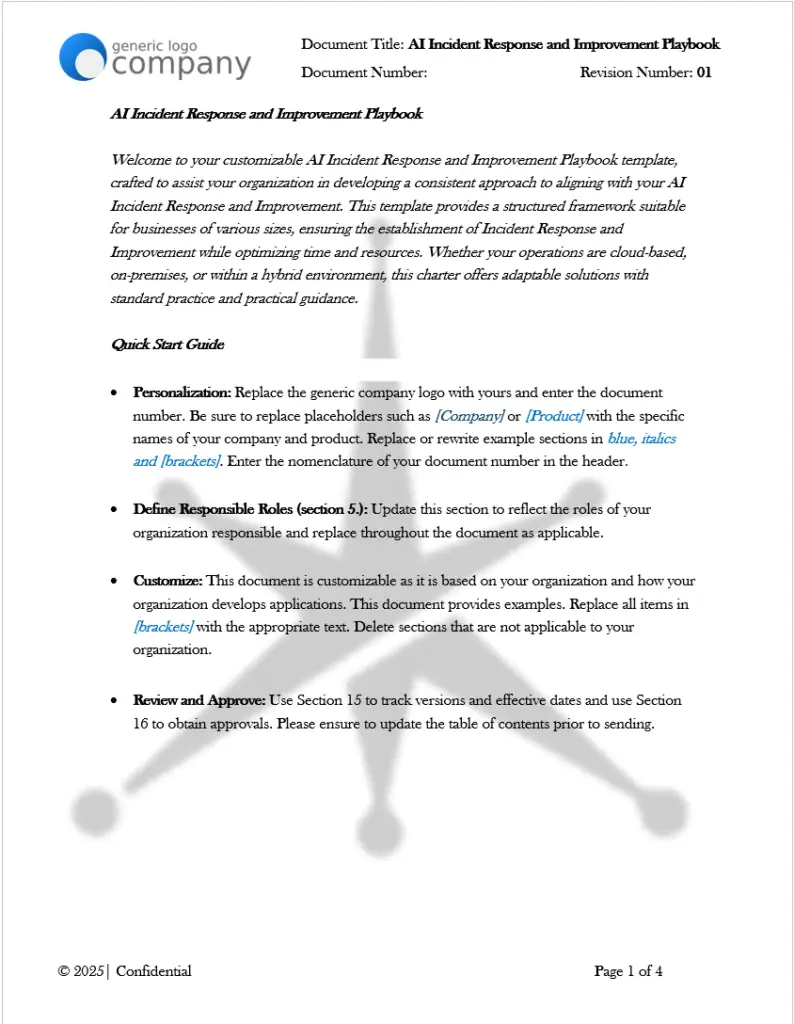
✓ Includes Quick Start Guide with step-by-step personalization instructions
✓ Provides definitions section covering key terminology (AI Systems, AI Incident, Digital Forensics Practices)
✓ Features version history and approval tracking tables
Who Uses This
This template is designed for:
- IT Security and Compliance Officers establishing AI incident protocols
- Risk Management professionals developing AI governance documentation
- Operations teams responsible for AI system monitoring and response
- Organizations beginning their AI governance journey
- Small to mid-sized businesses seeking structured incident response frameworks
What’s Included (Preview)
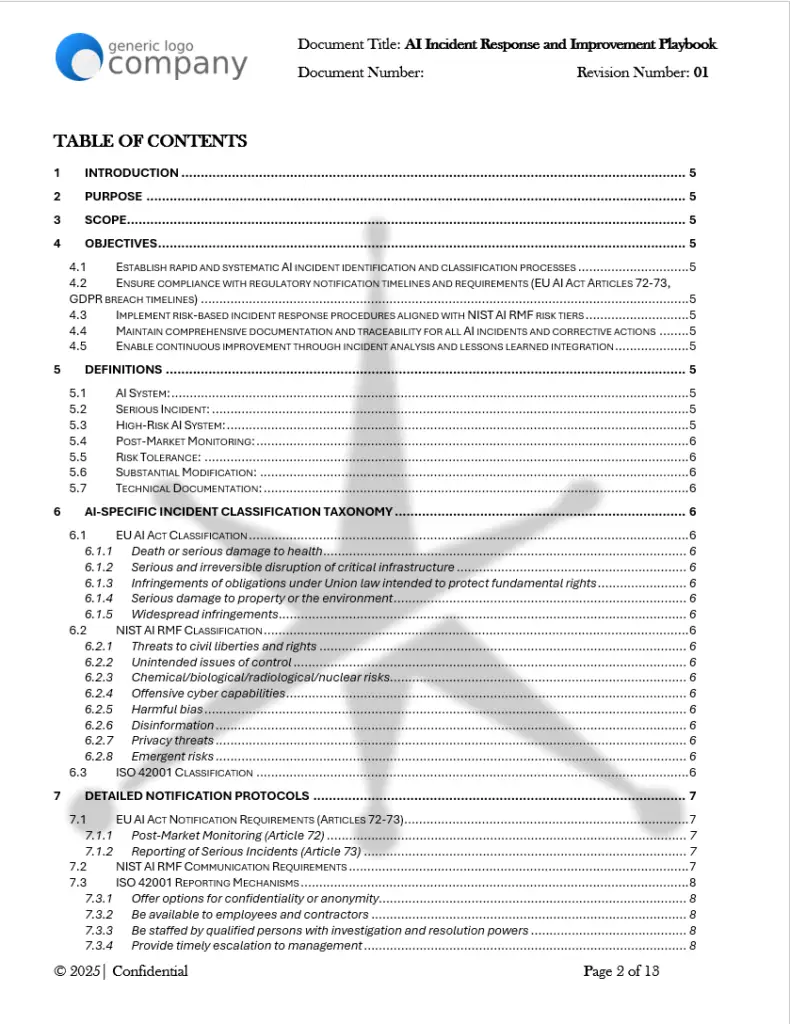
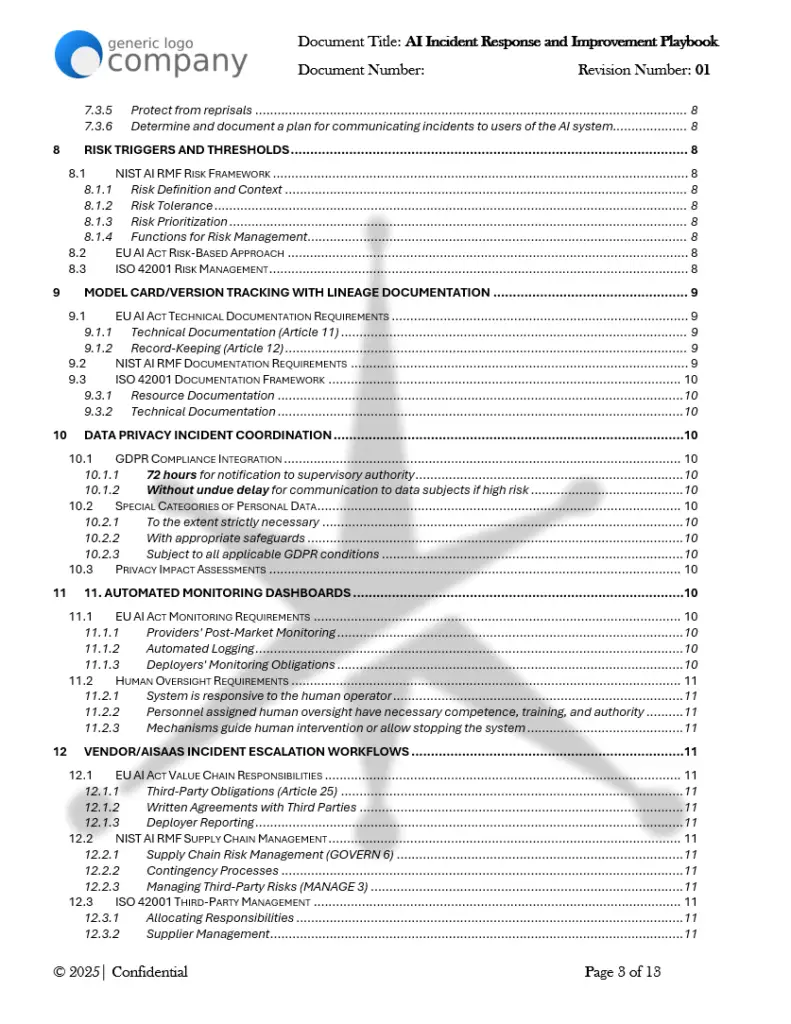
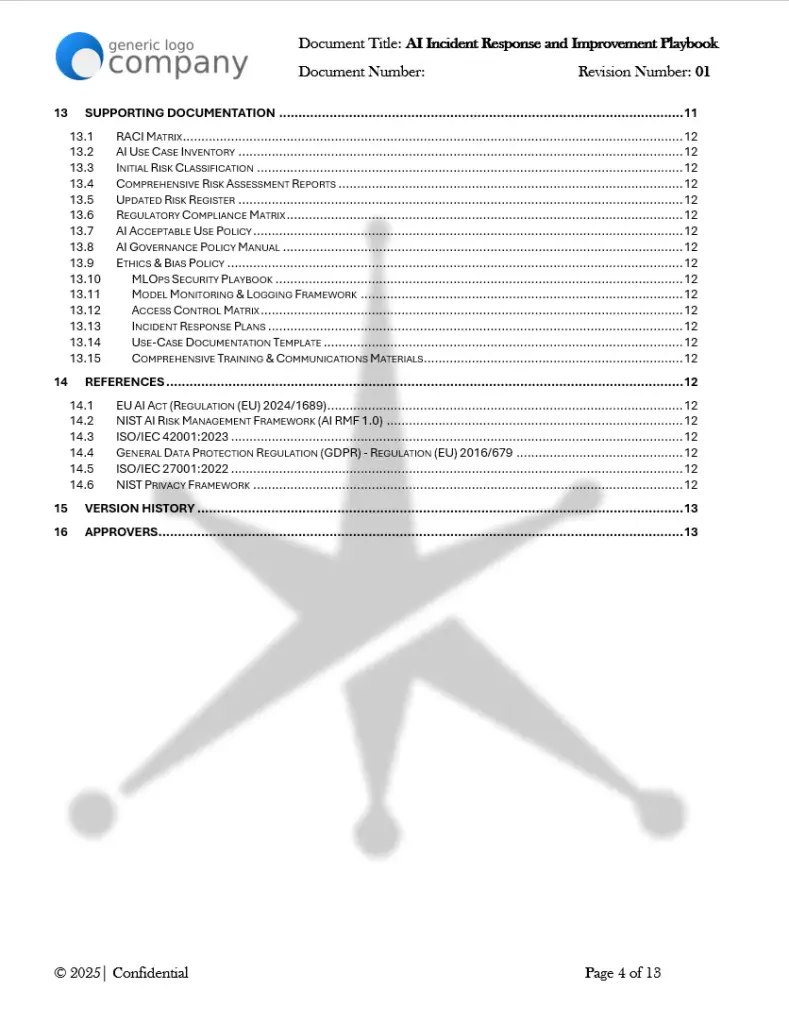
The template contains the following sections:
- Purpose and Scope definitions
- 9-step Procedure workflow (Prerequisites, Identification & Triage, Team Assembly, Containment, Investigation & Diagnosis, Resolution & Recovery, Communication & Notification, Documentation & Incident Report, Post-Incident Review)
- Risk & Impact Assessment Guidance
- Approval Workflow section
- Monitoring and Review guidance
- Alignment to Regulations and Standards section
- References section (ISO 27001, NIST AI RMF, EU AI Act)
- Definitions glossary
- Version History table
- Approvers signature table
Why This Matters
AI systems can experience technical failures (such as model outages or significant error spikes) or governance issues (such as the identification of user-harming biases or data breaches involving AI data). Without structured response procedures, organizations may face prolonged incident resolution times, inconsistent handling across teams, and gaps in learning from incidents to prevent recurrence.
A documented incident response playbook helps organizations establish consistent procedures for identifying, containing, investigating, and resolving AI-related issues. The playbook approach also supports regulatory alignment, as frameworks like ISO 27001 and the EU AI Act increasingly expect documented incident management capabilities for organizations deploying AI systems.
This template addresses the documentation gap by providing a structured starting point that organizations can customize to their specific operational context, reducing the effort required to develop incident response procedures from scratch.
Framework Alignment
The template references alignment with the following frameworks as documented in the source material:
- ISO 27001 (A.16 Incident Management): The template conforms to incident management guidelines for structured and systematic responses to AI-related issues
- NIST AI Risk Management Framework (AI RMF): Aligns with the feedback loop for continuous improvement, where learning from incidents to update risk controls is part of the “Manage” and “Govern” functions
- EU AI Act: The template addresses notification steps relevant to organizations that may need to log and report serious incidents or malfunctions of high-risk AI systems
Key Features
Based on the template’s table of contents and content:
- Incident Identification & Triage Section: Guidance on defining what constitutes an AI incident, establishing reporting procedures, and using severity scales (Severity 1 – critical impact, Severity 2 – high, etc.)
- Incident Response Team Assembly: Framework for assigning incident leaders and including necessary expertise (data scientist/engineer, IT support, security officer, compliance officer, communications lead)
- Containment Actions Guidance: Enumerated potential containment measures for various incident types (disabling AI features, switching to backup models, blocking inputs, isolating systems)
- Investigation & Diagnosis Procedures: Guidance on evidence gathering (log files, input data, outputs, model version information) and root cause analysis techniques (five whys, fishbone analysis)
- Resolution & Recovery Steps: Procedures for implementing solutions, testing, deployment, and addressing impacted data
- Communication & Notification Protocols: Guidance on stakeholder communication, including legal reporting requirements and coordination with PR/Communications teams
- Post-Incident Review Framework: Structure for lessons learned meetings, improvement identification, and follow-up action tracking
Comparison Table: Generic Policy vs. This Professional Template
| Aspect | Generic Approach | This Professional Template |
|---|---|---|
| Structure | Ad-hoc or missing documentation | 9-step procedural workflow with defined phases |
| Role Definition | Undefined responsibilities | Incident Response Team assembly guidance with role categories |
| Severity Classification | No standardized approach | Risk & Impact Assessment section with severity scale reference |
| Framework Alignment | No regulatory consideration | References ISO 27001, NIST AI RMF, and EU AI Act |
| Containment Guidance | Reactive decision-making | Enumerated containment measures by incident type |
| Root Cause Analysis | Informal or inconsistent | Investigation techniques documented (five whys, fishbone) |
| Continuous Improvement | Lessons not captured | Post-Incident Review and Follow-Up Actions sections |
| Customization Support | Starting from blank document | Quick Start Guide with personalization instructions |
FAQ Section
Q: What file format is this template delivered in? A: Documents are optimized for Microsoft Word and Excel to ensure proper formatting and collaborative editing capabilities.
Q: How much customization is required? A: The template includes sections marked in blue, italics, and brackets that require replacement with your organization’s specific information. The Quick Start Guide provides step-by-step personalization instructions. Customization effort varies based on organizational complexity.
Q: Does this template guarantee compliance with ISO 27001 or NIST AI RMF? A: This template is designed to support alignment with these frameworks but does not guarantee compliance. Organizations should assess their specific regulatory requirements and may need additional documentation or processes to achieve certification or full compliance.
Q: Is this template suitable for healthcare AI systems? A: The template includes references to healthcare considerations (patient safety event reporting systems, medical expert involvement). However, healthcare organizations may need additional customization to address specific regulatory requirements in their jurisdiction.
Q: What types of AI incidents does this template cover? A: The template addresses both technical failures (model outages, error spikes) and governance issues (user-harming biases, data breaches involving AI data), as defined in the Purpose section.
Q: Does this template include vendor or third-party incident management? A: This template focuses on internal AI incident response procedures. Organizations with significant vendor or AI-as-a-Service relationships may need supplementary documentation for third-party incident escalation.
Ideal For
- Organizations establishing initial AI incident response capabilities
- IT Security teams adding AI-specific procedures to existing incident management
- Compliance Officers documenting AI governance for audit readiness
- Risk Management professionals creating AI operational procedures
- Small to mid-sized businesses with straightforward AI deployments
- Teams seeking a structured starting point for AI incident documentation
SEO Keywords (for Metadata & Copy)
- AI incident response template
- AI incident management playbook
- AI governance documentation
- NIST AI RMF incident response
- ISO 27001 AI incident management
- AI system failure response
- AI bias incident procedures
- AI operations playbook
- Machine learning incident response
- AI risk management template
- AI incident investigation template
- AI post-incident review
- AI incident severity classification
- AI containment procedures
Pricing Strategy Options
Single Template: Contact for pricing based on organizational requirements and customization needs.
Bundle Option: May be combined with additional AI governance templates (such as the AI Incident Response and Improvement Playbook Enhancements Template) depending on organizational compliance scope.
Enterprise Option: Available as part of comprehensive AI governance documentation suites.
Differentiator
This AI Incident Response & Improvement Template provides a streamlined, accessible entry point for organizations establishing AI incident management capabilities. Unlike generic IT incident response procedures, this template specifically addresses AI-related scenarios including model failures, bias incidents, and AI data breaches. The 9-step procedural workflow offers clear structure while remaining adaptable to organizations of various sizes and operational contexts. The template includes framework alignment references to ISO 27001, NIST AI RMF, and EU AI Act, providing a foundation that organizations can build upon as their AI governance programs mature. The Quick Start Guide and clearly marked customization sections support efficient implementation while ensuring the final document reflects each organization’s specific roles, technologies, and operational requirements.