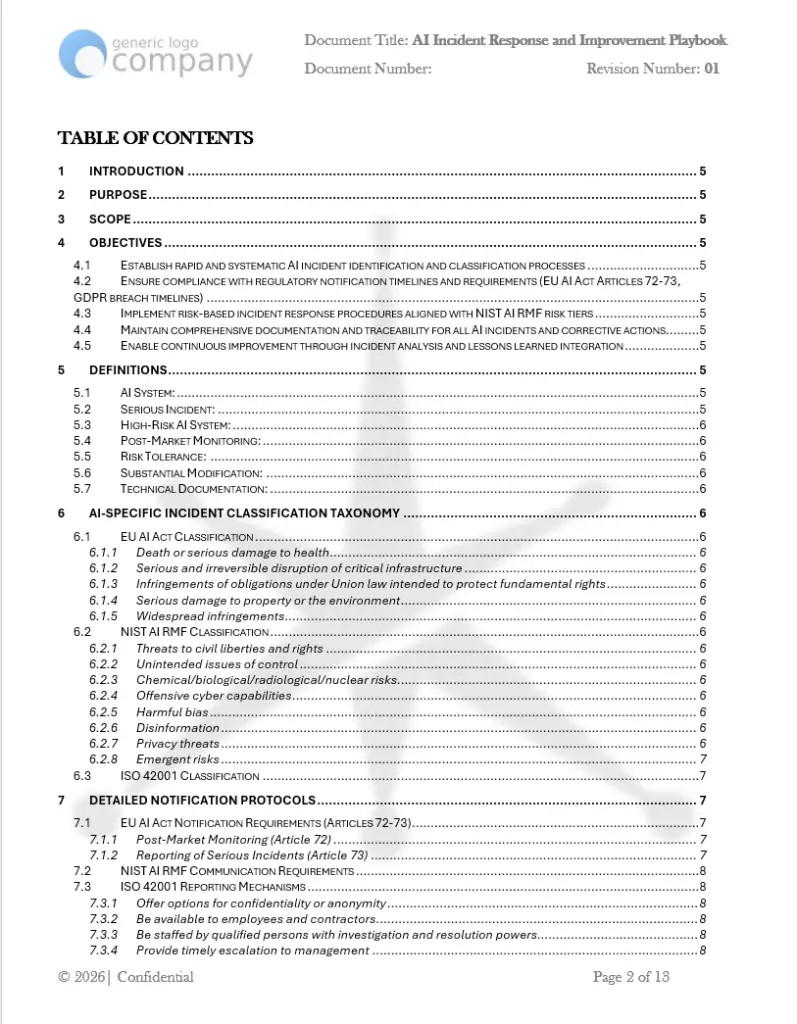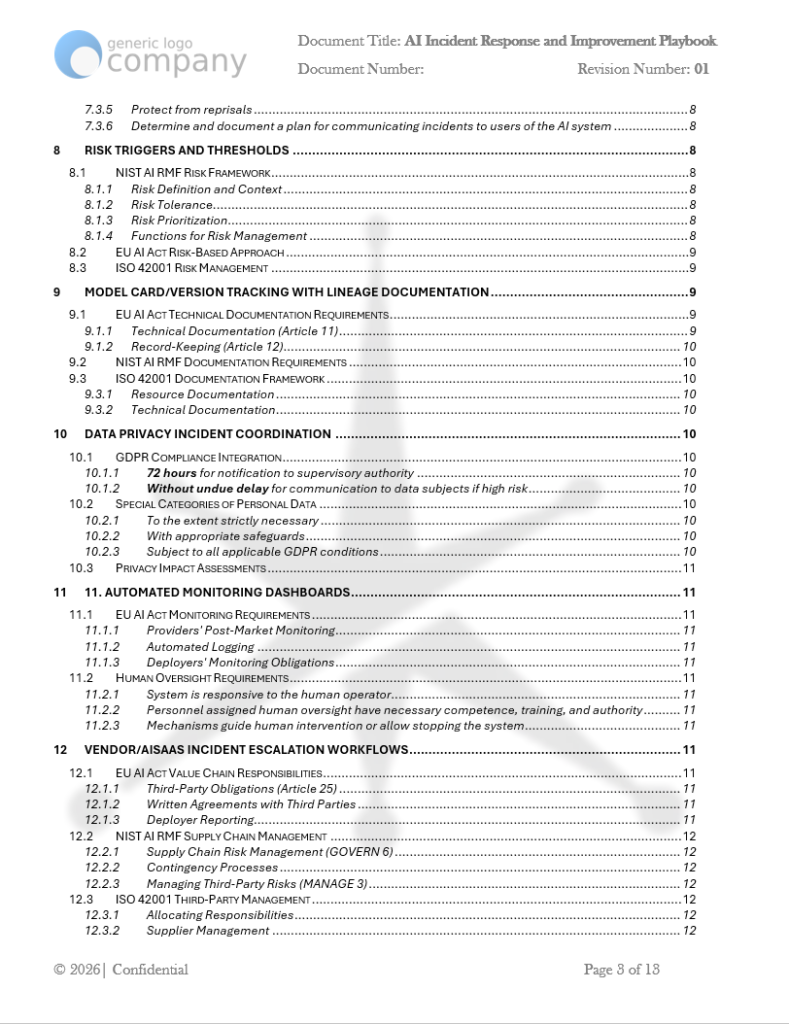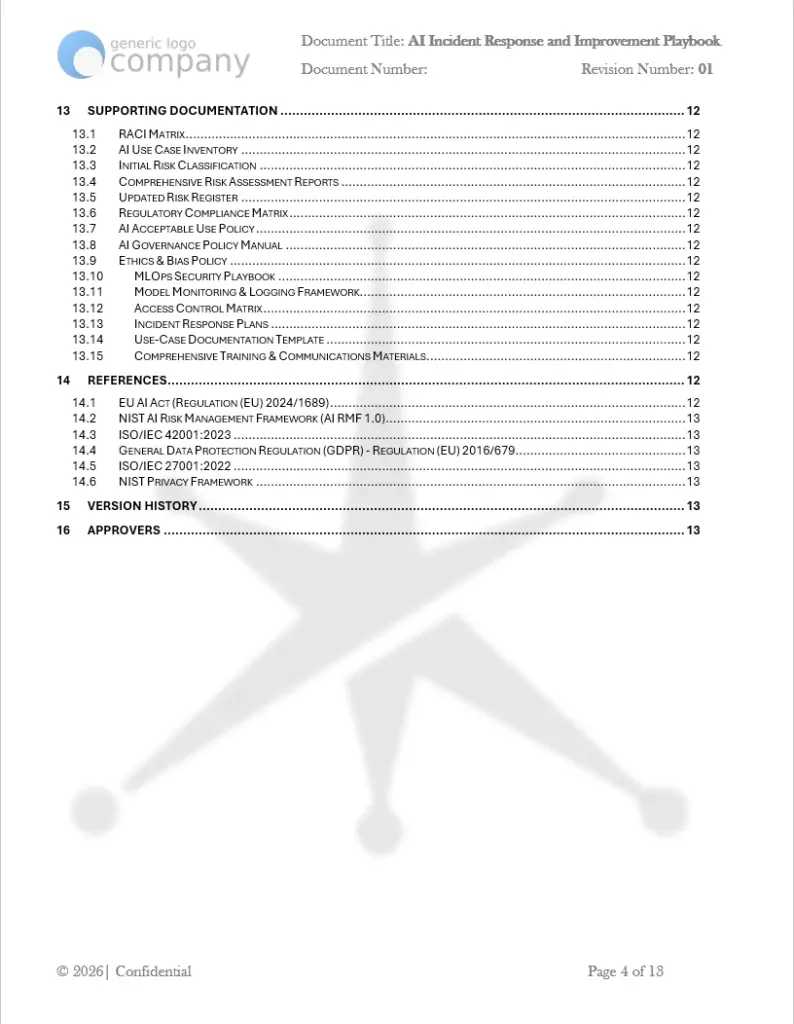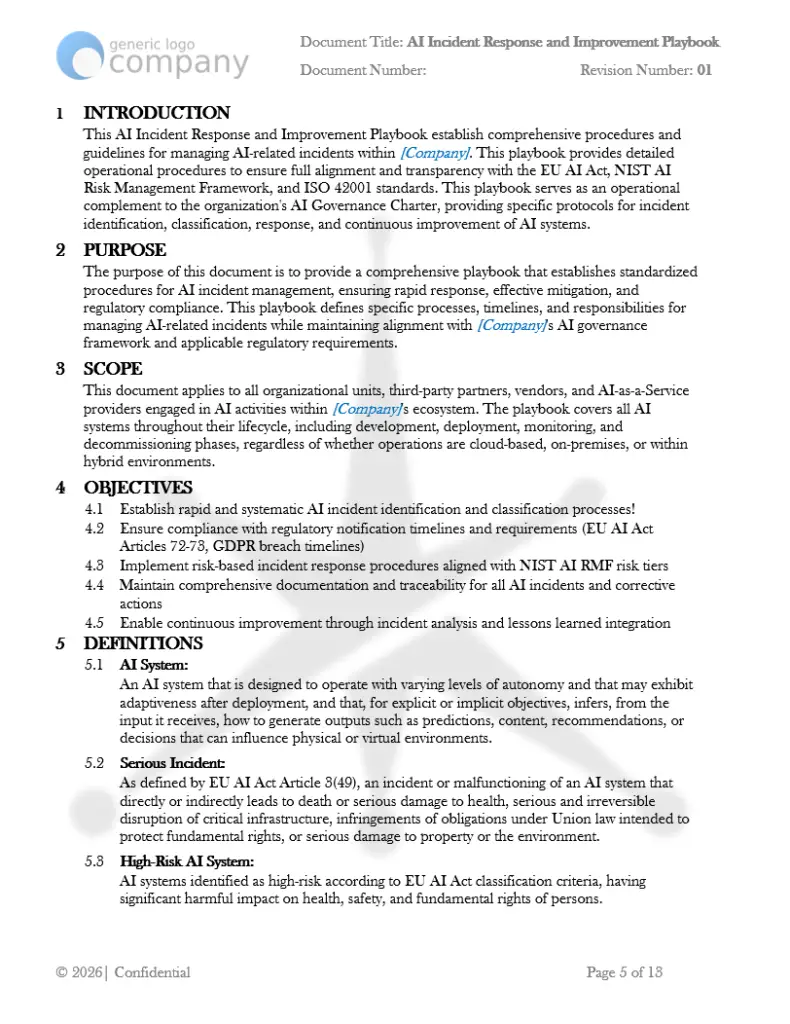
AI Incident Response and Improvement Playbook (Enhanced Framework)
A comprehensive operational playbook designed to support full alignment and transparency with the EU AI Act, NIST AI Risk Management Framework, and ISO 42001 standards, providing specific protocols for AI incident identification, classification, response, and continuous improvement.
[Download Now]
What This Template Provides
This AI Incident Response and Improvement Playbook provides comprehensive procedures and guidelines for managing AI-related incidents with detailed operational procedures supporting alignment with major regulatory frameworks. The template includes AI-specific incident classification taxonomies, detailed notification protocols with specific timelines, risk triggers and thresholds, model versioning requirements, data privacy coordination guidance, monitoring dashboard requirements, and vendor escalation workflows. Organizations will need to customize placeholder sections to reflect their specific operational context, roles, and regulatory obligations.
Key Benefits
✓ Provides AI-specific incident classification taxonomies aligned with EU AI Act, NIST AI RMF, and ISO 42001 frameworks
✓ Includes detailed notification protocols with specific regulatory timelines (15 days general, 2 days widespread, 10 days death/serious harm, 72 hours GDPR breach)
✓ Contains risk triggers and thresholds guidance based on NIST AI RMF risk framework
✓ Offers model card/version tracking requirements with lineage documentation guidance
✓ Provides data privacy incident coordination section integrating GDPR requirements
✓ Includes automated monitoring dashboard requirements referencing EU AI Act obligations
✓ Contains vendor/AI-as-a-Service incident escalation workflows with value chain responsibilities
✓ Lists 15 supporting documentation references for comprehensive governance programs
Who Uses This?
This template is designed for:
- Enterprise organizations subject to EU AI Act requirements
- Compliance Officers managing multi-framework AI governance programs
- Risk Management professionals requiring detailed regulatory alignment documentation
- Organizations deploying high-risk AI systems under EU AI Act classification
- Legal and compliance teams coordinating AI and data privacy incident response
- Companies with AI vendor relationships requiring supply chain incident management
What’s Included
The template contains the following sections:
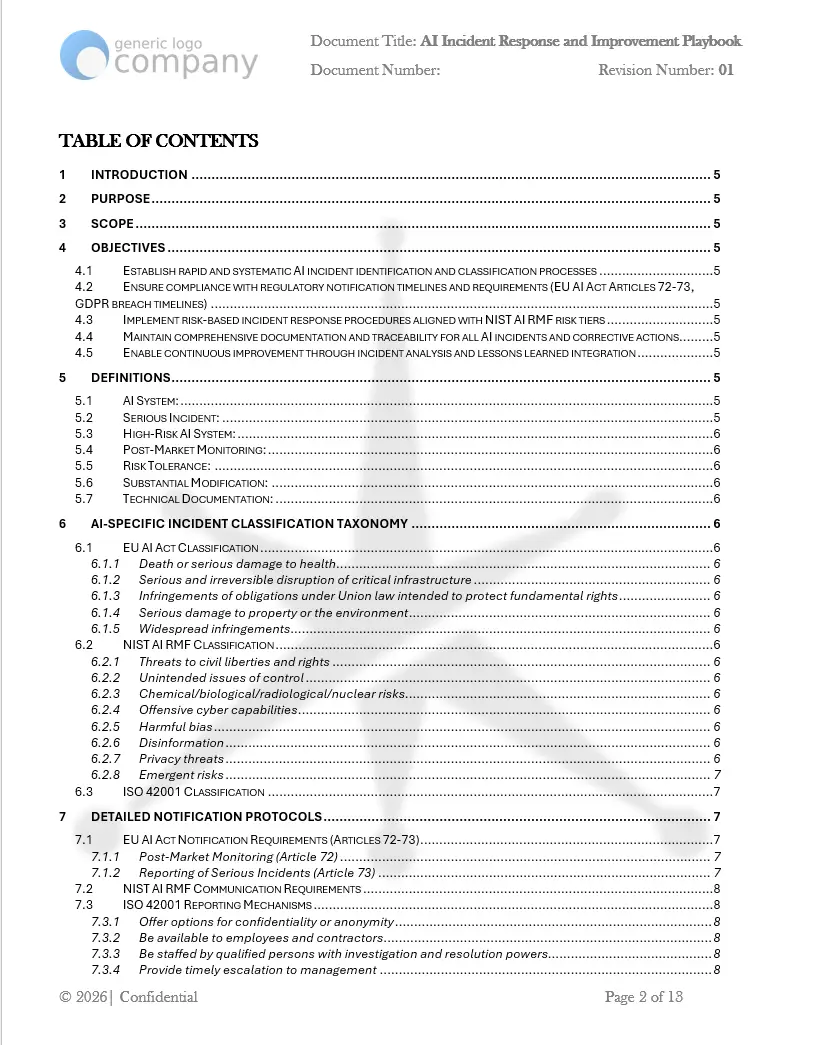
- Introduction, Purpose, and Scope definitions
- Objectives with specific regulatory citations
- Definitions section (7 AI-specific terms including Serious Incident, High-Risk AI System, Post-Market Monitoring, Substantial Modification)
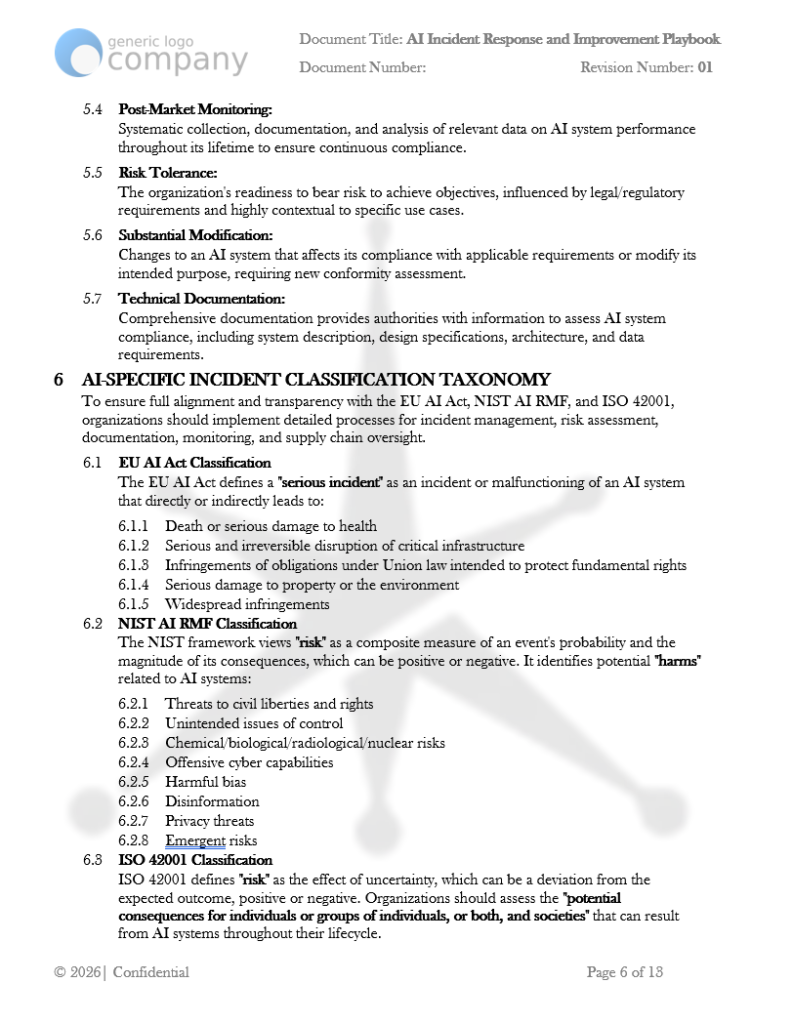
- AI-Specific Incident Classification Taxonomy (EU AI Act, NIST AI RMF, ISO 42001 classifications)
- Detailed Notification Protocols (EU AI Act Articles 72-73, NIST requirements, ISO 42001 reporting mechanisms)
- Risk Triggers and Thresholds (NIST AI RMF risk framework, EU AI Act risk-based approach, ISO 42001 risk management)
- Model Card/Version Tracking with Lineage Documentation (EU AI Act Technical Documentation Articles 11-12, NIST documentation requirements, ISO 42001 framework)
- Data Privacy Incident Coordination (GDPR integration, special categories of personal data, privacy impact assessments)
- Automated Monitoring Dashboards (EU AI Act monitoring requirements, human oversight requirements)
- Vendor/AISaaS Incident Escalation Workflows (EU AI Act value chain responsibilities Article 25, NIST supply chain management, ISO 42001 third-party management)
- Supporting Documentation list (15 related document references)
- References section (6 framework citations)
- Version History and Approvers tables
Why This Matters
Organizations deploying AI systems increasingly face regulatory requirements for incident management, particularly under the EU AI Act which mandates providers of high-risk AI systems to report serious incidents to market surveillance authorities within specific timelines. The regulation defines “serious incident” as incidents leading to death or serious damage to health, serious disruption of critical infrastructure, infringements of fundamental rights, or serious damage to property or the environment.
Beyond EU requirements, frameworks like NIST AI RMF and ISO 42001 emphasize structured incident management as part of responsible AI governance. Organizations operating internationally or serving EU markets need documentation that addresses multiple framework requirements while maintaining operational clarity.
This template addresses the documentation complexity by providing a single playbook structure that maps requirements across EU AI Act, NIST AI RMF, ISO 42001, and GDPR, reducing the effort required to develop separate procedures for each framework.
Framework Alignment
The template provides detailed alignment with the following frameworks as documented in the source material:
- EU AI Act (Regulation (EU) 2024/1689): Comprehensive requirements for high-risk AI systems including incident reporting (Articles 72-73), post-market monitoring, technical documentation (Articles 11-12), and value chain responsibilities (Article 25)
- NIST AI Risk Management Framework (AI RMF 1.0): Structured around four core functions (GOVERN, MAP, MEASURE, MANAGE) with specific guidance on risk tolerance, prioritization, and third-party risk management
- ISO/IEC 42001:2023: Requirements for AI management systems including risk assessment, documentation, third-party management, and reporting mechanisms
- General Data Protection Regulation (GDPR): Integration of 72-hour breach notification requirements and data protection impact assessment considerations
- ISO/IEC 27001:2022: Referenced for information security management system controls relevant to AI system security
- NIST Privacy Framework: Referenced for privacy risk identification and management in AI systems
Key Features
Based on the template’s table of contents and content:
- AI-Specific Incident Classification Taxonomy: Three classification frameworks including EU AI Act serious incident definitions (death/health damage, critical infrastructure disruption, fundamental rights infringements, property/environmental damage), NIST AI RMF harm categories (civil liberties threats, control issues, harmful bias, disinformation, privacy threats, emergent risks), and ISO 42001 risk definitions
- Detailed Notification Protocols: Specific timelines documented from EU AI Act Articles 72-73: 15 days general reporting, 2 days for widespread infringements, 10 days for death of a person; plus GDPR 72-hour breach notification integration
- Risk Triggers and Thresholds: NIST AI RMF risk framework guidance including risk definition, tolerance, prioritization, and four-function structure; EU AI Act risk-based classification approach; ISO 42001 risk management requirements
- Model Card/Version Tracking: EU AI Act Article 11 technical documentation requirements (general description, design specifications, system architecture, data requirements, change management) and Article 12 record-keeping requirements (automatic logging, six-month retention)
- Data Privacy Incident Coordination: GDPR compliance integration including breach timelines, special categories of personal data handling, and privacy impact assessment guidance
- Automated Monitoring Dashboards: EU AI Act post-market monitoring requirements, automated logging obligations, deployer monitoring responsibilities, and human oversight requirements
- Vendor/AISaaS Escalation Workflows: EU AI Act Article 25 third-party obligations, written agreement requirements, deployer reporting obligations; NIST AI RMF GOVERN 6 supply chain management and MANAGE 3 third-party risk monitoring; ISO 42001 responsibility allocation and supplier management
Comparison Table: Basic Incident Response vs. This Enhanced Framework
| Aspect | Basic Incident Response | This Enhanced Framework |
|---|---|---|
| Incident Classification | Generic IT categories | AI-specific taxonomy aligned with EU AI Act, NIST, and ISO 42001 |
| Notification Timelines | General escalation procedures | Specific regulatory timelines (15 days, 2 days, 10 days, 72 hours) |
| Framework Coverage | Single framework reference | Multi-framework alignment (EU AI Act, NIST AI RMF, ISO 42001, GDPR) |
| Risk Thresholds | Basic severity levels | NIST AI RMF risk framework with tolerance and prioritization guidance |
| Documentation Requirements | General incident records | Model versioning, lineage tracking, technical documentation per Article 11-12 |
| Privacy Integration | Separate from incident response | GDPR coordination integrated with AI incident procedures |
| Monitoring Requirements | Basic system monitoring | EU AI Act automated logging and human oversight requirements |
| Vendor Management | Ad-hoc escalation | Structured value chain responsibilities per Article 25 |
| Supporting Documentation | Standalone playbook | References to 15 related governance documents |
FAQ Section
Q: What file format is this template delivered in? A: Documents are optimized for Microsoft Word and Excel to ensure proper formatting and collaborative editing capabilities.
Q: Is this template required for EU AI Act compliance? A: This template is designed to support alignment with EU AI Act requirements but does not guarantee compliance. Organizations should assess their specific obligations based on their AI system classifications and may need legal review to confirm compliance with applicable regulations.
Q: What is the difference between this template and the basic AI Incident Response Template? A: This enhanced framework provides significantly more regulatory depth including specific EU AI Act article citations, detailed notification timelines, multi-framework classification taxonomies, model versioning requirements, GDPR integration, and vendor escalation workflows. The basic template provides a streamlined 9-step procedural approach suitable for organizations beginning their AI governance journey.
Q: Does this template address GDPR breach notification requirements? A: Yes, the Data Privacy Incident Coordination section integrates GDPR requirements including the 72-hour notification timeline to supervisory authorities and communication to data subjects for high-risk breaches.
Q: What supporting documentation is referenced in this template? A: The template references 15 separately maintained documents including RACI Matrix, AI Use Case Inventory, Risk Classification and Assessment Reports, Risk Register, Regulatory Compliance Matrix, AI Acceptable Use Policy, AI Governance Policy Manual, Ethics & Bias Policy, MLOps Security Playbook, Model Monitoring & Logging Framework, Access Control Matrix, Incident Response Plans, Use-Case Documentation Template, and Training Materials.
Q: Is this template suitable for organizations not subject to EU AI Act? A: Yes, while the template provides detailed EU AI Act alignment, the NIST AI RMF and ISO 42001 sections provide framework guidance applicable to organizations globally. The multi-framework approach allows organizations to focus on their relevant requirements.
Ideal For
- Enterprise organizations deploying high-risk AI systems under EU AI Act classification
- Compliance Officers managing multi-framework AI governance programs
- Organizations with EU market presence requiring AI Act alignment
- Legal and compliance teams coordinating AI and data privacy requirements
- Risk Management professionals requiring detailed regulatory documentation
- Companies with significant AI vendor or AI-as-a-Service relationships
- Organizations pursuing ISO 42001 certification
- Mature AI governance programs requiring comprehensive operational procedures
SEO Keywords (for Metadata & Copy)
- EU AI Act incident reporting template
- Article 72 post-market monitoring
- Article 73 serious incident reporting
- NIST AI RMF incident response
- ISO 42001 incident management
- AI governance enterprise template
- GDPR AI breach notification
- High-risk AI system compliance
- AI vendor escalation procedures
- AI technical documentation requirements
- AI model versioning template
- AI regulatory compliance playbook
- AI supply chain risk management
- AI human oversight requirements
Pricing Strategy Options
Single Template: Contact for pricing based on organizational requirements and customization needs.
Bundle Option: May be combined with the AI Incident Response & Improvement Template (basic version) for organizations requiring both streamlined procedures and comprehensive regulatory documentation.
Enterprise Option: Available as part of comprehensive AI governance documentation suites including supporting policy templates referenced in Section 13.
Differentiator
This AI Incident Response and Improvement Playbook (Enhanced Framework) provides the regulatory depth required by enterprise organizations navigating complex AI governance requirements across multiple jurisdictions and frameworks. Unlike basic incident response templates, this playbook specifically addresses EU AI Act Articles 72-73 notification requirements with documented timelines, NIST AI RMF’s four-function structure for risk management, and ISO 42001’s AI management system requirements. The template includes AI-specific incident classification taxonomies that map harm categories across frameworks, enabling consistent incident categorization regardless of which regulatory lens applies. The integration of GDPR data privacy coordination ensures organizations can manage AI and data protection incidents through unified procedures rather than parallel processes. For organizations with vendor relationships, the documented value chain responsibilities and supply chain risk management guidance support structured escalation without requiring separate third-party procedures. The 15 supporting documentation references provide a roadmap for building comprehensive AI governance programs, positioning this playbook as a central operational document within a broader governance framework.