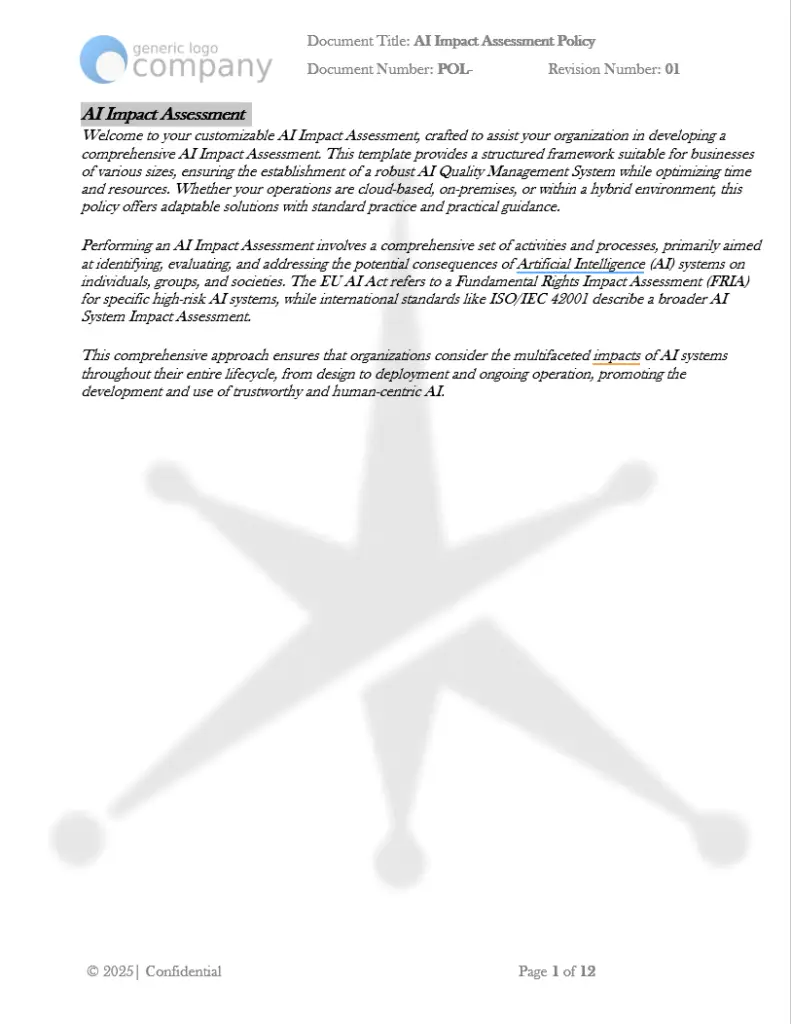
AI Impact Assessment Policy Template
Structured Framework for Evaluating AI System Impacts on Individuals and Society
A comprehensive, customizable template designed to support organizations in developing AI impact assessments aligned with EU AI Act Fundamental Rights Impact Assessment (FRIA) requirements and ISO/IEC 42001 AI management system methodologies.
[Download Now]
This AI Impact Assessment template offers a structured framework for organizations deploying AI systems to document and evaluate potential impacts systematically. The template includes eleven core assessment sections, a references guide citing specific EU AI Act articles, and over 30 defined terms to support consistent documentation.
Customization is required to align the template with your organization’s specific AI systems, operational context, and risk profile. The framework provides guidance on assessment methodology while allowing flexibility for organizational adaptation.
Time Investment: Organizations should anticipate dedicating internal resources to tailoring each section to their specific AI use cases, affected populations, and regulatory obligations.
Key Benefits
- ✓ Provides structured methodology for identifying affected parties, including guidance on vulnerable group considerations
- ✓ Includes framework for documenting prohibited AI practices and ensuring system compliance
- ✓ Contains human oversight implementation guidance with specific control measures
- ✓ Offers risk evaluation criteria and prioritization frameworks
- ✓ Supports documentation requirements referenced in EU AI Act articles
- ✓ Includes 30+ AI governance term definitions for organizational consistency
Who Uses This Template?
Designed for organizations deploying high-risk AI systems who need to document impact assessments. Typical users include:
- AI Governance Officers establishing assessment processes
- Compliance teams preparing for EU AI Act obligations
- Risk Managers evaluating AI system impacts
- Legal and ethics teams documenting fundamental rights considerations
- IT leaders implementing AI management systems
Template Preview
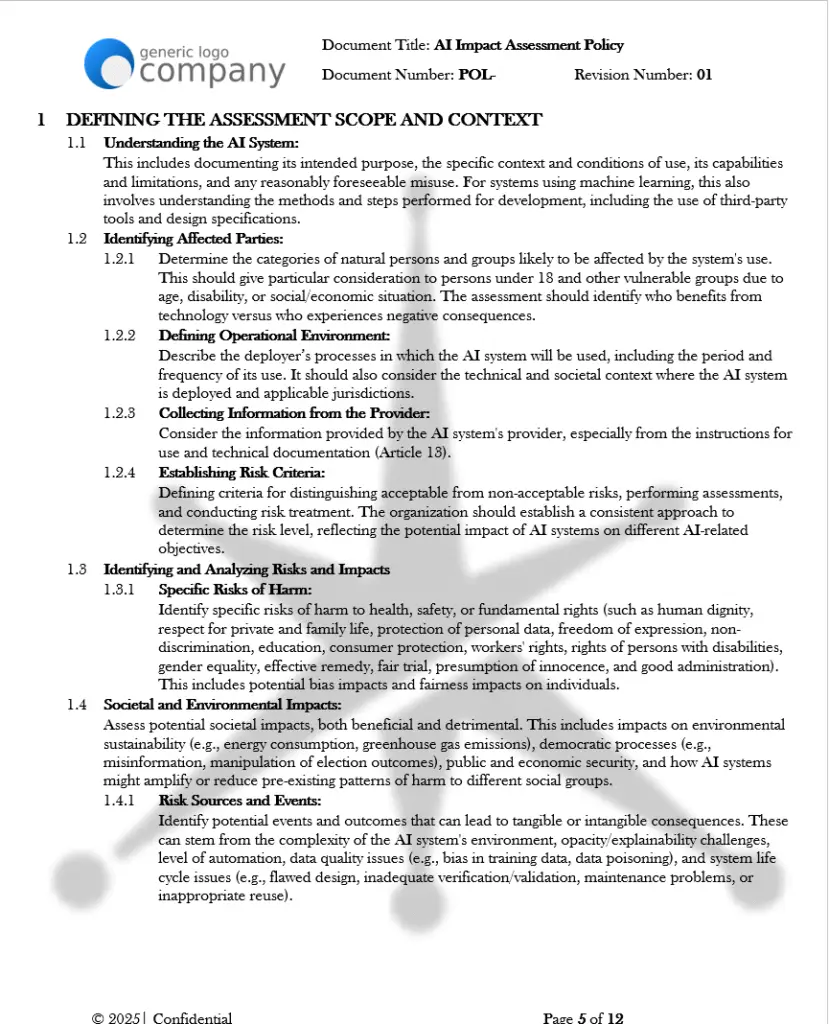
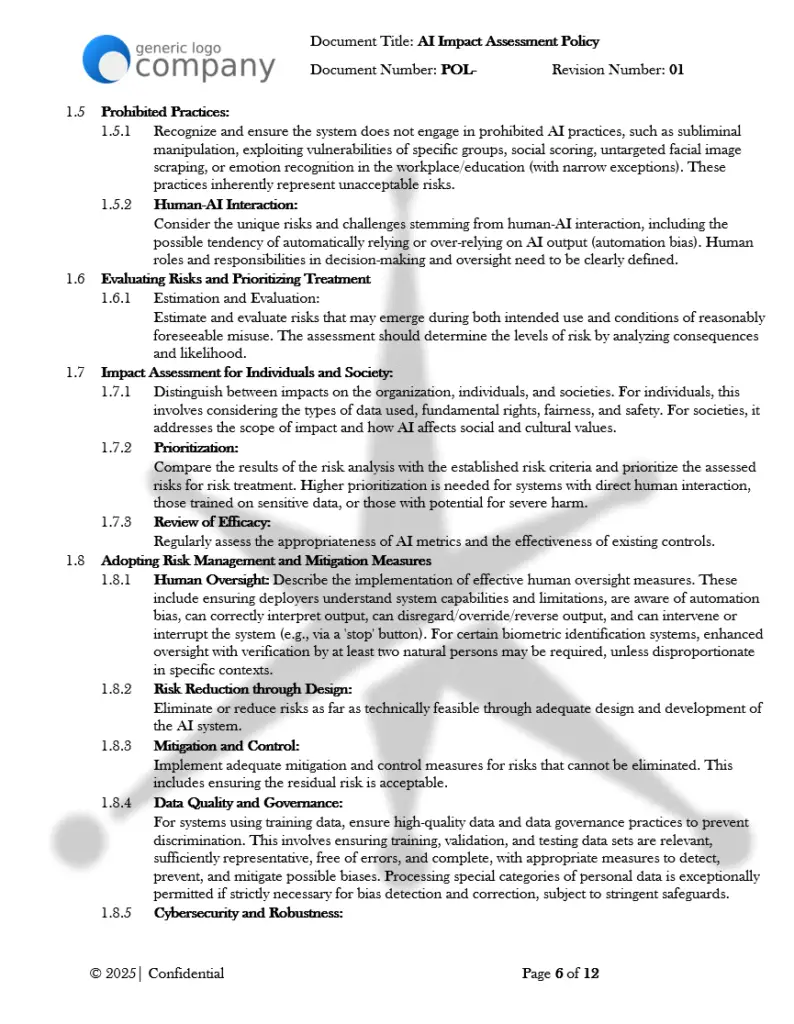
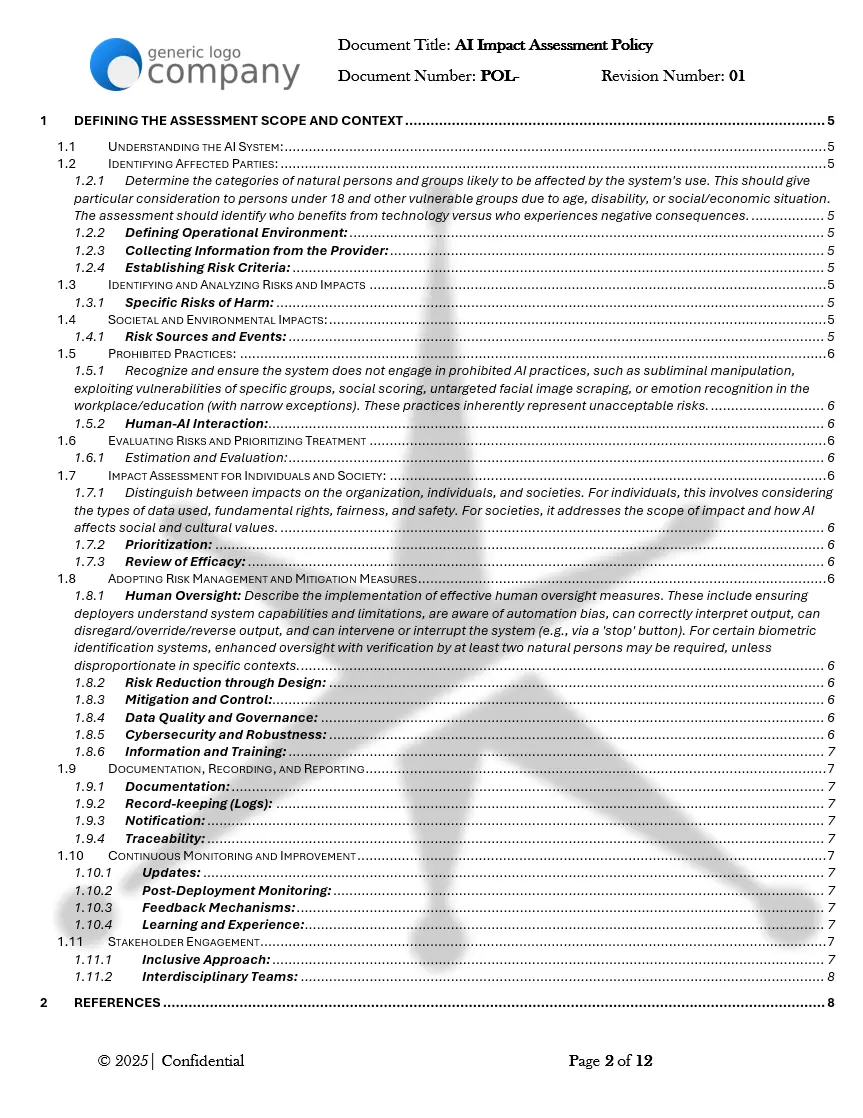
The template includes documented sections for:
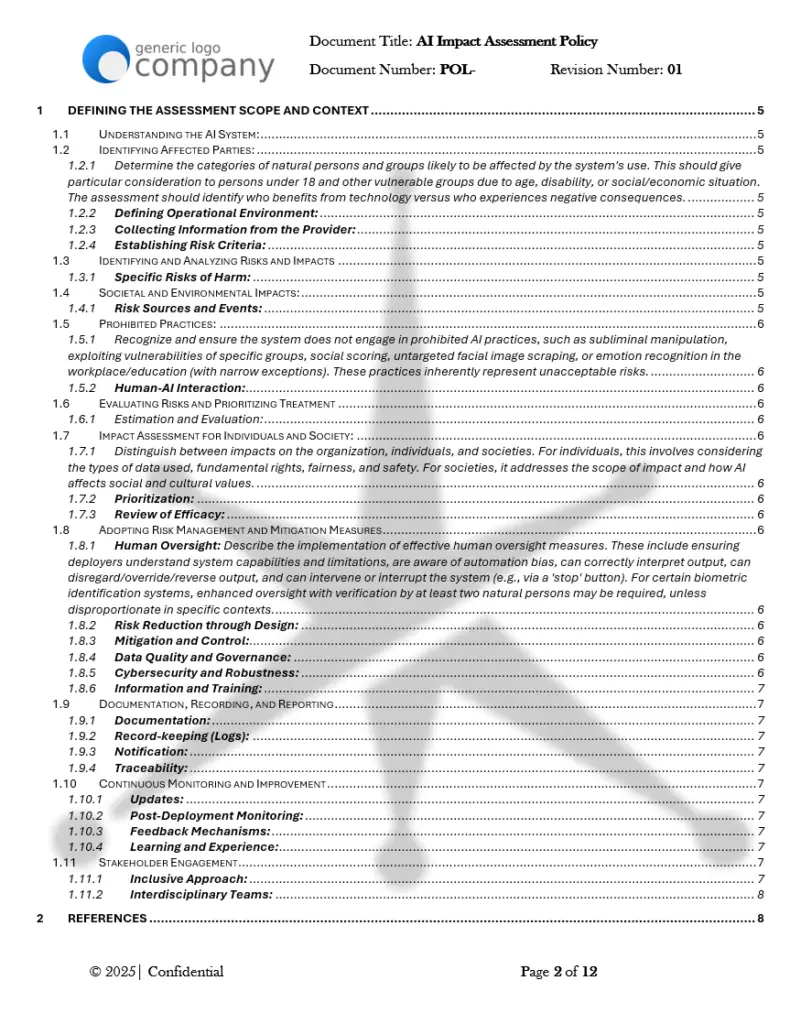
- Assessment scope and context definition (Section 1)
- Affected party identification with vulnerable group considerations
- Risk identification across health, safety, and fundamental rights
- Prohibited practices checklist aligned with EU AI Act provisions
- Human oversight implementation guidance
- Documentation and record-keeping frameworks
- Continuous monitoring and stakeholder engagement protocols
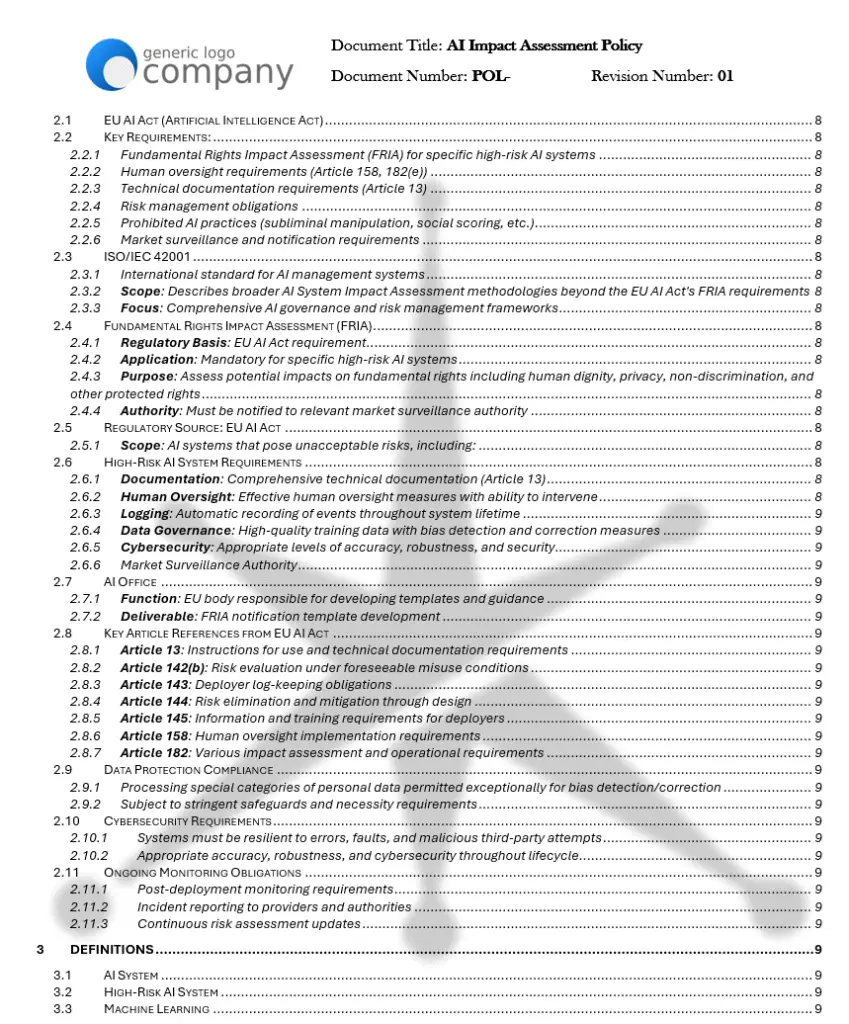
- References citing specific EU AI Act articles (13, 142(b), 143, 144, 145, 158, 182)
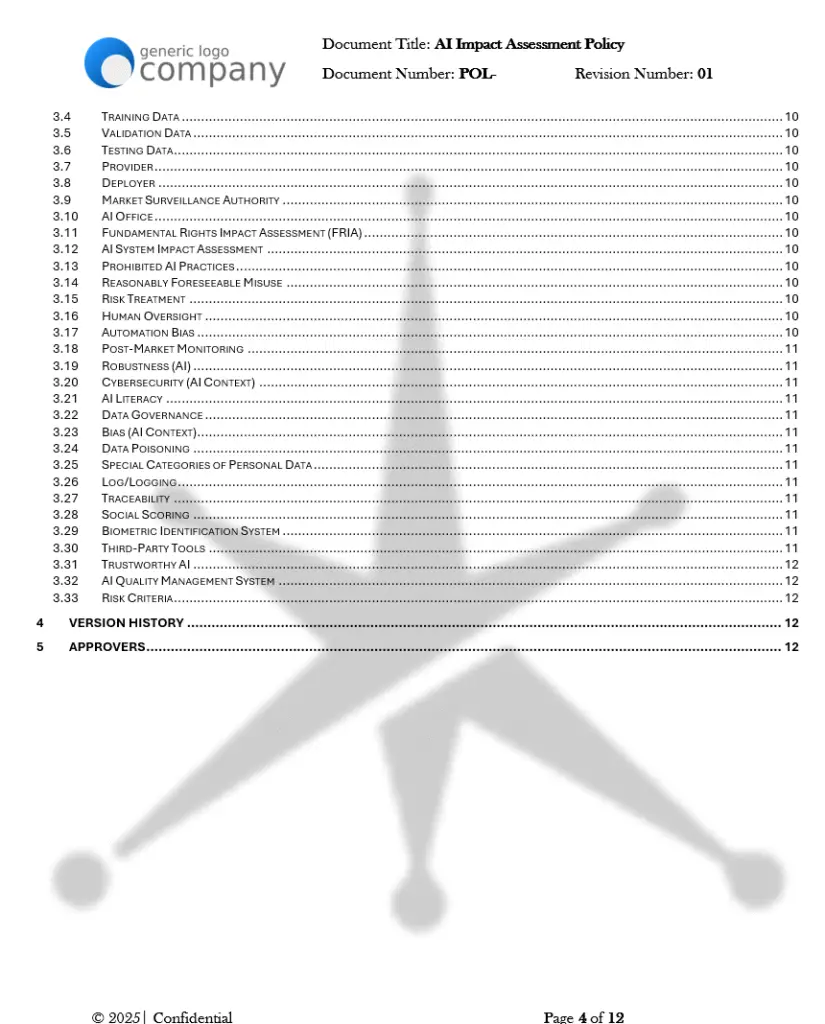
- Definitions glossary (30+ terms)
- Version history and approval tracking tables
Why This Matters
Organizations deploying AI systems face increasing requirements to assess and document potential impacts on individuals and society. The EU AI Act establishes specific obligations for high-risk AI system deployers, including Fundamental Rights Impact Assessment (FRIA) requirements and notification to market surveillance authorities.
ISO/IEC 42001 provides international guidance on AI management systems, describing broader impact assessment methodologies. Organizations pursuing structured AI governance benefit from documented assessment processes that address both regulatory requirements and responsible AI practices.
Without structured assessment documentation, organizations may struggle to demonstrate due diligence in evaluating AI system impacts, identifying affected populations, or implementing appropriate human oversight measures.
Framework Alignment
This template references guidance from:
- EU AI Act: Fundamental Rights Impact Assessment (FRIA) requirements, prohibited practices provisions, human oversight obligations (Articles 13, 142(b), 143, 144, 145, 158, 182), market surveillance notification requirements
- ISO/IEC 42001: AI management system methodologies and broader impact assessment frameworks
Key Features Mapped to Template Content
| Template Section | Coverage |
|---|---|
| Section 1.1-1.2 | AI system understanding, affected party identification including vulnerable groups |
| Section 1.3-1.5 | Risk identification covering fundamental rights, societal impacts, prohibited practices |
| Section 1.6-1.7 | Risk evaluation criteria, impact assessment for individuals and society |
| Section 1.8 | Mitigation measures including human oversight, data governance, cybersecurity |
| Section 1.9 | Documentation, record-keeping, notification, and traceability requirements |
| Section 1.10-1.11 | Continuous monitoring, feedback mechanisms, stakeholder engagement |
| Section 2 | References with specific EU AI Act article citations |
| Section 3 | 30+ term definitions (AI System, High-Risk AI System, FRIA, Deployer, etc.) |
Comparison: Starting From Scratch vs. Structured Template
| Approach | Starting From Scratch | This Template |
|---|---|---|
| Structure | Must research and design assessment framework | Provides 11-section assessment methodology |
| Regulatory References | Must identify and map applicable requirements | Includes specific EU AI Act article citations |
| Terminology | Inconsistent definitions across documents | 30+ defined terms for organizational consistency |
| Vulnerable Groups | May overlook specific consideration requirements | Explicit guidance on affected party identification |
| Prohibited Practices | Must compile from regulatory sources | Checklist aligned with EU AI Act provisions |
| Human Oversight | Must design from regulatory requirements | Implementation framework with control measures |
| Record-Keeping | Must establish documentation approach | Logging and traceability guidance included |
Frequently Asked Questions
What format is this template delivered in? The template is provided in Microsoft Word (.docx) format to support organizational editing, collaborative review, and formatting customization. Documents are optimized for Microsoft Word to ensure proper formatting and collaborative editing capabilities.
Does this template guarantee compliance with the EU AI Act? No. This template provides a structured framework designed to support impact assessment documentation efforts. Compliance determination depends on organizational implementation, the specific AI systems deployed, applicable jurisdictions, and regulatory interpretation. Organizations should consult qualified legal and compliance professionals for compliance verification.
What customization is required? Each section requires tailoring to your organization’s specific AI systems, operational context, affected populations, risk criteria, and oversight measures. The template provides structure and guidance; organizations supply the specific content reflecting their circumstances.
Is this template suitable for all AI systems? The template provides a comprehensive framework primarily designed for organizations evaluating high-risk AI systems under EU AI Act provisions. Organizations with lower-risk AI systems may adapt the framework to their assessment needs.
Does this template include the actual EU AI Act or ISO 42001 standard text? No. The template references these frameworks and cites specific articles but does not include the full regulatory or standard text. Organizations should obtain official copies of applicable regulations and standards separately.
What’s included in the definitions section? The template includes over 30 defined terms covering core AI concepts (AI System, Machine Learning, Training Data), regulatory terms (FRIA, Prohibited Practices, High-Risk AI System), roles (Provider, Deployer, Market Surveillance Authority), and technical concepts (Automation Bias, Data Poisoning, Robustness).
Ideal For
- Organizations deploying high-risk AI systems under EU AI Act classification
- Companies preparing for Fundamental Rights Impact Assessment obligations
- Enterprises building AI governance documentation programs
- Organizations pursuing ISO/IEC 42001 alignment
- Compliance teams establishing AI impact assessment processes
- Risk management functions evaluating AI system deployment decisions
Pricing
Single Template: Contact for pricing based on organizational requirements.
Bundle Option: May be combined with additional AI governance templates depending on organizational compliance scope.
Enterprise Option: Available as part of comprehensive AI governance documentation suites.
What Makes This Template Different
This AI Impact Assessment template provides practitioner-developed structure covering the full assessment lifecycle from scope definition through continuous monitoring. Rather than generic policy language, the template includes specific guidance on vulnerable group identification, prohibited practice evaluation, and human oversight implementation aligned with EU AI Act provisions.
The included references section maps specific EU AI Act articles to assessment activities, supporting organizations in connecting documentation to regulatory requirements. The 30+ term definitions section supports consistent language across AI governance documentation.
The template requires organizational customization to reflect specific AI systems, affected populations, and risk contexts. This framework provides structure and methodology; effective implementation requires dedicated internal effort to tailor content to organizational circumstances.
This template is designed to support AI impact assessment documentation efforts. It does not constitute legal advice and does not guarantee regulatory compliance. Organizations should consult qualified legal, compliance, and technical professionals when implementing AI governance programs.