
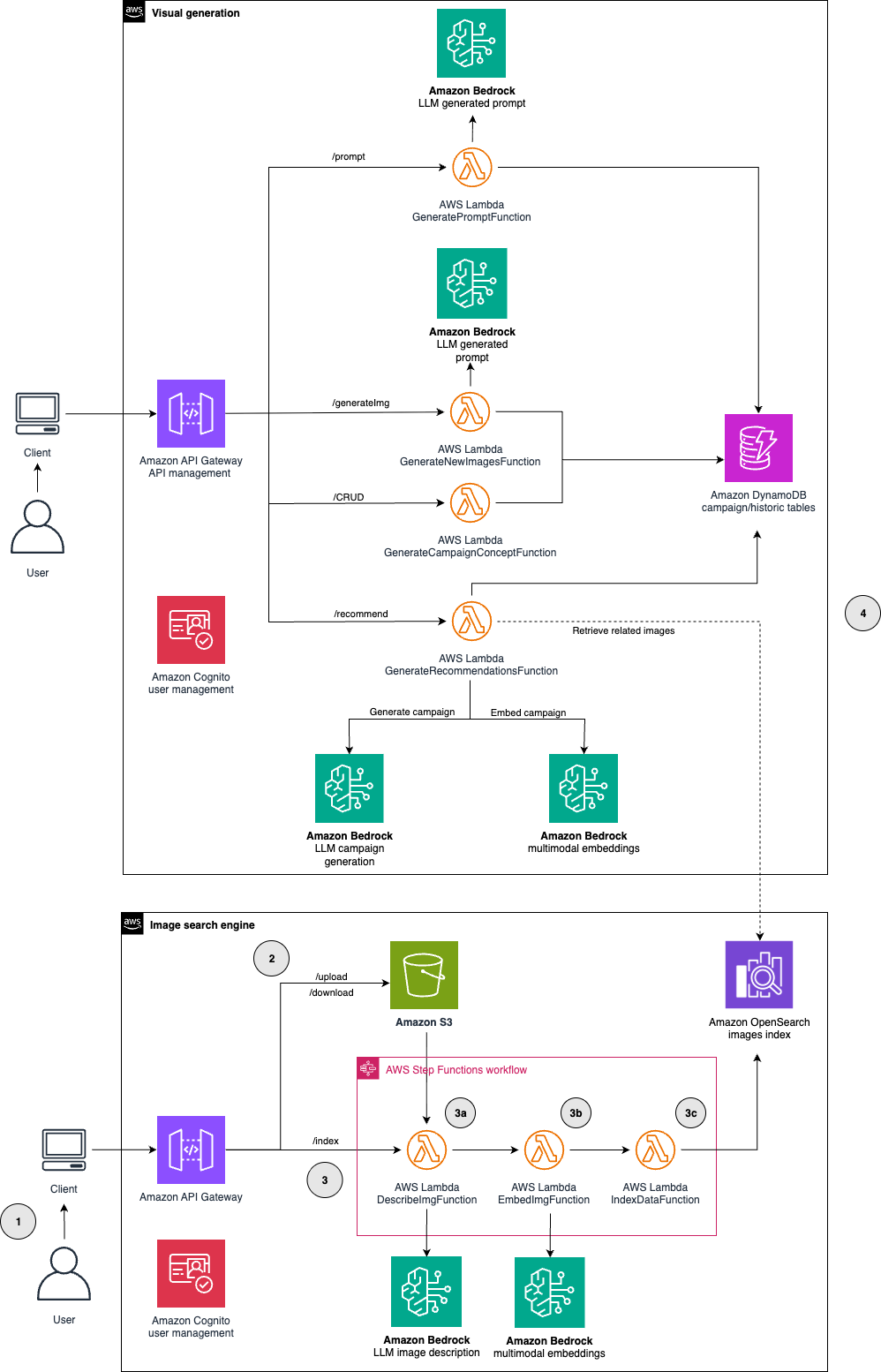
Accelerating your marketing ideation with generative AI – Part 2: Generate custom marketing images from historical referencesArtificial Intelligence Building upon our earlier work of marketing campaign image generation using Amazon Nova foundation models, in this post, we demonstrate how to enhance image generation by learning from previous marketing campaigns. We explore how to integrate Amazon Bedrock, AWS Lambda, and Amazon OpenSearch Serverless to create an advanced image generation system that uses reference campaigns to maintain brand guidelines, deliver consistent content, and enhance the effectiveness and efficiency of new campaign creation.
Building upon our earlier work of marketing campaign image generation using Amazon Nova foundation models, in this post, we demonstrate how to enhance image generation by learning from previous marketing campaigns. We explore how to integrate Amazon Bedrock, AWS Lambda, and Amazon OpenSearch Serverless to create an advanced image generation system that uses reference campaigns to maintain brand guidelines, deliver consistent content, and enhance the effectiveness and efficiency of new campaign creation. Read More

How to Work Effectively with Frontend and Backend CodeTowards Data Science Learn how to be an effective full-stack engineer with Claude Code
The post How to Work Effectively with Frontend and Backend Code appeared first on Towards Data Science.
Learn how to be an effective full-stack engineer with Claude Code
The post How to Work Effectively with Frontend and Backend Code appeared first on Towards Data Science. Read More
Rank-and-Reason: Multi-Agent Collaboration Accelerates Zero-Shot Protein Mutation Predictioncs.AI updates on arXiv.org arXiv:2602.00197v2 Announce Type: cross
Abstract: Zero-shot mutation prediction is vital for low-resource protein engineering, yet existing protein language models (PLMs) often yield statistically confident results that ignore fundamental biophysical constraints. Currently, selecting candidates for wet-lab validation relies on manual expert auditing of PLM outputs, a process that is inefficient, subjective, and highly dependent on domain expertise. To address this, we propose Rank-and-Reason (VenusRAR), a two-stage agentic framework to automate this workflow and maximize expected wet-lab fitness. In the Rank-Stage, a Computational Expert and Virtual Biologist aggregate a context-aware multi-modal ensemble, establishing a new Spearman correlation record of 0.551 (vs. 0.518) on ProteinGym. In the Reason-Stage, an agentic Expert Panel employs chain-of-thought reasoning to audit candidates against geometric and structural constraints, improving the Top-5 Hit Rate by up to 367% on ProteinGym-DMS99. The wet-lab validation on Cas12i3 nuclease further confirms the framework’s efficacy, achieving a 46.7% positive rate and identifying two novel mutants with 4.23-fold and 5.05-fold activity improvements. Code and datasets are released on GitHub (https://github.com/ai4protein/VenusRAR/).
arXiv:2602.00197v2 Announce Type: cross
Abstract: Zero-shot mutation prediction is vital for low-resource protein engineering, yet existing protein language models (PLMs) often yield statistically confident results that ignore fundamental biophysical constraints. Currently, selecting candidates for wet-lab validation relies on manual expert auditing of PLM outputs, a process that is inefficient, subjective, and highly dependent on domain expertise. To address this, we propose Rank-and-Reason (VenusRAR), a two-stage agentic framework to automate this workflow and maximize expected wet-lab fitness. In the Rank-Stage, a Computational Expert and Virtual Biologist aggregate a context-aware multi-modal ensemble, establishing a new Spearman correlation record of 0.551 (vs. 0.518) on ProteinGym. In the Reason-Stage, an agentic Expert Panel employs chain-of-thought reasoning to audit candidates against geometric and structural constraints, improving the Top-5 Hit Rate by up to 367% on ProteinGym-DMS99. The wet-lab validation on Cas12i3 nuclease further confirms the framework’s efficacy, achieving a 46.7% positive rate and identifying two novel mutants with 4.23-fold and 5.05-fold activity improvements. Code and datasets are released on GitHub (https://github.com/ai4protein/VenusRAR/). Read More
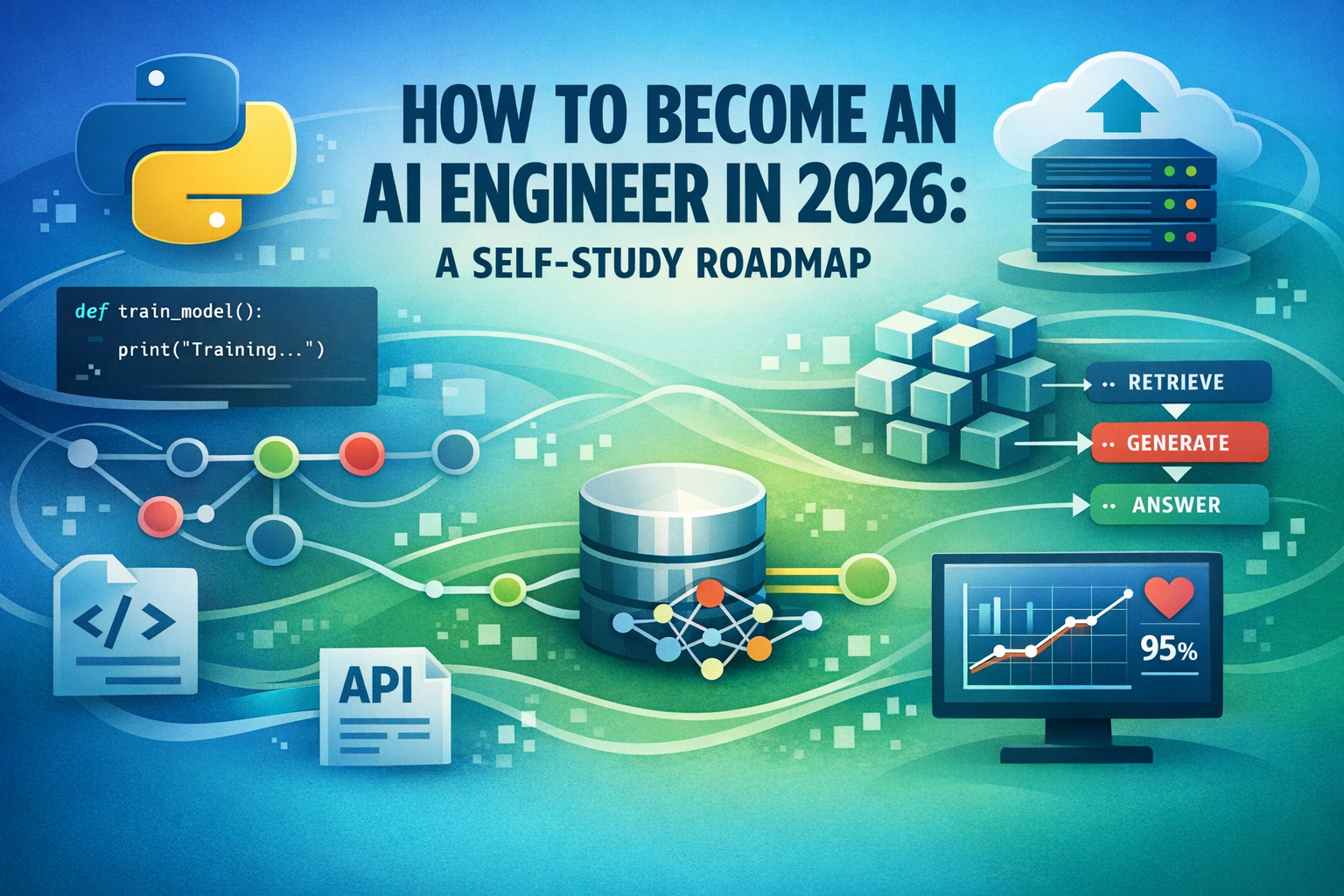
How to Become an AI Engineer in 2026: A Self-Study RoadmapKDnuggets Want to become an AI engineer in 2026? This step-by-step roadmap breaks down the skills, tools, and projects you need.
Want to become an AI engineer in 2026? This step-by-step roadmap breaks down the skills, tools, and projects you need. Read More

AI Expo 2026 Day 1: Governance and data readiness enable the agentic enterpriseAI News While the prospect of AI acting as a digital co-worker dominated the day one agenda at the co-located AI & Big Data Expo and Intelligent Automation Conference, the technical sessions focused on the infrastructure to make it work. A primary topic on the exhibition floor was the progression from passive automation to “agentic” systems. These
The post AI Expo 2026 Day 1: Governance and data readiness enable the agentic enterprise appeared first on AI News.
While the prospect of AI acting as a digital co-worker dominated the day one agenda at the co-located AI & Big Data Expo and Intelligent Automation Conference, the technical sessions focused on the infrastructure to make it work. A primary topic on the exhibition floor was the progression from passive automation to “agentic” systems. These
The post AI Expo 2026 Day 1: Governance and data readiness enable the agentic enterprise appeared first on AI News. Read More
AWS vs. Azure: A Deep Dive into Model Training – Part 2Towards Data Science This article covers how Azure ML’s persistent, workspace-centric compute resources differ from AWS SageMaker’s on-demand, job-specific approach. Additionally, we explored environment customization options, from Azure’s curated environments and custom environments to SageMaker’s three level of customizations.
The post AWS vs. Azure: A Deep Dive into Model Training – Part 2 appeared first on Towards Data Science.
This article covers how Azure ML’s persistent, workspace-centric compute resources differ from AWS SageMaker’s on-demand, job-specific approach. Additionally, we explored environment customization options, from Azure’s curated environments and custom environments to SageMaker’s three level of customizations.
The post AWS vs. Azure: A Deep Dive into Model Training – Part 2 appeared first on Towards Data Science. Read More
Navigating health questions with ChatGPTOpenAI News A family shares how ChatGPT helped them prepare for critical cancer treatment decisions for their son alongside expert guidance from his doctors.
A family shares how ChatGPT helped them prepare for critical cancer treatment decisions for their son alongside expert guidance from his doctors. Read More
How to Build Efficient Agentic Reasoning Systems by Dynamically Pruning Multiple Chain-of-Thought Paths Without Losing AccuracyMarkTechPost In this tutorial, we implement an agentic chain-of-thought pruning framework that generates multiple reasoning paths in parallel and dynamically reduces them using consensus signals and early stopping. We focus on improving reasoning efficiency by reducing unnecessary token usage while preserving answer correctness, demonstrating that self-consistency and lightweight graph-based agreement can serve as effective proxies for
The post How to Build Efficient Agentic Reasoning Systems by Dynamically Pruning Multiple Chain-of-Thought Paths Without Losing Accuracy appeared first on MarkTechPost.
In this tutorial, we implement an agentic chain-of-thought pruning framework that generates multiple reasoning paths in parallel and dynamically reduces them using consensus signals and early stopping. We focus on improving reasoning efficiency by reducing unnecessary token usage while preserving answer correctness, demonstrating that self-consistency and lightweight graph-based agreement can serve as effective proxies for
The post How to Build Efficient Agentic Reasoning Systems by Dynamically Pruning Multiple Chain-of-Thought Paths Without Losing Accuracy appeared first on MarkTechPost. Read More
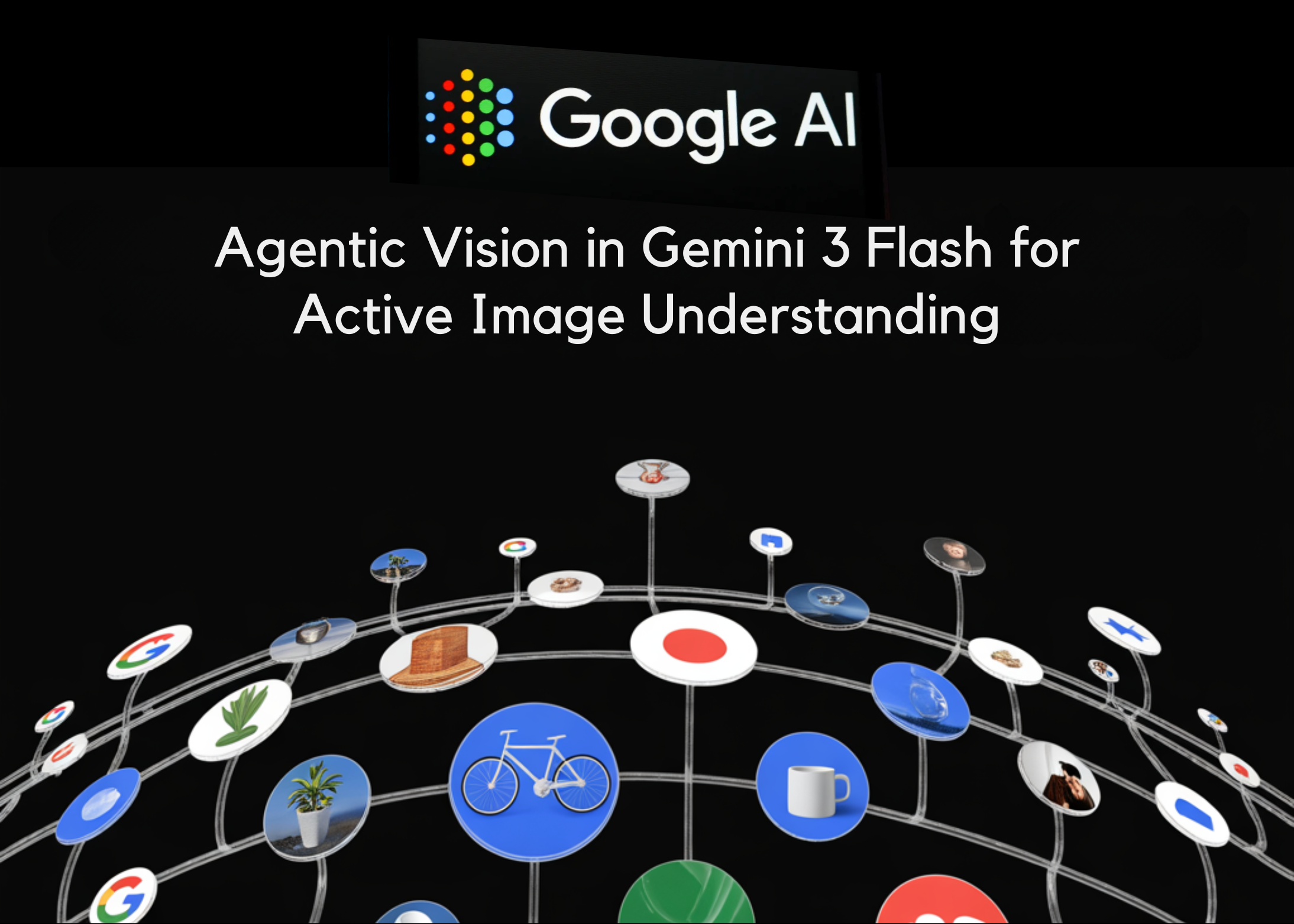
Google Introduces Agentic Vision in Gemini 3 Flash for Active Image UnderstandingMarkTechPost Frontier multimodal models usually process an image in a single pass. If they miss a serial number on a chip or a small symbol on a building plan, they often guess. Google’s new Agentic Vision capability in Gemini 3 Flash changes this by turning image understanding into an active, tool using loop grounded in visual
The post Google Introduces Agentic Vision in Gemini 3 Flash for Active Image Understanding appeared first on MarkTechPost.
Frontier multimodal models usually process an image in a single pass. If they miss a serial number on a chip or a small symbol on a building plan, they often guess. Google’s new Agentic Vision capability in Gemini 3 Flash changes this by turning image understanding into an active, tool using loop grounded in visual
The post Google Introduces Agentic Vision in Gemini 3 Flash for Active Image Understanding appeared first on MarkTechPost. Read More
Unlocking the Codex harness: how we built the App ServerOpenAI News Learn how to embed the Codex agent using the Codex App Server, a bidirectional JSON-RPC API powering streaming progress, tool use, approvals, and diffs.
Learn how to embed the Codex agent using the Codex App Server, a bidirectional JSON-RPC API powering streaming progress, tool use, approvals, and diffs. Read More