
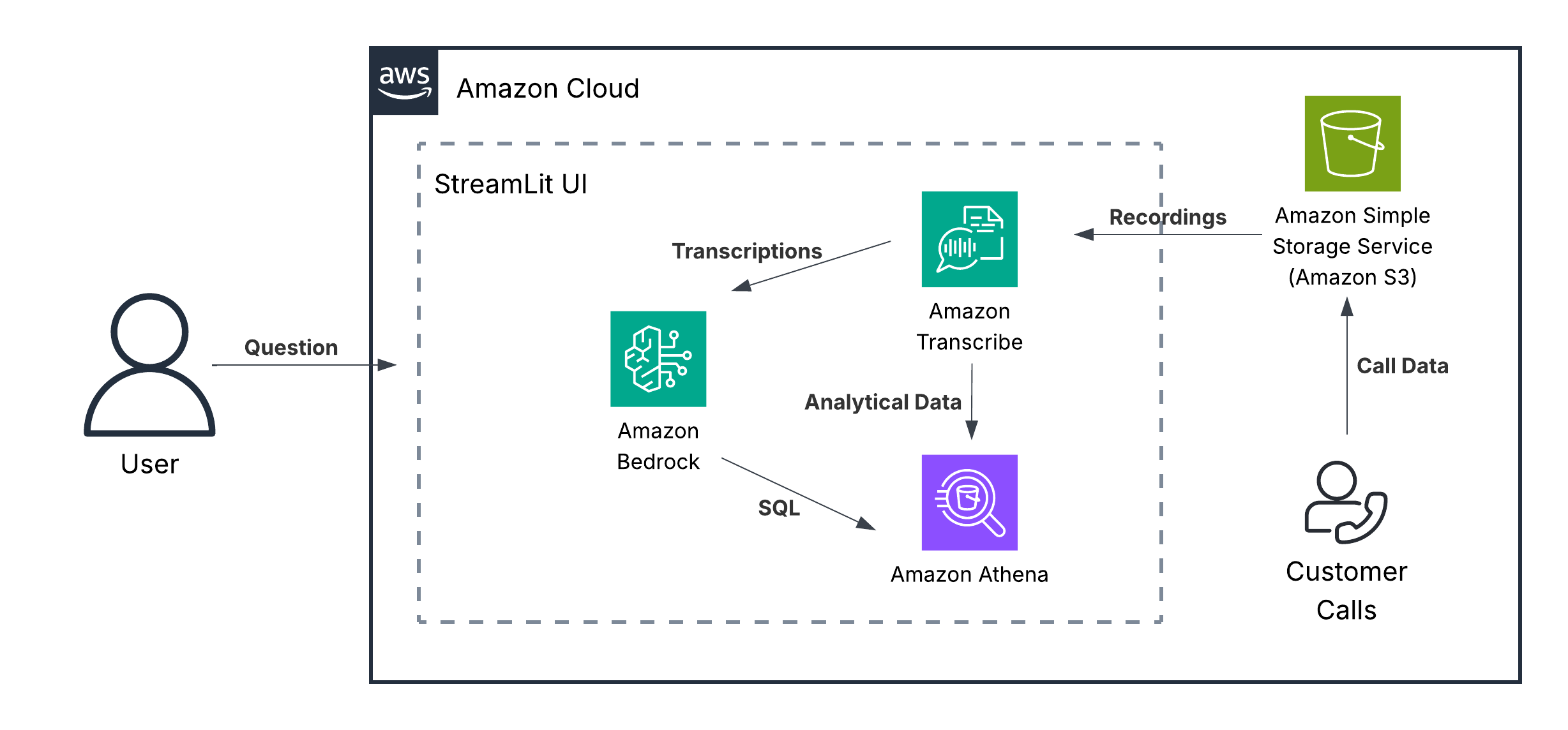
Unlock powerful call center analytics with Amazon Nova foundation modelsArtificial Intelligence In this post, we discuss how Amazon Nova demonstrates capabilities in conversational analytics, call classification, and other use cases often relevant to contact center solutions. We examine these capabilities for both single-call and multi-call analytics use cases.
In this post, we discuss how Amazon Nova demonstrates capabilities in conversational analytics, call classification, and other use cases often relevant to contact center solutions. We examine these capabilities for both single-call and multi-call analytics use cases. Read More

How Ricoh built a scalable intelligent document processing solution on AWSArtificial Intelligence This post explores how Ricoh built a standardized, multi-tenant solution for automated document classification and extraction using the AWS GenAI IDP Accelerator as a foundation, transforming their document processing from a custom-engineering bottleneck into a scalable, repeatable service.
This post explores how Ricoh built a standardized, multi-tenant solution for automated document classification and extraction using the AWS GenAI IDP Accelerator as a foundation, transforming their document processing from a custom-engineering bottleneck into a scalable, repeatable service. Read More

LangWatch Open Sources the Missing Evaluation Layer for AI Agents to Enable End-to-End Tracing, Simulation, and Systematic TestingMarkTechPost As AI development shifts from simple chat interfaces to complex, multi-step autonomous agents, the industry has encountered a significant bottleneck: non-determinism. Unlike traditional software where code follows a predictable path, agents built on LLMs introduce a high degree of variance. LangWatch is an open-source platform designed to address this by providing a standardized layer for
The post LangWatch Open Sources the Missing Evaluation Layer for AI Agents to Enable End-to-End Tracing, Simulation, and Systematic Testing appeared first on MarkTechPost.
As AI development shifts from simple chat interfaces to complex, multi-step autonomous agents, the industry has encountered a significant bottleneck: non-determinism. Unlike traditional software where code follows a predictable path, agents built on LLMs introduce a high degree of variance. LangWatch is an open-source platform designed to address this by providing a standardized layer for
The post LangWatch Open Sources the Missing Evaluation Layer for AI Agents to Enable End-to-End Tracing, Simulation, and Systematic Testing appeared first on MarkTechPost. Read More
A Guide to Kedro: Your Production-Ready Data Science ToolboxKDnuggets This article introduces and explores Kedro’s main features, guiding you through its core concepts for a better understanding before diving deeper into this framework for addressing real data science projects.
This article introduces and explores Kedro’s main features, guiding you through its core concepts for a better understanding before diving deeper into this framework for addressing real data science projects. Read More
Escaping the Prototype Mirage: Why Enterprise AI StallsTowards Data Science Too many prototypes, too few products
The post Escaping the Prototype Mirage: Why Enterprise AI Stalls appeared first on Towards Data Science.
Too many prototypes, too few products
The post Escaping the Prototype Mirage: Why Enterprise AI Stalls appeared first on Towards Data Science. Read More
5 Useful Python Scripts to Automate Exploratory Data AnalysisKDnuggets Spending hours cleaning, summarizing, and visualizing your data manually? Automate your exploratory data analysis workflow with these 5 ready-to-use Python scripts.
Spending hours cleaning, summarizing, and visualizing your data manually? Automate your exploratory data analysis workflow with these 5 ready-to-use Python scripts. Read More
RAG with Hybrid Search: How Does Keyword Search Work?Towards Data Science Understanding keyword search, TF-IDF, and BM25
The post RAG with Hybrid Search: How Does Keyword Search Work? appeared first on Towards Data Science.
Understanding keyword search, TF-IDF, and BM25
The post RAG with Hybrid Search: How Does Keyword Search Work? appeared first on Towards Data Science. Read More

AI agents prefer Bitcoin shaping new finance architectureAI News AI agents prefer Bitcoin for digital wealth storage, forcing finance chiefs to adapt their architecture for machine autonomy. When AI systems gain economic autonomy, their internal logic dictates how corporate capital flows. Non-partisan research by the Bitcoin Policy Institute evaluated how these frontier models would transact if operating as independent economic actors. The study tested
The post AI agents prefer Bitcoin shaping new finance architecture appeared first on AI News.
AI agents prefer Bitcoin for digital wealth storage, forcing finance chiefs to adapt their architecture for machine autonomy. When AI systems gain economic autonomy, their internal logic dictates how corporate capital flows. Non-partisan research by the Bitcoin Policy Institute evaluated how these frontier models would transact if operating as independent economic actors. The study tested
The post AI agents prefer Bitcoin shaping new finance architecture appeared first on AI News. Read More
Theory of Code Space: Do Code Agents Understand Software Architecture?cs.AI updates on arXiv.org arXiv:2603.00601v2 Announce Type: cross
Abstract: AI code agents excel at isolated tasks yet struggle with complex, multi-file software engineering requiring understanding of how dozens of modules relate. We hypothesize these failures stem from inability to construct, maintain, and update coherent architectural beliefs during codebase exploration. We introduce Theory of Code Space (ToCS), a benchmark that evaluates this capability by placing agents in procedurally generated codebases under partial observability, requiring them to build structured belief states over module dependencies, cross-cutting invariants, and design intent. The framework features: (1) a procedural codebase generator producing medium-complexity Python projects with four typed edge categories reflecting different discovery methods — from syntactic imports to config-driven dynamic wiring — with planted architectural constraints and verified ground truth; (2) a partial observability harness where agents explore under a budget; and (3) periodic belief probing via structured JSON, producing a time-series of architectural understanding. We decompose the Active-Passive Gap from spatial reasoning benchmarks into selection and decision components, and introduce Architectural Constraint Discovery as a code-specific evaluation dimension. Preliminary experiments with four rule-based baselines and five frontier LLM agents from three providers validate discriminative power: methods span a wide performance range (F1 from 0.129 to 0.646), LLM agents discover semantic edge types invisible to all baselines, yet weaker models score below simple heuristics — revealing that belief externalization, faithfully serializing internal understanding into structured JSON, is itself a non-trivial capability and a first-order confounder in belief-probing benchmarks. Open-source toolkit: https://github.com/che-shr-cat/tocs
arXiv:2603.00601v2 Announce Type: cross
Abstract: AI code agents excel at isolated tasks yet struggle with complex, multi-file software engineering requiring understanding of how dozens of modules relate. We hypothesize these failures stem from inability to construct, maintain, and update coherent architectural beliefs during codebase exploration. We introduce Theory of Code Space (ToCS), a benchmark that evaluates this capability by placing agents in procedurally generated codebases under partial observability, requiring them to build structured belief states over module dependencies, cross-cutting invariants, and design intent. The framework features: (1) a procedural codebase generator producing medium-complexity Python projects with four typed edge categories reflecting different discovery methods — from syntactic imports to config-driven dynamic wiring — with planted architectural constraints and verified ground truth; (2) a partial observability harness where agents explore under a budget; and (3) periodic belief probing via structured JSON, producing a time-series of architectural understanding. We decompose the Active-Passive Gap from spatial reasoning benchmarks into selection and decision components, and introduce Architectural Constraint Discovery as a code-specific evaluation dimension. Preliminary experiments with four rule-based baselines and five frontier LLM agents from three providers validate discriminative power: methods span a wide performance range (F1 from 0.129 to 0.646), LLM agents discover semantic edge types invisible to all baselines, yet weaker models score below simple heuristics — revealing that belief externalization, faithfully serializing internal understanding into structured JSON, is itself a non-trivial capability and a first-order confounder in belief-probing benchmarks. Open-source toolkit: https://github.com/che-shr-cat/tocs Read More
Confusion-Aware Rubric Optimization for LLM-based Automated Gradingcs.AI updates on arXiv.org arXiv:2603.00451v1 Announce Type: new
Abstract: Accurate and unambiguous guidelines are critical for large language model (LLM) based graders, yet manually crafting these prompts is often sub-optimal as LLMs can misinterpret expert guidelines or lack necessary domain specificity. Consequently, the field has moved toward automated prompt optimization to refine grading guidelines without the burden of manual trial and error. However, existing frameworks typically aggregate independent and unstructured error samples into a single update step, resulting in “rule dilution” where conflicting constraints weaken the model’s grading logic. To address these limitations, we introduce Confusion-Aware Rubric Optimization (CARO), a novel framework that enhances accuracy and computational efficiency by structurally separating error signals. CARO leverages the confusion matrix to decompose monolithic error signals into distinct modes, allowing for the diagnosis and repair of specific misclassification patterns individually. By synthesizing targeted “fixing patches” for dominant error modes and employing a diversity-aware selection mechanism, the framework prevents guidance conflict and eliminates the need for resource-heavy nested refinement loops. Empirical evaluations on teacher education and STEM datasets demonstrate that CARO significantly outperforms existing SOTA methods. These results suggest that replacing mixed-error aggregation with surgical, mode-specific repair yields robust improvements in automated assessment scalability and precision.
arXiv:2603.00451v1 Announce Type: new
Abstract: Accurate and unambiguous guidelines are critical for large language model (LLM) based graders, yet manually crafting these prompts is often sub-optimal as LLMs can misinterpret expert guidelines or lack necessary domain specificity. Consequently, the field has moved toward automated prompt optimization to refine grading guidelines without the burden of manual trial and error. However, existing frameworks typically aggregate independent and unstructured error samples into a single update step, resulting in “rule dilution” where conflicting constraints weaken the model’s grading logic. To address these limitations, we introduce Confusion-Aware Rubric Optimization (CARO), a novel framework that enhances accuracy and computational efficiency by structurally separating error signals. CARO leverages the confusion matrix to decompose monolithic error signals into distinct modes, allowing for the diagnosis and repair of specific misclassification patterns individually. By synthesizing targeted “fixing patches” for dominant error modes and employing a diversity-aware selection mechanism, the framework prevents guidance conflict and eliminates the need for resource-heavy nested refinement loops. Empirical evaluations on teacher education and STEM datasets demonstrate that CARO significantly outperforms existing SOTA methods. These results suggest that replacing mixed-error aggregation with surgical, mode-specific repair yields robust improvements in automated assessment scalability and precision. Read More