
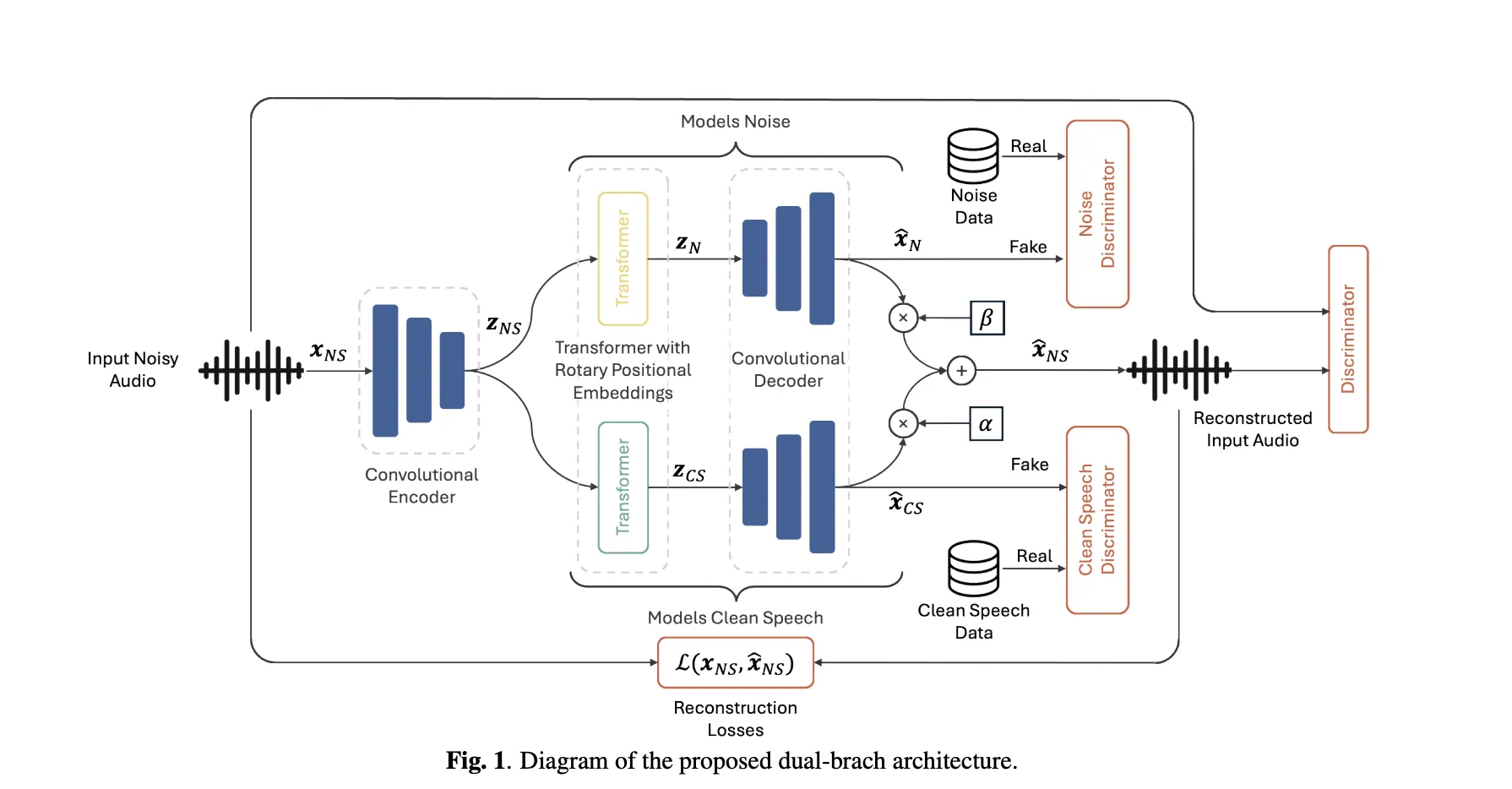
This AI Paper Proposes a Novel Dual-Branch Encoder-Decoder Architecture for Unsupervised Speech Enhancement (SE)MarkTechPost Can a speech enhancer trained only on real noisy recordings cleanly separate speech and noise—without ever seeing paired data? A team of researchers from Brno University of Technology and Johns Hopkins University proposes Unsupervised Speech Enhancement using Data-defined Priors (USE-DDP), a dual-stream encoder–decoder that separates any noisy input into two waveforms—estimated clean speech and residual
The post This AI Paper Proposes a Novel Dual-Branch Encoder-Decoder Architecture for Unsupervised Speech Enhancement (SE) appeared first on MarkTechPost.
Can a speech enhancer trained only on real noisy recordings cleanly separate speech and noise—without ever seeing paired data? A team of researchers from Brno University of Technology and Johns Hopkins University proposes Unsupervised Speech Enhancement using Data-defined Priors (USE-DDP), a dual-stream encoder–decoder that separates any noisy input into two waveforms—estimated clean speech and residual
The post This AI Paper Proposes a Novel Dual-Branch Encoder-Decoder Architecture for Unsupervised Speech Enhancement (SE) appeared first on MarkTechPost. Read More

A Coding Implementation to Build a Transformer-Based Regression Language Model to Predict Continuous Values from TextMarkTechPost We will build a Regression Language Model (RLM), a model that predicts continuous numerical values directly from text sequences in this coding implementation. Instead of classifying or generating text, we focus on training a transformer-based architecture that learns quantitative relationships hidden within natural language descriptions. We start by generating synthetic text-to-number data, tokenizing it efficiently,
The post A Coding Implementation to Build a Transformer-Based Regression Language Model to Predict Continuous Values from Text appeared first on MarkTechPost.
We will build a Regression Language Model (RLM), a model that predicts continuous numerical values directly from text sequences in this coding implementation. Instead of classifying or generating text, we focus on training a transformer-based architecture that learns quantitative relationships hidden within natural language descriptions. We start by generating synthetic text-to-number data, tokenizing it efficiently,
The post A Coding Implementation to Build a Transformer-Based Regression Language Model to Predict Continuous Values from Text appeared first on MarkTechPost. Read More
Real-Time Intelligence in Microsoft Fabric: The Ultimate GuideTowards Data Science Once upon a time, handling streaming data was considered an avant-garde approach. Since the introduction of relational database management systems in the 1970s and traditional data warehousing systems in the late 1980s, all data workloads began and ended with the so-called batch processing. Batch processing relies on the concept of collecting numerous tasks in a group (or batch)
The post Real-Time Intelligence in Microsoft Fabric: The Ultimate Guide appeared first on Towards Data Science.
Once upon a time, handling streaming data was considered an avant-garde approach. Since the introduction of relational database management systems in the 1970s and traditional data warehousing systems in the late 1980s, all data workloads began and ended with the so-called batch processing. Batch processing relies on the concept of collecting numerous tasks in a group (or batch)
The post Real-Time Intelligence in Microsoft Fabric: The Ultimate Guide appeared first on Towards Data Science. Read More
Is It Thinking or Cheating? Detecting Implicit Reward Hacking by Measuring Reasoning Effortcs.AI updates on arXiv.org arXiv:2510.01367v1 Announce Type: new
Abstract: Reward hacking, where a reasoning model exploits loopholes in a reward function to achieve high rewards without solving the intended task, poses a significant threat. This behavior may be explicit, i.e. verbalized in the model’s chain-of-thought (CoT), or implicit, where the CoT appears benign thus bypasses CoT monitors. To detect implicit reward hacking, we propose TRACE (Truncated Reasoning AUC Evaluation). Our key observation is that hacking occurs when exploiting the loophole is easier than solving the actual task. This means that the model is using less `effort’ than required to achieve high reward. TRACE quantifies effort by measuring how early a model’s reasoning becomes sufficient to pass a verifier. We progressively truncate a model’s CoT at various lengths, force the model to answer, and measure the verifier-passing rate at each cutoff. A hacking model, which takes a shortcut, will achieve a high passing rate with only a small fraction of its CoT, yielding a large area under the accuracy-vs-length curve. TRACE achieves over 65% gains over our strongest 72B CoT monitor in math reasoning, and over 30% gains over a 32B monitor in coding. We further show that TRACE can discover unknown loopholes during training. Overall, TRACE offers a scalable unsupervised approach for oversight where current monitoring methods prove ineffective.
arXiv:2510.01367v1 Announce Type: new
Abstract: Reward hacking, where a reasoning model exploits loopholes in a reward function to achieve high rewards without solving the intended task, poses a significant threat. This behavior may be explicit, i.e. verbalized in the model’s chain-of-thought (CoT), or implicit, where the CoT appears benign thus bypasses CoT monitors. To detect implicit reward hacking, we propose TRACE (Truncated Reasoning AUC Evaluation). Our key observation is that hacking occurs when exploiting the loophole is easier than solving the actual task. This means that the model is using less `effort’ than required to achieve high reward. TRACE quantifies effort by measuring how early a model’s reasoning becomes sufficient to pass a verifier. We progressively truncate a model’s CoT at various lengths, force the model to answer, and measure the verifier-passing rate at each cutoff. A hacking model, which takes a shortcut, will achieve a high passing rate with only a small fraction of its CoT, yielding a large area under the accuracy-vs-length curve. TRACE achieves over 65% gains over our strongest 72B CoT monitor in math reasoning, and over 30% gains over a 32B monitor in coding. We further show that TRACE can discover unknown loopholes during training. Overall, TRACE offers a scalable unsupervised approach for oversight where current monitoring methods prove ineffective. Read More

Is ChatGPT Study Mode a Hidden Gem or a Gimmick?KDnuggets This article critically explores both perspectives, weighing the benefits, drawbacks, and future potential of Study Mode to determine whether it lives up to the hype.
This article critically explores both perspectives, weighing the benefits, drawbacks, and future potential of Study Mode to determine whether it lives up to the hype. Read More
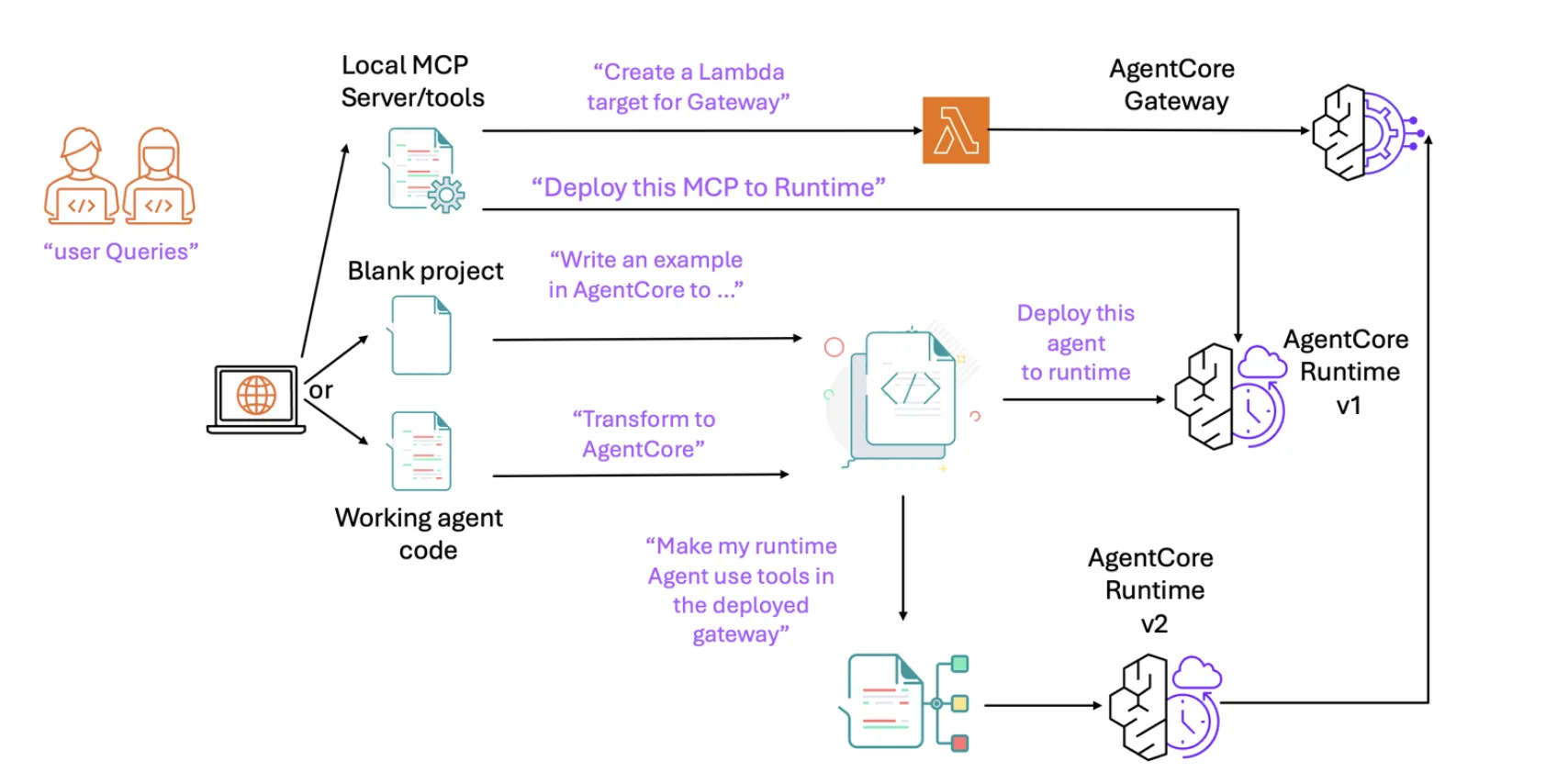
AWS Open-Sources an MCP Server for Bedrock AgentCore to Streamline AI Agent DevelopmentMarkTechPost AWS released an open-source Model Context Protocol (MCP) server for Amazon Bedrock AgentCore, providing a direct path from natural-language prompts in agentic IDEs to deployable agents on AgentCore Runtime. The package ships with automated transformations, environment provisioning, and Gateway/tooling hooks designed to compress typical multi-step integration work into conversational commands. So, what exactly is it?
The post AWS Open-Sources an MCP Server for Bedrock AgentCore to Streamline AI Agent Development appeared first on MarkTechPost.
AWS released an open-source Model Context Protocol (MCP) server for Amazon Bedrock AgentCore, providing a direct path from natural-language prompts in agentic IDEs to deployable agents on AgentCore Runtime. The package ships with automated transformations, environment provisioning, and Gateway/tooling hooks designed to compress typical multi-step integration work into conversational commands. So, what exactly is it?
The post AWS Open-Sources an MCP Server for Bedrock AgentCore to Streamline AI Agent Development appeared first on MarkTechPost. Read More
Unlock global AI inference scalability using new global cross-Region inference on Amazon Bedrock with Anthropic’s Claude Sonnet 4.5Artificial Intelligence Organizations are increasingly integrating generative AI capabilities into their applications to enhance customer experiences, streamline operations, and drive innovation. As generative AI workloads continue to grow in scale and importance, organizations face new challenges in maintaining consistent performance, reliability, and availability of their AI-powered applications. Customers are looking to scale their AI inference workloads across
Organizations are increasingly integrating generative AI capabilities into their applications to enhance customer experiences, streamline operations, and drive innovation. As generative AI workloads continue to grow in scale and importance, organizations face new challenges in maintaining consistent performance, reliability, and availability of their AI-powered applications. Customers are looking to scale their AI inference workloads across Read More
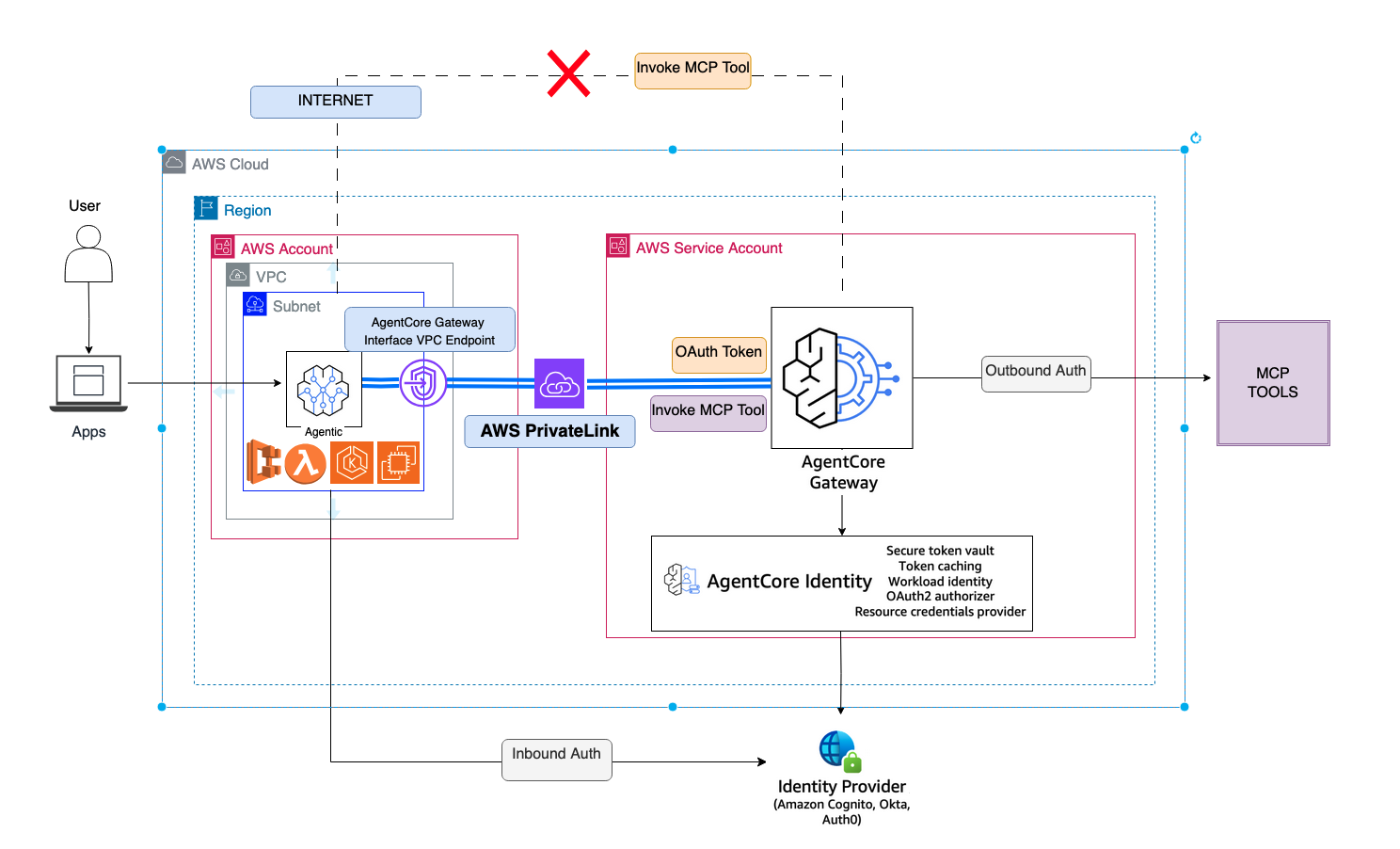
Secure ingress connectivity to Amazon Bedrock AgentCore Gateway using interface VPC endpointsArtificial Intelligence In this post, we demonstrate how to access AgentCore Gateway through a VPC interface endpoint from an Amazon Elastic Compute Cloud (Amazon EC2) instance in a VPC. We also show how to configure your VPC endpoint policy to provide secure access to the AgentCore Gateway while maintaining the principle of least privilege access.
In this post, we demonstrate how to access AgentCore Gateway through a VPC interface endpoint from an Amazon Elastic Compute Cloud (Amazon EC2) instance in a VPC. We also show how to configure your VPC endpoint policy to provide secure access to the AgentCore Gateway while maintaining the principle of least privilege access. Read More
What happens when generative AI models train recursively on each others’ outputs?cs.AI updates on arXiv.org arXiv:2505.21677v3 Announce Type: replace-cross
Abstract: The internet serves as a common source of training data for generative AI (genAI) models but is increasingly populated with AI-generated content. This duality raises the possibility that future genAI models may be trained on other models’ generated outputs. Prior work has studied consequences of models training on their own generated outputs, but limited work has considered what happens if models ingest content produced by other models. Given society’s increasing dependence on genAI tools, understanding such data-mediated model interactions is critical. This work provides empirical evidence for how data-mediated interactions might unfold in practice, develops a theoretical model for this interactive training process, and experimentally validates the theory. We find that data-mediated interactions can benefit models by exposing them to novel concepts perhaps missed in original training data, but also can homogenize their performance on shared tasks.
arXiv:2505.21677v3 Announce Type: replace-cross
Abstract: The internet serves as a common source of training data for generative AI (genAI) models but is increasingly populated with AI-generated content. This duality raises the possibility that future genAI models may be trained on other models’ generated outputs. Prior work has studied consequences of models training on their own generated outputs, but limited work has considered what happens if models ingest content produced by other models. Given society’s increasing dependence on genAI tools, understanding such data-mediated model interactions is critical. This work provides empirical evidence for how data-mediated interactions might unfold in practice, develops a theoretical model for this interactive training process, and experimentally validates the theory. We find that data-mediated interactions can benefit models by exposing them to novel concepts perhaps missed in original training data, but also can homogenize their performance on shared tasks. Read More
Interactive Learning for LLM Reasoningcs.AI updates on arXiv.org arXiv:2509.26306v3 Announce Type: replace
Abstract: Existing multi-agent learning approaches have developed interactive training environments to explicitly promote collaboration among multiple Large Language Models (LLMs), thereby constructing stronger multi-agent systems (MAS). However, during inference, they require re-executing the MAS to obtain final solutions, which diverges from human cognition that individuals can enhance their reasoning capabilities through interactions with others and resolve questions independently in the future. To investigate whether multi-agent interaction can enhance LLMs’ independent problem-solving ability, we introduce ILR, a novel co-learning framework for MAS that integrates two key components: Dynamic Interaction and Perception Calibration. Specifically, Dynamic Interaction first adaptively selects either cooperative or competitive strategies depending on question difficulty and model ability. LLMs then exchange information through Idea3 (Idea Sharing, Idea Analysis, and Idea Fusion), an innovative interaction paradigm designed to mimic human discussion, before deriving their respective final answers. In Perception Calibration, ILR employs Group Relative Policy Optimization (GRPO) to train LLMs while integrating one LLM’s reward distribution characteristics into another’s reward function, thereby enhancing the cohesion of multi-agent interactions. We validate ILR on three LLMs across two model families of varying scales, evaluating performance on five mathematical benchmarks and one coding benchmark. Experimental results show that ILR consistently outperforms single-agent learning, yielding an improvement of up to 5% over the strongest baseline. We further discover that Idea3 can enhance the robustness of stronger LLMs during multi-agent inference, and dynamic interaction types can boost multi-agent learning compared to pure cooperative or competitive strategies.
arXiv:2509.26306v3 Announce Type: replace
Abstract: Existing multi-agent learning approaches have developed interactive training environments to explicitly promote collaboration among multiple Large Language Models (LLMs), thereby constructing stronger multi-agent systems (MAS). However, during inference, they require re-executing the MAS to obtain final solutions, which diverges from human cognition that individuals can enhance their reasoning capabilities through interactions with others and resolve questions independently in the future. To investigate whether multi-agent interaction can enhance LLMs’ independent problem-solving ability, we introduce ILR, a novel co-learning framework for MAS that integrates two key components: Dynamic Interaction and Perception Calibration. Specifically, Dynamic Interaction first adaptively selects either cooperative or competitive strategies depending on question difficulty and model ability. LLMs then exchange information through Idea3 (Idea Sharing, Idea Analysis, and Idea Fusion), an innovative interaction paradigm designed to mimic human discussion, before deriving their respective final answers. In Perception Calibration, ILR employs Group Relative Policy Optimization (GRPO) to train LLMs while integrating one LLM’s reward distribution characteristics into another’s reward function, thereby enhancing the cohesion of multi-agent interactions. We validate ILR on three LLMs across two model families of varying scales, evaluating performance on five mathematical benchmarks and one coding benchmark. Experimental results show that ILR consistently outperforms single-agent learning, yielding an improvement of up to 5% over the strongest baseline. We further discover that Idea3 can enhance the robustness of stronger LLMs during multi-agent inference, and dynamic interaction types can boost multi-agent learning compared to pure cooperative or competitive strategies. Read More