
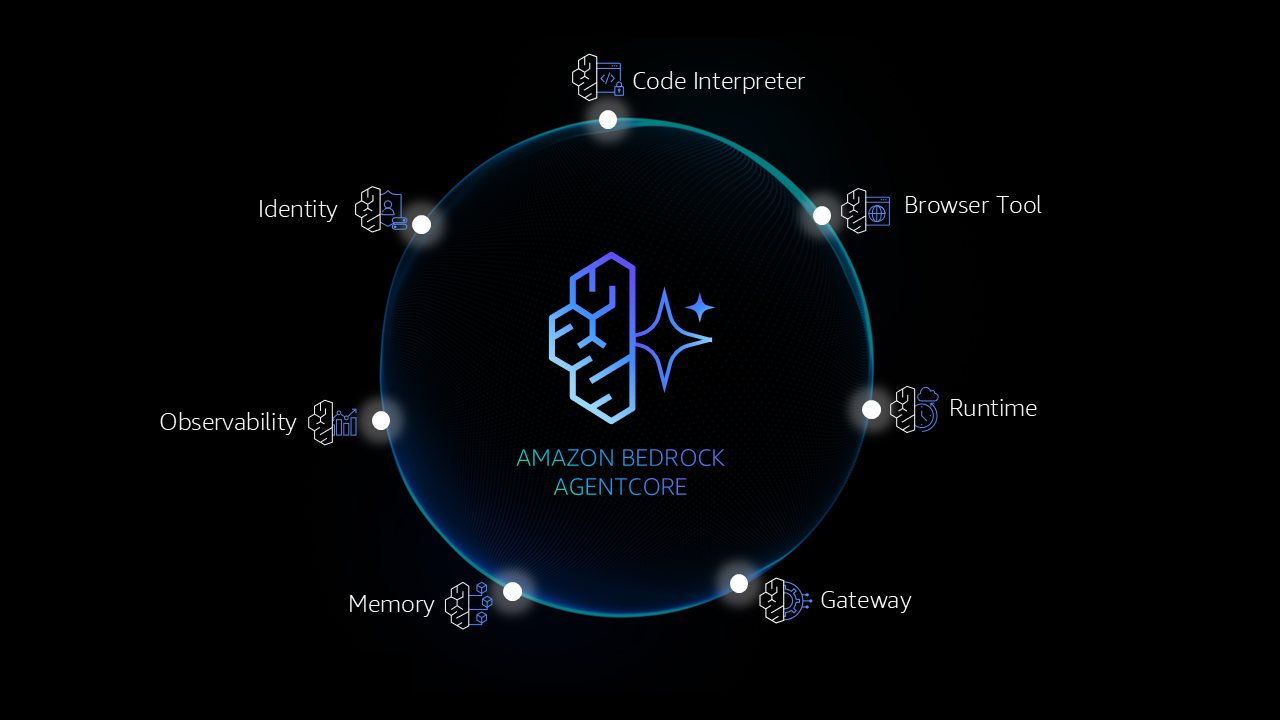
Make agents a reality with Amazon Bedrock AgentCore: Now generally availableArtificial Intelligence Learn why customers choose AgentCore to build secure, reliable AI solutions using their choice of frameworks and models for production workloads.
Learn why customers choose AgentCore to build secure, reliable AI solutions using their choice of frameworks and models for production workloads. Read More

OpenAI and Broadcom announce strategic collaboration to deploy 10 gigawatts of OpenAI-designed AI acceleratorsOpenAI News OpenAI and Broadcom announce a multi-year partnership to deploy 10 gigawatts of OpenAI-designed AI accelerators, co-developing next-generation systems and Ethernet solutions to power scalable, energy-efficient AI infrastructure by 2029.
OpenAI and Broadcom announce a multi-year partnership to deploy 10 gigawatts of OpenAI-designed AI accelerators, co-developing next-generation systems and Ethernet solutions to power scalable, energy-efficient AI infrastructure by 2029. Read More
What Is Your Agent’s GPA? A Framework for Evaluating Agent Goal-Plan-Action Alignmentcs.AI updates on arXiv.org arXiv:2510.08847v1 Announce Type: new
Abstract: We introduce the Agent GPA (Goal-Plan-Action) framework: an evaluation paradigm based on an agent’s operational loop of setting goals, devising plans, and executing actions. The framework includes five evaluation metrics: Goal Fulfillment, Logical Consistency, Execution Efficiency, Plan Quality, and Plan Adherence. Logical Consistency checks that an agent’s actions are consistent with its prior actions. Execution Efficiency checks whether the agent executes in the most efficient way to achieve its goal. Plan Quality checks whether an agent’s plans are aligned with its goals; Plan Adherence checks if an agent’s actions are aligned with its plan; and Goal Fulfillment checks that agent’s final outcomes match the stated goals. Our experimental results on two benchmark datasets – the public TRAIL/GAIA dataset and an internal dataset for a production-grade data agent – show that this framework (a) provides a systematic way to cover a broad range of agent failures, including all agent errors on the TRAIL/GAIA benchmark dataset; (b) supports LLM-judges that exhibit strong agreement with human annotation, covering 80% to over 95% errors; and (c) localizes errors with 86% agreement to enable targeted improvement of agent performance.
arXiv:2510.08847v1 Announce Type: new
Abstract: We introduce the Agent GPA (Goal-Plan-Action) framework: an evaluation paradigm based on an agent’s operational loop of setting goals, devising plans, and executing actions. The framework includes five evaluation metrics: Goal Fulfillment, Logical Consistency, Execution Efficiency, Plan Quality, and Plan Adherence. Logical Consistency checks that an agent’s actions are consistent with its prior actions. Execution Efficiency checks whether the agent executes in the most efficient way to achieve its goal. Plan Quality checks whether an agent’s plans are aligned with its goals; Plan Adherence checks if an agent’s actions are aligned with its plan; and Goal Fulfillment checks that agent’s final outcomes match the stated goals. Our experimental results on two benchmark datasets – the public TRAIL/GAIA dataset and an internal dataset for a production-grade data agent – show that this framework (a) provides a systematic way to cover a broad range of agent failures, including all agent errors on the TRAIL/GAIA benchmark dataset; (b) supports LLM-judges that exhibit strong agreement with human annotation, covering 80% to over 95% errors; and (c) localizes errors with 86% agreement to enable targeted improvement of agent performance. Read More
Barbarians at the Gate: How AI is Upending Systems Researchcs.AI updates on arXiv.org arXiv:2510.06189v3 Announce Type: replace
Abstract: Artificial Intelligence (AI) is starting to transform the research process as we know it by automating the discovery of new solutions. Given a task, the typical AI-driven approach is (i) to generate a set of diverse solutions, and then (ii) to verify these solutions and select one that solves the problem. Crucially, this approach assumes the existence of a reliable verifier, i.e., one that can accurately determine whether a solution solves the given problem. We argue that systems research, long focused on designing and evaluating new performance-oriented algorithms, is particularly well-suited for AI-driven solution discovery. This is because system performance problems naturally admit reliable verifiers: solutions are typically implemented in real systems or simulators, and verification reduces to running these software artifacts against predefined workloads and measuring performance. We term this approach as AI-Driven Research for Systems (ADRS), which iteratively generates, evaluates, and refines solutions. Using penEvolve, an existing open-source ADRS instance, we present case studies across diverse domains, including load balancing for multi-region cloud scheduling, Mixture-of-Experts inference, LLM-based SQL queries, and transaction scheduling. In multiple instances, ADRS discovers algorithms that outperform state-of-the-art human designs (e.g., achieving up to 5.0x runtime improvements or 50% cost reductions). We distill best practices for guiding algorithm evolution, from prompt design to evaluator construction, for existing frameworks. We then discuss the broader implications for the systems community: as AI assumes a central role in algorithm design, we argue that human researchers will increasingly focus on problem formulation and strategic guidance. Our results highlight both the disruptive potential and the urgent need to adapt systems research practices in the age of AI.
arXiv:2510.06189v3 Announce Type: replace
Abstract: Artificial Intelligence (AI) is starting to transform the research process as we know it by automating the discovery of new solutions. Given a task, the typical AI-driven approach is (i) to generate a set of diverse solutions, and then (ii) to verify these solutions and select one that solves the problem. Crucially, this approach assumes the existence of a reliable verifier, i.e., one that can accurately determine whether a solution solves the given problem. We argue that systems research, long focused on designing and evaluating new performance-oriented algorithms, is particularly well-suited for AI-driven solution discovery. This is because system performance problems naturally admit reliable verifiers: solutions are typically implemented in real systems or simulators, and verification reduces to running these software artifacts against predefined workloads and measuring performance. We term this approach as AI-Driven Research for Systems (ADRS), which iteratively generates, evaluates, and refines solutions. Using penEvolve, an existing open-source ADRS instance, we present case studies across diverse domains, including load balancing for multi-region cloud scheduling, Mixture-of-Experts inference, LLM-based SQL queries, and transaction scheduling. In multiple instances, ADRS discovers algorithms that outperform state-of-the-art human designs (e.g., achieving up to 5.0x runtime improvements or 50% cost reductions). We distill best practices for guiding algorithm evolution, from prompt design to evaluator construction, for existing frameworks. We then discuss the broader implications for the systems community: as AI assumes a central role in algorithm design, we argue that human researchers will increasingly focus on problem formulation and strategic guidance. Our results highlight both the disruptive potential and the urgent need to adapt systems research practices in the age of AI. Read More
Beyond Single-Granularity Prompts: A Multi-Scale Chain-of-Thought Prompt Learning for Graphcs.AI updates on arXiv.org arXiv:2510.09394v1 Announce Type: cross
Abstract: The “pre-train, prompt” paradigm, designed to bridge the gap between pre-training tasks and downstream objectives, has been extended from the NLP domain to the graph domain and has achieved remarkable progress. Current mainstream graph prompt-tuning methods modify input or output features using learnable prompt vectors. However, existing approaches are confined to single-granularity (e.g., node-level or subgraph-level) during prompt generation, overlooking the inherently multi-scale structural information in graph data, which limits the diversity of prompt semantics. To address this issue, we pioneer the integration of multi-scale information into graph prompt and propose a Multi-Scale Graph Chain-of-Thought (MSGCOT) prompting framework. Specifically, we design a lightweight, low-rank coarsening network to efficiently capture multi-scale structural features as hierarchical basis vectors for prompt generation. Subsequently, mimicking human cognition from coarse-to-fine granularity, we dynamically integrate multi-scale information at each reasoning step, forming a progressive coarse-to-fine prompt chain. Extensive experiments on eight benchmark datasets demonstrate that MSGCOT outperforms the state-of-the-art single-granularity graph prompt-tuning method, particularly in few-shot scenarios, showcasing superior performance.
arXiv:2510.09394v1 Announce Type: cross
Abstract: The “pre-train, prompt” paradigm, designed to bridge the gap between pre-training tasks and downstream objectives, has been extended from the NLP domain to the graph domain and has achieved remarkable progress. Current mainstream graph prompt-tuning methods modify input or output features using learnable prompt vectors. However, existing approaches are confined to single-granularity (e.g., node-level or subgraph-level) during prompt generation, overlooking the inherently multi-scale structural information in graph data, which limits the diversity of prompt semantics. To address this issue, we pioneer the integration of multi-scale information into graph prompt and propose a Multi-Scale Graph Chain-of-Thought (MSGCOT) prompting framework. Specifically, we design a lightweight, low-rank coarsening network to efficiently capture multi-scale structural features as hierarchical basis vectors for prompt generation. Subsequently, mimicking human cognition from coarse-to-fine granularity, we dynamically integrate multi-scale information at each reasoning step, forming a progressive coarse-to-fine prompt chain. Extensive experiments on eight benchmark datasets demonstrate that MSGCOT outperforms the state-of-the-art single-granularity graph prompt-tuning method, particularly in few-shot scenarios, showcasing superior performance. Read More
A methodology for clinically driven interactive segmentation evaluationcs.AI updates on arXiv.org arXiv:2510.09499v1 Announce Type: cross
Abstract: Interactive segmentation is a promising strategy for building robust, generalisable algorithms for volumetric medical image segmentation. However, inconsistent and clinically unrealistic evaluation hinders fair comparison and misrepresents real-world performance. We propose a clinically grounded methodology for defining evaluation tasks and metrics, and built a software framework for constructing standardised evaluation pipelines. We evaluate state-of-the-art algorithms across heterogeneous and complex tasks and observe that (i) minimising information loss when processing user interactions is critical for model robustness, (ii) adaptive-zooming mechanisms boost robustness and speed convergence, (iii) performance drops if validation prompting behaviour/budgets differ from training, (iv) 2D methods perform well with slab-like images and coarse targets, but 3D context helps with large or irregularly shaped targets, (v) performance of non-medical-domain models (e.g. SAM2) degrades with poor contrast and complex shapes.
arXiv:2510.09499v1 Announce Type: cross
Abstract: Interactive segmentation is a promising strategy for building robust, generalisable algorithms for volumetric medical image segmentation. However, inconsistent and clinically unrealistic evaluation hinders fair comparison and misrepresents real-world performance. We propose a clinically grounded methodology for defining evaluation tasks and metrics, and built a software framework for constructing standardised evaluation pipelines. We evaluate state-of-the-art algorithms across heterogeneous and complex tasks and observe that (i) minimising information loss when processing user interactions is critical for model robustness, (ii) adaptive-zooming mechanisms boost robustness and speed convergence, (iii) performance drops if validation prompting behaviour/budgets differ from training, (iv) 2D methods perform well with slab-like images and coarse targets, but 3D context helps with large or irregularly shaped targets, (v) performance of non-medical-domain models (e.g. SAM2) degrades with poor contrast and complex shapes. Read More
RAGDiffusion: Faithful Cloth Generation via External Knowledge Assimilationcs.AI updates on arXiv.org arXiv:2411.19528v3 Announce Type: replace-cross
Abstract: Standard clothing asset generation involves restoring forward-facing flat-lay garment images displayed on a clear background by extracting clothing information from diverse real-world contexts, which presents significant challenges due to highly standardized structure sampling distributions and clothing semantic absence in complex scenarios. Existing models have limited spatial perception, often exhibiting structural hallucinations and texture distortion in this high-specification generative task. To address this issue, we propose a novel Retrieval-Augmented Generation (RAG) framework, termed RAGDiffusion, to enhance structure determinacy and mitigate hallucinations by assimilating knowledge from language models and external databases. RAGDiffusion consists of two processes: (1) Retrieval-based structure aggregation, which employs contrastive learning and a Structure Locally Linear Embedding (SLLE) to derive global structure and spatial landmarks, providing both soft and hard guidance to counteract structural ambiguities; and (2) Omni-level faithful garment generation, which introduces a coarse-to-fine texture alignment that ensures fidelity in pattern and detail components within the diffusing. Extensive experiments on challenging real-world datasets demonstrate that RAGDiffusion synthesizes structurally and texture-faithful clothing assets with significant performance improvements, representing a pioneering effort in high-specification faithful generation with RAG to confront intrinsic hallucinations and enhance fidelity.
arXiv:2411.19528v3 Announce Type: replace-cross
Abstract: Standard clothing asset generation involves restoring forward-facing flat-lay garment images displayed on a clear background by extracting clothing information from diverse real-world contexts, which presents significant challenges due to highly standardized structure sampling distributions and clothing semantic absence in complex scenarios. Existing models have limited spatial perception, often exhibiting structural hallucinations and texture distortion in this high-specification generative task. To address this issue, we propose a novel Retrieval-Augmented Generation (RAG) framework, termed RAGDiffusion, to enhance structure determinacy and mitigate hallucinations by assimilating knowledge from language models and external databases. RAGDiffusion consists of two processes: (1) Retrieval-based structure aggregation, which employs contrastive learning and a Structure Locally Linear Embedding (SLLE) to derive global structure and spatial landmarks, providing both soft and hard guidance to counteract structural ambiguities; and (2) Omni-level faithful garment generation, which introduces a coarse-to-fine texture alignment that ensures fidelity in pattern and detail components within the diffusing. Extensive experiments on challenging real-world datasets demonstrate that RAGDiffusion synthesizes structurally and texture-faithful clothing assets with significant performance improvements, representing a pioneering effort in high-specification faithful generation with RAG to confront intrinsic hallucinations and enhance fidelity. Read More
Reimagining Agent-based Modeling with Large Language Model Agents via Shachics.AI updates on arXiv.org arXiv:2509.21862v2 Announce Type: replace
Abstract: The study of emergent behaviors in large language model (LLM)-driven multi-agent systems is a critical research challenge, yet progress is limited by a lack of principled methodologies for controlled experimentation. To address this, we introduce Shachi, a formal methodology and modular framework that decomposes an agent’s policy into core cognitive components: Configuration for intrinsic traits, Memory for contextual persistence, and Tools for expanded capabilities, all orchestrated by an LLM reasoning engine. This principled architecture moves beyond brittle, ad-hoc agent designs and enables the systematic analysis of how specific architectural choices influence collective behavior. We validate our methodology on a comprehensive 10-task benchmark and demonstrate its power through novel scientific inquiries. Critically, we establish the external validity of our approach by modeling a real-world U.S. tariff shock, showing that agent behaviors align with observed market reactions only when their cognitive architecture is appropriately configured with memory and tools. Our work provides a rigorous, open-source foundation for building and evaluating LLM agents, aimed at fostering more cumulative and scientifically grounded research.
arXiv:2509.21862v2 Announce Type: replace
Abstract: The study of emergent behaviors in large language model (LLM)-driven multi-agent systems is a critical research challenge, yet progress is limited by a lack of principled methodologies for controlled experimentation. To address this, we introduce Shachi, a formal methodology and modular framework that decomposes an agent’s policy into core cognitive components: Configuration for intrinsic traits, Memory for contextual persistence, and Tools for expanded capabilities, all orchestrated by an LLM reasoning engine. This principled architecture moves beyond brittle, ad-hoc agent designs and enables the systematic analysis of how specific architectural choices influence collective behavior. We validate our methodology on a comprehensive 10-task benchmark and demonstrate its power through novel scientific inquiries. Critically, we establish the external validity of our approach by modeling a real-world U.S. tariff shock, showing that agent behaviors align with observed market reactions only when their cognitive architecture is appropriately configured with memory and tools. Our work provides a rigorous, open-source foundation for building and evaluating LLM agents, aimed at fostering more cumulative and scientifically grounded research. Read More
E-ICL: Enhancing Fine-Grained Emotion Recognition through the Lens of Prototype Theorycs.AI updates on arXiv.org arXiv:2406.02642v4 Announce Type: replace-cross
Abstract: In-context learning (ICL) achieves remarkable performance in various domains such as knowledge acquisition, commonsense reasoning, and semantic understanding. However, its performance significantly deteriorates for emotion detection tasks, especially fine-grained emotion recognition. The underlying reasons for this remain unclear. In this paper, we identify the reasons behind ICL’s poor performance from the perspective of prototype theory and propose a method to address this issue. Specifically, we conduct extensive pilot experiments and find that ICL conforms to the prototype theory on fine-grained emotion recognition. Based on this theory, we uncover the following deficiencies in ICL: (1) It relies on prototypes (example-label pairs) that are semantically similar but emotionally inaccurate to predict emotions. (2) It is prone to interference from irrelevant categories, affecting the accuracy and robustness of the predictions. To address these issues, we propose an Emotion Context Learning method (E-ICL) on fine-grained emotion recognition. E-ICL relies on more emotionally accurate prototypes to predict categories by referring to emotionally similar examples with dynamic labels. Simultaneously, E-ICL employs an exclusionary emotion prediction strategy to avoid interference from irrelevant categories, thereby increasing its accuracy and robustness. Note that the entire process is accomplished with the assistance of a plug-and-play emotion auxiliary model, without additional training. Experiments on the fine-grained emotion datasets EDOS, Empathetic-Dialogues, EmpatheticIntent, and GoEmotions show that E-ICL achieves superior emotion prediction performance. Furthermore, even when the emotion auxiliary model used is lower than 10% of the LLMs, E-ICL can still boost the performance of LLMs by over 4% on multiple datasets.
arXiv:2406.02642v4 Announce Type: replace-cross
Abstract: In-context learning (ICL) achieves remarkable performance in various domains such as knowledge acquisition, commonsense reasoning, and semantic understanding. However, its performance significantly deteriorates for emotion detection tasks, especially fine-grained emotion recognition. The underlying reasons for this remain unclear. In this paper, we identify the reasons behind ICL’s poor performance from the perspective of prototype theory and propose a method to address this issue. Specifically, we conduct extensive pilot experiments and find that ICL conforms to the prototype theory on fine-grained emotion recognition. Based on this theory, we uncover the following deficiencies in ICL: (1) It relies on prototypes (example-label pairs) that are semantically similar but emotionally inaccurate to predict emotions. (2) It is prone to interference from irrelevant categories, affecting the accuracy and robustness of the predictions. To address these issues, we propose an Emotion Context Learning method (E-ICL) on fine-grained emotion recognition. E-ICL relies on more emotionally accurate prototypes to predict categories by referring to emotionally similar examples with dynamic labels. Simultaneously, E-ICL employs an exclusionary emotion prediction strategy to avoid interference from irrelevant categories, thereby increasing its accuracy and robustness. Note that the entire process is accomplished with the assistance of a plug-and-play emotion auxiliary model, without additional training. Experiments on the fine-grained emotion datasets EDOS, Empathetic-Dialogues, EmpatheticIntent, and GoEmotions show that E-ICL achieves superior emotion prediction performance. Furthermore, even when the emotion auxiliary model used is lower than 10% of the LLMs, E-ICL can still boost the performance of LLMs by over 4% on multiple datasets. Read More

The Download: planet hunting, and India’s e-scootersMIT Technology Review This is today’s edition of The Download, our weekday newsletter that provides a daily dose of what’s going on in the world of technology. An Earthling’s guide to planet hunting The pendant on Rebecca Jensen-Clem’s necklace is composed of 36 silver hexagons entwined in a honeycomb mosaic. At the Keck Observatory, in Hawaii, just as many segments…
This is today’s edition of The Download, our weekday newsletter that provides a daily dose of what’s going on in the world of technology. An Earthling’s guide to planet hunting The pendant on Rebecca Jensen-Clem’s necklace is composed of 36 silver hexagons entwined in a honeycomb mosaic. At the Keck Observatory, in Hawaii, just as many segments… Read More