

Axial Neural Networks for Dimension-Free Foundation Modelscs.AI updates on arXiv.org arXiv:2510.13665v1 Announce Type: cross
Abstract: The advent of foundation models in AI has significantly advanced general-purpose learning, enabling remarkable capabilities in zero-shot inference and in-context learning. However, training such models on physics data, including solutions to partial differential equations (PDEs), poses a unique challenge due to varying dimensionalities across different systems. Traditional approaches either fix a maximum dimension or employ separate encoders for different dimensionalities, resulting in inefficiencies. To address this, we propose a dimension-agnostic neural network architecture, the Axial Neural Network (XNN), inspired by parameter-sharing structures such as Deep Sets and Graph Neural Networks. XNN generalizes across varying tensor dimensions while maintaining computational efficiency. We convert existing PDE foundation models into axial neural networks and evaluate their performance across three training scenarios: training from scratch, pretraining on multiple PDEs, and fine-tuning on a single PDE. Our experiments show that XNNs perform competitively with original models and exhibit superior generalization to unseen dimensions, highlighting the importance of multidimensional pretraining for foundation models.
arXiv:2510.13665v1 Announce Type: cross
Abstract: The advent of foundation models in AI has significantly advanced general-purpose learning, enabling remarkable capabilities in zero-shot inference and in-context learning. However, training such models on physics data, including solutions to partial differential equations (PDEs), poses a unique challenge due to varying dimensionalities across different systems. Traditional approaches either fix a maximum dimension or employ separate encoders for different dimensionalities, resulting in inefficiencies. To address this, we propose a dimension-agnostic neural network architecture, the Axial Neural Network (XNN), inspired by parameter-sharing structures such as Deep Sets and Graph Neural Networks. XNN generalizes across varying tensor dimensions while maintaining computational efficiency. We convert existing PDE foundation models into axial neural networks and evaluate their performance across three training scenarios: training from scratch, pretraining on multiple PDEs, and fine-tuning on a single PDE. Our experiments show that XNNs perform competitively with original models and exhibit superior generalization to unseen dimensions, highlighting the importance of multidimensional pretraining for foundation models. Read More
MedREK: Retrieval-Based Editing for Medical LLMs with Key-Aware Promptscs.AI updates on arXiv.org arXiv:2510.13500v1 Announce Type: cross
Abstract: LLMs hold great promise for healthcare applications, but the rapid evolution of medical knowledge and errors in training data often cause them to generate outdated or inaccurate information, limiting their applicability in high-stakes clinical practice. Model editing has emerged as a potential remedy without full retraining. While parameter-based editing often compromises locality and is thus ill-suited for the medical domain, retrieval-based editing offers a more viable alternative. However, it still faces two critical challenges: (1) representation overlap within the medical knowledge space often causes inaccurate retrieval and reduces editing accuracy; (2) existing methods are restricted to single-sample edits, while batch-editing remains largely unexplored despite its importance for real-world medical applications. To address these challenges, we first construct MedVersa, hk{an enhanced benchmark with broader coverage of medical subjects, designed to evaluate both single and batch edits under strict locality constraints}. We then propose MedREK, a retrieval-based editing framework that integrates a shared query-key module for precise matching with an attention-based prompt encoder for informative guidance. Experimental results on various medical benchmarks demonstrate that our MedREK achieves superior performance across different core metrics and provides the first validated solution for batch-editing in medical LLMs. Our code and dataset are available at https://github.com/mylittleriver/MedREK.
arXiv:2510.13500v1 Announce Type: cross
Abstract: LLMs hold great promise for healthcare applications, but the rapid evolution of medical knowledge and errors in training data often cause them to generate outdated or inaccurate information, limiting their applicability in high-stakes clinical practice. Model editing has emerged as a potential remedy without full retraining. While parameter-based editing often compromises locality and is thus ill-suited for the medical domain, retrieval-based editing offers a more viable alternative. However, it still faces two critical challenges: (1) representation overlap within the medical knowledge space often causes inaccurate retrieval and reduces editing accuracy; (2) existing methods are restricted to single-sample edits, while batch-editing remains largely unexplored despite its importance for real-world medical applications. To address these challenges, we first construct MedVersa, hk{an enhanced benchmark with broader coverage of medical subjects, designed to evaluate both single and batch edits under strict locality constraints}. We then propose MedREK, a retrieval-based editing framework that integrates a shared query-key module for precise matching with an attention-based prompt encoder for informative guidance. Experimental results on various medical benchmarks demonstrate that our MedREK achieves superior performance across different core metrics and provides the first validated solution for batch-editing in medical LLMs. Our code and dataset are available at https://github.com/mylittleriver/MedREK. Read More

MHRA fast-tracks next wave of AI tools for patient careAI News Healthcare regulator MHRA is fast-tracking new AI tools that promise to dramatically improve patient care. The wait for medical test results can stretch from days, to weeks, or even months. That wait period is often filled with worry and it always feels like an eternity. But what if that wait could be cut from weeks
The post MHRA fast-tracks next wave of AI tools for patient care appeared first on AI News.
Healthcare regulator MHRA is fast-tracking new AI tools that promise to dramatically improve patient care. The wait for medical test results can stretch from days, to weeks, or even months. That wait period is often filled with worry and it always feels like an eternity. But what if that wait could be cut from weeks
The post MHRA fast-tracks next wave of AI tools for patient care appeared first on AI News. Read More
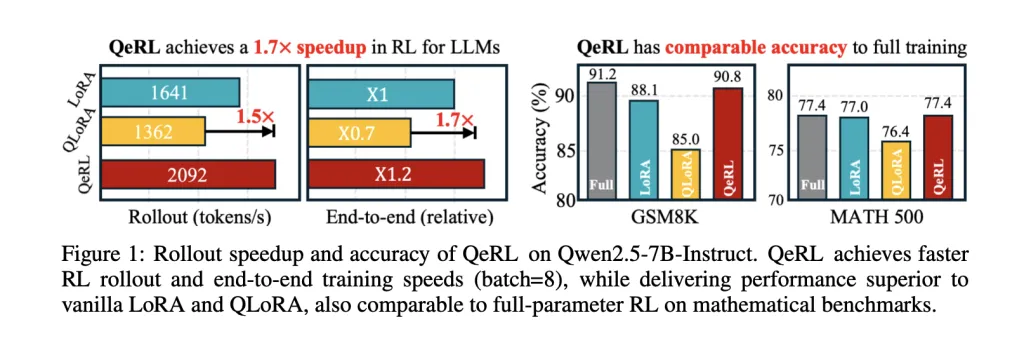
QeRL: NVFP4-Quantized Reinforcement Learning (RL) Brings 32B LLM Training to a Single H100—While Improving ExplorationMarkTechPost What would you build if you could run Reinforcement Learning (RL) post-training on a 32B LLM in 4-bit NVFP4—on a single H100—with BF16-level accuracy and 1.2–1.5× step speedups? NVIDIA researchers (with collaborators from MIT, HKU, and Tsinghua) have open-sourced QeRL (Quantization-enhanced Reinforcement Learning), a training framework that pushes Reinforcement Learning (RL) post-training into 4-bit FP4
The post QeRL: NVFP4-Quantized Reinforcement Learning (RL) Brings 32B LLM Training to a Single H100—While Improving Exploration appeared first on MarkTechPost.
What would you build if you could run Reinforcement Learning (RL) post-training on a 32B LLM in 4-bit NVFP4—on a single H100—with BF16-level accuracy and 1.2–1.5× step speedups? NVIDIA researchers (with collaborators from MIT, HKU, and Tsinghua) have open-sourced QeRL (Quantization-enhanced Reinforcement Learning), a training framework that pushes Reinforcement Learning (RL) post-training into 4-bit FP4
The post QeRL: NVFP4-Quantized Reinforcement Learning (RL) Brings 32B LLM Training to a Single H100—While Improving Exploration appeared first on MarkTechPost. Read More
MADREC: A Multi-Aspect Driven LLM Agent for Explainable and Adaptive Recommendationcs.AI updates on arXiv.org arXiv:2510.13371v1 Announce Type: cross
Abstract: Recent attempts to integrate large language models (LLMs) into recommender systems have gained momentum, but most remain limited to simple text generation or static prompt-based inference, failing to capture the complexity of user preferences and real-world interactions. This study proposes the Multi-Aspect Driven LLM Agent MADRec, an autonomous LLM-based recommender that constructs user and item profiles by unsupervised extraction of multi-aspect information from reviews and performs direct recommendation, sequential recommendation, and explanation generation. MADRec generates structured profiles via aspect-category-based summarization and applies Re-Ranking to construct high-density inputs. When the ground-truth item is missing from the output, the Self-Feedback mechanism dynamically adjusts the inference criteria. Experiments across multiple domains show that MADRec outperforms traditional and LLM-based baselines in both precision and explainability, with human evaluation further confirming the persuasiveness of the generated explanations.
arXiv:2510.13371v1 Announce Type: cross
Abstract: Recent attempts to integrate large language models (LLMs) into recommender systems have gained momentum, but most remain limited to simple text generation or static prompt-based inference, failing to capture the complexity of user preferences and real-world interactions. This study proposes the Multi-Aspect Driven LLM Agent MADRec, an autonomous LLM-based recommender that constructs user and item profiles by unsupervised extraction of multi-aspect information from reviews and performs direct recommendation, sequential recommendation, and explanation generation. MADRec generates structured profiles via aspect-category-based summarization and applies Re-Ranking to construct high-density inputs. When the ground-truth item is missing from the output, the Self-Feedback mechanism dynamically adjusts the inference criteria. Experiments across multiple domains show that MADRec outperforms traditional and LLM-based baselines in both precision and explainability, with human evaluation further confirming the persuasiveness of the generated explanations. Read More
AOAD-MAT: Transformer-based multi-agent deep reinforcement learning model considering agents’ order of action decisionscs.AI updates on arXiv.org arXiv:2510.13343v1 Announce Type: cross
Abstract: Multi-agent reinforcement learning focuses on training the behaviors of multiple learning agents that coexist in a shared environment. Recently, MARL models, such as the Multi-Agent Transformer (MAT) and ACtion dEpendent deep Q-learning (ACE), have significantly improved performance by leveraging sequential decision-making processes. Although these models can enhance performance, they do not explicitly consider the importance of the order in which agents make decisions. In this paper, we propose an Agent Order of Action Decisions-MAT (AOAD-MAT), a novel MAT model that considers the order in which agents make decisions. The proposed model explicitly incorporates the sequence of action decisions into the learning process, allowing the model to learn and predict the optimal order of agent actions. The AOAD-MAT model leverages a Transformer-based actor-critic architecture that dynamically adjusts the sequence of agent actions. To achieve this, we introduce a novel MARL architecture that cooperates with a subtask focused on predicting the next agent to act, integrated into a Proximal Policy Optimization based loss function to synergistically maximize the advantage of the sequential decision-making. The proposed method was validated through extensive experiments on the StarCraft Multi-Agent Challenge and Multi-Agent MuJoCo benchmarks. The experimental results show that the proposed AOAD-MAT model outperforms existing MAT and other baseline models, demonstrating the effectiveness of adjusting the AOAD order in MARL.
arXiv:2510.13343v1 Announce Type: cross
Abstract: Multi-agent reinforcement learning focuses on training the behaviors of multiple learning agents that coexist in a shared environment. Recently, MARL models, such as the Multi-Agent Transformer (MAT) and ACtion dEpendent deep Q-learning (ACE), have significantly improved performance by leveraging sequential decision-making processes. Although these models can enhance performance, they do not explicitly consider the importance of the order in which agents make decisions. In this paper, we propose an Agent Order of Action Decisions-MAT (AOAD-MAT), a novel MAT model that considers the order in which agents make decisions. The proposed model explicitly incorporates the sequence of action decisions into the learning process, allowing the model to learn and predict the optimal order of agent actions. The AOAD-MAT model leverages a Transformer-based actor-critic architecture that dynamically adjusts the sequence of agent actions. To achieve this, we introduce a novel MARL architecture that cooperates with a subtask focused on predicting the next agent to act, integrated into a Proximal Policy Optimization based loss function to synergistically maximize the advantage of the sequential decision-making. The proposed method was validated through extensive experiments on the StarCraft Multi-Agent Challenge and Multi-Agent MuJoCo benchmarks. The experimental results show that the proposed AOAD-MAT model outperforms existing MAT and other baseline models, demonstrating the effectiveness of adjusting the AOAD order in MARL. Read More
SENTINEL: A Multi-Level Formal Framework for Safety Evaluation of LLM-based Embodied Agentscs.AI updates on arXiv.org arXiv:2510.12985v1 Announce Type: new
Abstract: We present Sentinel, the first framework for formally evaluating the physical safety of Large Language Model(LLM-based) embodied agents across the semantic, plan, and trajectory levels. Unlike prior methods that rely on heuristic rules or subjective LLM judgments, Sentinel grounds practical safety requirements in formal temporal logic (TL) semantics that can precisely specify state invariants, temporal dependencies, and timing constraints. It then employs a multi-level verification pipeline where (i) at the semantic level, intuitive natural language safety requirements are formalized into TL formulas and the LLM agent’s understanding of these requirements is probed for alignment with the TL formulas; (ii) at the plan level, high-level action plans and subgoals generated by the LLM agent are verified against the TL formulas to detect unsafe plans before execution; and (iii) at the trajectory level, multiple execution trajectories are merged into a computation tree and efficiently verified against physically-detailed TL specifications for a final safety check. We apply Sentinel in VirtualHome and ALFRED, and formally evaluate multiple LLM-based embodied agents against diverse safety requirements. Our experiments show that by grounding physical safety in temporal logic and applying verification methods across multiple levels, Sentinel provides a rigorous foundation for systematically evaluating LLM-based embodied agents in physical environments, exposing safety violations overlooked by previous methods and offering insights into their failure modes.
arXiv:2510.12985v1 Announce Type: new
Abstract: We present Sentinel, the first framework for formally evaluating the physical safety of Large Language Model(LLM-based) embodied agents across the semantic, plan, and trajectory levels. Unlike prior methods that rely on heuristic rules or subjective LLM judgments, Sentinel grounds practical safety requirements in formal temporal logic (TL) semantics that can precisely specify state invariants, temporal dependencies, and timing constraints. It then employs a multi-level verification pipeline where (i) at the semantic level, intuitive natural language safety requirements are formalized into TL formulas and the LLM agent’s understanding of these requirements is probed for alignment with the TL formulas; (ii) at the plan level, high-level action plans and subgoals generated by the LLM agent are verified against the TL formulas to detect unsafe plans before execution; and (iii) at the trajectory level, multiple execution trajectories are merged into a computation tree and efficiently verified against physically-detailed TL specifications for a final safety check. We apply Sentinel in VirtualHome and ALFRED, and formally evaluate multiple LLM-based embodied agents against diverse safety requirements. Our experiments show that by grounding physical safety in temporal logic and applying verification methods across multiple levels, Sentinel provides a rigorous foundation for systematically evaluating LLM-based embodied agents in physical environments, exposing safety violations overlooked by previous methods and offering insights into their failure modes. Read More
Behavioral Embeddings of Programs: A Quasi-Dynamic Approach for Optimization Predictioncs.AI updates on arXiv.org arXiv:2510.13158v1 Announce Type: cross
Abstract: Learning effective numerical representations, or embeddings, of programs is a fundamental prerequisite for applying machine learning to automate and enhance compiler optimization. Prevailing paradigms, however, present a dilemma. Static representations, derived from source code or intermediate representation (IR), are efficient and deterministic but offer limited insight into how a program will behave or evolve under complex code transformations. Conversely, dynamic representations, which rely on runtime profiling, provide profound insights into performance bottlenecks but are often impractical for large-scale tasks due to prohibitive overhead and inherent non-determinism. This paper transcends this trade-off by proposing a novel quasi-dynamic framework for program representation. The core insight is to model a program’s optimization sensitivity. We introduce the Program Behavior Spectrum, a new representation generated by probing a program’s IR with a diverse set of optimization sequences and quantifying the resulting changes in its static features. To effectively encode this high-dimensional, continuous spectrum, we pioneer a compositional learning approach. Product Quantization is employed to discretize the continuous reaction vectors into structured, compositional sub-words. Subsequently, a multi-task Transformer model, termed PQ-BERT, is pre-trained to learn the deep contextual grammar of these behavioral codes. Comprehensive experiments on two representative compiler optimization tasks — Best Pass Prediction and -Oz Benefit Prediction — demonstrate that our method outperforms state-of-the-art static baselines. Our code is publicly available at https://github.com/Panhaolin2001/PREP/.
arXiv:2510.13158v1 Announce Type: cross
Abstract: Learning effective numerical representations, or embeddings, of programs is a fundamental prerequisite for applying machine learning to automate and enhance compiler optimization. Prevailing paradigms, however, present a dilemma. Static representations, derived from source code or intermediate representation (IR), are efficient and deterministic but offer limited insight into how a program will behave or evolve under complex code transformations. Conversely, dynamic representations, which rely on runtime profiling, provide profound insights into performance bottlenecks but are often impractical for large-scale tasks due to prohibitive overhead and inherent non-determinism. This paper transcends this trade-off by proposing a novel quasi-dynamic framework for program representation. The core insight is to model a program’s optimization sensitivity. We introduce the Program Behavior Spectrum, a new representation generated by probing a program’s IR with a diverse set of optimization sequences and quantifying the resulting changes in its static features. To effectively encode this high-dimensional, continuous spectrum, we pioneer a compositional learning approach. Product Quantization is employed to discretize the continuous reaction vectors into structured, compositional sub-words. Subsequently, a multi-task Transformer model, termed PQ-BERT, is pre-trained to learn the deep contextual grammar of these behavioral codes. Comprehensive experiments on two representative compiler optimization tasks — Best Pass Prediction and -Oz Benefit Prediction — demonstrate that our method outperforms state-of-the-art static baselines. Our code is publicly available at https://github.com/Panhaolin2001/PREP/. Read More
Toward Reasoning-Centric Time-Series Analysiscs.AI updates on arXiv.org arXiv:2510.13029v1 Announce Type: new
Abstract: Traditional time series analysis has long relied on pattern recognition, trained on static and well-established benchmarks. However, in real-world settings — where policies shift, human behavior adapts, and unexpected events unfold — effective analysis must go beyond surface-level trends to uncover the actual forces driving them. The recent rise of Large Language Models (LLMs) presents new opportunities for rethinking time series analysis by integrating multimodal inputs. However, as the use of LLMs becomes popular, we must remain cautious, asking why we use LLMs and how to exploit them effectively. Most existing LLM-based methods still employ their numerical regression ability and ignore their deeper reasoning potential. This paper argues for rethinking time series with LLMs as a reasoning task that prioritizes causal structure and explainability. This shift brings time series analysis closer to human-aligned understanding, enabling transparent and context-aware insights in complex real-world environments.
arXiv:2510.13029v1 Announce Type: new
Abstract: Traditional time series analysis has long relied on pattern recognition, trained on static and well-established benchmarks. However, in real-world settings — where policies shift, human behavior adapts, and unexpected events unfold — effective analysis must go beyond surface-level trends to uncover the actual forces driving them. The recent rise of Large Language Models (LLMs) presents new opportunities for rethinking time series analysis by integrating multimodal inputs. However, as the use of LLMs becomes popular, we must remain cautious, asking why we use LLMs and how to exploit them effectively. Most existing LLM-based methods still employ their numerical regression ability and ignore their deeper reasoning potential. This paper argues for rethinking time series with LLMs as a reasoning task that prioritizes causal structure and explainability. This shift brings time series analysis closer to human-aligned understanding, enabling transparent and context-aware insights in complex real-world environments. Read More
From Narratives to Probabilistic Reasoning: Predicting and Interpreting Drivers’ Hazardous Actions in Crashes Using Large Language Modelcs.AI updates on arXiv.org arXiv:2510.13002v1 Announce Type: new
Abstract: Vehicle crashes involve complex interactions between road users, split-second decisions, and challenging environmental conditions. Among these, two-vehicle crashes are the most prevalent, accounting for approximately 70% of roadway crashes and posing a significant challenge to traffic safety. Identifying Driver Hazardous Action (DHA) is essential for understanding crash causation, yet the reliability of DHA data in large-scale databases is limited by inconsistent and labor-intensive manual coding practices. Here, we present an innovative framework that leverages a fine-tuned large language model to automatically infer DHAs from textual crash narratives, thereby improving the validity and interpretability of DHA classifications. Using five years of two-vehicle crash data from MTCF, we fine-tuned the Llama 3.2 1B model on detailed crash narratives and benchmarked its performance against conventional machine learning classifiers, including Random Forest, XGBoost, CatBoost, and a neural network. The fine-tuned LLM achieved an overall accuracy of 80%, surpassing all baseline models and demonstrating pronounced improvements in scenarios with imbalanced data. To increase interpretability, we developed a probabilistic reasoning approach, analyzing model output shifts across original test sets and three targeted counterfactual scenarios: variations in driver distraction and age. Our analysis revealed that introducing distraction for one driver substantially increased the likelihood of “General Unsafe Driving”; distraction for both drivers maximized the probability of “Both Drivers Took Hazardous Actions”; and assigning a teen driver markedly elevated the probability of “Speed and Stopping Violations.” Our framework and analytical methods provide a robust and interpretable solution for large-scale automated DHA detection, offering new opportunities for traffic safety analysis and intervention.
arXiv:2510.13002v1 Announce Type: new
Abstract: Vehicle crashes involve complex interactions between road users, split-second decisions, and challenging environmental conditions. Among these, two-vehicle crashes are the most prevalent, accounting for approximately 70% of roadway crashes and posing a significant challenge to traffic safety. Identifying Driver Hazardous Action (DHA) is essential for understanding crash causation, yet the reliability of DHA data in large-scale databases is limited by inconsistent and labor-intensive manual coding practices. Here, we present an innovative framework that leverages a fine-tuned large language model to automatically infer DHAs from textual crash narratives, thereby improving the validity and interpretability of DHA classifications. Using five years of two-vehicle crash data from MTCF, we fine-tuned the Llama 3.2 1B model on detailed crash narratives and benchmarked its performance against conventional machine learning classifiers, including Random Forest, XGBoost, CatBoost, and a neural network. The fine-tuned LLM achieved an overall accuracy of 80%, surpassing all baseline models and demonstrating pronounced improvements in scenarios with imbalanced data. To increase interpretability, we developed a probabilistic reasoning approach, analyzing model output shifts across original test sets and three targeted counterfactual scenarios: variations in driver distraction and age. Our analysis revealed that introducing distraction for one driver substantially increased the likelihood of “General Unsafe Driving”; distraction for both drivers maximized the probability of “Both Drivers Took Hazardous Actions”; and assigning a teen driver markedly elevated the probability of “Speed and Stopping Violations.” Our framework and analytical methods provide a robust and interpretable solution for large-scale automated DHA detection, offering new opportunities for traffic safety analysis and intervention. Read More