
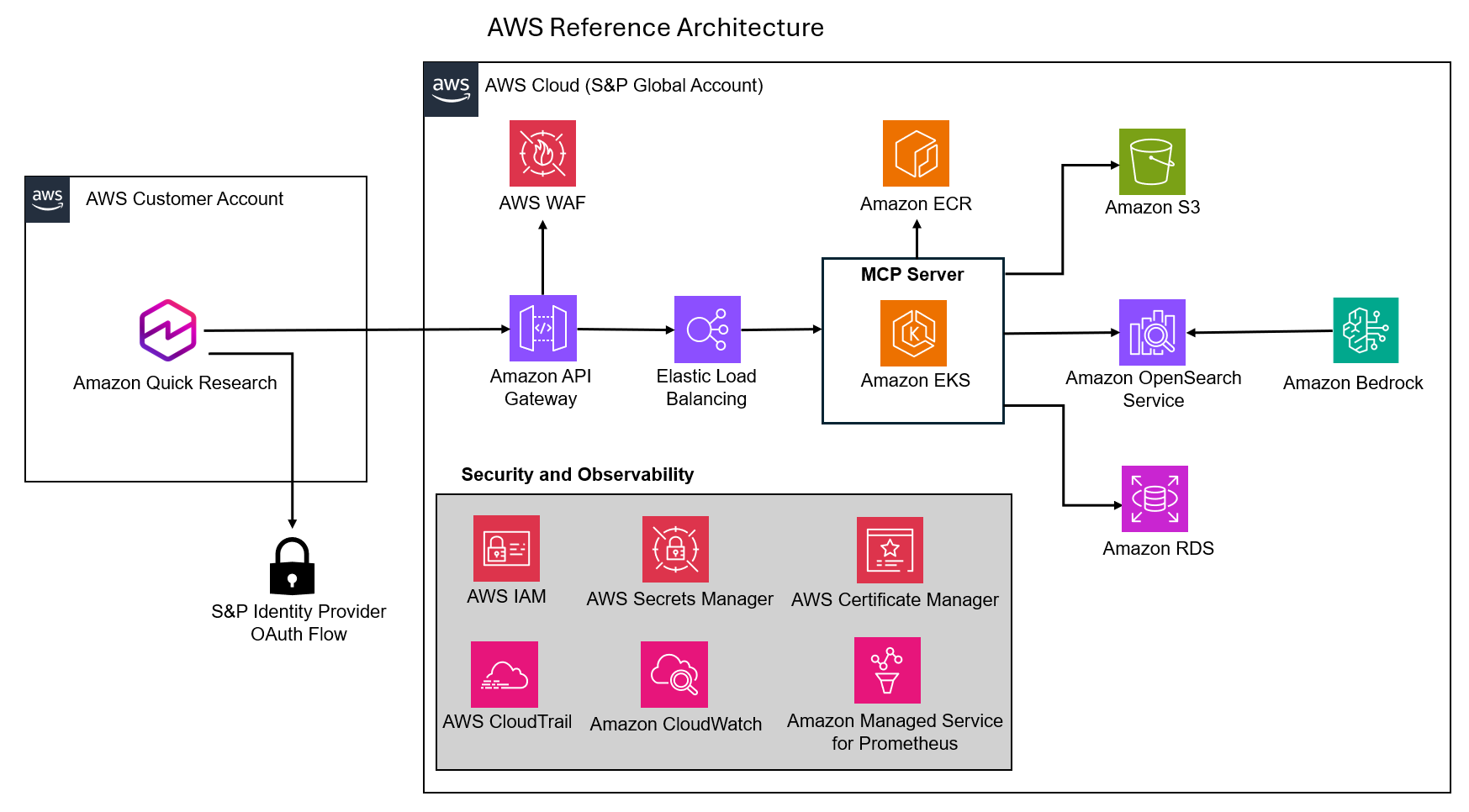
S&P Global Data integration expands Amazon Quick Research capabilitiesArtificial Intelligence Today, we are pleased to announce a new integration between Amazon Quick Research and S&P Global. This integration brings both S&P Global Energy news, research, and insights and S&P Global Market Intelligence data to Quick Research customers in one deep research agent. In this post, we explore S&P Global’s data sets and the solution architecture of the integration with Quick Research.
Today, we are pleased to announce a new integration between Amazon Quick Research and S&P Global. This integration brings both S&P Global Energy news, research, and insights and S&P Global Market Intelligence data to Quick Research customers in one deep research agent. In this post, we explore S&P Global’s data sets and the solution architecture of the integration with Quick Research. Read More
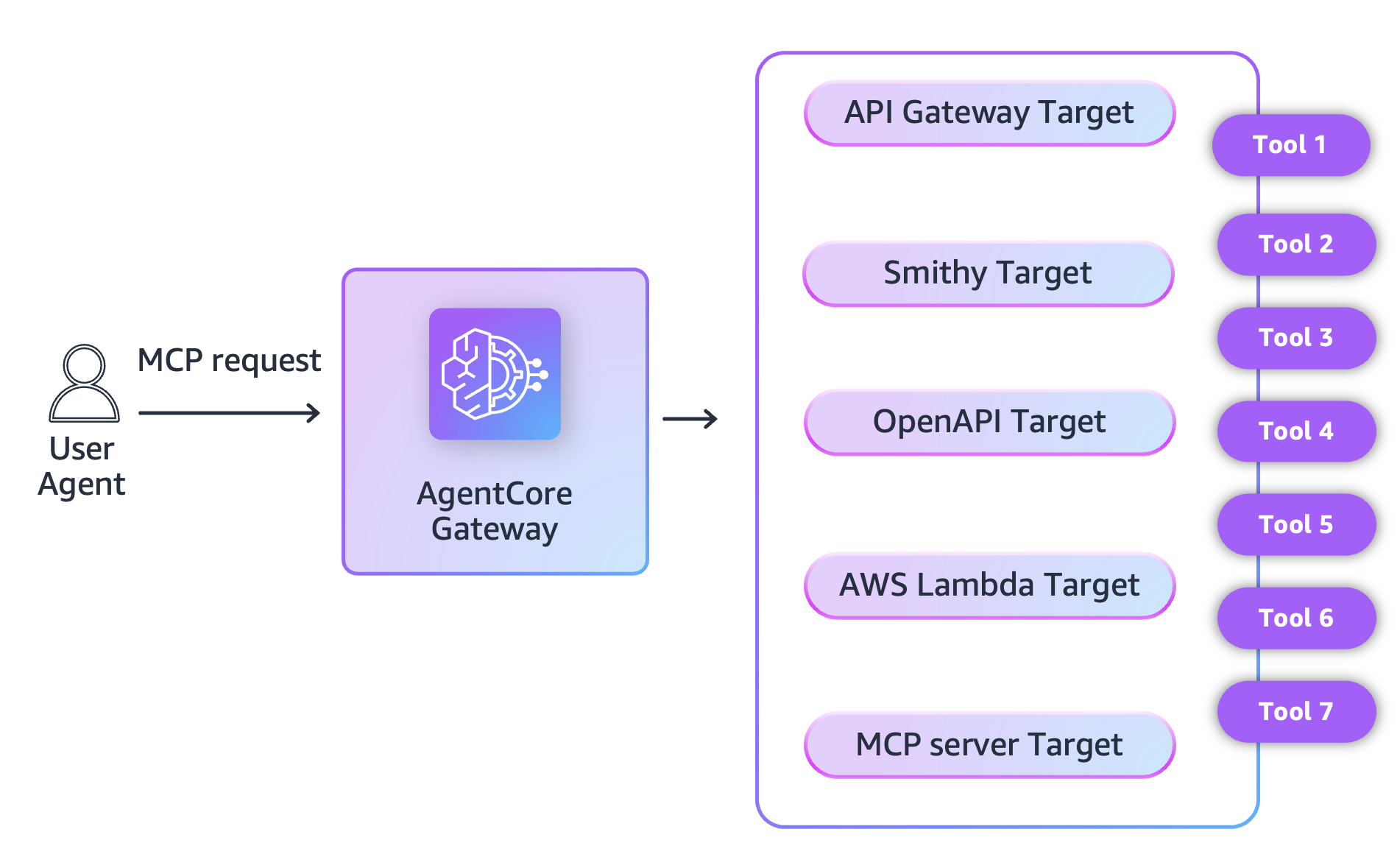
Streamline AI agent tool interactions: Connect API Gateway to AgentCore Gateway with MCPArtificial Intelligence AgentCore Gateway now supports API GatewayAs organizations explore the possibilities of agentic applications, they continue to navigate challenges of using enterprise data as context in invocation requests to large language models (LLMs) in a manner that is secure and aligned with enterprise policies. This post covers these new capabilities and shows how to implement them.
AgentCore Gateway now supports API GatewayAs organizations explore the possibilities of agentic applications, they continue to navigate challenges of using enterprise data as context in invocation requests to large language models (LLMs) in a manner that is secure and aligned with enterprise policies. This post covers these new capabilities and shows how to implement them. Read More
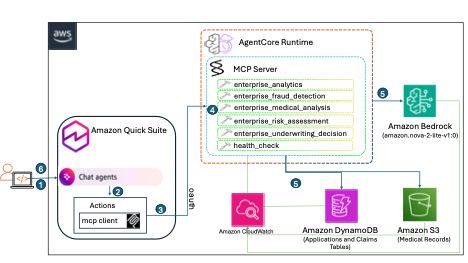
Create an intelligent insurance underwriter agent powered by Amazon Nova 2 Lite and Amazon Quick SuiteArtificial Intelligence In this post, we demonstrate how to build an intelligent insurance underwriting agent that addresses three critical challenges: unifying siloed data across CRM systems and databases, providing explainable and auditable AI decisions for regulatory compliance, and enabling automated fraud detection with consistent underwriting rules. The solution combines Amazon Nova 2 Lite for transparent risk assessment, Amazon Bedrock AgentCore for managed MCP server infrastructure, and Amazon Quick Suite for natural language interactions—delivering a production-ready system that underwriters can deploy in under 30 minutes .
In this post, we demonstrate how to build an intelligent insurance underwriting agent that addresses three critical challenges: unifying siloed data across CRM systems and databases, providing explainable and auditable AI decisions for regulatory compliance, and enabling automated fraud detection with consistent underwriting rules. The solution combines Amazon Nova 2 Lite for transparent risk assessment, Amazon Bedrock AgentCore for managed MCP server infrastructure, and Amazon Quick Suite for natural language interactions—delivering a production-ready system that underwriters can deploy in under 30 minutes . Read More

Instacart pilots agentic commerce by embedding in ChatGPTAI News Instacart has deployed an embedded checkout experience within ChatGPT through the emerging Agentic Commerce Protocol. With the deployment, the company is the first partner to launch an app on ChatGPT that offers a complete shopping cycle – from query to payment – without requiring the user to leave the conversation interface. Operationalising agentic commerce The
The post Instacart pilots agentic commerce by embedding in ChatGPT appeared first on AI News.
Instacart has deployed an embedded checkout experience within ChatGPT through the emerging Agentic Commerce Protocol. With the deployment, the company is the first partner to launch an app on ChatGPT that offers a complete shopping cycle – from query to payment – without requiring the user to leave the conversation interface. Operationalising agentic commerce The
The post Instacart pilots agentic commerce by embedding in ChatGPT appeared first on AI News. Read More

The AI Bubble Will Pop — And Why That Doesn’t MatterTowards Data Science How history’s biggest tech bubble explains where AI is headed next
The post The AI Bubble Will Pop — And Why That Doesn’t Matter appeared first on Towards Data Science.
How history’s biggest tech bubble explains where AI is headed next
The post The AI Bubble Will Pop — And Why That Doesn’t Matter appeared first on Towards Data Science. Read More

OpenAI: Enterprise users swap AI pilots for deep integrationsAI News According to OpenAI, enterprise AI has graduated from the sandbox and is now being used for daily operations with deep workflow integrations. New data from the company shows that firms are now assigning complex and multi-step workflows to models rather than simply asking for text summaries. The figures illustrate a hard change in how organisations
The post OpenAI: Enterprise users swap AI pilots for deep integrations appeared first on AI News.
According to OpenAI, enterprise AI has graduated from the sandbox and is now being used for daily operations with deep workflow integrations. New data from the company shows that firms are now assigning complex and multi-step workflows to models rather than simply asking for text summaries. The figures illustrate a hard change in how organisations
The post OpenAI: Enterprise users swap AI pilots for deep integrations appeared first on AI News. Read More

Battling algorithmic bias in digital payments leads to competition winAI News Digital payments and fintech company Ant International, has won the NeurIPS Competition of Fairness in AI Face Detection. The company says it’s committed to developing secure and inclusive financial services, particularly as deepfake technologies are becoming more common. The growing use of facial recognition in many sectors has highlighted the issue of algorithmic bias in
The post Battling algorithmic bias in digital payments leads to competition win appeared first on AI News.
Digital payments and fintech company Ant International, has won the NeurIPS Competition of Fairness in AI Face Detection. The company says it’s committed to developing secure and inclusive financial services, particularly as deepfake technologies are becoming more common. The growing use of facial recognition in many sectors has highlighted the issue of algorithmic bias in
The post Battling algorithmic bias in digital payments leads to competition win appeared first on AI News. Read More

Google, Sony Innovation Fund, and Okta back Resemble AI’s push into deepfake detectionAI News Resemble AI has raised US$13 million in a new strategic investment round for AI deepfake detection. The funding brings its total venture investment to US$25 million, with participation from Berkeley CalFund, Berkeley Frontier Fund, Comcast Ventures, Craft Ventures, Gentree, Google’s AI Futures Fund, IAG Capital Partners, and others. The funding comes as organisations are under
The post Google, Sony Innovation Fund, and Okta back Resemble AI’s push into deepfake detection appeared first on AI News.
Resemble AI has raised US$13 million in a new strategic investment round for AI deepfake detection. The funding brings its total venture investment to US$25 million, with participation from Berkeley CalFund, Berkeley Frontier Fund, Comcast Ventures, Craft Ventures, Gentree, Google’s AI Futures Fund, IAG Capital Partners, and others. The funding comes as organisations are under
The post Google, Sony Innovation Fund, and Okta back Resemble AI’s push into deepfake detection appeared first on AI News. Read More
ChipMind: Retrieval-Augmented Reasoning for Long-Context Circuit Design Specificationscs.AI updates on arXiv.org arXiv:2512.05371v1 Announce Type: new
Abstract: While Large Language Models (LLMs) demonstrate immense potential for automating integrated circuit (IC) development, their practical deployment is fundamentally limited by restricted context windows. Existing context-extension methods struggle to achieve effective semantic modeling and thorough multi-hop reasoning over extensive, intricate circuit specifications. To address this, we introduce ChipMind, a novel knowledge graph-augmented reasoning framework specifically designed for lengthy IC specifications. ChipMind first transforms circuit specifications into a domain-specific knowledge graph ChipKG through the Circuit Semantic-Aware Knowledge Graph Construction methodology. It then leverages the ChipKG-Augmented Reasoning mechanism, combining information-theoretic adaptive retrieval to dynamically trace logical dependencies with intent-aware semantic filtering to prune irrelevant noise, effectively balancing retrieval completeness and precision. Evaluated on an industrial-scale specification reasoning benchmark, ChipMind significantly outperforms state-of-the-art baselines, achieving an average improvement of 34.59% (up to 72.73%). Our framework bridges a critical gap between academic research and practical industrial deployment of LLM-aided Hardware Design (LAD).
arXiv:2512.05371v1 Announce Type: new
Abstract: While Large Language Models (LLMs) demonstrate immense potential for automating integrated circuit (IC) development, their practical deployment is fundamentally limited by restricted context windows. Existing context-extension methods struggle to achieve effective semantic modeling and thorough multi-hop reasoning over extensive, intricate circuit specifications. To address this, we introduce ChipMind, a novel knowledge graph-augmented reasoning framework specifically designed for lengthy IC specifications. ChipMind first transforms circuit specifications into a domain-specific knowledge graph ChipKG through the Circuit Semantic-Aware Knowledge Graph Construction methodology. It then leverages the ChipKG-Augmented Reasoning mechanism, combining information-theoretic adaptive retrieval to dynamically trace logical dependencies with intent-aware semantic filtering to prune irrelevant noise, effectively balancing retrieval completeness and precision. Evaluated on an industrial-scale specification reasoning benchmark, ChipMind significantly outperforms state-of-the-art baselines, achieving an average improvement of 34.59% (up to 72.73%). Our framework bridges a critical gap between academic research and practical industrial deployment of LLM-aided Hardware Design (LAD). Read More
Data-Augmented Deep Learning for Downhole Depth Sensing and Field Validation AI updates on arXiv.org
Data-Augmented Deep Learning for Downhole Depth Sensing and Field Validationcs.AI updates on arXiv.org arXiv:2511.00129v2 Announce Type: replace-cross
Abstract: Accurate downhole depth measurement is essential for oil and gas well operations, directly influencing reservoir contact, production efficiency, and operational safety. Collar correlation using a casing collar locator (CCL) is fundamental for precise depth calibration. While neural network-based CCL signal recognition has achieved significant progress in collar identification, preprocessing methods for such applications remain underdeveloped. Moreover, the limited availability of real well data poses substantial challenges for training neural network models that require extensive datasets. This paper presents a system integrated into downhole tools for CCL signal acquisition to facilitate dataset construction. We propose comprehensive preprocessing methods for data augmentation and evaluate their effectiveness using our neural network models. Through systematic experimentation across various configuration combinations, we analyze the contribution of each augmentation method. Results demonstrate that standardization, label distribution smoothing (LDS), and random cropping are fundamental requirements for model training, while label smoothing regularization (LSR), time scaling, and multiple sampling significantly enhance model generalization capability. The F1 scores of our two benchmark models trained with the proposed augmentation methods maximumly improve from 0.937 and 0.952 to 1.0 and 1.0, respectively. Performance validation on real CCL waveforms confirms the effectiveness and practical applicability of our approach. This work addresses the gaps in data augmentation methodologies for training casing collar recognition models in CCL data-limited environments.
arXiv:2511.00129v2 Announce Type: replace-cross
Abstract: Accurate downhole depth measurement is essential for oil and gas well operations, directly influencing reservoir contact, production efficiency, and operational safety. Collar correlation using a casing collar locator (CCL) is fundamental for precise depth calibration. While neural network-based CCL signal recognition has achieved significant progress in collar identification, preprocessing methods for such applications remain underdeveloped. Moreover, the limited availability of real well data poses substantial challenges for training neural network models that require extensive datasets. This paper presents a system integrated into downhole tools for CCL signal acquisition to facilitate dataset construction. We propose comprehensive preprocessing methods for data augmentation and evaluate their effectiveness using our neural network models. Through systematic experimentation across various configuration combinations, we analyze the contribution of each augmentation method. Results demonstrate that standardization, label distribution smoothing (LDS), and random cropping are fundamental requirements for model training, while label smoothing regularization (LSR), time scaling, and multiple sampling significantly enhance model generalization capability. The F1 scores of our two benchmark models trained with the proposed augmentation methods maximumly improve from 0.937 and 0.952 to 1.0 and 1.0, respectively. Performance validation on real CCL waveforms confirms the effectiveness and practical applicability of our approach. This work addresses the gaps in data augmentation methodologies for training casing collar recognition models in CCL data-limited environments. Read More