

FLEX: Continuous Agent Evolution via Forward Learning from Experiencecs.AI updates on arXiv.org arXiv:2511.06449v2 Announce Type: replace-cross
Abstract: Autonomous agents driven by Large Language Models (LLMs) have revolutionized reasoning and problem-solving but remain static after training, unable to grow with experience as intelligent beings do during deployment. We introduce Forward Learning with EXperience (FLEX), a gradient-free learning paradigm that enables LLM agents to continuously evolve through accumulated experience. Specifically, FLEX cultivates scalable and inheritable evolution by constructing a structured experience library through continual reflection on successes and failures during interaction with the environment. FLEX delivers substantial improvements on mathematical reasoning, chemical retrosynthesis, and protein fitness prediction (up to 23% on AIME25, 10% on USPTO50k, and 14% on ProteinGym). We further identify a clear scaling law of experiential growth and the phenomenon of experience inheritance across agents, marking a step toward scalable and inheritable continuous agent evolution. Project Page: https://flex-gensi-thuair.github.io.
arXiv:2511.06449v2 Announce Type: replace-cross
Abstract: Autonomous agents driven by Large Language Models (LLMs) have revolutionized reasoning and problem-solving but remain static after training, unable to grow with experience as intelligent beings do during deployment. We introduce Forward Learning with EXperience (FLEX), a gradient-free learning paradigm that enables LLM agents to continuously evolve through accumulated experience. Specifically, FLEX cultivates scalable and inheritable evolution by constructing a structured experience library through continual reflection on successes and failures during interaction with the environment. FLEX delivers substantial improvements on mathematical reasoning, chemical retrosynthesis, and protein fitness prediction (up to 23% on AIME25, 10% on USPTO50k, and 14% on ProteinGym). We further identify a clear scaling law of experiential growth and the phenomenon of experience inheritance across agents, marking a step toward scalable and inheritable continuous agent evolution. Project Page: https://flex-gensi-thuair.github.io. Read More
A Unified Perspective for Loss-Oriented Imbalanced Learning via Localization AI updates on arXiv.org
A Unified Perspective for Loss-Oriented Imbalanced Learning via Localizationcs.AI updates on arXiv.org arXiv:2310.04752v2 Announce Type: replace-cross
Abstract: Due to the inherent imbalance in real-world datasets, na”ive Empirical Risk Minimization (ERM) tends to bias the learning process towards the majority classes, hindering generalization to minority classes. To rebalance the learning process, one straightforward yet effective approach is to modify the loss function via class-dependent terms, such as re-weighting and logit-adjustment. However, existing analysis of these loss-oriented methods remains coarse-grained and fragmented, failing to explain some empirical results. After reviewing prior work, we find that the properties used through their analysis are typically global, i.e., defined over the whole dataset. Hence, these properties fail to effectively capture how class-dependent terms influence the learning process. To bridge this gap, we turn to explore the localized versions of such properties i.e., defined within each class. Specifically, we employ localized calibration to provide consistency validation across a broader range of losses and localized Lipschitz continuity to provide a fine-grained generalization bound. In this way, we reach a unified perspective for improving and adjusting loss-oriented methods. Finally, a principled learning algorithm is developed based on these insights. Empirical results on both traditional ResNets and foundation models validate our theoretical analyses and demonstrate the effectiveness of the proposed method.
arXiv:2310.04752v2 Announce Type: replace-cross
Abstract: Due to the inherent imbalance in real-world datasets, na”ive Empirical Risk Minimization (ERM) tends to bias the learning process towards the majority classes, hindering generalization to minority classes. To rebalance the learning process, one straightforward yet effective approach is to modify the loss function via class-dependent terms, such as re-weighting and logit-adjustment. However, existing analysis of these loss-oriented methods remains coarse-grained and fragmented, failing to explain some empirical results. After reviewing prior work, we find that the properties used through their analysis are typically global, i.e., defined over the whole dataset. Hence, these properties fail to effectively capture how class-dependent terms influence the learning process. To bridge this gap, we turn to explore the localized versions of such properties i.e., defined within each class. Specifically, we employ localized calibration to provide consistency validation across a broader range of losses and localized Lipschitz continuity to provide a fine-grained generalization bound. In this way, we reach a unified perspective for improving and adjusting loss-oriented methods. Finally, a principled learning algorithm is developed based on these insights. Empirical results on both traditional ResNets and foundation models validate our theoretical analyses and demonstrate the effectiveness of the proposed method. Read More
Large Language Models Miss the Multi-Agent Markcs.AI updates on arXiv.org arXiv:2505.21298v4 Announce Type: replace-cross
Abstract: Recent interest in Multi-Agent Systems of Large Language Models (MAS LLMs) has led to an increase in frameworks leveraging multiple LLMs to tackle complex tasks. However, much of this literature appropriates the terminology of MAS without engaging with its foundational principles. In this position paper, we highlight critical discrepancies between MAS theory and current MAS LLMs implementations, focusing on four key areas: the social aspect of agency, environment design, coordination and communication protocols, and measuring emergent behaviours. Our position is that many MAS LLMs lack multi-agent characteristics such as autonomy, social interaction, and structured environments, and often rely on oversimplified, LLM-centric architectures. The field may slow down and lose traction by revisiting problems the MAS literature has already addressed. Therefore, we systematically analyse this issue and outline associated research opportunities; we advocate for better integrating established MAS concepts and more precise terminology to avoid mischaracterisation and missed opportunities.
arXiv:2505.21298v4 Announce Type: replace-cross
Abstract: Recent interest in Multi-Agent Systems of Large Language Models (MAS LLMs) has led to an increase in frameworks leveraging multiple LLMs to tackle complex tasks. However, much of this literature appropriates the terminology of MAS without engaging with its foundational principles. In this position paper, we highlight critical discrepancies between MAS theory and current MAS LLMs implementations, focusing on four key areas: the social aspect of agency, environment design, coordination and communication protocols, and measuring emergent behaviours. Our position is that many MAS LLMs lack multi-agent characteristics such as autonomy, social interaction, and structured environments, and often rely on oversimplified, LLM-centric architectures. The field may slow down and lose traction by revisiting problems the MAS literature has already addressed. Therefore, we systematically analyse this issue and outline associated research opportunities; we advocate for better integrating established MAS concepts and more precise terminology to avoid mischaracterisation and missed opportunities. Read More
AI Application in Anti-Money Laundering for Sustainable and Transparent Financial Systemscs.AI updates on arXiv.org arXiv:2512.06240v1 Announce Type: new
Abstract: Money laundering and financial fraud remain major threats to global financial stability, costing trillions annually and challenging regulatory oversight. This paper reviews how artificial intelligence (AI) applications can modernize Anti-Money Laundering (AML) workflows by improving detection accuracy, lowering false-positive rates, and reducing the operational burden of manual investigations, thereby supporting more sustainable development. It further highlights future research directions including federated learning for privacy-preserving collaboration, fairness-aware and interpretable AI, reinforcement learning for adaptive defenses, and human-in-the-loop visualization systems to ensure that next-generation AML architectures remain transparent, accountable, and robust. In the final part, the paper proposes an AI-driven KYC application that integrates graph-based retrieval-augmented generation (RAG Graph) with generative models to enhance efficiency, transparency, and decision support in KYC processes related to money-laundering detection. Experimental results show that the RAG-Graph architecture delivers high faithfulness and strong answer relevancy across diverse evaluation settings, thereby enhancing the efficiency and transparency of KYC CDD/EDD workflows and contributing to more sustainable, resource-optimized compliance practices.
arXiv:2512.06240v1 Announce Type: new
Abstract: Money laundering and financial fraud remain major threats to global financial stability, costing trillions annually and challenging regulatory oversight. This paper reviews how artificial intelligence (AI) applications can modernize Anti-Money Laundering (AML) workflows by improving detection accuracy, lowering false-positive rates, and reducing the operational burden of manual investigations, thereby supporting more sustainable development. It further highlights future research directions including federated learning for privacy-preserving collaboration, fairness-aware and interpretable AI, reinforcement learning for adaptive defenses, and human-in-the-loop visualization systems to ensure that next-generation AML architectures remain transparent, accountable, and robust. In the final part, the paper proposes an AI-driven KYC application that integrates graph-based retrieval-augmented generation (RAG Graph) with generative models to enhance efficiency, transparency, and decision support in KYC processes related to money-laundering detection. Experimental results show that the RAG-Graph architecture delivers high faithfulness and strong answer relevancy across diverse evaluation settings, thereby enhancing the efficiency and transparency of KYC CDD/EDD workflows and contributing to more sustainable, resource-optimized compliance practices. Read More
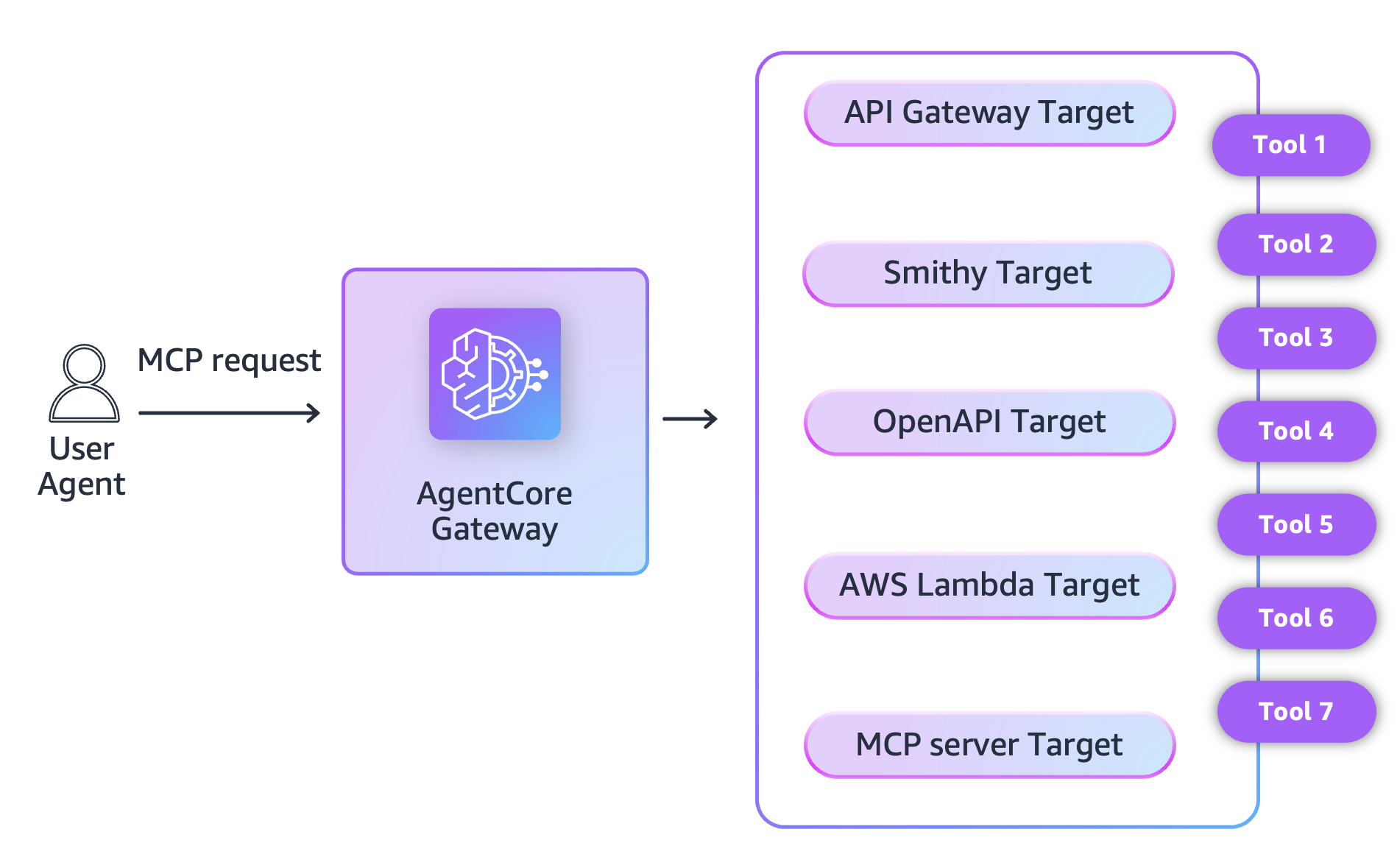
Streamline AI agent tool interactions: Connect API Gateway to AgentCore Gateway with MCPArtificial Intelligence AgentCore Gateway now supports API GatewayAs organizations explore the possibilities of agentic applications, they continue to navigate challenges of using enterprise data as context in invocation requests to large language models (LLMs) in a manner that is secure and aligned with enterprise policies. This post covers these new capabilities and shows how to implement them.
AgentCore Gateway now supports API GatewayAs organizations explore the possibilities of agentic applications, they continue to navigate challenges of using enterprise data as context in invocation requests to large language models (LLMs) in a manner that is secure and aligned with enterprise policies. This post covers these new capabilities and shows how to implement them. Read More
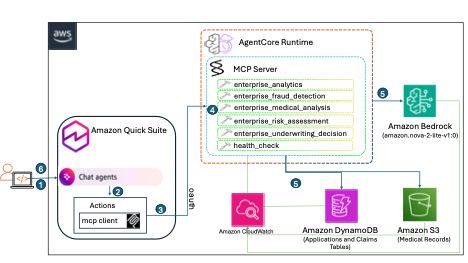
Create an intelligent insurance underwriter agent powered by Amazon Nova 2 Lite and Amazon Quick SuiteArtificial Intelligence In this post, we demonstrate how to build an intelligent insurance underwriting agent that addresses three critical challenges: unifying siloed data across CRM systems and databases, providing explainable and auditable AI decisions for regulatory compliance, and enabling automated fraud detection with consistent underwriting rules. The solution combines Amazon Nova 2 Lite for transparent risk assessment, Amazon Bedrock AgentCore for managed MCP server infrastructure, and Amazon Quick Suite for natural language interactions—delivering a production-ready system that underwriters can deploy in under 30 minutes .
In this post, we demonstrate how to build an intelligent insurance underwriting agent that addresses three critical challenges: unifying siloed data across CRM systems and databases, providing explainable and auditable AI decisions for regulatory compliance, and enabling automated fraud detection with consistent underwriting rules. The solution combines Amazon Nova 2 Lite for transparent risk assessment, Amazon Bedrock AgentCore for managed MCP server infrastructure, and Amazon Quick Suite for natural language interactions—delivering a production-ready system that underwriters can deploy in under 30 minutes . Read More

Instacart pilots agentic commerce by embedding in ChatGPTAI News Instacart has deployed an embedded checkout experience within ChatGPT through the emerging Agentic Commerce Protocol. With the deployment, the company is the first partner to launch an app on ChatGPT that offers a complete shopping cycle – from query to payment – without requiring the user to leave the conversation interface. Operationalising agentic commerce The
The post Instacart pilots agentic commerce by embedding in ChatGPT appeared first on AI News.
Instacart has deployed an embedded checkout experience within ChatGPT through the emerging Agentic Commerce Protocol. With the deployment, the company is the first partner to launch an app on ChatGPT that offers a complete shopping cycle – from query to payment – without requiring the user to leave the conversation interface. Operationalising agentic commerce The
The post Instacart pilots agentic commerce by embedding in ChatGPT appeared first on AI News. Read More
The AI Bubble Will Pop — And Why That Doesn’t MatterTowards Data Science How history’s biggest tech bubble explains where AI is headed next
The post The AI Bubble Will Pop — And Why That Doesn’t Matter appeared first on Towards Data Science.
How history’s biggest tech bubble explains where AI is headed next
The post The AI Bubble Will Pop — And Why That Doesn’t Matter appeared first on Towards Data Science. Read More

OpenAI: Enterprise users swap AI pilots for deep integrationsAI News According to OpenAI, enterprise AI has graduated from the sandbox and is now being used for daily operations with deep workflow integrations. New data from the company shows that firms are now assigning complex and multi-step workflows to models rather than simply asking for text summaries. The figures illustrate a hard change in how organisations
The post OpenAI: Enterprise users swap AI pilots for deep integrations appeared first on AI News.
According to OpenAI, enterprise AI has graduated from the sandbox and is now being used for daily operations with deep workflow integrations. New data from the company shows that firms are now assigning complex and multi-step workflows to models rather than simply asking for text summaries. The figures illustrate a hard change in how organisations
The post OpenAI: Enterprise users swap AI pilots for deep integrations appeared first on AI News. Read More

Battling algorithmic bias in digital payments leads to competition winAI News Digital payments and fintech company Ant International, has won the NeurIPS Competition of Fairness in AI Face Detection. The company says it’s committed to developing secure and inclusive financial services, particularly as deepfake technologies are becoming more common. The growing use of facial recognition in many sectors has highlighted the issue of algorithmic bias in
The post Battling algorithmic bias in digital payments leads to competition win appeared first on AI News.
Digital payments and fintech company Ant International, has won the NeurIPS Competition of Fairness in AI Face Detection. The company says it’s committed to developing secure and inclusive financial services, particularly as deepfake technologies are becoming more common. The growing use of facial recognition in many sectors has highlighted the issue of algorithmic bias in
The post Battling algorithmic bias in digital payments leads to competition win appeared first on AI News. Read More