
Google Open-Sources an MCP Server for the Google Ads API, Bringing LLM-Native Access to Ads DataMarkTechPost Google has open-sourced a Model Context Protocol (MCP) server that exposes read-only access to the Google Ads API for agentic and LLM applications. The repository googleads/google-ads-mcp implements an MCP server in Python that surfaces two tools today: search (GAQL queries over Ads accounts) and list_accessible_customers (enumeration of customer resources). It includes setup via pipx, Google
The post Google Open-Sources an MCP Server for the Google Ads API, Bringing LLM-Native Access to Ads Data appeared first on MarkTechPost.
Google has open-sourced a Model Context Protocol (MCP) server that exposes read-only access to the Google Ads API for agentic and LLM applications. The repository googleads/google-ads-mcp implements an MCP server in Python that surfaces two tools today: search (GAQL queries over Ads accounts) and list_accessible_customers (enumeration of customer resources). It includes setup via pipx, Google
The post Google Open-Sources an MCP Server for the Google Ads API, Bringing LLM-Native Access to Ads Data appeared first on MarkTechPost. Read More
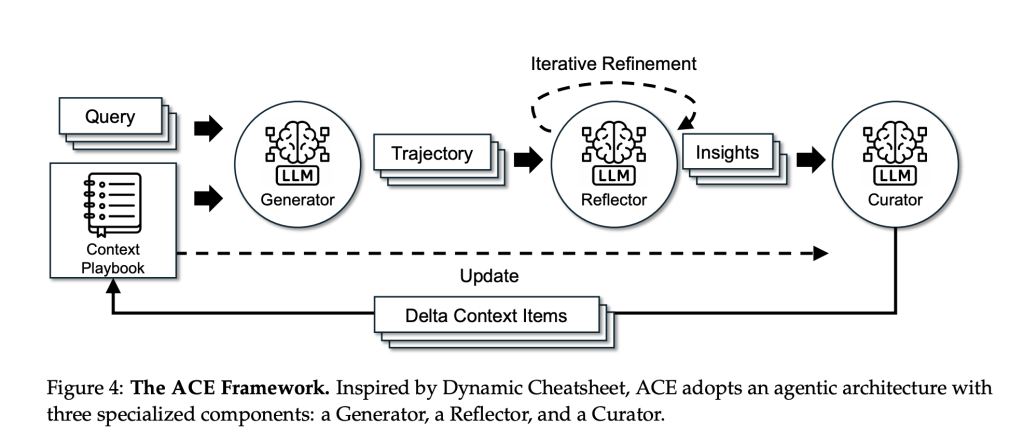
Agentic Context Engineering (ACE): Self-Improving LLMs via Evolving Contexts, Not Fine-TuningMarkTechPost TL;DR: A team of researchers from Stanford University, SambaNova Systems and UC Berkeley introduce ACE framework that improves LLM performance by editing and growing the input context instead of updating model weights. Context is treated as a living “playbook” maintained by three roles—Generator, Reflector, Curator—with small delta items merged incrementally to avoid brevity bias and
The post Agentic Context Engineering (ACE): Self-Improving LLMs via Evolving Contexts, Not Fine-Tuning appeared first on MarkTechPost.
TL;DR: A team of researchers from Stanford University, SambaNova Systems and UC Berkeley introduce ACE framework that improves LLM performance by editing and growing the input context instead of updating model weights. Context is treated as a living “playbook” maintained by three roles—Generator, Reflector, Curator—with small delta items merged incrementally to avoid brevity bias and
The post Agentic Context Engineering (ACE): Self-Improving LLMs via Evolving Contexts, Not Fine-Tuning appeared first on MarkTechPost. Read More

10 Command-Line Tools Every Data Scientist Should KnowKDnuggets Get control of your data workflows with these essential CLI tools.
Get control of your data workflows with these essential CLI tools. Read More
Model Context Protocol (MCP) vs Function Calling vs OpenAPI Tools — When to Use Each?MarkTechPost Comparison Table Concern MCP Function Calling OpenAPI Tools Interface contract Protocol data model (tools/resources/prompts) Per-function JSON Schema OAS 3.1 document Discovery Dynamic via tools/list Static list provided to the model From OAS; catalogable Invocation tools/call over JSON-RPC session Model selects function; app executes HTTP request per OAS op Orchestration Host routes across many servers/tools App-local
The post Model Context Protocol (MCP) vs Function Calling vs OpenAPI Tools — When to Use Each? appeared first on MarkTechPost.
Comparison Table Concern MCP Function Calling OpenAPI Tools Interface contract Protocol data model (tools/resources/prompts) Per-function JSON Schema OAS 3.1 document Discovery Dynamic via tools/list Static list provided to the model From OAS; catalogable Invocation tools/call over JSON-RPC session Model selects function; app executes HTTP request per OAS op Orchestration Host routes across many servers/tools App-local
The post Model Context Protocol (MCP) vs Function Calling vs OpenAPI Tools — When to Use Each? appeared first on MarkTechPost. Read More
Data Visualization Explained (Part 3): The Role of ColorTowards Data Science A simple and powerful guide to using color for more impactful data stories.
The post Data Visualization Explained (Part 3): The Role of Color appeared first on Towards Data Science.
A simple and powerful guide to using color for more impactful data stories.
The post Data Visualization Explained (Part 3): The Role of Color appeared first on Towards Data Science. Read More
Introducing the Gemini 2.5 Computer Use modelGoogle DeepMind Blog Available in preview via the API, our Computer Use model is a specialized model built on Gemini 2.5 Pro’s capabilities to power agents that can interact with user interfaces.
Available in preview via the API, our Computer Use model is a specialized model built on Gemini 2.5 Pro’s capabilities to power agents that can interact with user interfaces. Read More
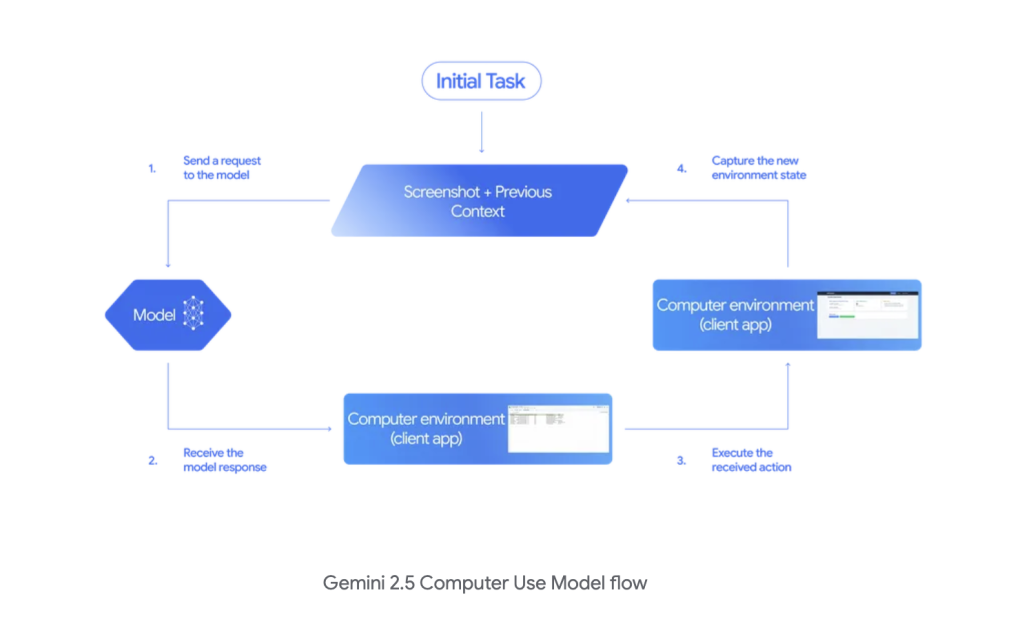
Google AI Introduces Gemini 2.5 ‘Computer Use’ (Preview): A Browser-Control Model to Power AI Agents to Interact with User InterfacesMarkTechPost Which of your browser workflows would you delegate today if an agent could plan and execute predefined UI actions? Google AI introduces Gemini 2.5 Computer Use, a specialized variant of Gemini 2.5 that plans and executes real UI actions in a live browser via a constrained action API. It’s available in public preview through Google
The post Google AI Introduces Gemini 2.5 ‘Computer Use’ (Preview): A Browser-Control Model to Power AI Agents to Interact with User Interfaces appeared first on MarkTechPost.
Which of your browser workflows would you delegate today if an agent could plan and execute predefined UI actions? Google AI introduces Gemini 2.5 Computer Use, a specialized variant of Gemini 2.5 that plans and executes real UI actions in a live browser via a constrained action API. It’s available in public preview through Google
The post Google AI Introduces Gemini 2.5 ‘Computer Use’ (Preview): A Browser-Control Model to Power AI Agents to Interact with User Interfaces appeared first on MarkTechPost. Read More
Google DeepMind Introduces CodeMender: A New AI Agent that Uses Gemini Deep Think to Automatically Patch Critical Software VulnerabilitiesMarkTechPost What if an AI agent could localize a root cause, prove a candidate fix via automated analysis and testing, and proactively rewrite related code to eliminate the entire vulnerability class—then open an upstream patch for review? Google DeepMind introduces CodeMender, an AI agent that generates, validates, and upstreams fixes for real-world vulnerabilities using Gemini “Deep
The post Google DeepMind Introduces CodeMender: A New AI Agent that Uses Gemini Deep Think to Automatically Patch Critical Software Vulnerabilities appeared first on MarkTechPost.
What if an AI agent could localize a root cause, prove a candidate fix via automated analysis and testing, and proactively rewrite related code to eliminate the entire vulnerability class—then open an upstream patch for review? Google DeepMind introduces CodeMender, an AI agent that generates, validates, and upstreams fixes for real-world vulnerabilities using Gemini “Deep
The post Google DeepMind Introduces CodeMender: A New AI Agent that Uses Gemini Deep Think to Automatically Patch Critical Software Vulnerabilities appeared first on MarkTechPost. Read More
How to Perform Effective Agentic Context EngineeringTowards Data Science Learn how to optimize the context of your agents, for powerful agentic performance
The post How to Perform Effective Agentic Context Engineering appeared first on Towards Data Science.
Learn how to optimize the context of your agents, for powerful agentic performance
The post How to Perform Effective Agentic Context Engineering appeared first on Towards Data Science. Read More
Adversarial Agent Collaboration for C to Rust Translationcs.AI updates on arXiv.org arXiv:2510.03879v1 Announce Type: cross
Abstract: Translating C to memory-safe languages, like Rust, prevents critical memory safety vulnerabilities that are prevalent in legacy C software. Existing approaches for C to safe Rust translation, including LLM-assisted ones, do not generalize on larger (> 500 LoC) C codebases because they depend on complex program analyses that frequently break. In this work, we present ACToR (Adversarial C To Rust translator), a simple LLM agent-based approach. Inspired by GANs, ACToR pits a generator agent against a discriminator agent, which collaborate to iteratively generate a Rust translation. On each iteration, the translator agent synthesizes and refines a Rust translation to pass an existing suite of tests, and then the discriminator agent finds new failing tests. We demonstrate that ACToR translates all of the 63 real-world command line utilities considered in our benchmarks, which have an average size of 485 lines of code, and it achieves over 90% test pass rate with zero human intervention. To our knowledge, it is the first such system that reliably translates C programs of this scale. Furthermore, ACToR improves translation correctness by up to 18.9% compared to baseline, non-adversarial approaches.
arXiv:2510.03879v1 Announce Type: cross
Abstract: Translating C to memory-safe languages, like Rust, prevents critical memory safety vulnerabilities that are prevalent in legacy C software. Existing approaches for C to safe Rust translation, including LLM-assisted ones, do not generalize on larger (> 500 LoC) C codebases because they depend on complex program analyses that frequently break. In this work, we present ACToR (Adversarial C To Rust translator), a simple LLM agent-based approach. Inspired by GANs, ACToR pits a generator agent against a discriminator agent, which collaborate to iteratively generate a Rust translation. On each iteration, the translator agent synthesizes and refines a Rust translation to pass an existing suite of tests, and then the discriminator agent finds new failing tests. We demonstrate that ACToR translates all of the 63 real-world command line utilities considered in our benchmarks, which have an average size of 485 lines of code, and it achieves over 90% test pass rate with zero human intervention. To our knowledge, it is the first such system that reliably translates C programs of this scale. Furthermore, ACToR improves translation correctness by up to 18.9% compared to baseline, non-adversarial approaches. Read More