

Scaling ML Inference on Databricks: Liquid or Partitioned? Salted or Not?Towards Data Science A case study on techniques to maximize your clusters
The post Scaling ML Inference on Databricks: Liquid or Partitioned? Salted or Not? appeared first on Towards Data Science.
A case study on techniques to maximize your clusters
The post Scaling ML Inference on Databricks: Liquid or Partitioned? Salted or Not? appeared first on Towards Data Science. Read More
Cost-of-Pass: An Economic Framework for Evaluating Language Modelscs.AI updates on arXiv.org arXiv:2504.13359v2 Announce Type: replace
Abstract: Widespread adoption of AI systems hinges on their ability to generate economic value that outweighs their inference costs. Evaluating this tradeoff requires metrics accounting for both performance and costs. Building on production theory, we develop an economically grounded framework to evaluate language models’ productivity by combining accuracy and inference cost. We formalize cost-of-pass: the expected monetary cost of generating a correct solution. We then define the frontier cost-of-pass: the minimum cost-of-pass achievable across available models or the human-expert(s), using the approx. cost of hiring an expert. Our analysis reveals distinct economic insights. First, lightweight models are most cost-effective for basic quantitative tasks, large models for knowledge-intensive ones, and reasoning models for complex quantitative problems, despite higher per-token costs. Second, tracking the frontier cost-of-pass over the past year reveals significant progress, particularly for complex quant. tasks where the cost roughly halved every few months. Third, to trace key innovations driving this progress, we examine counterfactual frontiers — estimates of cost-efficiency without specific model classes. We find that innovations in lightweight, large, and reasoning models have been essential for pushing the frontier in basic quant., knowledge-intensive, and complex quant. tasks, respectively. Finally, we assess the cost-reductions from common inference-time techniques (majority voting and self-refinement), and a budget-aware technique (TALE-EP). We find that performance-oriented methods with marginal performance gains rarely justify the costs, while TALE-EP shows some promise. Overall, our findings underscore that complementary model-level innovations are the primary drivers of cost-efficiency and our framework provides a principled tool for measuring this progress and guiding deployment.
arXiv:2504.13359v2 Announce Type: replace
Abstract: Widespread adoption of AI systems hinges on their ability to generate economic value that outweighs their inference costs. Evaluating this tradeoff requires metrics accounting for both performance and costs. Building on production theory, we develop an economically grounded framework to evaluate language models’ productivity by combining accuracy and inference cost. We formalize cost-of-pass: the expected monetary cost of generating a correct solution. We then define the frontier cost-of-pass: the minimum cost-of-pass achievable across available models or the human-expert(s), using the approx. cost of hiring an expert. Our analysis reveals distinct economic insights. First, lightweight models are most cost-effective for basic quantitative tasks, large models for knowledge-intensive ones, and reasoning models for complex quantitative problems, despite higher per-token costs. Second, tracking the frontier cost-of-pass over the past year reveals significant progress, particularly for complex quant. tasks where the cost roughly halved every few months. Third, to trace key innovations driving this progress, we examine counterfactual frontiers — estimates of cost-efficiency without specific model classes. We find that innovations in lightweight, large, and reasoning models have been essential for pushing the frontier in basic quant., knowledge-intensive, and complex quant. tasks, respectively. Finally, we assess the cost-reductions from common inference-time techniques (majority voting and self-refinement), and a budget-aware technique (TALE-EP). We find that performance-oriented methods with marginal performance gains rarely justify the costs, while TALE-EP shows some promise. Overall, our findings underscore that complementary model-level innovations are the primary drivers of cost-efficiency and our framework provides a principled tool for measuring this progress and guiding deployment. Read More
Probing for Knowledge Attribution in Large Language Modelscs.AI updates on arXiv.org arXiv:2602.22787v1 Announce Type: cross
Abstract: Large language models (LLMs) often generate fluent but unfounded claims, or hallucinations, which fall into two types: (i) faithfulness violations – misusing user context – and (ii) factuality violations – errors from internal knowledge. Proper mitigation depends on knowing whether a model’s answer is based on the prompt or its internal weights. This work focuses on the problem of contributive attribution: identifying the dominant knowledge source behind each output. We show that a probe, a simple linear classifier trained on model hidden representations, can reliably predict contributive attribution. For its training, we introduce AttriWiki, a self-supervised data pipeline that prompts models to recall withheld entities from memory or read them from context, generating labelled examples automatically. Probes trained on AttriWiki data reveal a strong attribution signal, achieving up to 0.96 Macro-F1 on Llama-3.1-8B, Mistral-7B, and Qwen-7B, transferring to out-of-domain benchmarks (SQuAD, WebQuestions) with 0.94-0.99 Macro-F1 without retraining. Attribution mismatches raise error rates by up to 70%, demonstrating a direct link between knowledge source confusion and unfaithful answers. Yet, models may still respond incorrectly even when attribution is correct, highlighting the need for broader detection frameworks.
arXiv:2602.22787v1 Announce Type: cross
Abstract: Large language models (LLMs) often generate fluent but unfounded claims, or hallucinations, which fall into two types: (i) faithfulness violations – misusing user context – and (ii) factuality violations – errors from internal knowledge. Proper mitigation depends on knowing whether a model’s answer is based on the prompt or its internal weights. This work focuses on the problem of contributive attribution: identifying the dominant knowledge source behind each output. We show that a probe, a simple linear classifier trained on model hidden representations, can reliably predict contributive attribution. For its training, we introduce AttriWiki, a self-supervised data pipeline that prompts models to recall withheld entities from memory or read them from context, generating labelled examples automatically. Probes trained on AttriWiki data reveal a strong attribution signal, achieving up to 0.96 Macro-F1 on Llama-3.1-8B, Mistral-7B, and Qwen-7B, transferring to out-of-domain benchmarks (SQuAD, WebQuestions) with 0.94-0.99 Macro-F1 without retraining. Attribution mismatches raise error rates by up to 70%, demonstrating a direct link between knowledge source confusion and unfaithful answers. Yet, models may still respond incorrectly even when attribution is correct, highlighting the need for broader detection frameworks. Read More
A Coding Implementation to Build a Hierarchical Planner AI Agent Using Open-Source LLMs with Tool Execution and Structured Multi-Agent ReasoningMarkTechPost In this tutorial, we build a hierarchical planner agent using an open-source instruct model. We design a structured multi-agent architecture comprising a planner agent, an executor agent, and an aggregator agent, where each component plays a specialized role in solving complex tasks. We use the planner agent to decompose high-level goals into actionable steps, the
The post A Coding Implementation to Build a Hierarchical Planner AI Agent Using Open-Source LLMs with Tool Execution and Structured Multi-Agent Reasoning appeared first on MarkTechPost.
In this tutorial, we build a hierarchical planner agent using an open-source instruct model. We design a structured multi-agent architecture comprising a planner agent, an executor agent, and an aggregator agent, where each component plays a specialized role in solving complex tasks. We use the planner agent to decompose high-level goals into actionable steps, the
The post A Coding Implementation to Build a Hierarchical Planner AI Agent Using Open-Source LLMs with Tool Execution and Structured Multi-Agent Reasoning appeared first on MarkTechPost. Read More
How to Build Interactive Geospatial Dashboards Using Folium with Heatmaps, Choropleths, Time Animation, Marker Clustering, and Advanced Interactive PluginsMarkTechPost In this Folium tutorial, we build a complete set of interactive maps that run in Colab or any local Python setup. We explore multiple basemap styles, design rich markers with HTML popups, and visualize spatial density using heatmaps. We also create region-level choropleth maps from GeoJSON, scale to thousands of points using marker clustering, and
The post How to Build Interactive Geospatial Dashboards Using Folium with Heatmaps, Choropleths, Time Animation, Marker Clustering, and Advanced Interactive Plugins appeared first on MarkTechPost.
In this Folium tutorial, we build a complete set of interactive maps that run in Colab or any local Python setup. We explore multiple basemap styles, design rich markers with HTML popups, and visualize spatial density using heatmaps. We also create region-level choropleth maps from GeoJSON, scale to thousands of points using marker clustering, and
The post How to Build Interactive Geospatial Dashboards Using Folium with Heatmaps, Choropleths, Time Animation, Marker Clustering, and Advanced Interactive Plugins appeared first on MarkTechPost. Read More

Sakana AI Introduces Doc-to-LoRA and Text-to-LoRA: Hypernetworks that Instantly Internalize Long Contexts and Adapt LLMs via Zero-Shot Natural LanguageMarkTechPost Customizing Large Language Models (LLMs) currently presents a significant engineering trade-off between the flexibility of In-Context Learning (ICL) and the efficiency of Context Distillation (CD) or Supervised Fine-Tuning (SFT). Tokyo-based Sakana AI has proposed a new approach to bypass these constraints through cost amortization. In two of their recent papers, they introduced Text-to-LoRA (T2L) and
The post Sakana AI Introduces Doc-to-LoRA and Text-to-LoRA: Hypernetworks that Instantly Internalize Long Contexts and Adapt LLMs via Zero-Shot Natural Language appeared first on MarkTechPost.
Customizing Large Language Models (LLMs) currently presents a significant engineering trade-off between the flexibility of In-Context Learning (ICL) and the efficiency of Context Distillation (CD) or Supervised Fine-Tuning (SFT). Tokyo-based Sakana AI has proposed a new approach to bypass these constraints through cost amortization. In two of their recent papers, they introduced Text-to-LoRA (T2L) and
The post Sakana AI Introduces Doc-to-LoRA and Text-to-LoRA: Hypernetworks that Instantly Internalize Long Contexts and Adapt LLMs via Zero-Shot Natural Language appeared first on MarkTechPost. Read More
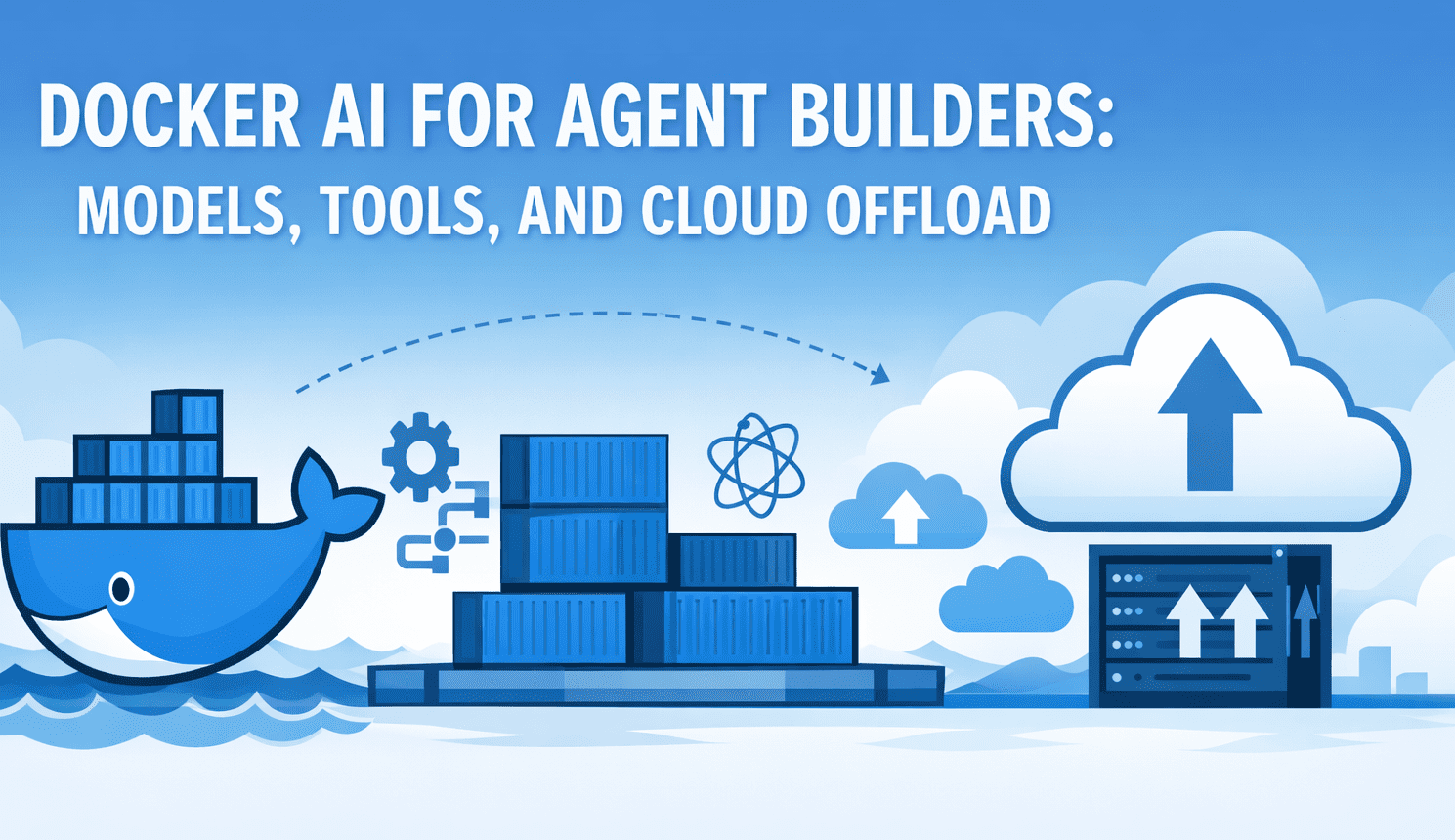
Docker AI for Agent Builders: Models, Tools, and Cloud OffloadKDnuggets This article explores five infrastructure patterns that make Docker a powerful foundation for building robust, autonomous AI applications.
This article explores five infrastructure patterns that make Docker a powerful foundation for building robust, autonomous AI applications. Read More
The Future of Data Storytelling Formats: Beyond DashboardsKDnuggets Redefining data storytelling through interactive narratives, immersive environments, and alternative sensory techniques
Redefining data storytelling through interactive narratives, immersive environments, and alternative sensory techniques Read More
Generative AI, Discriminative HumanTowards Data Science How to think critically about AI in an ocean of hype
The post Generative AI, Discriminative Human appeared first on Towards Data Science.
How to think critically about AI in an ocean of hype
The post Generative AI, Discriminative Human appeared first on Towards Data Science. Read More
Joint Statement from OpenAI and MicrosoftOpenAI News Microsoft and OpenAI continue to work closely across research, engineering, and product development, building on years of deep collaboration and shared success.
Microsoft and OpenAI continue to work closely across research, engineering, and product development, building on years of deep collaboration and shared success. Read More