
Whisper Leak: a side-channel attack on Large Language Modelscs.AI updates on arXiv.org arXiv:2511.03675v1 Announce Type: cross
Abstract: Large Language Models (LLMs) are increasingly deployed in sensitive domains including healthcare, legal services, and confidential communications, where privacy is paramount. This paper introduces Whisper Leak, a side-channel attack that infers user prompt topics from encrypted LLM traffic by analyzing packet size and timing patterns in streaming responses. Despite TLS encryption protecting content, these metadata patterns leak sufficient information to enable topic classification. We demonstrate the attack across 28 popular LLMs from major providers, achieving near-perfect classification (often >98% AUPRC) and high precision even at extreme class imbalance (10,000:1 noise-to-target ratio). For many models, we achieve 100% precision in identifying sensitive topics like “money laundering” while recovering 5-20% of target conversations. This industry-wide vulnerability poses significant risks for users under network surveillance by ISPs, governments, or local adversaries. We evaluate three mitigation strategies – random padding, token batching, and packet injection – finding that while each reduces attack effectiveness, none provides complete protection. Through responsible disclosure, we have collaborated with providers to implement initial countermeasures. Our findings underscore the need for LLM providers to address metadata leakage as AI systems handle increasingly sensitive information.
arXiv:2511.03675v1 Announce Type: cross
Abstract: Large Language Models (LLMs) are increasingly deployed in sensitive domains including healthcare, legal services, and confidential communications, where privacy is paramount. This paper introduces Whisper Leak, a side-channel attack that infers user prompt topics from encrypted LLM traffic by analyzing packet size and timing patterns in streaming responses. Despite TLS encryption protecting content, these metadata patterns leak sufficient information to enable topic classification. We demonstrate the attack across 28 popular LLMs from major providers, achieving near-perfect classification (often >98% AUPRC) and high precision even at extreme class imbalance (10,000:1 noise-to-target ratio). For many models, we achieve 100% precision in identifying sensitive topics like “money laundering” while recovering 5-20% of target conversations. This industry-wide vulnerability poses significant risks for users under network surveillance by ISPs, governments, or local adversaries. We evaluate three mitigation strategies – random padding, token batching, and packet injection – finding that while each reduces attack effectiveness, none provides complete protection. Through responsible disclosure, we have collaborated with providers to implement initial countermeasures. Our findings underscore the need for LLM providers to address metadata leakage as AI systems handle increasingly sensitive information. Read More
From Measurement to Expertise: Empathetic Expert Adapters for Context-Based Empathy in Conversational AI Agentscs.AI updates on arXiv.org arXiv:2511.03143v1 Announce Type: cross
Abstract: Empathy is a critical factor in fostering positive user experiences in conversational AI. While models can display empathy, it is often generic rather than tailored to specific tasks and contexts. In this work, we introduce a novel framework for developing and evaluating context-specific empathetic large language models (LLMs). We first analyze a real-world conversational dataset consisting of 672 multi-turn conversations across 8 tasks, revealing significant differences in terms of expected and experienced empathy before and after the conversations, respectively. To help minimize this gap, we develop a synthetic multi-turn conversational generation pipeline and steer responses toward our defined empathy patterns based on the context that more closely matches users’ expectations. We then train empathetic expert adapters for context-specific empathy that specialize in varying empathy levels based on the recognized task. Our empirical results demonstrate a significant gap reduction of 72.66% between perceived and desired empathy with scores increasing by an average factor of 2.43 as measured by our metrics and reward models. Additionally, our trained empathetic expert adapters demonstrate superior effectiveness in preserving empathy patterns throughout conversation turns, outperforming system prompts, which tend to dramatically diminish in impact as conversations lengthen.
arXiv:2511.03143v1 Announce Type: cross
Abstract: Empathy is a critical factor in fostering positive user experiences in conversational AI. While models can display empathy, it is often generic rather than tailored to specific tasks and contexts. In this work, we introduce a novel framework for developing and evaluating context-specific empathetic large language models (LLMs). We first analyze a real-world conversational dataset consisting of 672 multi-turn conversations across 8 tasks, revealing significant differences in terms of expected and experienced empathy before and after the conversations, respectively. To help minimize this gap, we develop a synthetic multi-turn conversational generation pipeline and steer responses toward our defined empathy patterns based on the context that more closely matches users’ expectations. We then train empathetic expert adapters for context-specific empathy that specialize in varying empathy levels based on the recognized task. Our empirical results demonstrate a significant gap reduction of 72.66% between perceived and desired empathy with scores increasing by an average factor of 2.43 as measured by our metrics and reward models. Additionally, our trained empathetic expert adapters demonstrate superior effectiveness in preserving empathy patterns throughout conversation turns, outperforming system prompts, which tend to dramatically diminish in impact as conversations lengthen. Read More
GraphCliff: Short-Long Range Gating for Subtle Differences but Critical Changescs.AI updates on arXiv.org arXiv:2511.03170v1 Announce Type: cross
Abstract: Quantitative structure-activity relationship assumes a smooth relationship between molecular structure and biological activity. However, activity cliffs defined as pairs of structurally similar compounds with large potency differences break this continuity. Recent benchmarks targeting activity cliffs have revealed that classical machine learning models with extended connectivity fingerprints outperform graph neural networks. Our analysis shows that graph embeddings fail to adequately separate structurally similar molecules in the embedding space, making it difficult to distinguish between structurally similar but functionally different molecules. Despite this limitation, molecular graph structures are inherently expressive and attractive, as they preserve molecular topology. To preserve the structural representation of molecules as graphs, we propose a new model, GraphCliff, which integrates short- and long-range information through a gating mechanism. Experimental results demonstrate that GraphCliff consistently improves performance on both non-cliff and cliff compounds. Furthermore, layer-wise node embedding analyses reveal reduced over-smoothing and enhanced discriminative power relative to strong baseline graph models.
arXiv:2511.03170v1 Announce Type: cross
Abstract: Quantitative structure-activity relationship assumes a smooth relationship between molecular structure and biological activity. However, activity cliffs defined as pairs of structurally similar compounds with large potency differences break this continuity. Recent benchmarks targeting activity cliffs have revealed that classical machine learning models with extended connectivity fingerprints outperform graph neural networks. Our analysis shows that graph embeddings fail to adequately separate structurally similar molecules in the embedding space, making it difficult to distinguish between structurally similar but functionally different molecules. Despite this limitation, molecular graph structures are inherently expressive and attractive, as they preserve molecular topology. To preserve the structural representation of molecules as graphs, we propose a new model, GraphCliff, which integrates short- and long-range information through a gating mechanism. Experimental results demonstrate that GraphCliff consistently improves performance on both non-cliff and cliff compounds. Furthermore, layer-wise node embedding analyses reveal reduced over-smoothing and enhanced discriminative power relative to strong baseline graph models. Read More
Beyond Numbers: How to Humanize Your Data & AnalysisTowards Data Science The scintillating grid optical illusion is a perfect metaphor for how raw data can mislead us, causing us to see false trends. To escape the “data-rich, action-poor” paradox, organizations should need data humanization.
This approach focuses on turning abstract metrics (the what) into clear, actionable stories (the why). It requires new roles like “Data Artisans,” a core competency in “Data Storytelling,” and a focus on proving the financial Impact (ROI) of these clearer insights.
The post Beyond Numbers: How to Humanize Your Data & Analysis appeared first on Towards Data Science.
The scintillating grid optical illusion is a perfect metaphor for how raw data can mislead us, causing us to see false trends. To escape the “data-rich, action-poor” paradox, organizations should need data humanization.
This approach focuses on turning abstract metrics (the what) into clear, actionable stories (the why). It requires new roles like “Data Artisans,” a core competency in “Data Storytelling,” and a focus on proving the financial Impact (ROI) of these clearer insights.
The post Beyond Numbers: How to Humanize Your Data & Analysis appeared first on Towards Data Science. Read More

Free AI and Data Courses with 365 Data Science— 100% Unlimited Access until Nov 21KDnuggets Begin your AI and data journey for free at 365 Data Science.
Begin your AI and data journey for free at 365 Data Science. Read More
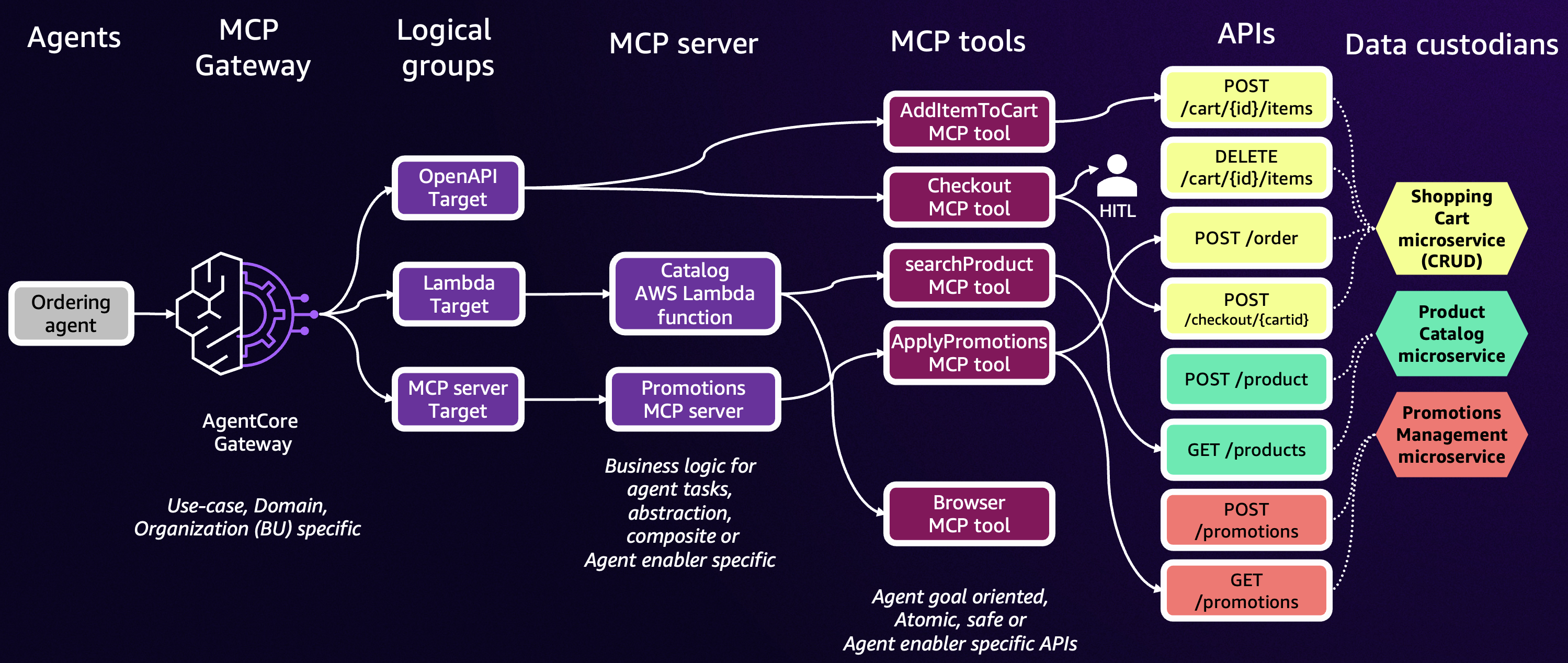
Transform your MCP architecture: Unite MCP servers through AgentCore Gateway Artificial Intelligence
Transform your MCP architecture: Unite MCP servers through AgentCore GatewayArtificial Intelligence Earlier this year, we introduced Amazon Bedrock AgentCore Gateway, a fully managed service that serves as a centralized MCP tool server, providing a unified interface where agents can discover, access, and invoke tools. Today, we’re extending support for existing MCP servers as a new target type in AgentCore Gateway. With this capability, you can group multiple task-specific MCP servers aligned to agent goals behind a single, manageable MCP gateway interface. This reduces the operational complexity of maintaining separate gateways, while providing the same centralized tool and authentication management that existed for REST APIs and AWS Lambda functions.
Earlier this year, we introduced Amazon Bedrock AgentCore Gateway, a fully managed service that serves as a centralized MCP tool server, providing a unified interface where agents can discover, access, and invoke tools. Today, we’re extending support for existing MCP servers as a new target type in AgentCore Gateway. With this capability, you can group multiple task-specific MCP servers aligned to agent goals behind a single, manageable MCP gateway interface. This reduces the operational complexity of maintaining separate gateways, while providing the same centralized tool and authentication management that existed for REST APIs and AWS Lambda functions. Read More

Exclusive: Dubai’s Digital Government chief says speed trumps spending in AI efficiency race AI News
Exclusive: Dubai’s Digital Government chief says speed trumps spending in AI efficiency raceAI News When Dubai launched its State of AI Report in April 2025, revealing over 100 high-impact AI use cases, the emirate wasn’t just showcasing technological prowess—it was making a calculated bet that speed, not spending, would determine which cities win the global race for AI-powered governance. In an exclusive interview, Matar Al Hemeiri, Chief Executive of Digital Dubai
The post Exclusive: Dubai’s Digital Government chief says speed trumps spending in AI efficiency race appeared first on AI News.
When Dubai launched its State of AI Report in April 2025, revealing over 100 high-impact AI use cases, the emirate wasn’t just showcasing technological prowess—it was making a calculated bet that speed, not spending, would determine which cities win the global race for AI-powered governance. In an exclusive interview, Matar Al Hemeiri, Chief Executive of Digital Dubai
The post Exclusive: Dubai’s Digital Government chief says speed trumps spending in AI efficiency race appeared first on AI News. Read More
Expected Value Analysis in AI Product ManagementTowards Data Science An introduction to key concepts and practical applications
The post Expected Value Analysis in AI Product Management appeared first on Towards Data Science.
An introduction to key concepts and practical applications
The post Expected Value Analysis in AI Product Management appeared first on Towards Data Science. Read More

Using NotebookLM to Tackle Tough Questions: Interview Smarter, Not HarderKDnuggets Turn one interview question into a complete learning experience with NotebookLM.
Turn one interview question into a complete learning experience with NotebookLM. Read More

Is AI in a bubble? Succeed despite a market correctionAI News Amid pressure to deploy generative and agentic solutions, a familiar question is surfacing: “Is there an AI bubble, and is it about to burst?” For many organisations, this new wave of generative and agentic AI is still very much in experimental stages. The primary focus, and the low-hanging fruit, has been internal. Most businesses are
The post Is AI in a bubble? Succeed despite a market correction appeared first on AI News.
Amid pressure to deploy generative and agentic solutions, a familiar question is surfacing: “Is there an AI bubble, and is it about to burst?” For many organisations, this new wave of generative and agentic AI is still very much in experimental stages. The primary focus, and the low-hanging fruit, has been internal. Most businesses are
The post Is AI in a bubble? Succeed despite a market correction appeared first on AI News. Read More